Theresa May scored an own goal with her disastrous decision to call a snap UK election, but her humiliating defeat was not a plea from the public to stay in the EU.
When Theresa May called a snap election in April, it was a nakedly opportunistic move.
The opposition Labour Party was in disarray, 20 points behind the Conservatives in the polls. Their leader, Jeremy Corbyn, did not command the loyalty of his MPs and had only held on to his position because of grassroots support.
The UK Independence Party essentially had no raison d'etre any more. The one-issue party had gotten their wish - Britain was leaving the EU. The Scottish National Party looked to be in trouble in Scotland as well. May saw an opportunity to hoover up Labour, UKIP and SNP votes and give her perhaps the largest majority in UK history - making the country effectively a one-party state. It would be a big improvement from her existing situation, having inherited a razor-thin majority government from David Cameron.
Showing posts with label UK elections. Show all posts
Friday, 9 June 2017
Friday, 18 November 2016
3/4 of electorate gave their nod to Trumpism
In the week since the US presidential election I've seen a lot of people posting that "only one in five Americans" endorsed Trump for president. No.
While it is true that only 19.5% of Americans cast a vote for Donald Trump last Tuesday (versus 19.8% for Clinton), one cannot then make the leap to say that 80% of Americans are opposed to Trump and are being dragged along unwillingly. That is nonsense.
First off, 29% of Americans are not eligible to vote, either because they are too young or because they have committed a crime. We have no way of knowing how those people feel about Trump. Then we have to people who were eligible to vote but chose not to - 45% of the eligible population.
While it is true that only 19.5% of Americans cast a vote for Donald Trump last Tuesday (versus 19.8% for Clinton), one cannot then make the leap to say that 80% of Americans are opposed to Trump and are being dragged along unwillingly. That is nonsense.
First off, 29% of Americans are not eligible to vote, either because they are too young or because they have committed a crime. We have no way of knowing how those people feel about Trump. Then we have to people who were eligible to vote but chose not to - 45% of the eligible population.
Sunday, 3 July 2016
Thousands marched, but what are the options for keeping UK in EU?
Yesterday saw an unprecedented, and uncharacteristic, outpouring of love for the European Union on the streets of London.
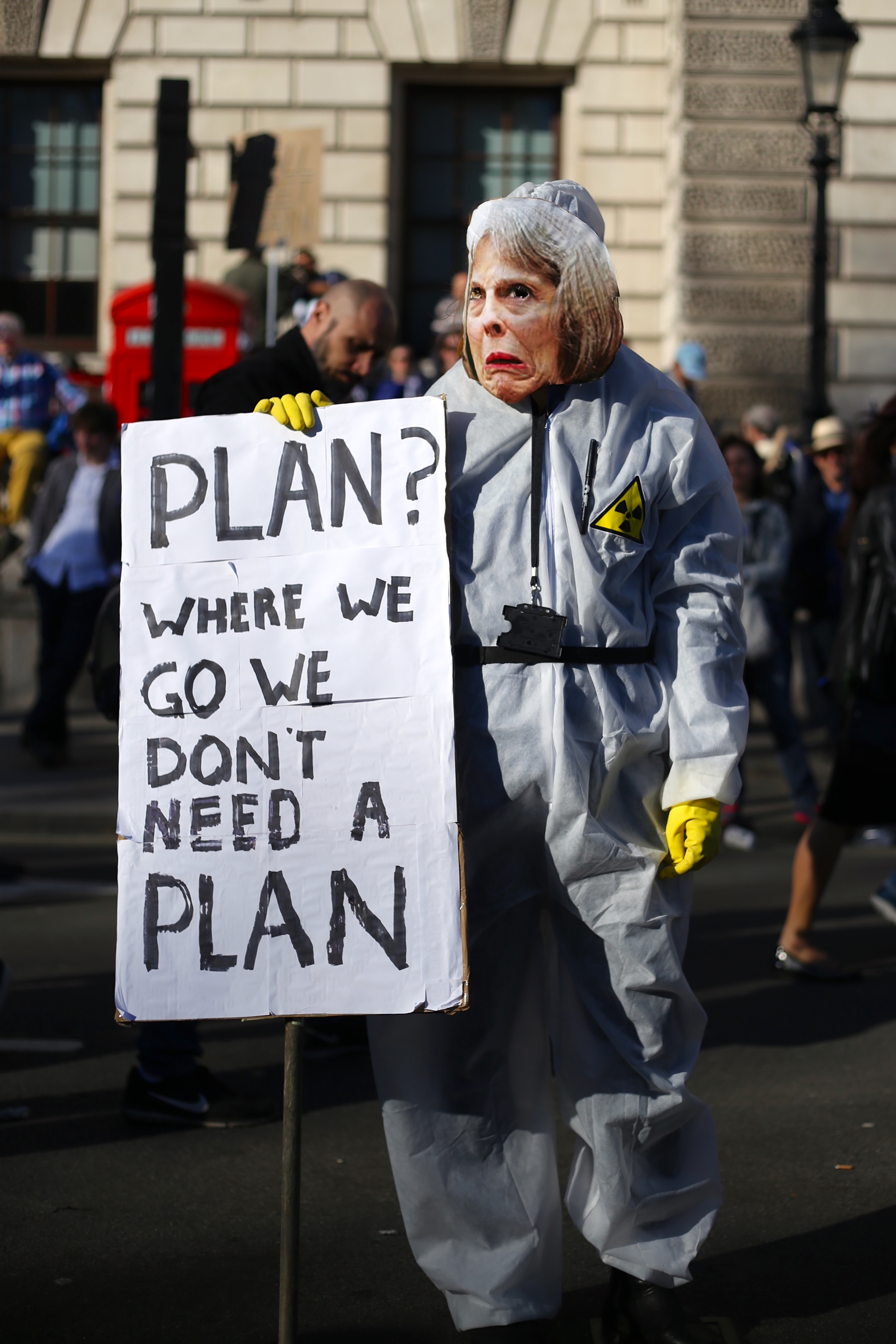
Tens of thousands of people marched on the British Parliament in a protest hastily organised on Facebook called 'March for Europe'. It was a show of European love not ordinarily seen in the British capital, where EU flags are normally verboten. And it wasn't a vague outpouring of sentiment either. The protesters had a specific demand for the parliament - do not pull the trigger on Brexit. That trigger is known as article 50 (more on that later).
The crowd was overwhelmingly young and educated. As The Guardian's Ed Vulliamy noted, "the hollow, bitter wit of the banners and placards was a fair indication of who took to the streets". “Un-Fuck My Future”, the placards pleaded. “No Brex Please, We’re British”. "Fromage, not Farage". Pictures of Whitney Houston singing “I Will Always Love EU” and Rick Astley singing "Never gonna give EU up, never gonna let EU down".
“Hell no, we won’t go!” they chanted.
Tens of thousands of people marched on the British Parliament in a protest hastily organised on Facebook called 'March for Europe'. It was a show of European love not ordinarily seen in the British capital, where EU flags are normally verboten. And it wasn't a vague outpouring of sentiment either. The protesters had a specific demand for the parliament - do not pull the trigger on Brexit. That trigger is known as article 50 (more on that later).
The crowd was overwhelmingly young and educated. As The Guardian's Ed Vulliamy noted, "the hollow, bitter wit of the banners and placards was a fair indication of who took to the streets". “Un-Fuck My Future”, the placards pleaded. “No Brex Please, We’re British”. "Fromage, not Farage". Pictures of Whitney Houston singing “I Will Always Love EU” and Rick Astley singing "Never gonna give EU up, never gonna let EU down".
“Hell no, we won’t go!” they chanted.
Tuesday, 28 June 2016
Can we stop the 'Democracy is beautiful' platitudes? This vote was a travesty
In the West we are brainwashed to always view more democracy as better. But the Brexit fiasco shows how inappropriate referenda are.
Being a Swiss person in England on Saturday, British journalists were keen to get tennis star Roger Federer's take on the Brexit chaos taking place around him. He gave a politician's answer. "It’s nice to have democracy here, that you have an opportunity to vote. It’s a beautiful thing."
Really Roger? You think what we've seen over the past days is "a beautiful thing?"
David Cameron expressed similar sentiments in his resignation speech after losing the vote. "The country has just taken part in a giant democratic exercise, perhaps the biggest in our history," he said. "We should be proud of the fact that in these islands we trust the people for these big decisions."
Being a Swiss person in England on Saturday, British journalists were keen to get tennis star Roger Federer's take on the Brexit chaos taking place around him. He gave a politician's answer. "It’s nice to have democracy here, that you have an opportunity to vote. It’s a beautiful thing."
Really Roger? You think what we've seen over the past days is "a beautiful thing?"
David Cameron expressed similar sentiments in his resignation speech after losing the vote. "The country has just taken part in a giant democratic exercise, perhaps the biggest in our history," he said. "We should be proud of the fact that in these islands we trust the people for these big decisions."
Monday, 27 June 2016
The UK Parliament can block Brexit, but it needs a mandate
There is zero prospect for a second referendum, but a general election may be called in the next few months that would be a de-facto second vote. The result could be an unravelling of the main political parties.
In the three days since Brexit, social media has been abuzz with the prospect of holding a second referendum. The argument goes that so many leave voters did not understand what they were voting for, it justifies holding a new poll.
An official petition asking for a second referendum has collected more than four million signatures, which will force a parliamentary debate on the subject.
But the idea of a second referendum is fanciful. The process of the first referendum was so ugly, so destabilising, that few would want to put the UK through that again.
Thursday, 21 April 2016
Laissez-faire politics: how America's free-market elections compare to Europe's
Few would disagree that the 2016 US presidential election in is a low point for American politics. But what has frustrated me over the past months is that there doesn't seem to be much serious conversation about what to do to fix the problem.
On this Sunday's Meet the Press, I was relieved to hear Washington Post columnist Kathleen Parker bring up a subject that few in America seem to grasp. The American structure of running election campaigns is an entirely different animal from most other democracies. It is the fundamental structure that is broken. The 'money in politics' problem that Bernie Sanders rails about is only a symptom of the broken foundation.
"What I want to know is, is there ever any serious consideration given to a possibility of just limiting campaigns as other countries do, to two months, say, and make them completely publicly funded?" she asked Debbie Wasserman Schulz, the chairwoman of the Democratic Party. "Is that ever anything that gets serious consideration and would it be possible?"
Wednesday, 23 January 2013
Brexit begins
By all accounts, the speech delivered by UK Prime Minister David Cameron this morning outlining his vision for a British disengagement with the EU was short on substance, contradictory and hackneyed. He mixed metaphors, made embarrassing errors reflecting a lack of EU knowledge and managed to enrage his EU partners even without having made specific demands.
But despite its rhetorical
flaws, Cameron’s speech will be one for the history books. With three words - "in/out
referendum" – Cameron has plunged the UK into four years of economic
uncertainty. The prime minister will have the dreaded ‘Brexit vote’, but only
in 2017, after the next election. With this he hopes to placate the fiercely eurosceptic
wing of his party while at the same time kicking the can down the road. But the
long time frame, business leaders and non-EU governments have warned, could be hugely damaging to the
British economy. Investors will likely be hesitant to invest in the UK when their
future in the European market is uncertain.
Wednesday, 2 June 2010
The European left: an endangered species?
At the moment, Europe is a conservative-dominated continent. The anecdotal evidence that Europeans have been veering to the right at this time of economic crisis has been evident for some time, especially in last year’s European Parliament elections where voters handed a strong majority to the conservative EPP. But the string of centre-right victories over the past few months has demonstrated clearly that the European public is gravitating toward conservative ideologies as their own economic situations become more uncertain. And looking at the geographic location of the few centre-left governments left in Europe, once can see that Europe’s Social Democrats are really in trouble.
This weekend Czechs went to the polls to select a new government. They faced a stark choice between the centre-left Social Democrats who promised during the campaign to increase spending and social benefits, and the centre-right Civic Democratic Party (ODS) who pledged to make drastic budget cuts and reduce the deficit. It is a battle economists have been waging as well. As most countries emerge from recession, is it better to maintain state spending to fuel the recovery or to make drastic cuts to tackle the large deficits and public debt?
Wednesday, 12 May 2010
An unholy alliance
Well, that was a crazy couple days. But last night it all came to a dramatic and sudden end as Gordon Brown abruptly drove to Buckingham Palace to hand in his resignation to Queen Elisabeth II, making Conservative leader David Cameron prime minister. So now it’s all done and dusted right? Hardly.
The excitement started Monday afternoon when, as the Conservatives and Liberal Democrats were still holding their negotiations, Gordon Brown emerged from 10 Downing Street to announced that Lib Dem leader Nick Clegg had approached the Labour Party to see what they could offer instead. And, most dramatically, Brown announced that he would be resigning as leader of the Labour Party.
That announcement soon sparked breathless speculation throughout the media. Gordon Brown stepping down was considered by many to be a precondition for a Liberal Democrat – Labour coalition. Surely, the media inferred, Brown would not have made that dramatic (and rather humiliating) announcement unless some kind of deal had been worked out. For the rest of the day Monday the assumption was that some kind of Lib-Lab coalition was being formed. The problem of course was that a Lib-Lab union would still not meet the threshold of reaching a majority in the parliament.
The excitement started Monday afternoon when, as the Conservatives and Liberal Democrats were still holding their negotiations, Gordon Brown emerged from 10 Downing Street to announced that Lib Dem leader Nick Clegg had approached the Labour Party to see what they could offer instead. And, most dramatically, Brown announced that he would be resigning as leader of the Labour Party.
That announcement soon sparked breathless speculation throughout the media. Gordon Brown stepping down was considered by many to be a precondition for a Liberal Democrat – Labour coalition. Surely, the media inferred, Brown would not have made that dramatic (and rather humiliating) announcement unless some kind of deal had been worked out. For the rest of the day Monday the assumption was that some kind of Lib-Lab coalition was being formed. The problem of course was that a Lib-Lab union would still not meet the threshold of reaching a majority in the parliament.
Monday, 10 May 2010
Brussels holds breath as leaked Tory memo shows plan of attack
It’s safe to say that EU leaders have bigger things to worry about today than the UK general election. But a leaked memo about the Conservatives’ Europe strategy is likely causing extra heartburn throughout Brussels today. And it’s likely also added an extra dose of complication to the fertive negotiations going on between David Cameron and Nick Clegg. The talks are proving difficult because the two parties are so far apart on major issues, and it’s going to be difficult for them to come to some kind of an understanding on how they can govern together. One of those major issues is Britain’s relationship with the EU, and hopes of agreement in this area were dramatically undermined last night when a top-secret letter from shadow foreign secretary William Hague to David Cameron was leaked.
The letter, written last week, assumed a Tory victory on Thursday and outlined a plan for a brash and aggressive introduction of the new UK government to EU foreign ministers at a meeting today. According to the document, Hague planned to tell the foreign ministers "the British relationship with the EU has changed with our election". Hague then planned to tell the ministers there would be no further integration of the UK with the rest of Europe. Instead, the UK would be clawing back national powers over criminal justice, social policy and employment policy during the first term of the Tory government. He also planned to tell the foreign ministers bluntly "we will never join the euro".
Saturday, 8 May 2010
The British election explained
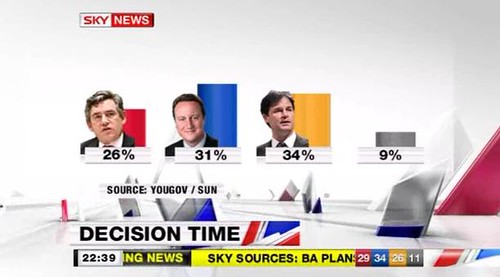
Nick Clegg is holding intense talks with David Cameron today, and it looks like these negotiations could go on for days. At the heart of the complications is this fact - even if the two men can work out an agreement and trust between them on how they would join together to form a government, they would still need to get that agreement approved by their parties. And given the big political differences between the Conservatives and the Liberal Democrats, that could be a herculean task.Many Americans I've talked to have been confused about what exactly is going on here, and I can certainly sympathize. First they were hearing that this was the Liberal Democrats' year, that following the televised debates the "Clegg effect" was going to transform this election and make the UK's third party politically relevant for the first time in decades. But then when the results came in Thursday night, Americans heard that the Liberal Democrats had suffered a stunning defeat, actually losing seats in the parliament. Oh well, so much for that then. But wait, come Friday they learn that the Liberal Democrats are now the most important factor in these post-election days, as they will be selecting who will be prime minister. So how does someone lose so badly and yet end up selecting who the winner will be?
Friday, 7 May 2010
Westminster in chaos
It was a long night, and it was only just a moment ago that the BBC was finally able to declare an official UK election result – or non-result, as the case may be. For the first time in decades, a British election has yielded a hung parliament. No single party has a majority, with the Conservatives falling well short of the 326 seats they needed to form a government. Now the clock is ticking as politicians scramble to come up with some kind of solution.It’s looking as if a Liberal Democrat – Labour coalition may not be enough for a majority either, which may rule out that option. It was a disastrously disappointing night for the Lib Dems and their supporters. Despite all the speculation after the first televised debate that this could be their year, the Lib Dems actually lost seats in this election. It’s truly stunning.
Of course along with all the polling showing surging support for the Lib Dems after the first debate came notes of caution that the pollsters did not know how the increased support would affect the actual vote. UK elections still use a peculiar first-past-the-post system for their elections which heavily favours the two main parties. This type of electoral system is normal in the presidential system of the US, but it is unusual in a parliamentary system. Most other parliamentary democracies use a ranked voting system where people indicate your first choice and then a second choice. The Lib Dems have made switching to a proportional representation or ranked system a cornerstone of their campaign, and recently Labour agreed to put it to a referendum. The Tories have refused to consider such a change, but it is likely that the Lib Dems would demand this if they were to enter into a coalition with the Conservatives..
Wednesday, 5 May 2010
Populism, David Cameron, and the gulf oil spill
The election campaign is in its last heated days here in London, and it really is inescapable. I’m just here for a few days staying with my partner, and it seems like it’s been all anyone can talk about. Sarah Brown, the prime minister’s wife, even made a bizarre special appearance at a Vauxhall gay club Saturday night. Hey, gotta get those votes wherever you can! But I found it amusing that the next morning she was up early to attend mass at a black church in South London.
I’m on the Eurostar back to Brussels at the moment and feeling pretty bummed to be leaving right before the big day. I have a feeling the real excitement is going to begin Friday when the parties have to somehow hash out how they form a government from a hung parliament.
If I had to sum up the mood of my London friends in one word it would be anxious. They all come from various political stripes, but interestingly most everyone I know is planning to vote Lib Dem. Whatever their political ideology they have one thing in common – David Cameron makes them very nervous. They fear the former PR-turned-politician is all window-dressing with little real policy ideas, and in reality it will be the “nasty Tories” of the 1990’s that will be taking power. Having not lived through this period in Britain I can’t entirely relate, but some of them feel very strongly about this fear. But an opinion piece in the Independent this weekend compared the situation with the campaign of George W. Bush in 2000. He also promised "compassionate conservartism" but in the eyes of many he turned out to be just a populist front man for a Neo Conservative cabal with a very specific agenda. That agenda included going to war with Iraq.
I’m on the Eurostar back to Brussels at the moment and feeling pretty bummed to be leaving right before the big day. I have a feeling the real excitement is going to begin Friday when the parties have to somehow hash out how they form a government from a hung parliament.
If I had to sum up the mood of my London friends in one word it would be anxious. They all come from various political stripes, but interestingly most everyone I know is planning to vote Lib Dem. Whatever their political ideology they have one thing in common – David Cameron makes them very nervous. They fear the former PR-turned-politician is all window-dressing with little real policy ideas, and in reality it will be the “nasty Tories” of the 1990’s that will be taking power. Having not lived through this period in Britain I can’t entirely relate, but some of them feel very strongly about this fear. But an opinion piece in the Independent this weekend compared the situation with the campaign of George W. Bush in 2000. He also promised "compassionate conservartism" but in the eyes of many he turned out to be just a populist front man for a Neo Conservative cabal with a very specific agenda. That agenda included going to war with Iraq.
Thursday, 29 April 2010
"That bigoted woman”
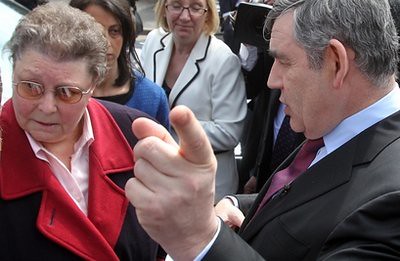
I was surprised to learn today that all the American nightly news broadcasts covered the british “bigotgate” scandal last night. I guess I shouldn’t be so shocked, it is a pretty crazy story and doesn’t require much background info to understand. A politician makes nice with a supporter, all smiles, then gets into his Lexus but forgets to turn his radio mic off. He launches into a rant about how horrible it is that he was made to talk to that awful “bigoted woman”. It’s fairly comical really, at least for those looking in. But for Labour supporters, yesterday afternoon was devastating. Coming just a week before the election, it has dashed any Labour hope of squeeking through and remaining in power.It was almost the perfect storm to sink Prime Minister Gordon Brown – an aloof, awkward politician with a reputation for behind-the-scenes temper tantrums disrespects a middle England voter by deriding her as “bigoted” because she brought up a question about immigration, the most sensitive political issue in Britain. Add to that the fact that this was an elderly woman who had actually stated her concerns to Brown in a fairly reasonable manner and you’ve got a concoction that is virtually guaranteed to spell the end of Gordon Brown’s political career.
Brown has never liked the schmoozing, glad-handing aspect of politics. He has long been known to get frustrated with the American-style 'popularity contest'that Tony Blair brought to British politics. It is likely that on this occasion, his frustration boiled over. Unfortunately for him, it happened while he was still on mic.
Friday, 23 April 2010
The Anti-American vs. the Anti-European
If we are to believe Gordon Brown, last night’s British election debate was between himself - the thoughtful moderate, Nick Clegg - the naïve anti-American, and David Cameron – the nationalistic anti-European. And Brown didn’t want us to forget this point, saying it over and over and even at one point pointing at the other two candidates saying forcefully “YOU are a risk to the economy and YOU are a risk to our security!” Really Gordon? Did this guy not receive any debate training at all?
I was eagerly awaiting this debate because it was meant to be focused on foreign policy. Unfortunately Sky News made a bit of a muck of it, the moderator was awful and the debate got off topic very easily. Bizarrely the moderator allowed the conversation to stay for long periods of time on silly questions (like “what are you personally doing in your daily life to help the earth?”) or questions that had already been covered in the previous debate (like immigration), while he cut questions on actual foreign policy topics (like the EU) short.
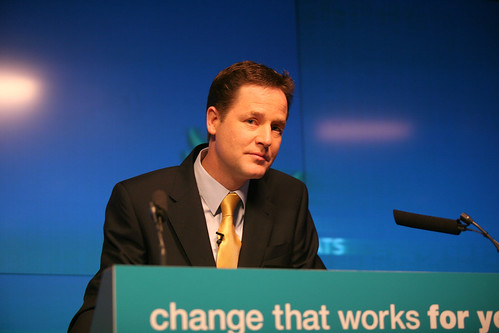
Still, I did get a solid 15 minutes of good EU discussion right at the start of the debate, so I was pleased. By far the most encouraging words came from Nick Clegg, the most pro-EU of the three candidates. Rather than lay off the usual meaningless populist nonsense that David Cameron comes up with or the usual “EU? What’s an EU?” of Gordon Brown, Clegg walked people through why the EU is important and why the UK cannot achieve its goals alone. His example of the EU pedophile law that the Conservatives opposed was brilliant (a friend of mine quipped, “The EU helps catch pedophiles? The Daily Mail is going to be so confused”). He also explained how he had worked in Brussels representing the UK to the EU under Margaret Thatcher and also represented the EU in its negotiations with China. He actually knows the EU, he has connections there and he would work to make the UK more influential in Europe instead of sitting on the sidelines as it does now.
I was eagerly awaiting this debate because it was meant to be focused on foreign policy. Unfortunately Sky News made a bit of a muck of it, the moderator was awful and the debate got off topic very easily. Bizarrely the moderator allowed the conversation to stay for long periods of time on silly questions (like “what are you personally doing in your daily life to help the earth?”) or questions that had already been covered in the previous debate (like immigration), while he cut questions on actual foreign policy topics (like the EU) short.
Still, I did get a solid 15 minutes of good EU discussion right at the start of the debate, so I was pleased. By far the most encouraging words came from Nick Clegg, the most pro-EU of the three candidates. Rather than lay off the usual meaningless populist nonsense that David Cameron comes up with or the usual “EU? What’s an EU?” of Gordon Brown, Clegg walked people through why the EU is important and why the UK cannot achieve its goals alone. His example of the EU pedophile law that the Conservatives opposed was brilliant (a friend of mine quipped, “The EU helps catch pedophiles? The Daily Mail is going to be so confused”). He also explained how he had worked in Brussels representing the UK to the EU under Margaret Thatcher and also represented the EU in its negotiations with China. He actually knows the EU, he has connections there and he would work to make the UK more influential in Europe instead of sitting on the sidelines as it does now.
Friday, 16 April 2010
The big debate
The UK election debate last night focused on domestic policy, so sadly I didn’t get my EU fix from them. Still, it was very interesting to watch the first-ever televised political debate in British history after having watched so many in America. There was a lot of skepticism in the UK over whether this was really a useful exercise. After all, the party leaders already have a televised debate every week with prime ministers questions, when the full parliament sits and the leaders ask each other questions for 30 minutes. PMQs get very raucous, with hooting and hollering, accusations, jeers, laughter, you name it. Over the years they’ve gotten increasingly theatrical and bombastic, to the point where these days it seems a lot more like political theatre than legitimate debate.
There have been calls for the UK to start doing American-style televised debates during their general elections for decades, but every prime minister from Thatcher to Blair has always refused. It was, according to conventional wisdom, the sitting prime minister who had the most to lose by participating in a debate that would put them on an equal playing field with the opposition. But this year Gordon Brown relented, and of course, there’s no putting the lid back on that jar. Last night was the dawn of a new era in British politics. Never again will a sitting prime minister be able to avoid a televised debate.
Thursday, 15 April 2010
The UK election and the EU – a stark choice
It’s really an incredible thing to witness – British elections apparently don’t slowly emerge and gather pace, but instead arrive with a loud thud. Last week Prime Minister Gordon Brown called an election, and on Monday the Queen ceremoniously dissolved parliament. Almost on cue, my Facebook feed suddenly lit up with status messages from Brits asking who they should vote for.
It’s strange, because it’s been known for months that the election would be at some point in May. it’s literally the last moment at which Gordon Brown could have called an election since the last one was 5 years ago. But I guess it isn’t ok to start thinking about how you will vote until the Queen tells you to!
This will be the first UK election I will have observed since moving there. The process is extremely different from that in the US. Once the parliament is dissolved, MPs have just a few weeks to rush home to their constituencies to campaign. On 6 May the Brits will go to the polls, and whichever party gets the most votes will be able to appoint the prime minister. But one part of this year’s election will be very American. For the first time ever, the leaders from the three main parties will take place in an American-style TV debate. The first one will air tonight.
It’s strange, because it’s been known for months that the election would be at some point in May. it’s literally the last moment at which Gordon Brown could have called an election since the last one was 5 years ago. But I guess it isn’t ok to start thinking about how you will vote until the Queen tells you to!
This will be the first UK election I will have observed since moving there. The process is extremely different from that in the US. Once the parliament is dissolved, MPs have just a few weeks to rush home to their constituencies to campaign. On 6 May the Brits will go to the polls, and whichever party gets the most votes will be able to appoint the prime minister. But one part of this year’s election will be very American. For the first time ever, the leaders from the three main parties will take place in an American-style TV debate. The first one will air tonight.
Tuesday, 30 March 2010
The new power of the pink press? British, Czech conservatives fumble in gay interviews
Surely this is just a bizarre coincidence, but oddly enough two conservative politicians at opposite ends of Europe took major tumbles last week following misstatements in interviews in gay newspapers. Both David Cameron in the UK and Mirek Topolánek in the Czech Republic have run into trouble for ill-chosen words used in interviews they had clearly underprepared for. Does this mean the pink press has come of age?Last week British Conservative leader David Cameron, who will be challenging Gordon Brown in next month’s general election in the UK, had a mini meltdown of sorts during a filmed interview with the Gay Times. The trouble started when the interviewer asked Cameron why his Tories in the European Parliament failed to support a recent vote criticising a Lithuanian law banning the “promotion of homosexuality” (The image below is an actual campaign flyer in Vilnius for the Lithuanian law). David Cameron seemed completely caught off guard, and could only respond that he didn’t know anything about the vote.
Thursday, 25 February 2010
Nigel Farage, europhile hero?
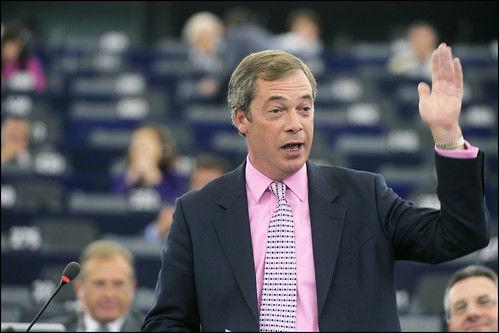
Has the world gone topsy turvey? It's safe to say there is little that unites the rabidly Eurosceptic Nigel Farage of the UK Independence Party with pro-Europeans. Yet during newly-appointed European Council president Herman van Rumpuy's first appearance before the European Parliament this week, Farage was the only MEP to even remotely express the frustration many Europhiles are feeling with the presidential selection. And when Nigel Farage is the only one willing to say what the europhiles are thinking, it's a strange time indeed!Farage delivered yesterday a blisteringly insulting attack on the new "EU President", telling him he has the "charisma of a damp rag" and the "appearance of a low-grade bank clerk". Now, such personal attacks may be commonplace in Westminster, but that is not how the European Parliament operates (or any other parliament I know of! Except maybe Australia...). MEPs today have been furious about the outburst. The parliamen's president is considering disciplinary action against him, and has summoned him for a meeting on Tuesday to discuss the incident.
Wednesday, 10 June 2009
Euroelection: BNP Overshadows the Real Story
Europe’s centre-left is licking its wounds this week after the European Parliament vote, and nowhere is the pain being felt more acutely than by Labour in Britain. But perhaps the larger significance of the poll results for this island nation, which the British media have so far failed to pick up on, is the fact that the British will not be using 60% of their potential voting power in the new European Parliament.Anti-EU parties did enormously well in Britain’s European Parliament vote. The UK Independence Party, which believes that Britain should secede from the EU, got 16.5% of the vote, beating Labour and coming in second with 13 seats. With the far-right British National Party – which also wants to exit the EU – gaining two seats, Britain will be sending 15 MEPs to represent them in the European Parliament who don’t believe the institution should exist at all. And of course “sending” is perhaps a misleading term here, since all 15 of these MEPs are unlikely to ever show up in Brussels to cast a vote, preferring to remain in Britain in protest.
Yesterday I was at a sustainability conference in London’s Docklands, and was listening to an opening speech given by Tory MEP Caroline Jackson, who represents Britain’s Southwest region. She said she was dismayed that British voters had chosen to waste 15 of their seats in parliament. Those 15 seats which will remain conspicuously empty for the next five years, as the British people have elected them in based on an issue that has absolutely nothing to do with the European Parliament, which decides neither which countries are in the EU nor the makeup and structure of the union.
Jackson went on to point out that with the departure of the Tories from the main centre-right group European People’s Party (EPP), the reality was that the UK has now effectively relinquished 30 out of its 72 seats.
Fulfilling a pledge he made back when he was campaigning for the Conservative Party’s leadership, David Cameron is taking the Tories out of the EPP, the largest block in the European Parliament with all the continent’s centre-right parties – including those of Angela Merkel and Nicolas Sarkozy – saying that the block is too federalist. He is instead trying to form a new Eurosceptic party, finding strange far-right allies from Eastern Europe to join him. Jackson, who has decided to leave the parliament after this term, could barely conceal her disdain as she listed these parties, which include the Czech Republic’s ODS (which she pronounced o-di-ous) and Poland’s PIS (which she refrained from making into a word). “Rather unfortunate acronyms” she observed dryly.“It’s a sad moment for me, as a Conservative, to find that the Conservatives have put themselves in this bottom group, leading effectively nowhere,” she said. She isn’t alone in this observation. Many Tory MEPs have pointed out that this decision will put the Conservatives on the fringes of Europe, with no influence in the parliament and shut out of decision-making. If they had stayed in the EPP, the Conservatives would have been one of the largest parties in the EP’s largest block. It would have been a powerful position in an increasingly powerful body within the EU, which now controls the majority of British policy in the areas of environment, agriculture and trade.
As it stands, the second-largest country in the EU will have just 42 real usable seats in the European parliament (minus 30 wasted seats), compared to Germany’s 99 effective seats and France’s 68 (minus their 4 wasted seats from fringe parties). While the rest of mainstream Europe is fully engaged in the EU as it works to solve problems that cannot be solved nationally - such as climate change, terrorism and the financial crisis – Britain will have taken its toys and gone home. They’ll remain part of the EU, governed by its laws, but refusing to actively take part in shaping its policy. The Tories are now going to lose most of their ranking seats on the parliament's committees. Representatives of British industry and NGOs will now have few MEP to go to to influence EU policy in Britain's favour. Essentially, the UK has cut off its nose to spite its face. Many in Brussels are scratching their heads at what could motivate what they see as an idiotic, irresponsible decision.
Far-Right Ascendance in Britain
However the fact remains that a vast swathe of the British people have yet to be convinced that the EU serves any purpose, and they see no reason why the UK can’t single-handedly solve these large problems all on its own. And there is a growing segment of the country that believes the “British race” would also be better off on its own.The British Media hasn’t taken much notice of the diminished influence the UK now has in the parliament. They’ve instead focused on the fact that the British National Party, the far-right group that doesn’t allow non-whites as members and espouses the ideas of Adolph Hitler, won two MEP seats. The victories, which were won in the North of England, have caused alarm and revulsion across the UK. When notorious BNP leader Nick Griffin tried to hold an impromptu victory press conference outside the houses of Parliament yesterday he was confronted by a group of anti-fascist protestors who pelted him with eggs. The anti-fascist group says they will trail the far-right leader wherever he goes to remind the public of his extreme racist views, but the reality is such protests will probably bring him more attention than having the seat will.
Of course Britain won’t be the first EU country sending far-right MEPs to Brussels. Jean-Marie Le Pen’s Front National has long been sending elected members to the body, and there are far-right MEPs from Eastern Europe that have called for the mass deportation of Roma (gypsies). But this is the first time that Britain, the mother of all Democracies, has sent a fascist representative to Europe. In fact, this is the first high office that the BNP has been elected to (so far they’ve only managed to get seats on local town councils), and without a doubt it gives them some legitimacy (if not any actual power since they’re unlikely to ever make a trip to Brussels to cast a vote, lest they mix with the foreigns).
Such a win for the BNP does great damage to the nation’s psyche because it challenges many of the narratives the British people have for themselves. Most British people forget that there was significant fascist movement here during the 1930’s that in the end was unable to wrest power. The sad reality is that this win means the BNP is now a bit player in British Politics that isn’t going away, but they are unlikely to become a significance force with anywhere near the reach of Oswald Mosley’s fascists of the ‘30s.
The British people’s attitude about the irrelevance of the European Parliament has enabled two fascists to sneak into their representation in Brussels. In the long-run, the more important consequence of that will be the European disengagement and isolationism that one day Britain may look back on and regret if it finds itself alone and irrelevant in the 21st century. “And all we were talking about was the bloody BNP,” they may remark with a larf.
Subscribe to:
Posts (Atom)


_2_new.jpg)