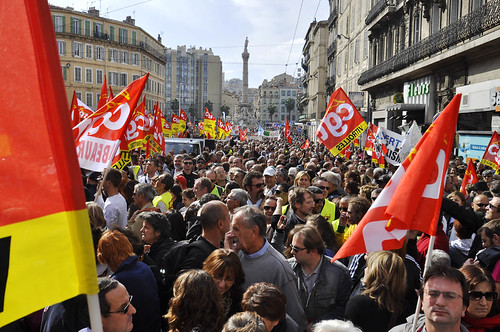
As rolling strikes and violent protests against austerity measures continue to cause chaos in France today, across the channel the new conservative government of David Cameron introduced their much-anticipated package of budget cuts, the biggest slash to the UK budget since World War II. Naturally, the stoic British public is not reacting in the same 'take to the streets' manner of the French in their reaction to Sarkozy's attempts at budget cuts. Instead, there seems to be a sense of profound sadness and anxiety in the UK today.
Put quite simply, the cuts are massive. £83 billion ($130 billion) in cuts were announced this afternoon, an average of 20% out of every government department. 490,000 government employees will lose their jobs. Government offices in London will be cut by a third. Rent will be increased for people in public housing, police services will be cut, local town councils will get less money, and prisons will have less space. The retirement age will be raised to 66 (compared to 62 in the US). Both the sales and income tax will rise, with most of the increases coming out of the salaries of top earners. University teaching budgets will be cut by 75%, meaning the cost of tuition will rise considerably. And the British military isn't immune either, it will see an 8% cut in its budget. Even the queen will have to make do with less. Cameron is giving her a 14% pay cut.
Showing posts with label John McCain. Show all posts
Wednesday, 20 October 2010
Wednesday, 5 May 2010
Populism, David Cameron, and the gulf oil spill
The election campaign is in its last heated days here in London, and it really is inescapable. I’m just here for a few days staying with my partner, and it seems like it’s been all anyone can talk about. Sarah Brown, the prime minister’s wife, even made a bizarre special appearance at a Vauxhall gay club Saturday night. Hey, gotta get those votes wherever you can! But I found it amusing that the next morning she was up early to attend mass at a black church in South London.
I’m on the Eurostar back to Brussels at the moment and feeling pretty bummed to be leaving right before the big day. I have a feeling the real excitement is going to begin Friday when the parties have to somehow hash out how they form a government from a hung parliament.
If I had to sum up the mood of my London friends in one word it would be anxious. They all come from various political stripes, but interestingly most everyone I know is planning to vote Lib Dem. Whatever their political ideology they have one thing in common – David Cameron makes them very nervous. They fear the former PR-turned-politician is all window-dressing with little real policy ideas, and in reality it will be the “nasty Tories” of the 1990’s that will be taking power. Having not lived through this period in Britain I can’t entirely relate, but some of them feel very strongly about this fear. But an opinion piece in the Independent this weekend compared the situation with the campaign of George W. Bush in 2000. He also promised "compassionate conservartism" but in the eyes of many he turned out to be just a populist front man for a Neo Conservative cabal with a very specific agenda. That agenda included going to war with Iraq.
I’m on the Eurostar back to Brussels at the moment and feeling pretty bummed to be leaving right before the big day. I have a feeling the real excitement is going to begin Friday when the parties have to somehow hash out how they form a government from a hung parliament.
If I had to sum up the mood of my London friends in one word it would be anxious. They all come from various political stripes, but interestingly most everyone I know is planning to vote Lib Dem. Whatever their political ideology they have one thing in common – David Cameron makes them very nervous. They fear the former PR-turned-politician is all window-dressing with little real policy ideas, and in reality it will be the “nasty Tories” of the 1990’s that will be taking power. Having not lived through this period in Britain I can’t entirely relate, but some of them feel very strongly about this fear. But an opinion piece in the Independent this weekend compared the situation with the campaign of George W. Bush in 2000. He also promised "compassionate conservartism" but in the eyes of many he turned out to be just a populist front man for a Neo Conservative cabal with a very specific agenda. That agenda included going to war with Iraq.
Wednesday, 5 November 2008
The Obama Urban Coalition
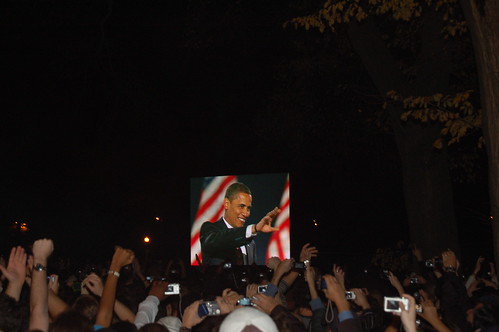
Wow, what a night. I have to say I was pretty bummed to not be in the US for election night. Watching Grant Park and the city streets across the nation erupt in celebration, it just wasn't the same sitting alone in my apartment at five in the morning. Still it was an amazing moment, seeing the celebrations across the world as the Bush era was declared definitively finished.I started the evening by going with some American friends to a US election party at the town hall of the 3rd arrondisement here in Paris. We were expecting your classic election party, with television, food platters, drinks, etc. Instead we found an art exhibit! Apparently the French conception of an 'election party' involves an exhibition of photography from the US election and the screening of a conceptual art film about American politics. And no booze! There was a large screen showing French coverage of the election, but it was outdoors so the prospect of hanging out to watch the results there for six hours wasn't too enticing! Still it was interesting, when people heard our accents they were very eager to talk about the election. They were really fascinated by it, as the art exhibits reflected. And as the only Americans there we were the self-appointed experts of the moment.
We sort of moved around from cafe to cafe but after it started to get late I went back to my apartment to watch the results. I live on a street with a lot of expat bars and the place across from me was having an election viewing party, but I don't think they realized how late the result was coming because when they finally called it at 5am I went to look out the window to see if they were pouring into the street, and the bar had already closed! So I was a bit jealous as I talked to my friends in the US and they told me how people were pouring into the streets to celebrate. It was really wild. I spoke with one friend who lives in DC, he was outside the white house among the huge crowds that had gathered outside the lawn. He said it almost looked like they were going to storm the gates and drag Bush out themselves. Another friend called me from Grant Park in Chicago and said it was absolutely amazing, unlike anything he had ever seen. It wouldn't be hyperbole to say it looked like a third world country that had just overthrown a dictator. Here's a video someone took from a window in New York's east village.So what prompted this huge outpouring of jubilation? Certainly it was an extremely unusual reaction to an election result in the US, especially in the last ten years, when election nights were more likely to see people crying in the streets of American cities. To understand why US cities erupted in celebration like this, you have to look beyond the current campaign and look back at the last ten years. Since the election of 2000, which most Democrats considered to have been stolen from Al Gore, residents of American cities in the Northeast and the West Coast have felt as if the Bush Administration was literally at war with them. The Republican Party's strategy during this time has been to appeal almost exclusively to rural white voters, vilifying urban dwellers and using social issues like abortion and gay marriage to drive cultural conservatives to the polls. The strategy worked, and the GOP was voted into office again and again by turning out rural votes. This left American city dwellers feeling almost completely powerless. as if they had no power and no voice while their country's leaders continually vilified and insulted them.
The same playbook was used by the McCain campaign in this election, dividing the country into "real America" and "fake America." So when that strategy didn't work this time, it signalled to city-dwellers that their long period of exile from power was finally over.
Of course there was another reason for the celebrations as well. Part of the GOP's process of vilifying urbanites also involved fostering distrust of African Americans, albeit not with direct language. African Americans felt completely ignored by the Bush Administration, particularly during Hurricane Katrina. Tuesday night the African American community celebrated a minor victory, the defeat of a party which most of them despise, and a major victory, the election of the first black president. No wonder there were tears in the streets. And it was hard not to be moved by them.
What's Next?
The fact is that despite their personal ideology, politicians often take their cues from the people who put them in office. For instance, no matter how much she is vilified as a "liberal" by the American right, Nancy Pelosi has pursued a rather moderate agenda as speaker of the house over the last two years, because she knows Democrats were given their majority by moderate voters in a center-right country. So who put Obama in office?
I thought former speechwriter David Frum made an interesting comment on the BBC Tuesday night, saying Obama was elected into office by a coalition of "the very top and the very bottom." Frum questioned whether over the long term these two groups will have aligning interests. College-educated whites voted almost exclusively for Barack Obama, as did 96 percent of African Americans. But non college-educated whites, especially those in rural areas, voted largely for McCain. Frum insisted on calling this group of McCain voters the "middle class," which I think is debatable. But there is no denying that the majority of blue collar white voters, those in the middle of the income spectrum, did not vote for Barack Obama.So will this coalition of college-educated whites and African Americans hold? Do they have more in common philosophically than their hatred for George W. Bush? Only time will tell, but early philosophical differences may have already been exposed by the passing of Proposition 8 in California. The proposition sought to amend the constitution to overrule a recent California Supreme Court decision to allow gay marriages in the state, which prompted 18,000 marriages including those of a few celebrities including Ellen DeGeneres. In the end the proposition to ban gay marriage passed by a very narrow margin, and ironically it looks like it was Barack Obama's presence on the ballot that enabled it to pass. Because although the college-educated whites who turned out for Obama would have mostly voted against it, the huge African American turnout that was driven to the polls for Obama would have mostly voted for it. This is perhaps the biggest divide between African Americans, who are largely socially conservative and religious, and college-educated whites, who are often socially progressive and secular.
With control of both houses of congress and the presidency, the Democrats have a huge mandate for action. But what action will they take? it's going to be fascinating to watch.
Friday, 19 September 2008
The Blame Game
As the global financial system falls apart around our ears, a few things have stuck out to me in the way that politicians in the US are reacting to the crisis. One has been the incredibly bizarre words coming out of John McCain's mouth in response to this disastrous week. Suddenly he's lambasting a "culture of unrestrained greed" on Wall Street and urging greater oversight. This is from a senator who has been one of the biggest champions of unbridled free-market capitalism throughout his decades in the senate. Has the world gone topsy-turvey? This may be what a paniced American population wants to hear right now, but it is clearly not the way John McCain truly views how the economy should be run.
I mean who would have thought they'd see the day that Hank Paulson, who is as aggressively free market as you can get, would be leading the kind of bailouts we're seeing today. He has to, the government doesn't have a choice in these circumstances. But it's truly bizarre to see John McCain blasting "unrestrained greed" on Wall Street as causing the current crisis when he and his party have led the charge to unrestrain that greed over the past ten years.
Beyond that, I think there is something culturally interesting about the language both candidates are using about the crisis, language which shows that no matter which candidate is elected in November, the US is unlikely to address the fundamental problem it faces any time soon.
Big Bad "Washington"
Both candidates are blaming the crisis on purely conceptual factors like "Wall Street Greed." It is symptomatic of the way the entire campaign has been phrased. The many problems America currently faces are the fault of "Washington," "terrorism," "lobbyists," "oil companies," you name it. In fact if you listen to American politicians, the one group that doesn't share any blame for the country's problems is the American people themselves.
But this argument is not only illogical, it's also unproductive. The dirtiest word during this election campaign has probably been "Washington." This is nothing new. Each election since Nixon has been presented to the American public in this way: Washington is broken and we need an 'outsider' or a 'maverick' to change it. It's how Reagan, Clinton and Bush were all elected. But this year the anti-Washington rhetoric seems to have hit new heights. And yet, what is Washington? Washington is a creation of the people, full of democratically elected politicians who the American public put there. Washington is, therefor, a reflection of the US population. So if there's something wrong with Washington, then there's something wrong with the US public.
The current economic troubles have been presented in the same way, as if it's all conceptual factors that are affecting the blameless American people. Nowhere was this more evident than when John McCain made the bonehead mistake of repeating his "the fundamentals of the economy are strong" line in Florida Monday morning on the day of the Lehman Brothers collapse. Rapidly going into damage control mode, he quickly shifted his wording later in the day to say that the 'fundamentals' he was referring to was the 'hard-working American worker.' Beyond being a laughable backtrack, it reflects the fundamental problem with the way American politicians are dealing with this cris. They're not being straight with the American people, because they won't tell them that it is the people who are to blame.
Debt Addiction
The American economy has been fundamentally operating on borrowed money for decades now. From the most microeconomic level (Americans now have a negative rate of average savings) to the most macroeconomic (the national debt is at a record high level), America is addicted to spending money it does not have to fund an opulant lifestyle. And it isn't just consumer debt like credit cards that has saddled the American people and the American economy. People took out mortgages that they couldn't possibly pay back, thereby spurring the mortgage crisis. People took out student loans that they knew they wouldn't be able to pay back for 30 years (I'm one of them). A combination of a lack of government oversight and assistance and Americans own culture of greed and vanity has pushed the country into a system where it lives far beyonds it means.
The average family debt in America is around $30,000, and that's not even including mortgages and student debt. The average college graduate from a private university leaves school with $60,000 in debt (Me? I had $120,000 in debt by the time I finished grad school). And how does Americans' -0.2 percent rate of savings compare our rapidly emerging superpower rival? In China, the average savings rate is 20 percent.
Jimmy Carter was the last president to touch this issue with a ten foot pole, in a speech he gave shortly before he lost the election to Ronald Reagan. The speech, widely called the "malaise" speech because it seemed defeatist, is widely credited with losing the reelection for Carter, who was defeated by Ronald Reagan who promised the American people "morning in America" with an endless luxurious lifestyle. Reagan then plunged the nation into an unprecedented level of peacetime national debt.
America has a problem. It is addicted to spending money, and resources, it does not have. The only solution to this problem is for Americans to stop spending what they don't have. But no politician is willing to say that. Instead, everyone in government is blaming the ethereal concepts of "Washington" and "Wall Street." And while much of this crisis can be blamed on the deregulation that a Republican congress has championed over the past 15 years (and that New Democrats rubber-stamped), most of it can be blamed on Americans' spend today, worry about it tomorrow lifestyle. The only real solution, for people, government and business, is to live within our means.
But per usual, when something goes wrong with the United States, it is never the fault of its citizenry. When a hijacking disaster came to its shores, it was blamed on the ethereal concept of "terrorism" rather than American foreign policy or the isolationism of its citizenry. When George W. Bush was elected - twice - it was somehow the fault of some larger "Washington" system rather than the fault of the voters themselves. And now, with the financial crisis, once again we see that Americans are refusing to look in the mirror and take responsibility for their own culture and their own lifestyle.
Self-Efacing Europe
I can tell you that this contrasts sharply with how Europeans view their own problems. When I speak with Europeans about the problems plaguing Europe, and the inability of the continent to address those problems, they throw their hands up in the air and give a morose explanation about how Europeans have petty rivalries and nationalism that make them unable to cooperate, or how they are are rendered complacent by their generous social welfare systems, or how the people of Europe lack any significant ambition or direction. They don't blame their concepts on etherial concepts, but rather themselves. They could never be as sucesful as America, so many of them say to me, because Europeans don't have the same drive for success.
In the end, I'd say Americans could do with a lot less self confidence and Europeans could do with a lot more. Americans inability to take personal responsibilty and tendency to blame vague concepts for their woes has gotten them into a quagmire in which they are unable to come up with real solutions to their problems. Europeans' lack of self confidence and their acceptance of a storyline that paints them as lazy and complacent makes it difficult to achieve any new success.
Maybe America has some extra swagger it could loan to Europe for awhile.
I mean who would have thought they'd see the day that Hank Paulson, who is as aggressively free market as you can get, would be leading the kind of bailouts we're seeing today. He has to, the government doesn't have a choice in these circumstances. But it's truly bizarre to see John McCain blasting "unrestrained greed" on Wall Street as causing the current crisis when he and his party have led the charge to unrestrain that greed over the past ten years.
Beyond that, I think there is something culturally interesting about the language both candidates are using about the crisis, language which shows that no matter which candidate is elected in November, the US is unlikely to address the fundamental problem it faces any time soon.
Big Bad "Washington"
Both candidates are blaming the crisis on purely conceptual factors like "Wall Street Greed." It is symptomatic of the way the entire campaign has been phrased. The many problems America currently faces are the fault of "Washington," "terrorism," "lobbyists," "oil companies," you name it. In fact if you listen to American politicians, the one group that doesn't share any blame for the country's problems is the American people themselves.
But this argument is not only illogical, it's also unproductive. The dirtiest word during this election campaign has probably been "Washington." This is nothing new. Each election since Nixon has been presented to the American public in this way: Washington is broken and we need an 'outsider' or a 'maverick' to change it. It's how Reagan, Clinton and Bush were all elected. But this year the anti-Washington rhetoric seems to have hit new heights. And yet, what is Washington? Washington is a creation of the people, full of democratically elected politicians who the American public put there. Washington is, therefor, a reflection of the US population. So if there's something wrong with Washington, then there's something wrong with the US public.
The current economic troubles have been presented in the same way, as if it's all conceptual factors that are affecting the blameless American people. Nowhere was this more evident than when John McCain made the bonehead mistake of repeating his "the fundamentals of the economy are strong" line in Florida Monday morning on the day of the Lehman Brothers collapse. Rapidly going into damage control mode, he quickly shifted his wording later in the day to say that the 'fundamentals' he was referring to was the 'hard-working American worker.' Beyond being a laughable backtrack, it reflects the fundamental problem with the way American politicians are dealing with this cris. They're not being straight with the American people, because they won't tell them that it is the people who are to blame.
Debt Addiction
The American economy has been fundamentally operating on borrowed money for decades now. From the most microeconomic level (Americans now have a negative rate of average savings) to the most macroeconomic (the national debt is at a record high level), America is addicted to spending money it does not have to fund an opulant lifestyle. And it isn't just consumer debt like credit cards that has saddled the American people and the American economy. People took out mortgages that they couldn't possibly pay back, thereby spurring the mortgage crisis. People took out student loans that they knew they wouldn't be able to pay back for 30 years (I'm one of them). A combination of a lack of government oversight and assistance and Americans own culture of greed and vanity has pushed the country into a system where it lives far beyonds it means.
The average family debt in America is around $30,000, and that's not even including mortgages and student debt. The average college graduate from a private university leaves school with $60,000 in debt (Me? I had $120,000 in debt by the time I finished grad school). And how does Americans' -0.2 percent rate of savings compare our rapidly emerging superpower rival? In China, the average savings rate is 20 percent.
Jimmy Carter was the last president to touch this issue with a ten foot pole, in a speech he gave shortly before he lost the election to Ronald Reagan. The speech, widely called the "malaise" speech because it seemed defeatist, is widely credited with losing the reelection for Carter, who was defeated by Ronald Reagan who promised the American people "morning in America" with an endless luxurious lifestyle. Reagan then plunged the nation into an unprecedented level of peacetime national debt.
America has a problem. It is addicted to spending money, and resources, it does not have. The only solution to this problem is for Americans to stop spending what they don't have. But no politician is willing to say that. Instead, everyone in government is blaming the ethereal concepts of "Washington" and "Wall Street." And while much of this crisis can be blamed on the deregulation that a Republican congress has championed over the past 15 years (and that New Democrats rubber-stamped), most of it can be blamed on Americans' spend today, worry about it tomorrow lifestyle. The only real solution, for people, government and business, is to live within our means.
But per usual, when something goes wrong with the United States, it is never the fault of its citizenry. When a hijacking disaster came to its shores, it was blamed on the ethereal concept of "terrorism" rather than American foreign policy or the isolationism of its citizenry. When George W. Bush was elected - twice - it was somehow the fault of some larger "Washington" system rather than the fault of the voters themselves. And now, with the financial crisis, once again we see that Americans are refusing to look in the mirror and take responsibility for their own culture and their own lifestyle.
Self-Efacing Europe
I can tell you that this contrasts sharply with how Europeans view their own problems. When I speak with Europeans about the problems plaguing Europe, and the inability of the continent to address those problems, they throw their hands up in the air and give a morose explanation about how Europeans have petty rivalries and nationalism that make them unable to cooperate, or how they are are rendered complacent by their generous social welfare systems, or how the people of Europe lack any significant ambition or direction. They don't blame their concepts on etherial concepts, but rather themselves. They could never be as sucesful as America, so many of them say to me, because Europeans don't have the same drive for success.
In the end, I'd say Americans could do with a lot less self confidence and Europeans could do with a lot more. Americans inability to take personal responsibilty and tendency to blame vague concepts for their woes has gotten them into a quagmire in which they are unable to come up with real solutions to their problems. Europeans' lack of self confidence and their acceptance of a storyline that paints them as lazy and complacent makes it difficult to achieve any new success.
Maybe America has some extra swagger it could loan to Europe for awhile.
Wednesday, 10 September 2008
Europe still favours Obama, but has it lost faith in the US?
Obama may be having trouble in the polls lately in the US, but a new poll by the BBC released yesterday shows that he is still favoured by the rest of the world by a large margin. A poll by the BBC released yesterday surveyed 22 countries around the world and found that in each one, Barack Obama was highly favored over John McCain to become the US president. In total, 49 percent of the global respondents wanted to see Obama win, compared with 12 percent who favoured McCain. 17 of the 22 countries thought that if Obama were to be elected, relations between the US and the rest of the world would improve.
I thought the results for Europe were particularly interesting, not because Europe's preference for Obama hasn't been well-documented before, but because although Europeans seem to think Obama will usher in a closer relationship between the US and its European allies, many of them aren't particularly interested in that becoming a reality. Although the majority of respondents in the 12 European countries surveyed said they thought Obama's election would bring closer relations with the United States, a majority also said they do not want closer ties with America. This would suggest that even if a president Obama were to heal the rifts between Europe and America, so much damage has been done by the Bush administration that Europeans now view the United States as an unstable or undependable partner. The logic being, if the elected a George W. Bush once, they could easily elect one again in the future, even if the preferred candidate is elected for now. The logic here would be that the election and reelection of George W. Bush exposed a fundamental difference in values between Europe and America.
Still, 67 percent of Europeans said the European Union should deal with international threats in partnership with the United States rather than independently. While this is a healthy majority, it is significantly down from previous years, and is about 10 points lower than the 75 percent of American who agreed with that statement.
I thought the results for Europe were particularly interesting, not because Europe's preference for Obama hasn't been well-documented before, but because although Europeans seem to think Obama will usher in a closer relationship between the US and its European allies, many of them aren't particularly interested in that becoming a reality. Although the majority of respondents in the 12 European countries surveyed said they thought Obama's election would bring closer relations with the United States, a majority also said they do not want closer ties with America. This would suggest that even if a president Obama were to heal the rifts between Europe and America, so much damage has been done by the Bush administration that Europeans now view the United States as an unstable or undependable partner. The logic being, if the elected a George W. Bush once, they could easily elect one again in the future, even if the preferred candidate is elected for now. The logic here would be that the election and reelection of George W. Bush exposed a fundamental difference in values between Europe and America.
Still, 67 percent of Europeans said the European Union should deal with international threats in partnership with the United States rather than independently. While this is a healthy majority, it is significantly down from previous years, and is about 10 points lower than the 75 percent of American who agreed with that statement.
Thursday, 4 September 2008
Back to the culture wars: Palin's brilliant debut
I just watched the Sarah Palin RNC speech on CNN Europe, and all I can say is wow. A star is born.The speech was brilliant. In one fell swoop Palin managed to deliver one of the most vicious political speeches in modern history while at the same time coming off as sweet and domestic. While trumpeting her own "small town values" of compassion and simplicity, she outlined a series of blisteringly cynical attacks on Obama's 'elitism.' Trust me, this will play in Peoria.
Every European should watch this speech if they want to fully understand the current American political climate. The strategy employed here is classically American, and I think it will work. For a week the McCain campaign let the media criticise the Palin choice because of her inexperience (she's only been governor of Alaska for 20 months, and before that she was a suburban housewife - she's only left the United States twice) without seeming to offer any defense of her. Throughout the revelations about her teenage daughter's pregnancy, her questionable dealings while in the governor's office and her past as an Alaskan separatist, the McCain campaign refused to put her forward to answer reporters' questions, and even McCain himself was unavailable for comment. From the outside, it looked like the campaign was in full implosion.
But in reality, it was a set-up. The campaign was using the media circus around Palin to draw a record number of viewers for her speech last night (early speculation is that viewership will rival Obama's speech). Once they were there, she made herself out to be the victim of media elitism. How dare they question her lack of relevant experience for the presidency! They just don't appreciate small-town values like you and me. They are "entrenched interests" who don't want to see a "Washington outsider" come in and shake things up. It was brilliant, and the anti-elitist message will play big in the US.
The crowd went nuts. It's definitely been a long time since a group of Republicans felt so enthused. You can see from the reactions of the crowd, as the camera pans to their faces and they mouth "I love her!" This woman is going to be a force to reckon with.
What was also clear from this speech is that the GOP intends to once again frame this election in the context of the 'culture wars,' an us-versus-them mentality which seeks to capitalize on the fact that one half of the country seems to despise the other half. It's small-town, regular Joe Americans versus those liberal urban elites, and it's a tried and true tactic.
Yet the fact remains the idea of Palin becoming president is almost absurd, with her complete lack of relevant experience. This was echoed by the fact that she didn't bring up a single policy issue in her speech. And yet with McCain's age and his history of melanoma, this is a very real possibility. I'm reminded of the fictional situation that was presented with the short-lived NBC drama "Commander in Chief," in which Geena Davis plays a woman who was selected as vice president as a gimick, but then shortly into her running mates' term he falls ill and dies. She's expected to resign and allow the speaker of the house to become president, but instead she stays on. One can imagine that if something were to happen to a President McCain, such a situation would present itself.
It will be interesting to see what happens after this speech, but its hard to see how the McCain camp won't get a huge poll boost from it. And yet, it will be a tough act to follow for McCain's speech tonight. Perhaps all the enthusiasm and excitement that Palin has generated for the demoralized GOP will fizzle if McCain delivers a lacklustre acceptance speech.
Thursday, 14 August 2008
Ring Around the Russia
Things seem to be getting worse before they get better in Georgia. At the moment, according to Georgia, there is a 100-vehicle tank convoy heading again toward the capital, and Russia now controls 1/3 of the country. The Sarkozy-brokered EU cease fire agreement doesn't appear to be working.
As the world tries to figure out what to do about this mess, I was struck by something in John McCain's editorial, entitled, We Are all Georgians, in the Wall Street Journal today. McCain's editorial was strongly worded and stark, and there's speculation tonight that President Bush's decision to send Secretary of State Condoleeza Rise to Tblisi was driven by not being a desire to not be overshadowed by McCain. Meanwhile Obama seems to be nowhere to be found.
McCain's editorial is almost like a little trip down memory lane, presenting a renewed us-versus-them approach when it comes to Russia. But most interestingly, it seems to display a complete misunderstanding of current geopolitics. Either that or he's being deliberately disingenuous.
As the world tries to figure out what to do about this mess, I was struck by something in John McCain's editorial, entitled, We Are all Georgians, in the Wall Street Journal today. McCain's editorial was strongly worded and stark, and there's speculation tonight that President Bush's decision to send Secretary of State Condoleeza Rise to Tblisi was driven by not being a desire to not be overshadowed by McCain. Meanwhile Obama seems to be nowhere to be found.
McCain's editorial is almost like a little trip down memory lane, presenting a renewed us-versus-them approach when it comes to Russia. But most interestingly, it seems to display a complete misunderstanding of current geopolitics. Either that or he's being deliberately disingenuous.
Subscribe to:
Posts (Atom)