Showing posts with label austerity cuts. Show all posts

Monday, 6 July 2015

Berliners and Madriders see Greek referendum very differently

Berliners seem calm about yesterday's 'no' vote in Greece, but they also don't seem inclined to cut the Greeks any slack.

Ahead of yesterday's Greek referendum, I was in Madrid for the weekend with some friends from Brussels. I arrived back in Berlin last night. The contrast between the opinions I encountered in these two capitals could not be more stark.

During Saturday's Madrid gay pride parade, one of the highlights was a large Greek flag making its way down the parade route. The flag was greeted by huge cheers, just a day before the Greeks were set to go to the polls for a referendum which was being billed by EU leaders as an in-out vote on the country's euro membership.

The flag was, I believe, carried by the contingent of Podemos, Spain's far-left opposition party which is closely aligned with Syriza, the far-left governing party in Greece. But the cheers weren't for Podemos. They were in solidarity with the Greek people. This sentiment was largely reflected in the conversations I had with people there. They were sympathetic, and supportive of a debt write-off.

Monday, 20 May 2013

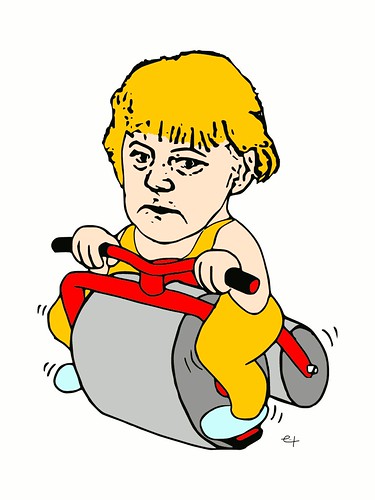
Is Merkel to blame for Germany's Eurovision loss?

German commentators were wringing their hands on Sunday over the country’s disappointing finish at the Eurovision final Saturday night. The country came 21st out of the 26 countries performing, despite fielding well-known dance act Cascada with a radio-friendly song which the German media had predicted could possibly win.

Others in Germany had, before the final, predicted the opposite – that the high level of anti-German feeling in Europe today over the austerity regimes imposed by Angela Merkel would make it impossible for Germany to win even if they fielded the greatest song eversung by mankind.

Out of the 39 countries voting, 34 refused to give Germany any points at all. Austria, Switzerland, Israel and Albania were the only ones to award the country points, along with bailed-out Spain - which came as a surprise (but could be accounted for by the large amount of German pensioners living in Spain for retirement). Germany received a humiliating score of just 18 points, compared to 281 points for Denmark's winning entry.

The coordinator for Germany’s ARD TV network told German media on Sunday, "There's obviously a political situation to keep in mind - I don't want to say 'this was 18 points for Angela Merkel', but we all have to be aware that it wasn't just Cascada up there on stage, but all of Germany."

Friday, 22 February 2013

The Italian election that could sink Europe

Italy’s constant lurching between left and right since WWII had, in the past, become so frequent that few people bothered to pay too much attention to the vagaries of Italian politics. But all that has changed since the advent of the eurozone crisis. All eyes are on the Eurozone's third largest economy this weekend as Italians go to the polls in what could be the most consequential Italian election of the modern republic.

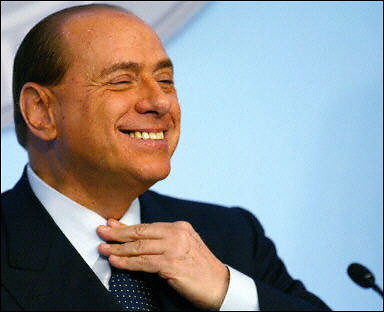
Much of the international media attention has focused on the possibility of a return to power for the country’s notorious former leader Silvio Berlusconi, who was ousted in 2011 by what essentially amounted to an EU putsch. The prospect of a return to power for the now clearly mentally unstable Berlusconi is terrifying to the rest of Europe and would likely result in absolute panic in the Eurozone. But such a scenario is unlikely, even with Berlusconi’s last-minute efforts to try to buy votes by promising tax rebates.

Friday, 18 May 2012

Obama gets tough with Merkel, but is it too late?


Now that German Chancellor Angela Merkel has been hobbled by the loss of her key ally in France, it seems the Obama administration is wasting no time in pressuring her into a course correction. The chorus of anti-austerity (and by extension anti-Merkel) voices is growing louder by the minute.

At next week’s G8 summit at Camp David, Barack Obama is reportedly going to put pressure on Germany to drop its insistence on the Eurozone economies adopting a severe austerity regime. He will ask Merkel to instead pursue a policy of stimulus and growth. He will apparently do so in no uncertain terms – warning Merkel that if she does not change course quickly she risks plunging the world into another deep recession that would be even worse than the Lehman Bros collapse in 2008.

The Guardian reports that the Obama administration is expected to try to forge close ties with new French President Francois Hollande at the first meeting of the two leaders on Tuesday. They are keen to rapidly establish Hollande as an ally in exerting pressure on Merkel to change course.

Obama already has the support of UK Prime Minister David Cameron, who while unwavering in his demand for austerity at home, publicly chastised the German chancellor in a speech yesterday for her lack of flexibility. Saying that the eurozone either had to “make up…or break up”, he said urgent steps are needed quickly to prevent an economic implosion of epic proportions in the coming weeks. He will reportedly tell Merkel this weekend to use Germany's wealth to rescue Southern Europe before it is too late.

Wednesday, 9 May 2012

Angela vs. the growth

As predicted, Socialist Francois Hollande ousted the centre-right Nicolas Sarkozy in French elections on Sunday after a campaign in which he railed against the German-led austerity drive in Europe. He has insisted that Europe needs to end its obsession with austerity to dig its way out of the debt crisis, and instead focus on growth.

Coming as it did on the same day that anti-austerity parties in Greece took a majority of the vote, Sunday has been interpreted as a Europe-wide rejection of German Chancellor Angela Merkel and her insistence on austerity and budget cuts. The markets have certainly interpreted it as such. Stock exchanges across the world have taken a dive the last three days, particularly in Europe, over fears that the delicately crafted ‘fiscal union pact’ worked out over the past several months is now about to fall apart.

Whether that actually comes to pass may depend less on Hollande than on how his victory is interpreted in other European capitals. All eyes will be on the new French president’s first meeting with Merkel next week, a day after he is sworn in on 15 May. It is in both of their interests that the meeting goes well. Hollande needs to walk away with something to say that he “renegotiated” the fiscal compact, while Angela needs to reassure the German people that Eurozone countries will still have to adhere to strict budgetary rule while at the same time reassuring the markets that there will be no Franco-German rift.

What will likely be worked out is the addition of a paragraph about stimulating the economy into the compact – something that wouldn’t require new ratifications by national parliaments.

Tuesday, 24 April 2012

Are Europe's conservatives now dependent on the far right?

Yesterday’s news that the government of Dutch Prime Minister Mark Rutte had collapsed sent almost immediate shock waves through the world’s financial markets.

Investors, who were already feeling skittish about the first-round victory of French Socialist presidential candidate Francois Hollande on Sunday, found themselves with something much more serious to worry about. The government of the Netherlands, one of the core austerity-pushing states of the Eurozone, couldn’t even pass the tough medicine they helped design for Europe.

Holland and the three other euro-using countries that still have triple A ratings (Germany, Finland and Austria) have pushed for every eurozone country to make massive cuts by the end of the month. But yesterday Rutte was forced to tender his resignation after it became clear he could not get his own parliament to approve the tough medicine he had helped design for all of Europe.

But perhaps more interesting from a political perspective is who it was that precipitated this crisis – the infamous far right leader GeertWilders. Rutte was only able to form his governing coalition in 2010 by relying on the backing of Wilders and his far right Party of Freedom group, which had polled at 15.5% in that year's election. Wilders has been tried in the Netherlands for hate speech against Muslims, and has been banned from entering the UK in the past.

Monday, 23 April 2012

Is Europe set for a Socialist comeback?

Yesterday’s first round of presidential elections in France delivered a humiliating defeat for president Nicolas Sarkozy, who trailed over one percentage point below his Socialist Party challenger Francois Hollande - the ex-partner of Sarkozy's 2007 rival for the presidency Segolene Royal. It is the first time in the history of the fifth republic that a sitting president has not won the first round of elections.

Public polling had predicted a Sarkozy win in the first round, in which all candidates compete, followed by a Hollande victory in the final round on 6 May, where the two leading candidates face off against each other. The low showing for Sarkozy already has papers predicting that, barring a miracle, Sarkozy is finished.

Much of Sarkozy’s trouble has come from Marine Le Pen, the leader of the far right National Front party. She came in at 18%, far higher than the previous leader of the party, her father Jean-Marie Le Pen, scored in 2002 when a split Left meant he came in second in the first round. Sarkozy has been desperately trying to win over the far right vote in France, telling French television that the country has “too many immigrants,” joining a crusade against halal meat, and saying the EU’s passport-free Schengen Area should be renegotiated. But it apparently wasn’t enough to convince the far right voters to vote for him.

Sarkozy now has two weeks to convince Le Pen’s followers to support him in the final round, but it will be a difficult task. National Front voters, aside from being xenophobic, racist and anti-EU, also have a strong anti-establishment impulse. This was reflected in Le Pen’s ecstatic victory speech last night, as she declared with a clenched fist in the air, “We have blown apart the monopoly of the two parties of banking, finance and multinationals. Nothing will ever be the same.”

Tuesday, 6 December 2011

Kicking them while they’re down

It wouldn’t have taken much to make the US-based ratings agencies less popular in Europe. But Standard & Poor’s decision last night to put all 17 countries that use the euro on review for a possible downgrade has left European leaders seething with anger. Just two days before the make-or-break European Summit that was supposed to save the euro, the markets seem to have decided that whatever the European heads of government decide will not be enough.

Just hours before the S&P news broke, German Chancellor Angela Merkel and French President Nicolas Sarkozy had emerged from an emergency meeting in Paris outlining a plan for rapid and fundamental treaty change in order to stem the crisis – to be agreed on Friday. That, combined with Italy’s unveiling of drastic austerity cuts over the weekend, caused European markets to rally and Italy’s long-term borrowing rate to fall below 6% on Monday afternoon – the lowest it’s been since October. But S&P soon put an end to the party by announcing that the AAA ratings of the FANG countries (Finland, Austria, Netherlands and Germany) are in jeopardy. Without that AAA rating these countries can’t hope to bail out the collapsed economies of the PIGS (Portugal, Italy, Greece and Spain).

It’s not hard to see what influenced S&P's decision. Merkozy - I mean, Merkel and Sarkozy - had emerged from their meeting at the Elysee Palace in almost lock step. Sarkozy, who has been pleading with his German counterpart for months to embrace the idea of ‘Eurobonds’ that would collectivise European debt, suddenly did an about-face.

Thursday, 3 November 2011

Was it all for nought?

Greek Prime Minister George Papandreou is getting an earful today at the G20 summit in Cannes from world leaders furious at his shocking and sudden call for a referendum on the Greek bailout on Tuesday. The surprise announcement sent markets into a tailspin and seemed to, in an instant, eviscerate the deal painstakingly crafted last week by European leaders to save the euro. Now for the first time EU leaders are today openly talking about Greece leaving the Euro. Was last week's all-night negotiating session all for nothing?

Papandreou is facing the same level of fury at home, much of it coming from within his own party. His own finance minister broke ranks shortly after the announcement and reacted with incredulity to the idea of calling a referendum. Papandreou's Socialist government is now hanging by a thread as it looks like he will have to step down or face an imminent vote of no confidence.

Reports coming out of the G20 meeting this afternoon indicate that Papandreou may have been convinced to cancel his call for a referendum. But whether he cancels the referendum or his soon-to-come replacement does, it will only serve to enrage the Greek public further. Promising them a referendum and then snatching it away is undoubtedly worse than having never promised a referendum at all.

Wednesday, 26 October 2011

Will Europe be saved tonight?

I'm here at the big EU summit in Brussels, the D-day event that is being billed as the last chance to save the Euro and prevent a collapse of the European economy. Even if the leaders emerge from those fortified doors having done everything the markets are asking, there will still be a long road ahead in this crisis. But this could be the moment they were finally able to turn the tide and appear in control.

Or it could be remembered as the moment where the entire European project collapsed. The tension in the press room is palpable. It's hard to say if it's coming from the stressed-out journalists or seeping in from the inner chambers where the European leaders are meeting. Either way, I would venture to say the Justus Lipsius building (or 'Just Lips' as I like to call it) is one of the most tense places on earth at the moment.

The markets need the leaders to come out of those doors and tell the press room two things: First, that they have amassed a trillion euro war chest to protect all of the Southern European economies, including Italy and Spain, from collapse. Second, that Italy has agreed to put in place a drastic austerity plan in line with what is being imposed on Greece.

Tuesday, 4 October 2011

The Knox verdict: another humiliation for Italy

These are embarrassing times to be Italian. The country is in a financial mess, on the precipice of becoming the latest victim of the debt crisis. The prime minister is now regarded even by most Italians to be a national embarrassment, yet he still clings to power. The waste crisis in Naples has spiralled out of control, and Italy's handling of migrants from North Africa during the Arab Spring has drawn condemnation from human rights groups and European leaders alike. Even their prime minister has heaped scorn upon Italy, calling it a "shitty country". The last thing Italians needed was another embarrassment.

As I write this, Amanda Knox is boarding a plane in Rome, heading back to her home in the US after four years in an Italian jail for a crime the judiciary now says she did not commit. Yesterday's verdict of innocence, the conclusion of the most closely-watched Italian court case in decades, brought jeers and condemnation not just from the crowd of Italians outside but also from the Italian media. Many in Italy see the verdict as the judiciary bending to American pressure. But other Italians agree with the sentiment felt abroad - particularly in the US – that the Italian judiciary and police system are so flawed there was no way Ms Knox could be convicted without significant doubt about her guilt.

Friday, 9 September 2011

War of words between PIGS and FANGs

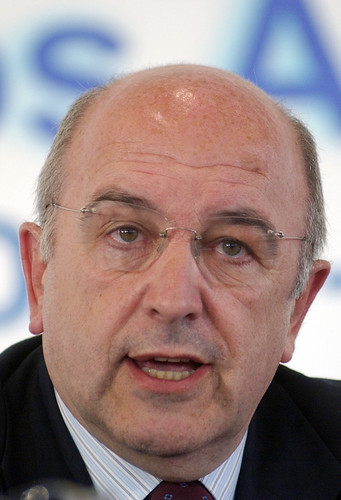
The European Commissioner from Spain delivered a surprising attack yesterday on the Northern European countries pushing Southern Europe to adopt painful austerity measures. The comments follow a controversial proposal from the Dutch prime minister earlier this week which called for EU member states struggling with debt to be put under the 'guardianship' of the European Commission, surrendering their ability to make their own financial decisions.

"There are member states, in particular some of the most powerful -- Germany, Netherlands, Finland, Austria -- who feel that they don't have this kind of problem," Almunia told a group of business executives in New York. "[They believe] they don't need to make an additional effort to compensate the lack of resources of the countries who have the most difficulties to reduce imbalances."

The rhetoric was then ratcheted up to an even more dramatic level today when the European Commissioner from Germany told the tabloid Bild that if indebted (read: Southern) EU countries refuse to comply with new rules on debts and deficits, their flags should be flown at half mast outside institutional buildings. Mourning the loss of fiscal prudence, perhaps?

Tuesday, 9 August 2011

Britain's teenage riot

London was ablaze last night as an unprecedented wave of violence and looting spread throughout the city, spreading to other cities in England. It was the third day of rioting in London, initially sparked by the police shooting of a young black man in Tottenham last week. But last night saw the situation explode and quickly spread after the government and the police appeared to lose control of the situation.

The rioters carrying out the violence were mostly children, teenagers in hooded sweatshirts covering their faces, bashing in store windows and setting cars on fire. I've written before about how Britain is terrified of its own children. Last night was a shocking manifestation of that problem. A 2008 poll showed that more than half of British adults are afraid of British children, believing they behave like animals and pose an increasing danger to themselves and others.

The images from last night are truly shocking, particularly the fires. It was the largest number of simultaneous fires London has seen since the blitz. There were reportedly children as young as seven taking part in the violence. What precipitated the violence was the fatal police shooting of a young black man last week in Tottenham. The police say he had a gun and was shooting at them, but his family says he was unarmed. The facts surrounding the case are still unclear.

Wednesday, 13 July 2011

Eurozone in panic: Is Italy next domino to fall?

The Eurozone is looking at several doomsday scenarios this week after Italy emerged as the latest EU state to face serious and sudden attack by international bond and security markets. After a very public spat between Prime Minister Silvio Berlusconi and his finance minister, and with the continued political uncertainty over Berlusconi's position, the markets have decided Italy may not be safe to lend to any longer.

With the paralysis in the country's government likely to prevent decisive action to confront the crisis, some are saying Italy is perhaps days away from becoming an economic failed state. And unfortunately it is not too big to fail, but it is too big for the EU to bail out.

Such extreme rhetoric may or may not be justified, depending on who you talk to. But the risk is extreme. The countries that have so far fallen victim to the debt crisis and required an EU bailout – Portugal, Ireland and Greece – are relatively tiny and their debt makes up less than 5% of overall eurozone public debt. If worse came to worse, France and Germany could afford to buy back all of their debt combined.

Monday, 27 June 2011

US getting worried and impatient over euro crisis

The Greek parliament is voting this week on the drastic austerity measures that have been ordered by the EU as a condition for the country receiving the rest of its bailout money. As Washington watches the situation unfold with unease, US officials are voicing an increasing amount of frustration that European leaders do not seem to have the situation under control. And the officials know that if the euro collapses, it could easily take the US economy down with it.

As Quatremer noted today, the euro has become such a powerful currency (now the second reserve currency of the world) that if it runs into trouble it would have a devastating impact not just in continental Europe but throughout the world.

Back in the 1970's when the US took the decision to take the dollar off the gold standard, the situation was watched intensely by the rest of the world. As the US treasury secretary noted at the time, "the dollar is our currency but your problem." Now, with the euro being used by a common market larger than America's, the opposite could be said to America. And the increasing grumblings suggest that American officials don't like being at the whim of decisions being taken across the Atlantic.

Monday, 20 June 2011

EU issues Greece an ultimatum - could it backfire?

Last night Eurozone finance ministers got tough with Greece, deciding to withhold payment of €12 billion in emergency loans until the Greek Parliament enacts drastic austerity measures. The move is intended to intimidate the opposition forces (which includes the majority of the Greek public) into accepting the cuts, as the Greek prime minister faces a confidence vote in parliament this week.

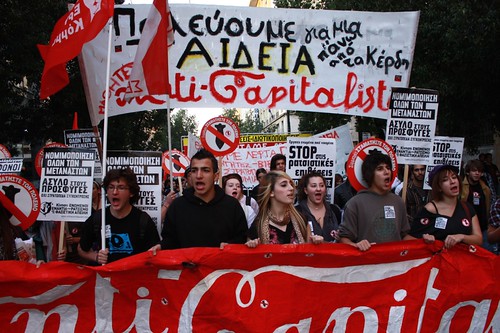
But given the enormous disaster that would likely befall the Eurozone if Greece leaves the currency union, is this a threat the EU can afford to make? There is a real risk that this latest move could backfire. Massive protests continue in Athens today as people stand in front of the parliament chanting "we won't pay". Inside the building, Socialist prime minister George Papandreou is holding a confidence vote to reaffirm his mandate before he attempts to push these austerity measures through the parliament.

Now facing defection from his own party's members and extreme pressure from public opinion, Papandreou's confidence vote will be a rollercoaster ride over the next few days. There is a chance that this latest move from the finance ministers will further enrage Greek public opinion, where there is already an impression that the EU, at the insistence of Germany, is dictating draconian measures in an anti-democratic way. A perceived insult like this could put public optinion in Greece over the edge and cause even more Socialists to withdraw from the parliament. If Papandreaou's government falls it could mean a default on Greece's debt and, most chillingly, a withdrawal from the Euro. These events could spiral out of control and cause a meltdown of the European economy, and maybe even the world economy. Given that reality, is this really a threat the finance ministers can afford to make?

Monday, 6 June 2011

Europe's left continues to disappear

Yet another centre-left European government was ousted yesterday as the Portuguese voted overwhelmingly for the country's conservatives. Prime Minister Jose Socrates' Socialists, who have been in power since 2005, received just 28% of the vote. The centre-right party, bizarrely named the 'Social Democrats' (a legacy of Portugal's desire to avoid conservative-sounding names reminiscent of the dictatorship) got 37% of the vote, just short of an overall majority. They will form a coalition with the further right People's Party who polled at 11%.

"Centre-right wins in _____" is becoming a familiar headline for European Monday mornings. Conservative governments are re-elected, while centre-left governments are voted out. The left hasn't won an election here since the Socialists took power in Greece in 2009. With the Portuguese Socialists gone, this leaves the EU with only five centre-left governments - Greece, Cyprus, Austria, Slovenia and Spain. Compare this to the 19 governments controlled by the centre-right - plus three controlled by the right-leaning free-market Liberals.

Given the disastrous local election results for Spain's Socialists two weeks ago one can assume they will fall from power in the country's general election next year, if not earlier. This will leave the left with essentially no presence in Europe. It is an unprecedented situation in modern European history - the first time since the advent of widespread Democracy that the European left has had no voice.

Wednesday, 11 May 2011

Lost in translation?

Portugal's Eurovision performance last night at the first semi-final in Dusseldorf raised more than a few eyebrows. In the midst of what many see as a German-imposed austerity drive forced on Portugal after they had to take a €78 billion bailout from the EU and IMF, their Eurovision entry performed a song dressed as protestors and chanting slogans, right in the belly of the beast. It was a bit of an awkward moment, especially considering political messages are supposed to be banned from the Eurovision Song Contest.


According to the group, the song was apparently supposed to be a sort of celebration of Portugal despite all of its bad news. Entitled "A Luta é Alegria" (The Struggle is Joy), it calls on the Portuguese to not give in to feelings of despair or rage at the restrictions being imposed on them. The message, I imagine, was intended to be like the old expression 'keep calm and carry on' used by the British during World War II. "There’s no point in tightening the belt, there’s no point in complaining," they sang. "There’s no point in frowning and rage is pointless, it won’t help you. Many people wish to silence you. Many people want you to feel resentful. Many people want to sell you the air itself."

Thursday, 24 March 2011

Anti-austerity protests shut down EU Quarter

As one of the last remaining Socialist governments in Europe collapses today, the left is taking to the streets in Brussels in what seems like a last-ditch effort to stop the massive austerity cuts to government spending taking place across Europe.

This morning I had the arduous task of trying to make my way to work through the massive union demonstrations by the European Trade Union Confederation that have closed off the EU Quarter. While some parts of the protests seemed relatively peaceful and good-natured, I could already observe danger signs. The security forces are wearing body armour, riot gear and gas masks. Youths with bandanas around their faces were everywhere, particularly on the side streets. Many of the older demonstrators are already intoxicated. I saw eggs being pelted at the windows of buildings on Rue de la Loi. Firecrackers were exploding all over the place (my suitcase got hit by one in fact!). My friend tells me a window in her office was smashed by a rock. It's going to be a fun day…

Thursday, 9 December 2010

Violent protests in London as government increases tuition

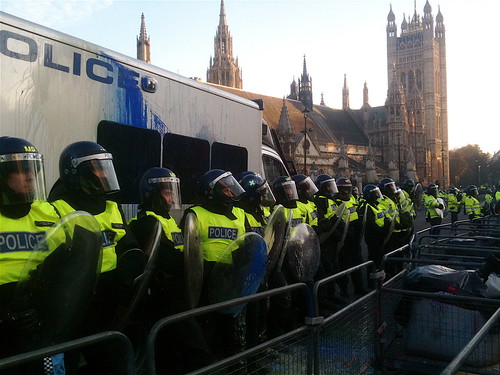
London was rocked today by the most violent anti-austerity protests yet seen, with Parliament Square becoming the scene of incredible sights of mayhem. The near-rioting took place just outside the Houses of Parliament where, inside, British politicians were casting the big vote on increasing English tuition rates by 300%. Horses charged into the crowd, fires raged and several police officers were seriously injured. Protesters broke into the treasury building and ransacked it. Christmas shoppers on Oxford Street were attacked. Even Prince Charles and Camilla were attacked as they tried to drive to the theatre, with protesters surrounding their car and smashing the windows.

The turmoil outside was mirrored by turmoil inside. The Liberal Democrats, who are in the governing coalition with the Conservative Party, saw a rebellion over the issue. Half of the Liberals defected, as did several Conservatives, shrinking the coalition's 84-seat majority to a majority of just 21 on this vote. The opposition Labour Party brutally criticised the plan, which will for the first time put British students in tens of thousands of pounds of debt after finishing a four-year degree - a situation that will be unique in all of Europe.