Showing posts with label university. Show all posts

Thursday, 9 December 2010

Violent protests in London as government increases tuition

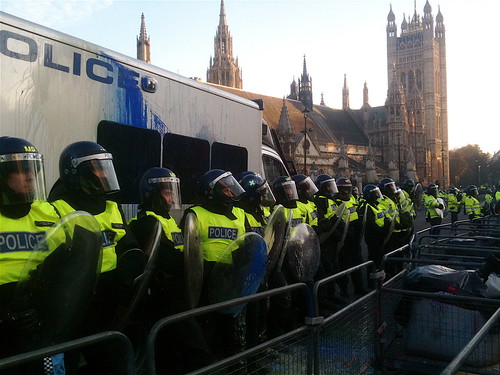
London was rocked today by the most violent anti-austerity protests yet seen, with Parliament Square becoming the scene of incredible sights of mayhem. The near-rioting took place just outside the Houses of Parliament where, inside, British politicians were casting the big vote on increasing English tuition rates by 300%. Horses charged into the crowd, fires raged and several police officers were seriously injured. Protesters broke into the treasury building and ransacked it. Christmas shoppers on Oxford Street were attacked. Even Prince Charles and Camilla were attacked as they tried to drive to the theatre, with protesters surrounding their car and smashing the windows.

The turmoil outside was mirrored by turmoil inside. The Liberal Democrats, who are in the governing coalition with the Conservative Party, saw a rebellion over the issue. Half of the Liberals defected, as did several Conservatives, shrinking the coalition's 84-seat majority to a majority of just 21 on this vote. The opposition Labour Party brutally criticised the plan, which will for the first time put British students in tens of thousands of pounds of debt after finishing a four-year degree - a situation that will be unique in all of Europe.
Monday, 28 September 2009

Return to Prague

Shiny new trams, freshly-cleaned buildings and, believe it or not, some smiling waitresses - Prague has come a long way since I lived there in 2002.

This past weekend I made a pilgrimage of sorts back to where my European adventure began. I had been to Europe before I moved to Prague to study and do an internship at Radio Free Europe in 2002 (just once on a trip to Austria and Germany with my high school band). But Prague was the first place in Europe I lived, and it was experience that changed my life. I had always been fascinated by European history, but it was in Prague that I was introduced to the possibility of living on this continent.

It was quite a setting in which to be introduced to Europe. Having survived both world wars largely undamaged, and containing a treasure-trove of OTT counter-reformation architectural delights, it’s truly a stunning city. To be sure, the oft-levelled criticism that the refab following the Velvet Revolution have turned the city into a fairy tale Disney World are fair. At times the city centre does seem a little too much like a contrived veneer set up for tourists. But as opposed to other such cities which get that description such as Venice or Florence, Prague is also a living, functioning capital city. And its fascinating history is not limited to the fairy tale buildings of Stare Mesto and Hradchany, it is also a living museum of sorts to the communist era.

That is really what I found so thrilling about living in Prague. The city has gone through so many distinct periods – from early success as an independent medieval kingdom, to various control by German Luxembourg and Habsburg dynasties, a hotbed of the reformation, the centre of production for the Austo-Hungarian empire, 40 dark years under Communist rule, and finally to a member state of the EU. All of this history is reflected in the city’s architecture and layout, not too mention in the unique personality of its inhabitants.

Of course, these impressions were all shaped back in 2002, when the country was not yet in the EU and still very much in transition. It’s still a society in transition to be sure, but the city felt quite different this time around. But perhaps it’s me that’s changed more than Prague. Living in the UK I’ve become well aware that Prague has turned into one of those cities where Brits go to get drunk for cheap, often in the form of stag and hen dos (Bachelor and Bachelorette parties). I was a bit concerned that seeing British tourists peeing and vomiting all over everything might take away some of the magic in my memory of Prague!

To be sure there were plenty of groups of drunk Brits stumbling about, but the most unavoidable tourists were Americans. They were literally everywhere, so much so that after awhile I started to feel like I could have been walking around in Boston. Unlike the British tourists, the Americans were perfectly well behaved and nice enough. Still, it’s not so nice to hear that nasal, loud accent everywhere. I began to wonder if it had been like that when I lived there and I just hadn’t noticed, because I hadn’t yet come to view hearing American accents as hearing something obtrusive or ‘foreign’.

Czesky Changes

Whether or not the hordes of Americans were there back in 2002, there were plenty of things that have changed since then. The most startling was seeing my old place of employment, Radio Free Europe, turned into a museum. Back in 2002 it was housed in the old Czechoslovak federal assembly building (which had closed in ’93 after there was no longer a Czech-Slovak federation to assemble) located next to the National Museum on Wenceslas Square (pictured left).

RFE is a radio broadcaster set up during the Cold War by the United States congress in order to broadcast programming into Eastern Europe. Listening to the broadcasts was often a criminal offense back then. After the cold war ended RFE began gradually closing its Eastern European stations and opening new ones in the Middle East and Central Asia. After 9/11, the US government decided that the building needed a huge cordon of security around it, because it was broadcasting into the middle east. So the traffic flow at the top of Wenceslas Square was severely disrupted as all the roads around it were closed off. To get into the building I had to go through an elaborate system of security checks at 4 different points!

Because of the chaos this was creating RFE had to move out, and today the area around the building is completely opened up and a museum about the federal assembley is now housed inside. What a strange feeling, being able to see the desk you used to work at being shown to you on a guided museum tour.

Down at Old Town Square I came across a thoroughly nauseating change that’s taken place below the NYU in Prague building, where I went to school. There right below it was a new Hard Rock CafĂ©, screaming out in all its tacky glory (pictured). I really hope NYU kids aren’t going there all the time. Really, how horrid!

Blocked by Floods and Popes

I first arrived in Prague in September of 2002, just after the worst floods in the country’s history swelled the Vltava across vast swathes of the city. I stepped off the plane into what was still a disaster area. The metro had been flooded, streets had been ripped apart, and cultural institutions like the Rudolfinium were in ruin. It all added to the learning experience really, it was incredibly interesting to watch as the city slowly recovered and rebuilt.

But unfortunately Prague’s very efficient and comprehensive metro system was shut down almost the entire time I lived there, and I never ended up taking it. So I was excited to finally use it this time around. It’s a really great system, and it made it so much easier to get around rather than having to use the tram to get everywhere. Still, I guess travelling by tram is nicer because you can get a better feel for the layout of the city, plus it’s much more old-timey!

However our transportation wasn’t completely unfettered, as this time around it was the pope rather than rising flood waters which blocked my path. The pontiff happened to be making an official visit to the Czech Republic while we were there, closing off sections of the city as he moved around. The castle was effectively closed the whole weekend because the pope was there addressing Czech politicians. This video of a spider crawling around his robes while he spoke to them has been circulating across the internets.


The stated purpose of his visit was to bring the largely atheist Czechs back to the fold of Catholicism. The Czech Republic is the most atheistic country in Europe, with 60% identifying as Atheist or Agnostic and few regular church attenders. In his speech to the politicians the pope blamed the communist government for this current state of affairs, recounting how they closed churches and arrested priests. But it’s quite a stretch to say that Czech atheism is entirely the result of just 40 years of Communist suppression, particularly when the Czech Republic’s fellow post-communist neighbour, Poland, is the most religious country in Europe. The reality is that it was the Catholic church itself which engendered this disgust with religion in the Czech people, coming down brutally and severely against the country’s attempts to switch to protestantism during the Hussite and 30 Years wars.

The counter-reformation came with a fierce and imposing blow, the leaders of the Hussite protestant religion were executed by the Catholic Habsburgs and grand building projects were instituted throughout Prague in order to show the Czechs who was boss and intimidate them into nominally returning to Catholicism. In fact, that is why Prague is such a beautiful city, because this massive building project was undertaken after the 30-years war to win back the Czech people. They nominally returned to Catholicism but it never really took, and their enthusiasm for the religion was sufficiently low that when the communists came in and suppressed the church, few people complained. Even now it was evidence how little impact religion has in this country, as there were no picture of the pope around the city or cheering crowds anywhere to be seen. Indeed, everyone seemed to be either indifferent to or unaware of his visit.

It was notable too that even St. Vitus Cathedral he celebrated mass in is still owned by the Czech governmentand is operated as a museum, not as a place of worship. The Catholic Church has been trying for years to get the most important Czech cathedral back but has so far been unable to do so.

The Rudeness Thing

One consistent observation from Western tourists about Czechs is the almost unbelievable rudeness of service staff. I’ve always thought this was rather unfair to the Czech Republic, as this is a trait common to all the post-communist countries of Eastern Europe. Prague just happens to be the most visited city in that region. But it is true, ideas about customer service vary differently between Western and Eastern Europe.

While there this weekend I noticed perhaps a slight improvement in customer service, but there were still plenty of almost comically unfriendly staff interactions. One thing that does seem to be unique to the Czechs is that their unfriendly interactions with strangers, be it in the context of customer service or not, seem to be tinged with an explosive and inexplicable rage.

For instance, as we were visiting the Loretto monastery in Hradchany, we entered about ten minutes before they were closing for a lunch break. We were still in the courtyard when they wanted to close it up, but there were still plenty of people milling about. A staff woman yelled at me from across the courtyard that we had to leave, but her directions on where to go were confusing and I was unclear on what she wanted me to do, come toward her or go along the ropes. My hesitation seemed to infuriate her, she became flustered and belted out with exasperated rage ‘You must leave!!”

The British person I was with was confused by the interaction, but I recalled from living in Prague that I encountered this kind of thing a lot. Once I was quietly humming to myself while riding the tram and listening to my discman, and a woman of about 35 came over and said something to me in Czech. I removed my headphones and told her I don’t speak Czech, and she glared at my icily. She then spat out, literally almost quaking with fury, “Stop…singing.”

I have no idea where this bizarre rage in customer service comes from, but I would be interested to hear any theories from Czechs! I did notice that it’s perhaps gotten a little better, in that we did encounter a few service people who were nice, and one waitress who even smiled!

For the most part all my old haunts were still there: Radost, Chapeau Rouge, Roxy. But I did notice that the gay scene in Prague has changed dramatically. When I was living there there were lots of gay bars and clubs but they were mostly underground, with doorbells to get in. The most popular bar, Friends, was down in a dank cellar. Now Friends has moved down the street in a very open bar with big windows. The biggest club, now renamed Valentino’s, has undergone such a transformation that it barely resembles its former self. That was really interesting to see.

It did take a bit of the edge out of the experience, I no longer felt like I was at some kind of dangerous periphery of Europe. But as the Czech Republic becomes more integrated into the EU and Western Europe, it was bound to happen. It’s still an amazing city and I’ll always look back at my time there with affection. But seeing the city this weekend with my new ‘Europeanised’ eyes, Prague became more of a real city rather than an ‘idea’ in my head. And that’s really what I wanted, to integrate my experience in Prague with my current life in Europe. It might not be as edgy or as adventurous, but Europe has become home now. And I’m glad that I now feel like Prague is part of that.

Thursday, 18 September 2008

Getting Settled in Paris

I'm doing my freelance writing shift at a sidewalk cafe in St. Germain des Pres at the moment, a move necessitated by the internet being out at my apartment this morning. My French really isn't good enough to call the provider and find out what's going on, so I'm hoping the situation resolves itself on its own! But as long as I'm here, watching the pedestrians stroll along the cobblestoned Rue de Buci, I figured it would be a good time to write an entry about my first few weeks in Paris, and share some photos I've taken.

I've now been here about three weeks, and I'm slowly adjusting to the "work-at-home" lifestyle. I have a freelancing shift I do for a news web site in the morning, and then in the afternoons I have French class every day for four hours (2 hours of phoenetics, two hours of grammar). The schedule has kept me much busier than I thought I would be, as evidenced by my lack of blog posts recently. Obviously the events of this week in the world's financial markets have inspired some ideas, and there's an entry I want to write about the root cause of the crisis, but I just simply haven't had the time. Why aren't I writing it now? Well I'm at a cafe nursing my capuccino, and it seems more appropriate to write about life in Paris!

So far I've actually found everyone here to be really friendly and nice, which is completely different from my previous visits here when I was visiting. Perhaps it's because I'm speaking French with people, although for more complicated interactions that has been difficult. It really is just a shockingly beautiful city. I've been utilizing the city's 'velib' service, in which you can check out bikes from stations posted around the city and return them anywhere else. The first half hour is free, and it's just a euro for each half hour after that.

This past Sunday I rode my bike around the city a bit, first visiting the Palais Garnier, the grand opera house at the center of Paris. It was really stunniny, I'm hoping to see an opera there before I leave. Afterwards I rode the bike to La Defense, the business district outside the city that is similiar to London's Canary Wharf. The tendency in Europe over the past 30 years has been to impose height restrictions for buildings in the city centers and establish skyscraper zones in specific districts outside the city. It was interesting to be in La Defense on a weekend, as it was almost completely deserted and I was able to ride the bike all around the walkways, platforms and planks. It's much bigger than Canary Wharf, and some of the buildings are really quite interesting. I went behind L'Arc de La Defense, a huge arch-shaped building that mirrors L'Arc de Triomphe miles away. >That's where the construction for La Defense stops abruptly, because there's a massive (and chaotic) cemetary there. Bizarrely, there's this long wooden plank that extends out over the cemetary. it looks as if it should be over a beautiful waterfront, and I rode my bike down it assuming that at the end there would be a stairway to go down to the cemetary/construction zone. But there was nothing, just a big plankway overlooking graves and piles of asphalt. Perhaps they're planning to put something in this area later? Afterwards I rode my bike through the Bois de Bologna, a gigantic park on the outskirts of the city just outside the ring road. It was rather uninspiring, as my guidebook predicted. But apparently they're planning to give it a big revamp soon.

Class has been ok, but not ideal. To my dismay the other students turned out to be mostly American college kids, all either 19 or 20. There are some other "older students," but not many, and none of them are anywhere near my age. It would appear the students in the program are either 19 or 40, but nowhere in between! There's a significant contingent of Latin American college students as well, but the Americans make up the overwhelming (and loudest) majority. I don't have a problem with their being American per se, or the fact that they're young. But they're clearly in this course for a very different reason than us old folks. Theyre on their semester abroad, and the course is being paid for by mom and dad. For that reason most of them are not taking the classes very seriously, and seem to be more focused on where they're travelling to every weekend than with how their French is progressing. Don't get me wrong, I was one of them once too! I mean, my study abroad semester in Prague was academically challenging (it's known as the most academic of NYU's study abroad programs), but I definitly didn't take my Czech language course very seriously as a 21 year old spending a semester in Europe and jetting off on fabulous trips every weekend. But I'm not in that situation any more. It's very important for my career that I have a proficient level of French by the end of this course, and I resent it when the American college students speak in English during the class and don't do the homework, because it's wasting my time. Maybe I'm just becoming a cranky old man.

My verdict on the city so far is that it's beatiful, very fun, but I don't think I would live here long term. It may be large and cosmopolitan, but it just isn't an 'international' city on the model of London or New York. It actually feels quite provincial. Most everyone I meet here is French, and most of them have never lived outside the country. In fact, I've met two people who have never even left the country! I can't imagine meeting any such person in London. Paris is just very French, in a way that London is definitly not British! London may belong to the world, but Paris belongs to the French, and they make that very clear!

I have some friends from London scheduled to come visit over the next few weeks, so hopefully the Eurotunnel mess won't mess up their plans. Other than that I hope to take some weekend train trips over the next few weeks. I hope to visit Lille, Normandy and Brittany in particular.

Tuesday, 19 August 2008

Binge drinking and the 21 limit in the US

One of the most interesting differences I’ve observed between Europe and the United States has been the very different drinking cultures. A lot of those observations have been prompted by the unique experience of my brother, who moved to Switzerland at 16 when my father was transferred there for his job. As a high school sophomore in the US, he would have had five more years before he could legally have a beer.

But since the drinking age in Switzerland is 16, as it is in most of Europe, he was able to drink right from the start. Obviously his high school experience was quite different from mine in many ways, but one of the most notable aspects was his social life. While I had little access to alcohol in high school and my social life was mostly composed of small parties or trips to the local diner, he’s spent his weekends with his high school friends clubbing at some of Zurich’s premier nightspots. And while you might think that an American teenager arriving in a European country where he could suddenly legally drink would overdo it, I’ve observed that he’s been quite responsible and moderate about drinking. He’s been in a culture where binge drinking is not common and teenagers see alcohol not as just a means to getting yourself obliterated but rather a normal part of social interaction.