Thursday, 10 September 2015
Eastern Europe's discomfort with diversity
This week I took a train to Prague from Berlin, in order to talk to people continuing on the train to Budapest for a radio report I was working on about Europe's disappearing overnight trains. I lived in Prague back in 2002, and it was nice to be back. I met up with a few Czech friends, and at each meeting the subject of the refugee crisis came up. My Czech friends said they were very embarassed of the images being shown to the world, of Czech security officers marking Syrian refugees with numbers and treating them inhumanely. I told them, at least the Hungarians are making you lookmore humane by comparison.
A real East-West split has emerged in the EU over how to deal with the refugee crisis. Right now the 'Vyshegrad Four' - Poland, Slovakia, Hungary and the Czech Republic - are furiously resisting a proposal to resettle the Syrian refugees pouring into Europe in a proportionate way across EU member states. Much ink has been spilled analysing why Eastern European governments are behaving in this way.
Friday, 16 December 2011
An itinerant decade
I came to a startling realization yesterday. 2011 will be the first year in a decade that I have not moved to a different city during the course of the year. Since 2001 I have packed up and moved to a new city at least once each year. And there has actually never been a year in my adult life where I haven’t moved to a new apartment! 2001 and 2011 have the exception of being years where I moved to a new apartment, but in the same city. Tuesday, 2 February 2010
No red carpet for pope in Britain
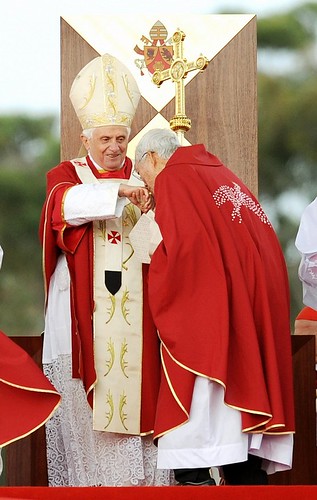
Back in September I wrote about my surprise when, during a visit to Prague, I was prevented from entering Prague Castle because the pope was paying a visit. I wasn't surprised that they weren't letting visitors in during the papal visit, that stands to reason. What seemed curious was the fact that we had been in Prague three days, made the journey all the way up the the castle, and all that time we had no idea the pope was visiting the city. Indeed, there was absolutely no sign of the visit - no banners, no news reports, nothing. People on the street seemed to either be unaware or apathetic about it. I suppose that's not surprising in the most atheistic country in Europe. But at the time, I contrasted it to the huge pomp and ceremony that accompanied the pope's visit to Paris while I was living there in the fall of 2009. You couldn't get away from all the fuss during that visit!When I learned this week that the pope is planning a visit to the UK, another of Europe's most atheistic countries, I wondered how the visit will contrast to the ones I've witnessed in Paris and Prague. I suspect it will be an animal all its own, but disinterest may not be the main reaction from the public. The Czech Republic may be a majority atheist country, but it is still nominally Catholic. So it isn't so unusual or notable that the pope would visit. The UK is very much not a Catholic country. Historically it and Prussia were always the most virulently anti-Catholic states in Europe. Not only does the UK have a protestant state religion (with the Queen as church leader), it is also still technically illegal for an heir to the throne or a government leader to be a Catholic. One of the main holidays here actually celebrates burning Catholic effigies.
Wednesday, 25 November 2009
Vienna - Back to the Start
It’s interesting visiting a city again after a ten year absence. I’m on a bunpy flight back to London at the moment, after a very nice few days in Vienna. I hadn’t been there since I went on a trip with my high school band in 1998. Vienna was actually the first city I had ever visited in Europe. Given that this city was my first ‘introduction’ to this continent, it was interesting to go back there now that I’ve lived in Europe several years and have travelled extensively through it. Needless to say, my impressions were far different this time around.I don’t remember much about that first visit – actually the main impression I remember from it was of a city full of sex. I was just 17 at the time and I remember me and the other high schoolers being amazed when we turned on our TV the first night in the Vienna hotel and saw – get this – breasts! We couldn’t get over it, there were breasts on a main Vienna network! Then we looked out of our window and saw a real live prostitute – or at least a person who we convinced ourselves was a lady of the night. Exploring the city I remember us seeing a few scattered sex shops and thinking truly Vienna was some kind of throbbing sex-obsessed mecca.
It’s amusing to look back on because in reality, Austria is one of the most conservative countries in Europe, and Vienna is known as one of the continent’s more staid and prudish major cities. But to some band geek teenagers from conservative America, it seemed pretty wild!During the year I lived in Prague in 2002 I kept meaning to take a train down to Vienna but I never made it, which was a shame because I was there studying Central European history. Much like Prague, Vienna is a city reflecting many different eras of European history, from the glory days as capital of the enormous Habsburg empire to its awkward cold war role as a supposedly neutral zone. Because if this Cold War confusion Austria has never really had a period of national soul-searching about its Nazi past, unlike Germany. It remains a staunchly conservative country with an especially hostile attitude toward foreigners. It maintains the toughest asylum rules in Europe and getting a visa to work there is notoriously difficult.
Vienna is a bit like Prague on steroids. It's jam-packed with massively intimidating counter-reformation architecture. But thought it may look like Prague architecturally, the vibe is very different. Miraculously spared the ravages of Soviet domination through sheer luck, Austria is a prosperous country that maintains the third highest GDP in the EU. Despite the fact that it was once part of the same country as its Central European neighbours to the North and East, Austria today bears much more resemblance to Switzerland than to Hungary or the Czech Republic. The two Alpine countries are both beautiful, efficient, prosperous and, above all, uncompromisingly conservative. Austria had to be dragged kicking and screaming into the EU in 1995, and public approval ratings of Brussels remain among the lowest in continental Europe. Obsessed with its Catholic Habsburg heritage, Austria is also one of the more religious countries in Europe.
Over the past few days I couldn’t help continuously comparing Vienna to Zurich, where my father lives. Though the ethos and culture may be very similar, of course the size of Vienna dwarfs that of Zurich, as does the monumental scale of its public buildings. Switzerland, after all, was never the centre of an empire. The Habsburgs left some monumental mementos from the days in which they ruled over nearly 70 million Europeans. It’s often been said that if Martians came to Earth, they would mistake Vienna as the capital of the world.At the same time there were plenty of reminders of the Swiss mentality, particularly in all the Christmas markets around the city serving Gluhwine. It made me excited that I’ll be in Zurich next weekend for a Thanksgiving dinner at my dad’s house. Zurich at Christmastime is beautiful, and the gluhwine aint half bad either!
So all in all it was a good trip. I spent a near fortune though – museums in Vienna are not cheap. I’m looking forward to a few days at home back in London before Thanksgiving in Zurich next weekend.
Monday, 28 September 2009
Return to Prague
Shiny new trams, freshly-cleaned buildings and, believe it or not, some smiling waitresses - Prague has come a long way since I lived there in 2002.This past weekend I made a pilgrimage of sorts back to where my European adventure began. I had been to Europe before I moved to Prague to study and do an internship at Radio Free Europe in 2002 (just once on a trip to Austria and Germany with my high school band). But Prague was the first place in Europe I lived, and it was experience that changed my life. I had always been fascinated by European history, but it was in Prague that I was introduced to the possibility of living on this continent.
It was quite a setting in which to be introduced to Europe. Having survived both world wars largely undamaged, and containing a treasure-trove of OTT counter-reformation architectural delights, it’s truly a stunning city. To be sure, the oft-levelled criticism that the refab following the Velvet Revolution have turned the city into a fairy tale Disney World are fair. At times the city centre does seem a little too much like a contrived veneer set up for tourists. But as opposed to other such cities which get that description such as Venice or Florence, Prague is also a living, functioning capital city. And its fascinating history is not limited to the fairy tale buildings of Stare Mesto and Hradchany, it is also a living museum of sorts to the communist era.
Of course, these impressions were all shaped back in 2002, when the country was not yet in the EU and still very much in transition. It’s still a society in transition to be sure, but the city felt quite different this time around. But perhaps it’s me that’s changed more than Prague. Living in the UK I’ve become well aware that Prague has turned into one of those cities where Brits go to get drunk for cheap, often in the form of stag and hen dos (Bachelor and Bachelorette parties). I was a bit concerned that seeing British tourists peeing and vomiting all over everything might take away some of the magic in my memory of Prague!To be sure there were plenty of groups of drunk Brits stumbling about, but the most unavoidable tourists were Americans. They were literally everywhere, so much so that after awhile I started to feel like I could have been walking around in Boston. Unlike the British tourists, the Americans were perfectly well behaved and nice enough. Still, it’s not so nice to hear that nasal, loud accent everywhere. I began to wonder if it had been like that when I lived there and I just hadn’t noticed, because I hadn’t yet come to view hearing American accents as hearing something obtrusive or ‘foreign’.
Czesky Changes
Whether or not the hordes of Americans were there back in 2002, there were plenty of things that have changed since then. The most startling was seeing my old place of employment, Radio Free Europe, turned into a museum. Back in 2002 it was housed in the old Czechoslovak federal assembly building (which had closed in ’93 after there was no longer a Czech-Slovak federation to assemble) located next to the National Museum on Wenceslas Square (pictured left).
RFE is a radio broadcaster set up during the Cold War by the United States congress in order to broadcast programming into Eastern Europe. Listening to the broadcasts was often a criminal offense back then. After the cold war ended RFE began gradually closing its Eastern European stations and opening new ones in the Middle East and Central Asia. After 9/11, the US government decided that the building needed a huge cordon of security around it, because it was broadcasting into the middle east. So the traffic flow at the top of Wenceslas Square was severely disrupted as all the roads around it were closed off. To get into the building I had to go through an elaborate system of security checks at 4 different points!
Because of the chaos this was creating RFE had to move out, and today the area around the building is completely opened up and a museum about the federal assembley is now housed inside. What a strange feeling, being able to see the desk you used to work at being shown to you on a guided museum tour.Down at Old Town Square I came across a thoroughly nauseating change that’s taken place below the NYU in Prague building, where I went to school. There right below it was a new Hard Rock Café, screaming out in all its tacky glory (pictured). I really hope NYU kids aren’t going there all the time. Really, how horrid!
Blocked by Floods and Popes
I first arrived in Prague in September of 2002, just after the worst floods in the country’s history swelled the Vltava across vast swathes of the city. I stepped off the plane into what was still a disaster area. The metro had been flooded, streets had been ripped apart, and cultural institutions like the Rudolfinium were in ruin. It all added to the learning experience really, it was incredibly interesting to watch as the city slowly recovered and rebuilt.
But unfortunately Prague’s very efficient and comprehensive metro system was shut down almost the entire time I lived there, and I never ended up taking it. So I was excited to finally use it this time around. It’s a really great system, and it made it so much easier to get around rather than having to use the tram to get everywhere. Still, I guess travelling by tram is nicer because you can get a better feel for the layout of the city, plus it’s much more old-timey!However our transportation wasn’t completely unfettered, as this time around it was the pope rather than rising flood waters which blocked my path. The pontiff happened to be making an official visit to the Czech Republic while we were there, closing off sections of the city as he moved around. The castle was effectively closed the whole weekend because the pope was there addressing Czech politicians. This video of a spider crawling around his robes while he spoke to them has been circulating across the internets.
The stated purpose of his visit was to bring the largely atheist Czechs back to the fold of Catholicism. The Czech Republic is the most atheistic country in Europe, with 60% identifying as Atheist or Agnostic and few regular church attenders. In his speech to the politicians the pope blamed the communist government for this current state of affairs, recounting how they closed churches and arrested priests. But it’s quite a stretch to say that Czech atheism is entirely the result of just 40 years of Communist suppression, particularly when the Czech Republic’s fellow post-communist neighbour, Poland, is the most religious country in Europe. The reality is that it was the Catholic church itself which engendered this disgust with religion in the Czech people, coming down brutally and severely against the country’s attempts to switch to protestantism during the Hussite and 30 Years wars.
The counter-reformation came with a fierce and imposing blow, the leaders of the Hussite protestant religion were executed by the Catholic Habsburgs and grand building projects were instituted throughout Prague in order to show the Czechs who was boss and intimidate them into nominally returning to Catholicism. In fact, that is why Prague is such a beautiful city, because this massive building project was undertaken after the 30-years war to win back the Czech people. They nominally returned to Catholicism but it never really took, and their enthusiasm for the religion was sufficiently low that when the communists came in and suppressed the church, few people complained. Even now it was evidence how little impact religion has in this country, as there were no picture of the pope around the city or cheering crowds anywhere to be seen. Indeed, everyone seemed to be either indifferent to or unaware of his visit.It was notable too that even St. Vitus Cathedral he celebrated mass in is still owned by the Czech governmentand is operated as a museum, not as a place of worship. The Catholic Church has been trying for years to get the most important Czech cathedral back but has so far been unable to do so.
The Rudeness Thing
One consistent observation from Western tourists about Czechs is the almost unbelievable rudeness of service staff. I’ve always thought this was rather unfair to the Czech Republic, as this is a trait common to all the post-communist countries of Eastern Europe. Prague just happens to be the most visited city in that region. But it is true, ideas about customer service vary differently between Western and Eastern Europe.
While there this weekend I noticed perhaps a slight improvement in customer service, but there were still plenty of almost comically unfriendly staff interactions. One thing that does seem to be unique to the Czechs is that their unfriendly interactions with strangers, be it in the context of customer service or not, seem to be tinged with an explosive and inexplicable rage.For instance, as we were visiting the Loretto monastery in Hradchany, we entered about ten minutes before they were closing for a lunch break. We were still in the courtyard when they wanted to close it up, but there were still plenty of people milling about. A staff woman yelled at me from across the courtyard that we had to leave, but her directions on where to go were confusing and I was unclear on what she wanted me to do, come toward her or go along the ropes. My hesitation seemed to infuriate her, she became flustered and belted out with exasperated rage ‘You must leave!!”
The British person I was with was confused by the interaction, but I recalled from living in Prague that I encountered this kind of thing a lot. Once I was quietly humming to myself while riding the tram and listening to my discman, and a woman of about 35 came over and said something to me in Czech. I removed my headphones and told her I don’t speak Czech, and she glared at my icily. She then spat out, literally almost quaking with fury, “Stop…singing.”
For the most part all my old haunts were still there: Radost, Chapeau Rouge, Roxy. But I did notice that the gay scene in Prague has changed dramatically. When I was living there there were lots of gay bars and clubs but they were mostly underground, with doorbells to get in. The most popular bar, Friends, was down in a dank cellar. Now Friends has moved down the street in a very open bar with big windows. The biggest club, now renamed Valentino’s, has undergone such a transformation that it barely resembles its former self. That was really interesting to see.
Thursday, 9 April 2009
Obama's Europe Verdict
Barack Obama is back home after his busy week abroad, and the time for reflection on what his trip to Europe says about his presidency is well underway. In London, Strasbourg, Prague and Istanbul Obama wowed the crowds and charmed the leaders, but what do his words say about how the relationship between Europe and the US is going to be defined during his presidency?There's no doubt that a dramatic change in US foreign policy was officially unveiled during this trip. On the most symbolic level, the change in tone was striking. Obama seemed to be concentrating on putting distance between his policies and those of his predecessor. He admitted the mistakes America has made, while at the same time arguing that America is still the greatest hope for the world.
His speech in Prague, at the EU-US summit, was the main vehicle to deliver this message. "We must be honest with ourselves," he told the crowd. "In recent years, we've allowed our alliance to drift. I know that there have been honest disagreements over policy. But we also know that there's something more that has crept into our relationship. In America, there's a failure to appreciate Europe's leading role in the world. Instead of celebrating your dynamic union and seeking to partner with you to meet common challenges, there have been times where America's showed arrogance and been dismissive, even derisive. But in Europe, there is an anti-Americanism that is at once casual but can also be insidious. Instead of recognizing the good that America so often does in the world, there have been times where Europeans choose to blame America for much of what's bad."
"On both sides of the Atlantic, these attitudes have become all too common. They are not wise; they do not represent the truth. They threaten to widen the divide across the Atlantic and leave us both more isolated."
It is precisely because Obama remains so popular in Europe that he was able to deliver the critical second part of this message. Just imagine George W. Bush in Prague lecturing Europeans on their anti-Americanism. But Obama also warned Europe not to think it can sit back and relax now that Obama has been elected, expecting him to solve all their problems. "America is changing," he said, "but it cannot be America alone that changes."
This later expression of consternation was perhaps essential, as throughout all of these summits European leaders seemed to melt like jelly in Obama's presence, and there is a real risk that Europeans will think that Obama's election means that everything can return to the way it was before. As much as Obama insisted that he respects Europe as an equal partner and he will listen to it, the personal dynamic between the leaders seemed to suggest a very different sort of relationship. It was almost embarrassing to watch Gordon Brown smiling ear to ear during his press conference with Obama in London ahead of the G20, as he basked in the byproduct of the US president's celebrity. And Berlusconi was so overcome with Obamania during the group photo with the queen that he couldn't stop himself from screaming out the US president's name, which earned him a royal rebuke from her majesty.
But after all of Obama's talk about respect for the EU as an equal partner, his speech in Turkey seemed to undermine that. He affirmed the United State's continued support for Turkey's membership in the EU, a very controversial issue within the union. For many this statement not only betrayed a bit of American arrogance in meddling in the internal affairs of the EU, but also seemed to place Obama firmly in the 'EU as a merely a free trade zone' camp. Many have argued, most notably Nicolas Sarkozy, that the issue of Turkey joining the union is really fundamentally about what type of EU Europe wants. They argue that a strong, federal EU could never work after taking on Turkey as a member, and that the Anglo-Saxon desire to see Turkey as a member is reflective of the British/American desire to see the EU be only a free trade zone. Whether or not one agrees with this analysis, it was perhaps unwise of Obama to wade into the thorny issue immediately after affirming is respect and admiration for the EU. Sarkozy has been willing to look the other way in response to the comments, but privately he must be pretty displeased.
All in all it was an impressive visit, plagued by some hypocrisy and inconsistencies of message but as a whole wildly successful in the main thing it set out to accomplish: unveiling a new US foreign policy that will be a dramatic departure from the previous eight years.
Tuesday, 24 March 2009
Czech Government Falls
They're falling like dominos in Eastern Europe. The government of the Czech Republic has become the latest to fall as a result of the financial crisis, following Hungary, Latvia and Iceland. The timing is not only scary for the struggling non-Eurozone EU member states, it's also potentially disastrous for the EU presidency, which the Czech Republic still holds until July.The resignation of the country's center-right prime minister Mirek Topolanek has thrown the government into chaos. With the G20 talks coming up, and an EU-US summit in Prague on 5 April, it remains unclear who is going to be representing the Czech EU presidency, as this role would normally fall to the prime minister. Topolanek was supposed to represent the EU at the G20 talks in London next week. Now it could end up being an empty chair. Or perhaps even more worrying to Brussels, the EU could instead be represented by the controversial Eurosceptic Czech president Vaclav Klaus.
There were more than a few people in Brussels today pointing out that this very bad situation wouldn't be happening if the Lisbon Treaty had already been adopted, as it would end the rotating EU presidency and instead create a permanent president. But the Czech Republic still hasn't ratified the treaty, and the government's collapse will likely delay any ratification until Autumn at the earliest.
It's not a good situation for the EU.
Thursday, 18 September 2008
Getting Settled in Paris
I'm doing my freelance writing shift at a sidewalk cafe in St. Germain des Pres at the moment, a move necessitated by the internet being out at my apartment this morning. My French really isn't good enough to call the provider and find out what's going on, so I'm hoping the situation resolves itself on its own! But as long as I'm here, watching the pedestrians stroll along the cobblestoned Rue de Buci, I figured it would be a good time to write an entry about my first few weeks in Paris, and share some photos I've taken.I've now been here about three weeks, and I'm slowly adjusting to the "work-at-home" lifestyle. I have a freelancing shift I do for a news web site in the morning, and then in the afternoons I have French class every day for four hours (2 hours of phoenetics, two hours of grammar).
I have some friends from London scheduled to come visit over the next few weeks, so hopefully the Eurotunnel mess won't mess up their plans. Other than that I hope to take some weekend train trips over the next few weeks. I hope to visit Lille, Normandy and Brittany in particular.
Friday, 21 December 2007
Today Eastern Europe wakes to no borders
Considering the post-cold war implications of this day (all but one of the 2004 entrants are former Warsaw Pact countries), the scenes last night were dripping with symbolism. As Canada’s Global Mail reports, at the border of Germany and Poland the guards spent yesterday removing kilometres of tall steel fence, leaving unmarked and unguarded fields between them. Fireworks lit up the border bridge between Poland and Germany in Frankfurt on Oder early this morning. On the road between Vienna and Bratislava, Austrian and Slovakian leaders met to saw through border-crossing barriers. And in Estonia, the government put its border-inspection stations up for auction. Perhaps nowhere was the scene more striking than on the Czech-Slovak border, as the countries were split apart just in 1993 and now find themselves without a border between them once again.Wednesday, 26 January 2005
Europe
--------------------------------------------------------------------------------------------
Last night I went out with a friend, and during our dinner conversation we started to swap stories about our respective travels through Europe. I realized as we were talking how intensely I miss it.
My semester abroad in Prague was the best semester of my entire undergrad experience, and probably the only redeemable semester I had at NYU - the only one where I actually learned something. I remember when I left Prague to come back to New York to finish my last semester. I was so incredibly miserable.
Even the whole time I was in Prague I was having slight anxiety about having to leave eventually. I would keep having these dreams where it was time to leave and go back to the US, but I wasn't ready to leave. Then I would wake up in a panic, and realize that it was only October and I didn't have to leave for a long time.
But eventually I did have to leave, and it was difficult. Once the semester was over I went to Paris by myself for a week, but had a hard time enjoying myself because I was so depressed about my semester ending. My last semester at NYU was quite melancholy. I didn't want to be there, I was angry with NYU for having wasted so much of my time and money. And I just wanted to be back in Europe, where I had felt so excited and engaged.
So now I've been thinking, why not just go back? I had entertained the idea before, and I was planning on doing the "Global Journalism" quarter in my program, where I would work for a broadcast news agency in London or Dublin for a quarter.
However, now that I'm doing this fellowship with PBS, I feel as if it would be foolish to pay full tuition for a quarter of working unpaid, when I'm essentially doing that now here, paying no tuition and being paid. And I would just be producing at one of these placements, which is what I'm doing now.
Of course, I could do a print placement, work for the AP in one of their European bureaus, maybe even Prague. But, now that all my quarters have been pushed forward, I would have to do the global quarter in the fall and then come back to do my last quarter in DC.
My original plan was to do the global quarter last and then stay in whatever country I did my placement in. I figured I could either try to get a job where I was placed or use my time there to do some job searching. But, maybe instead of spending all that money for tuition, I could take that money and use it to just get a ticket to London, find a flat, and try like hell to find a job. Maybe I could even travel around Europe for a bit first, handing out resumes.
The more I think about it, the more I become convinced that Europe is where I want to spend the rest of my life. When I think about my passion, the thing that I daydream about or maintain an affinity for, it's not really journalism, or filmmaking, or anything like that. My passion is really Europe. In my spare time I study Europe, I go into random chat rooms in Europe just to talk to people there, it's all I think about really.
The fact is I'm excited about where Europe is going, and I'm concerned about where the US is going.
I'm reading T.R. Reid's "The United States of Europe" right now. It's really fascinating the way he ties together all of the trends happening in Europe right now in a way that creates a larger picture of a new Europe that could potentially be on its way to becoming the newest superpower, a counter-balance to the United States. Since the most recent expansion in May 2004, the EU now has a larger population, higher GDP, and more trade than the United States. And it's a society which has a different moral orientation than the United States. It's a society that takes care of its citizens, provides a safety net. It operates a social model which I personally find more appealing than that of the US.
So I guess there's plenty of time to mull that over. But somehow I've got to make it happen. When I graduated college I had contemplated going to Europe and trying to find a job, but I wasn't ready. The idea of living so far away from all my friends and family was pretty daunting. But being in Chicago has, I think, prepared me for such a drastic move. We shall see.