Showing posts with label Switzerland. Show all posts

Friday, 22 September 2017

Pseudo-independence

Facing increasing panic over a looming exit deadline in March 2019, Theresa May has called for a ‘transition period’ in which the UK loses its EU voting power but still has to follow its rules. It could easily turn permanent.

Desperate to salvage Brexit talks which have gone off the rails, British Prime Minister Theresa May gave a much-anticipated speech in Florence today. She surely hopes it will stem the panic over the country’s lack of preparedness for the ‘cliffs edge’. That is March 29, 2019, when the country must leave the EU.

There is now little prospect that an agreement on Britain’s post-Brexit relationship with the EU can be agreed by that date. And so the prime minister had little choice but to do something to calm the jitters of British businesses and markets. 

Tuesday, 22 August 2017

My prediction: Britain will join the EEA

Like in Norway and Switzerland, British elites will have to accept an arrangement they know is bad in order to indulge the illusions of a slight majority of voters. 

The political class was stunned. After a nationwide in/out referendum on EU membership, expected to yield an 'in' result because the entirety of the political and business establishment supported it, people awoke to the news that people had voted out, by 52%. A yearning for national sovereignty had won the day.

This wasn't 24 June 2016. It was 29 November 1994, the day after Norway's referendum on whether to join the European Union. 52% voted for Norway to be outside the EU, while 47% voted to be in it - an almost exact mirror of the UK result 22 years later. The result was a political shock that sent reverberations through the government and business establishment. 

What happened in Norway in the ensuing years was a lesson in how politicians must sometimes pull their citizens along begrudgingly, or even unwittingly. Because even though EU membership had been rejected, Norway effectively ended up becoming an EU pseudo-member - under terms much worse than if it had become a member state. The same fate awaited Iceland and Switzerland. 

Sunday, 3 July 2016

Thousands marched, but what are the options for keeping UK in EU?

It is a time of huge uncertainty for Britain, but there are four scenarios which could see the country remain in the EU.

Yesterday saw an unprecedented, and uncharacteristic, outpouring of love for the European Union on the streets of London.
Tens of thousands of people marched on the British Parliament in a protest hastily organised on Facebook called 'March for Europe'. It was a show of European love not ordinarily seen in the British capital, where EU flags are normally verboten. And it wasn't a vague outpouring of sentiment either. The protesters had a specific demand for the parliament - do not pull the trigger on Brexit. That trigger is known as article 50 (more on that later).

The crowd was overwhelmingly young and educated. As The Guardian's Ed Vulliamy noted, "the hollow, bitter wit of the banners and placards was a fair indication of who took to the streets". “Un-Fuck My Future”, the placards pleaded. “No Brex Please, We’re British”. "Fromage, not Farage". Pictures of Whitney Houston singing “I Will Always Love EU” and Rick Astley singing "Never gonna give EU up, never gonna let EU down". 

“Hell no, we won’t go!” they chanted.

Saturday, 2 July 2016

Why England in the EEA would be a victory for France

France has always resented British influence in the EU. Excluding the UK from EU law-making could reshape the union in the French model.

In 1963, when the United Kingdom first applied to join the European Community, the answer from Paris was a resolute 'non'. 

French President Charles de Gaulle vetoed the application in '63 and again in '67. He said that "a number of aspects of Britain's economy, from working practices to agriculture...made Britain incompatible with Europe". He added that the UK had a “deep-seated hostility” to any pan-European project.

It wasn't until De Gaulle relinquished the French presidency that Paris finally relented and allowed the UK to join the club in 1972.

So what were the "aspects of Britain's economy" that De Gaulle was so worried about? It was free market liberal economics. De Gaulle, and his successors, distrusted the "Anglo-Saxon" (The French term for Anglo-American) model of capitalism and had a very different vision for Europe.

Tuesday, 28 June 2016

Can we stop the 'Democracy is beautiful' platitudes? This vote was a travesty

In the West we are brainwashed to always view more democracy as better. But the Brexit fiasco shows how inappropriate referenda are.

Being a Swiss person in England on Saturday, British journalists were keen to get tennis star Roger Federer's take on the Brexit chaos taking place around him. He gave a politician's answer. "It’s nice to have democracy here, that you have an opportunity to vote. It’s a beautiful thing."

Really Roger? You think what we've seen over the past days is "a beautiful thing?"

David Cameron expressed similar sentiments in his resignation speech after losing the vote. "The country has just taken part in a giant democratic exercise, perhaps the biggest in our history," he said. "We should be proud of the fact that in these islands we trust the people for these big decisions."

Sunday, 12 June 2016

After divorce, UK and EU unlikely to be 'friends with benefits'

The EEA was not built for a country the size of Britain. To think that the EU will allow it to easily join is folly.

This week the EU's most powerful finance minister, Germany's Wolfgang Schäuble, will say in an exclusive interview to be published by Der Spiegel that the UK should not be given special access to the EU common market, à la Norway, if it quits the bloc.

"In is in, out is out," he will say in the interview, which was seen and previewed by The Guardian.  “That won’t work, it would require the country to abide by the rules of a club from which it currently wants to withdraw. If the majority in Britain opts for Brexit, that would be a decision against the single market."

Wednesday, 1 June 2016

Ryanair for rail? Don't hold your breath

New 'budget trains' between Brussels and Paris give the illusion of competition, but in fact are designed to block new market entrants.

After 24 years in the making, today there is finally light at the end of the world's longest tunnel. Today in Switzerland the first train is passing through the monumental Gotthard Base Tunnel, carrying Germany's Angela Merkel, Italy's Matteo Renzi and France's Francois Hollande.

It will carry passengers between the German-speaking canton of Uri and the Italian-speaking canton of Ticino in an astonishing 16 minutes. It will cut the journey time between Zurich and Milan by one hour. 

Though you might expect a massive infrastructure project like this to be opposed by environmentalists, it was in fact welcomed. It will stop the daily journey of hundreds of trucks carrying goods over the Alps between Northern and Southern Europe, a journey which has been causing huge environmental damage.

It is part of the steady expansion of high-speed rail across Europe. Trains will be able to link up with Italy's impressive Frecciarossa trains, which whizz passengers from Milan to Naples in just four hours, at 360 km/h (224 m/h). New high-speed routes are coming online all over Europe.

Sunday, 1 May 2016

Norway is the Puerto Rico of Europe

Puerto Rico has to obey laws made in Washington, but has no say in shaping them. Sound familiar?

Over the past two years, Puerto Ricans have been reeling from a government debt crisis that is throwing the island into near chaos. But for their fellow American citizens, it has gone largely unnoticed.

The incomparable John Oliver did a segment about the crisis last week, and like a lot of Americans I found myself watching it with a sense of embarrassment. I also hadn't heard anything about the crisis before.

Continental Americans have a disconnected relationship with the American territory to their south. Many do not know that it is part of the United States, and even those that do know often forget.

Monday, 10 February 2014

Switzerland's misleading model

The EU helps Eurosceptics when it allows Switzerland to be in the single market while pretending to be outside of it.

Last week, when Dutch Eurosceptic politician Geert Wilders unveiled a much-anticipated 'nexit study' (Netherlands exit from the EU), Switzerland featured prominently in the press conference.

The wealthy Alpine nation, about the same size as the Netherlands geographically, was held out as the paradise which would await a country if it leaves the EU.  Mark Pragnel, an analyst at British firm Capital Economics, which conducted the study, said Switzerland’s bilateral system of treaties with the EU is a model that the Dutch should emulate. “We think the Swiss option is viable for the Netherlands,” he said.

The argument is not new. Switzerland often features prominently in British debates about leaving the union. Not being in the EU hasn’t harmed economically thriving Switzerland, so why would it harm the UK? In fact, Switzerland’s success is often held out as being the result of, rather than in spite of, the country not being subject to EU law.

But this narrative is false. Switzerland is in fact part of the EU’s single market and it has to follow most EU law. Like the European Economic Area (EEA) countries Norway, Iceland and Liechtenstein, Switzerland exists in a ‘fax democracy’. Its ten bilateral treaties with Brussels, which mirror EEA membership in all but name, bind the country to follow EU law in agriculture, transport, trade, public procurement, environment, free movement and border control.

Sunday, 22 April 2012

End of the Swiss chapter


I’m flying back to Brussels from Zurich at the moment, watching the snow-capped Alps to my left fade into the distance as we turn to follow the Rhine to the sea. This weekend was an emotional one, as I spent it helping my dad move out of his Swiss home.
He is moving back to the US this week, his company has transferred him back there. And with that, a very significant chapter of his life – and mine – has come to a close.
Switzerland was where I began this European adventure six years ago, so it was a bit jarring to see my dad’s empty house today and walk out the door for the last time.

Saturday, 3 December 2011

Customs, security and immigration - learn it, live it, love it

I have many irrational pet peeves, and many seem to involve air travel. One of the most silly may be my disproportional irritation when people use the word 'customs' when they really mean immigration or airport security. But as silly as this little hang-up is, it actually does make a big difference not only to public policy but also to your rights and plans as a traveler. And yet I hear people confuse these three things very often when they're telling their travel stories, even frequent travelers. I'm in Switzerland this weekend visiting my father, himself a very frequent traveler, and I was just explaining the difference to him. So I thought it might be helpful to write a blog post about it.

Customs, immigration and airport security checks are three distinct processes you may encounter at an airport or border crossing. Sometimes you may have to go through all three, other times you just encounter one or two and other times you won't go through any. It all depends on which countries you're traveling between. For instance, when you travel between Belgium and the UK you go through immigration, but not customs. When you travel between Belgium and Switzerland you go through customs, but not immigration. If you're flying between Belgium and Finland you would only go through security, the same as you would if you were flying between Florida and California. Confused yet? Here's a quick guide.

Tuesday, 6 September 2011

EU still terrified of treaty change

During today's midday briefing a European Commission spokesperson emphatically insisted that any tightening of economic integration in the Eurozone will not require treaty change. Reporters in the room didn't seem to be buying it. It's not hard to see why, after the president of the European Central Bank said yesterday that such a change would require such a treaty change.

It's an uncomfortable situation for the EU, which only recently was able to pass the long-stalled Lisbon Treaty after a painful and embarrassing six year saga. There is now a consensus that the only way to save the euro from the contagion of the debt crisis is to establish a tighter economic union between the countries that use the currency, essentially establishing a single finance ministry instead of having separate economic policies for the different states.

But there is fear that doing so will require yet another treaty change, and Brussels is worried that another round of treaty change approval by member states would be a disaster. There is still uncertainty over whether such changes would meet the threshold for UK Prime Minister David Cameron's 'cast-iron guarantee' to hold a public referendum on every treaty change. Because of the widespread antipathy toward the EU in Britain, it is guaranteed that any referendum on an EU question would fail – even if it is on a question that doesn't directly concern Britain, such as the eurozone (the UK does not use the euro and would therefore keep its own finance ministry).

Thursday, 11 August 2011

Switzerland considers pegging to the euro

With the world's main currencies in crisis, the historically stable Swiss Franc has exploded in value over the past year. This has had a disastrous effect on the Swiss economy, as its exports and tourism industries struggle under the effects of a drastically overvalued franc.

This was in clear evidence earlier this month when I took a trip on the Glacier Express train across the Swiss Alps with my father. Ordinarily this scenic tourist train would be packed in August, having sold out months in advanced. But our train was nearly empty. When we finished our journey in Zermatt, home of the Matterhorn, the city was dead quiet. It looked like three-quarters of the rooms in our hotel were vacant.

It makes sense. After all, who can afford a vacation in Switzerland these days? It was already an incredibly expensive country, and the current exchange rate close to one euro to one franc (three years ago it was 60 cents to one franc) makes it unaffordable for most tourists from France, Germany and Italy. When my father moved from the US to Zurich in 2006 the exchange rate was 80 US cents to one franc. Today it's $1.37 to one franc. Given that a value meal at McDonalds costs 15 francs ($20), it's a difficult place to be if you don't make a Swiss salary.

Wednesday, 9 February 2011

Switzerland buries its head in the sand

Switzerland's foreign minister was in Brussels yesterday for some awkward discussions with EU leaders, and despite the beaming smiles following her meetings it was clear that by this point Brussels and Bern are operating on two different wavelengths.

The visit was arranged following a serious souring in relations between Switzerland and the EU after a resolution from EU foreign ministers in December warned that the relationship between the two had become incoherent and unwieldy. While Switzerland is not a member of the EU, it is a sort of "pseudo-member" and is allowed to participate in the EU single market thanks to a series of bilateral agreements. These 120 agreements were negotiated in two rounds in 1999 and 2004. In exchange for allowing Switzerland the benefits of access to the common market, the EU expects certain things in return - such as the right for any EU citizen to live and work in Switzerland (and vice versa). But in return, the EU position is that if Switzerland violates any of these accords, all 120 of them will be torn up.

So far this arrangement has suited the Swiss just fine - probably because most Swiss citizens are unaware of the extent of the accords and think their country remains completely independent and separate from the EU. But Brussels has grown frustrated with the unwieldy and complicated arrangement, and now they are saying Switzerland needs to move over to a more defined relationship as exists in the other pseudo-EU countries - Norway, Iceland and Liechtenstein.

Wednesday, 15 December 2010

EU gets tough with Switzerland

Any Swiss citizen working in the EU, or vice versa, should take note of some stern language used toward Switzerland by EU foreign ministers in Brussels yesterday. Warning Switzerland that the system of bilateral agreements that govern the Alpine country's relationship with the EU has "clearly reached its limits," the ministers called the current arrangement incoherent and unwieldy. Switzerland, they warned, is in danger of losing its rights for free movement of goods, persons, services, and capital with its neighbours.

Switzerland's relationship with the EU is governed by a complex system of bilateral agreements which make the country a sort of "semi-member state". Switzerland has to follow certain areas of EU law, but doesn't have to follow others. It participates in the free movement provisions of EU law, which means that any EU citizen can work in Switzerland, and vice versa. It also participates in certain common market rules, but is not part of the customs union (which is why you can buy tax-free goods when flying from Switzerland to elsewhere in Europe). At the same time, as a non-EU member it gets no European Commissioner, has no vote in the European Council and does not have MEPs in the European Parliament.

Monday, 29 November 2010

Is Switzerland becoming the black sheep of Europe?

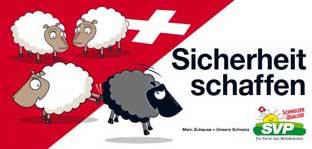
 The Swiss People's Party may have scored another victory yesterday in their campaign against the "black sheep" within Swiss society, but judging by the reaction of the European press today it may be the Swiss themselves who are becoming the real black sheep. In a referendum held Sunday, 53% of the Swiss endorsed a far-right initiative to automatically expel foreign residents who have committed a crime, following their time served in a Swiss prison.

According to the AFP, Austrian website news.at announced the news with the headline, "Switzerland is now the black sheep -- majority for tougher rules against foreigers." The headline is a reference to the notorious advertising used by the far-right Swiss People's Party (SVP) showing a group of white sheep kicking a black sheep out of Switzerland. The imagery, which helped propel the SVP to a huge election win in 2007, was again brought out in the SVP's campaign for the expulsion initiative (but this time with a new twist, one of the white sheep has been stabbed!). The Austrian press wasn't the only one criticising the referendum outcome. Belgian newspaper Le Soir noted today that the Swiss are increasingly choosing a "radical road". German newspaper Sueddeutsche Zeitung wrote that once again Switzerland is "sending a signal to the world that it doesn't care what others think of it." Many of the papers are noting that the vote comes exactly one year after the Swiss voted to ban minarets on mosques.

Sunday, 29 November 2009

Switzerland Declares War on Architecture

In a shocking result, 57% of the Swiss have voted to ban mosques with minarets in their country. Both the majority of cantons and the majority of people have voted to ban the mosques, reflecting the increasingly xenophobic mood of Swiss politics.

The vote follows the win of the anti-immigrant Swiss People’s Party (SVP) two years ago. Now the largest party in Switzerland’s parliament, the SVP strongly backed the constitutional ban, saying that minarets (the tall slender towers on traditional mosques) are a sign of militant Islam and a threat to Switzerland. However the rest of the political parties in government opposed the ban and warned that it was not only unnecessary, but also sending a hostile message to the country’s minority populations.

Of course in Switzerland it doesn’t matter that the majority of the government strongly opposed a ban, it is easy for citizens to put virtually anything to a national referendum for people to vote on. And with a saturation of posters like the one above, it’s relatively easy to whip up hysteria about what is essentially a non-issue.As demonstrated time and time again, referendums can never be counted on to protect the rigthts of minorities.

Switzerland has 4 minarets in the entire country, an incredibly low number for a Western European country. This is the result of two factors – the Muslim population is fairly small at 400,000, and planning applications for minarets are almost always refused by local authorities.

The campaigners for the ban have insisted that minarets are a symbol of militant Islam. SVP member of parliament Ulrich Schluer said "A minaret is a political symbol. It is a symbol for introducing, step-by-step, Sharia rights also in Switzerland, parallel to the Swiss law which is a result of Swiss democracy. And this is the problem. It is nothing against Muslims."

The reality of course is that the vast majority of Switzerland’s Muslims are either fellow Europeans from the Balkans or immigrants from Turkey. They’re not exactly coming from hotbeds of Islamic extremism. In fact Switzerland probably has one of the lowest penetrations of Islamic extremism in Western Europe, considering that immigration from geographic areas where Islamic extremism is a problem – North Africa, the Middle East, Pakistan and Indonesia – is very restricted. So it’s hard to see how such a drastic measure as changing the constitution to ban a piece of architecture is necessary.

Essentially it’s an imaginary solution to an imaginary problem. There is no Islamic extremism problem in Switzerland, and even if there were, how on earth would getting rid of minarets solve it?

The media has been making a lot of comparisons to the French head scarf ban in public schools, but I don't really think this is an apt comparison. The argument was made that the veil disrupted learning and encouraged hostility by providing visable markers of difference between students. There were also safety and practicality questions raised about students being allowed to cover their face in school. This Swiss minaret ban is entirely different, as there is no legitimate practical issue that this resolves - it's entirely symbolic. Muslim calls to prayer are already not allowed in the country because of blanket noise ordinances, so the presence of a minaret really has no practical effect on the population. A girl wearing a veil in a classroom arrguably has a very real effect on the learning environment for her, her teacher, and other pupils.

In any event, this is a dismaying result for a country that seems to be sliding into increasing xenophobia and nastiness. There is a debate to be had about Islam's place in Europe and in European law, but this largely symbolic vote has no practical effect other than alienating Swiss muslims. Perhaps even more importantly, it sends a troublingly hostile message to the world at large.

***Added 30/11/09: Analysis following the vote has found that the ban is most likely illegal under European and international law. I’ve heard a few comments in the UK about how the vote will be ok because Switzerland is not part of the EU. Actually Switzerland is a member of the Council of Europe and is party to the European Convention on Human Rights and subject to the European Court of Human Rights. Grahnlaw has a good entry summing up the various legal analysis, and the overall conclusion is that the ban is contrary to Switzerland’s obligations under European human rights law and will require corrective measures.

Wednesday, 25 November 2009

Vienna - Back to the Start

It’s interesting visiting a city again after a ten year absence. I’m on a bunpy flight back to London at the moment, after a very nice few days in Vienna. I hadn’t been there since I went on a trip with my high school band in 1998. Vienna was actually the first city I had ever visited in Europe. Given that this city was my first ‘introduction’ to this continent, it was interesting to go back there now that I’ve lived in Europe several years and have travelled extensively through it. Needless to say, my impressions were far different this time around.

I don’t remember much about that first visit – actually the main impression I remember from it was of a city full of sex. I was just 17 at the time and I remember me and the other high schoolers being amazed when we turned on our TV the first night in the Vienna hotel and saw – get this – breasts! We couldn’t get over it, there were breasts on a main Vienna network! Then we looked out of our window and saw a real live prostitute – or at least a person who we convinced ourselves was a lady of the night. Exploring the city I remember us seeing a few scattered sex shops and thinking truly Vienna was some kind of throbbing sex-obsessed mecca.

It’s amusing to look back on because in reality, Austria is one of the most conservative countries in Europe, and Vienna is known as one of the continent’s more staid and prudish major cities. But to some band geek teenagers from conservative America, it seemed pretty wild!

During the year I lived in Prague in 2002 I kept meaning to take a train down to Vienna but I never made it, which was a shame because I was there studying Central European history. Much like Prague, Vienna is a city reflecting many different eras of European history, from the glory days as capital of the enormous Habsburg empire to its awkward cold war role as a supposedly neutral zone. Because if this Cold War confusion Austria has never really had a period of national soul-searching about its Nazi past, unlike Germany. It remains a staunchly conservative country with an especially hostile attitude toward foreigners. It maintains the toughest asylum rules in Europe and getting a visa to work there is notoriously difficult.

Vienna is a bit like Prague on steroids. It's jam-packed with massively intimidating counter-reformation architecture. But thought it may look like Prague architecturally, the vibe is very different. Miraculously spared the ravages of Soviet domination through sheer luck, Austria is a prosperous country that maintains the third highest GDP in the EU. Despite the fact that it was once part of the same country as its Central European neighbours to the North and East, Austria today bears much more resemblance to Switzerland than to Hungary or the Czech Republic. The two Alpine countries are both beautiful, efficient, prosperous and, above all, uncompromisingly conservative. Austria had to be dragged kicking and screaming into the EU in 1995, and public approval ratings of Brussels remain among the lowest in continental Europe. Obsessed with its Catholic Habsburg heritage, Austria is also one of the more religious countries in Europe.

Over the past few days I couldn’t help continuously comparing Vienna to Zurich, where my father lives. Though the ethos and culture may be very similar, of course the size of Vienna dwarfs that of Zurich, as does the monumental scale of its public buildings. Switzerland, after all, was never the centre of an empire. The Habsburgs left some monumental mementos from the days in which they ruled over nearly 70 million Europeans. It’s often been said that if Martians came to Earth, they would mistake Vienna as the capital of the world.

At the same time there were plenty of reminders of the Swiss mentality, particularly in all the Christmas markets around the city serving Gluhwine. It made me excited that I’ll be in Zurich next weekend for a Thanksgiving dinner at my dad’s house. Zurich at Christmastime is beautiful, and the gluhwine aint half bad either!

Over the weekend I was able to do the three main tourist attractions – the Belvedere, St. Stephan’s Dome, and the Hofburg. I reluctantly went to the exhibit about Empress Elisabeth (“Sisi”) rather than the treasury, but actually I’m really glad I did. It was a fascinating exhibit about a monarch who, though legendary in Austria, I actually didn’t know that much about before. I did know quite a bit about her husband Emperor Franz Josef, and it was really interesting to see the state apartments where he conducted the business of the empire. You could see he was really consumed with the business of running the massive state. According to the tour he rose at 6am every morning and worked tirelessly until 10pm. Of course I took all this information with a dose of salt given the Austrians’ proclivity for glorifying the Habsburgs.

Perhaps the highlight of my trip though was just earlier today, when I stopped in to the crypt of the Kapuzieur Kirche, where all the Habsburgs were buried after 1633. The church itself is small and unassuming, but down in the crupt lies some absolutely massive tombs, including the largest containing the remains of Empress Maria Theresa and her husband. It’s a gigantic iron box mounted with angels and flourishes, and on top sit effigies of the imperial couple, who seem to be sitting on a bed embroiled in some kind of marital tiff. Further along are the tombs of Franz Josef and Sisi, along with their son Prince Rudolph, who died in the Mayerling suicide pact. Sisi’s tomb is decked out with the Hungarian flag and regalia, a testament to her sympathies for Hungarian independence (it is said it was she who finally convinced her husband to make Hungary a co-equal kingdom with Austria, creating the Austro-Hungarian Empire).

Of course it wasn’t all fun and games, I was in Vienna for work – attending a conference on upcoming changes to an EU law on biocides. The conference actually went pretty well, I’ve been covering the subject area for a bit so I felt comfortable talking with people there about it. This is in marked contrast to how I used to feel covering private equity conferences for my old job. It wasn’t a subject I was particularly interested in so it was hard to feign enthusiasm for it at the cocktail receptions. It’s so good to be covering politics again!

On my way to the airport today I also stopped at Donau City, Vienna’s version of London’s Canary Wharf or Paris’s La Defense. Like those two it was built in the 1970’s to form a business area outside the city centre where skyscrapers could be built with impugnity. However unlike the other two it doesn’t seem to have ever gotten off the ground. It was built around the United Nations Centre, which was constructed after Vienna was made the third seat of the UN in 1979. I have to say my heart goes out to anyone who has to work in this monstrosity, it is monumentally ugly. The whole complex just has giant grassy holes in it too. It looks like there were intended to be building sites but they never got around to it. The whole thing just looks rather small and unfinished, yet I didn’t see any construction activity going on there at all. Has Vienna just given up on its La Defense?

The trip out there at least provided an opportunity to actually see the Danube, Europe’s largest river. Oddly enough Vienna’s city centre is nowhere near the river, so it’s quite a hike to get over there. But ti was worth it to see these mighty waters flow south toward Bratislava, Budapest and Romania.

So all in all it was a good trip. I spent a near fortune though – museums in Vienna are not cheap. I’m looking forward to a few days at home back in London before Thanksgiving in Zurich next weekend.

Thursday, 19 February 2009

Switzerland Opens the Bank Floodgates

Europe may be continuing to wage its battle against Switzerland and Liechtenstein over banking secrecy, but after a Swiss government decision yesterday it looks like it may have been the US that has delivered the knock-out blow to the Alpine tax haven system. Switzerland's uunprecedented decision to let UBS turn over their clients' banking details to the US could open the floodgates for governments demanding previously secret bank details, causing the whole system of secret bank accounts to come crashing down like an avalanche.

Since 1934 Switzerland has relied on a pledge of secrecy to fill the coffers of its massive banking system. According to the Swiss Banking Association, 27 percent of all privately held offshore assets are located in Switzerland. The result has been that the country's economy is heavily reliant on the banking industry, with two of the world's largest financial institutions, Credit Suisse and UBS, being the pride of the country. The US Internal Revenue Service had filed criminal charges against UBS, accusing it of helping Americans avoid paying US tax by opening Swiss bank accounts and demanding that it hand over client data. Under Swiss law UBS wasn't allowed to turn over those records, so UBS petititioned the government to allow it to do so, saying that if they didn't their very existence would be at risk. Yesterday the Swiss Financial Market Supervisory Authority said it would allow the release, throwing Swiss market analysts into a panic. Many are saying the government's decision was unnecessary and premature, and could put the whole Swiss banking system at risk.

But the pressure on Switzerland to reform its banking secrecy laws has been steadily mounting for the past several years. Germany in particular has been aggressively pursuing the issue, leading the efforts to force Liechtenstein's hand by stalling its Schengen Zone membership until it makes concessions on the issues. Last year the German finance minister even made the argument that Switzerland should be put on a blacklist of tax havens. The EU has also been looking to end what it views as a no-longer-acceptable tax island within its borders. This month the EC introduced a proposal to end anonymity for bank accounts within the EU. But since such secrecy is already illegal in most EU countries anyway, many analysts think the proposal is actually being made with the intention of extending the legislation to Switzerland and Liechtenstein, which both have bilateral treaties with the EU locking them in to many decisions made in Brussels.

But although Europe's been gunning for the tax havens for some time, it looks like it is the IRS that's delivered the knock-out punch. The Swiss government was at pains today to insist that the ruling is an isolated case and will have no bearing on such negotiations with the rest of Europe. But it's undeniable that the decision is likely to encourage the EU and individual countries to pursue similar criminal action against Swiss banks in order to force their hand. And now that the precedent has been set, it will be hard for the Swiss government to block those requests in the future. As the economic crisis continues to worsen, governments will be keen to grab additional revenue wherever they can. Some of that may now come from unpaid taxes sitting in Swiss banks.

Monday, 9 February 2009

The Swiss Say Yes to Europe

Brussels was breathing a sigh of relief today as the news of yesterday's Swiss referendum result reached people's desks. There had been some apprehension about the vote, which extends free-movement rules to new EU entrants Bulgaria and Romania, as opinion polls taken before the vote seemed to suggest that it would have a razor-thin margin. In the end, a massive 60 percent of voters said 'JA.' Only four of Switzerland's 26 cantons voted no.

The vote is being called a "broad yes" by the Swiss to economic collaboration with Europe, and a mandate for pro-European parties in the Swiss government to increase ties. The news is already being taken as a sign that the financial crisis may lead to a more receptive attitude toward the EU and coordinated pan-European policies. With the Irish revote on the Lisbon Treaty just around the corner, many in Brussels are hoping this is a trend that will continue. But is the vote's outcome the result of changing EU attitudes in the face of the financial crisis, or was it simply the result of a skillful vote mobilisation effort on the ground by pro-EU groups?

Switzerland has a rather unusual arrangement with the EU. While it's not a member, it has a series of seven 'special accords' with the block that make it effectively a shadow member. It isn't an official member, so it doesn't have any representation in the European Parliament or Commission, but the accords oblige Switzerland to follow many areas of EU legislation. Free movement, which allows any EU citizen to work in any EU country, is one of those areas. However, now that EU membership hassuch a change must be put to a public vote (they basically have to have a public vote for everything in Switzerland). But here's where it gets tricky. The EU has made clear that Switzerland doesn't have the right to 'pick and choose' which parts of EU law it will follow, and under the infamous "guillotine clause," if the Swiss voted no to extending free movement to Bulgaria and Romania, all of their agreements with the EU would be torn up. Considering that the vast majority of Switzerland's trade is with the EU, and that non-Swiss EU citizens make up a huge percentage of its skilled workforce, a collapse in the accords would be catastrophic for the country's economy. So one has to ask, is this really a vote for increased EU ties, or a desire to maintain the status quo? And if it's now economically impossible for the Swiss to vote against policies enacted in Brussels, isn't this really just an illusory independence anyway?


Switzerland's biggest political party, the rightist Swiss People's Party, had waged an aggressive ad campaign urging people to vote no, arguing that the two new EU entrants were too poor to be allowed unfettered access to Swiss jobs. (this photo is of one of their billboards that was on the street outside my parents' house). The issue was complicated by the fact that Switzerland has had a less than smooth history with immigration from the Balkans. During the 1990's the country took in many refugees from the former Yugoslavia as the Balkan wars raged on. Now the country has a sizable former Yugoslav population, particularly in Zurich, which hasn't integrated with the wider Swiss society and who treated with much hostility from the native Swiss population (complete with a nasty epithet that I won't repeat here). Many, particularly in German-speaking Switzerland, aren't crazy about the idea of taking in more immigrants from Serbia's neighbors in the Balkans.

A Sign of the Times?

So does the wide victory in Switzerland mean that people's fears about the financial crisis are going to make them less likely to snub the EU, for fear of the economic consequences? I've speculated that the economic turmoil in Ireland will likely make the Irish too scared to vote against the Lisbon Treaty again when the revote occurs later this year. It seems likely that the hold-up in approval by the Czech Parliament may also be resolved quickly now that the future looks so uncertain. On the other hand, many commentators have speculated that the recession could lead to an increase in populism and protectionism, which could put the European single market in jeopardy. The recent walk-outs in the UK and the one-day strike in France have certainly been a worrying sign in that direction.

For now though, Brussels has reason to be encouraged by the Swiss result.