Showing posts with label Francois Hollande. Show all posts

Tuesday, 15 November 2016

Obama passes the torch to Merkel

For the past 70 years the US President has been known as the 'leader of the free world'. Tomorrow Barack Obama arrives in Berlin to hand that title to the German chancellor.

Barack Obama's European farewell tour, which is kicking off in Athens today, was meant to be a triumphant farewell to a continent where he remains enormously popular.

Instead, the trip has become a crisis tour. The US president must urgently reassure the European public that the continent is not about to be plunged into war by a Donald Trump presidency, and that American moral leadership remains intact. In his private meetings, however, he will have to acknowledge that he cannot assure any such thing. He will have to urgently plan with European leaders for how to peacefully transition to a post-Trump world.

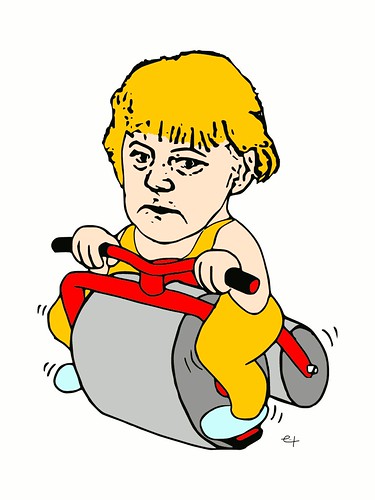
The most important of these meetings will come tomorrow in Berlin, when he meets with the reluctant new leader of Western liberal democracy - Angela Merkel.

Thursday, 28 July 2016

Despite a gruesome week, Germans keep calm and carry on

Reports in American media of German 'panic' are greatly exaggerated. Most still believe Merkel's refugee policy is the right thing to do.

Over the past week, as Germany was struck by a string of four violent attacks in a row, German Chancellor Angela Merkel stayed on holiday.

It might seem strange for people in other countries. It stands in stark contrast to the political reaction in neighboring France, where French President Francois Hollande rushed to the scene of recent attacks there and made dramatic pronouncements and new policy promises. 

It has matched the general tone of the measured response here in Germany, both from the media and from politicians. There has been no hysteria.

Of course, this is largely because the scale and scope of the French and German attacks were very different. The German terrorist attacks were failures, killing no one but the perpetrator. While the attacks in Belgium and France were co-ordinated large-sale attacks by ISIS cells, the events in Germany have been small attempts by lone wolves. While the other attacks have had clear links with ISIS, the Germany links are tenuous or non-existent.

Saturday, 2 July 2016

Why England in the EEA would be a victory for France

France has always resented British influence in the EU. Excluding the UK from EU law-making could reshape the union in the French model.

In 1963, when the United Kingdom first applied to join the European Community, the answer from Paris was a resolute 'non'. 

French President Charles de Gaulle vetoed the application in '63 and again in '67. He said that "a number of aspects of Britain's economy, from working practices to agriculture...made Britain incompatible with Europe". He added that the UK had a “deep-seated hostility” to any pan-European project.

It wasn't until De Gaulle relinquished the French presidency that Paris finally relented and allowed the UK to join the club in 1972.

So what were the "aspects of Britain's economy" that De Gaulle was so worried about? It was free market liberal economics. De Gaulle, and his successors, distrusted the "Anglo-Saxon" (The French term for Anglo-American) model of capitalism and had a very different vision for Europe.

Monday, 25 March 2013

Violence erupts at French anti-gay-marriage protests

Across Europe and the Americas, gay marriage has been enacted peacefully and with minimal protest. Meanwhile, in France...

Yesterday, an estimated one million people flooded the streets of Paris to protest plans to enact same-sex marriage in France. It was the second such massive demonstration, following one held in January against French President Francois Hollande’s effort to enact gay marriage - a fulfilment of a promise made during last year’s presidential campaign.

This time, the demonstration took a nasty turn. The protestors became violent. The police resorted to using tear gas, which allegedly injured some of the many children being used in the protest. The police counter that the anti-gay-marriage protestors were using children as human shields. The president of France's Christian Democrat party says she was injured by police during the protest. Today, the opposition UMP party of Nicolas Sarkozy is calling for the resignation of the Paris chief of police and French interior minister Manuel Valls in response to the tear gas 'used against children'.

Friday, 15 March 2013

Frigide Barjot - a very French protest


On Tuesday of this week, I was sitting in the press room of the European Parliament in Strasbourg - waiting for a press conference on the 2014 EU elections - when suddenly a woman clad in hot pink burst into the room. Her leathery brown skin and wild hair stood in stark contrast to the suited conservative members of parliament who were ushering her in. By her side was a young man with bleach-blond hair, also clad in pink.

This, the journalists learned, was Frigide Barjot - the leader of France’s anti-gay-marriage movement. The Conservative MEPs had invited her to the European Parliament to speak about her desire to extend her anti-gay-marriage movement to all of Europe. While notorious in France, Ms Barjot is unknown outside the country, and the journalists were perplexed as to why she was there. But I knew of her already, if only from the many Facebook posts I see from my French friends decrying her antics.

Tuesday, 5 February 2013

UK rejects ‘separate but equal’ marriage

The British House of Commons has just concluded a historic vote, voting 400 to 175 to adopt gay marriage in England. But despite its historic nature, the legislation will prove to be of more symbolic than practical importance – particularly for its author, Conservative Prime Minister David Cameron.

In effect, the UK has already had gay marriage for eight years – but by another name. The Civil Unions signed into UK law in 2004 confer the exact same rights as a marriage – to the letter. Interestingly, as I’ve written about before, this made the gay marriage debate fade out of the limelight for many years in the UK. Because the civil unions were theoretically “equal”, gay rights activists weren’t really pushing too hard to have the word changed to ‘marriage’.

That was until an unlikely hero came along – David Cameron, leader of the British Conservative party. Cameron made it the central mission of his leadership to “detoxify” the conservative brand in the UK after years of being successfully cast as the “nasty Tories” by Tony Blair. Part of his effort to modernise the party was an campaign pledge in 2010 to enact gay marriage if elected. The response from gay UK was, “well, alright then I guess.”

Thursday, 28 June 2012

The showdown: Germany v. Italy

The centre of political gravity may be in Brussels today as EU leaders meet for yet another “make-or-break” summit, but all eyes in Europe will tonight be on Warsaw. The German and Italian football teams will be battling it out to see who will go on to the European Championship final on Sunday.

Like the Germany-Greece game last week, tonight’s game will be fraught with political tension. Thankfully, German Chancellor Angela Merkel will not be at the match tonight to humiliate her Southern neighbours, as she did at the match with Greece. Instead she will be here in Brussels, perhaps watching the match with Italian prime minister Mario Monti. And as the Germans and Italians battle it out on the field in Poland, their leaders will be battling it out here in Brussels.

Monti, the ‘technocrat’ prime minister put into place by EU leaders after they forced disgraced former prime minister Silvio Berlusconi to resign, is coming to Brussels today with a list of demands. He wants the EU to take immediate measures to save the Italian and Spanish economies, which are teetering on the brink of collapse. Specifically, he wants the EU to collectivise debt by issuing ‘eurobonds’ – a joint bond guaranteed by all countries using the euro.

Wednesday, 13 June 2012

Is this the Élysée or Melrose Place?

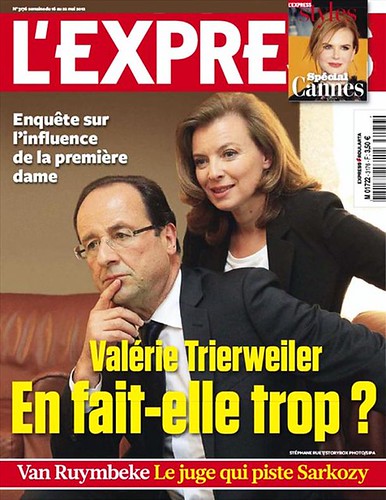
The French papers can hardly contain their excitement this morning over the catty details of the first scandal to come out of the Élysée Palace since the election of Socialist François Hollande – the self-styled “Mr. Normal”.

Journalist Valerie Trierweiler, Hollande’s partner (Americans – ‘partner’ is French for ‘unmarried fornicator’) made the faux pas of endorsing a rebel challenger to Socialist party standardbearer Segolene Royal in this Sunday’s elections for the French Parliament. This might seem fairly uninteresting, until you add the fact that Royale, herself the 2007 presidential candidate for the Socialists, is the former partner of Hollande and they have four children together.

The offending endorsement of challenger Olivier Falorni from the French first lady was made in a tweet posted by Trierweiler yesterday. The reaction from Hollande’s fellow Socialists has been furious. They have pointed out that not only has the tweet exacerbated the inter-party tensions and in a way that could cost the Socialists seats on Sunday, it also seems grotesque on a personal level. For the first lady to go out of her way to publicly insult and humiliate the mother of her partner’s four children seems exceptionally cruel, French politician Daniel Cohn Bennett said. But it seems entirely consistent with her previous behaviour toward Royal (more on that later).

Friday, 18 May 2012

Obama gets tough with Merkel, but is it too late?


Now that German Chancellor Angela Merkel has been hobbled by the loss of her key ally in France, it seems the Obama administration is wasting no time in pressuring her into a course correction. The chorus of anti-austerity (and by extension anti-Merkel) voices is growing louder by the minute.

At next week’s G8 summit at Camp David, Barack Obama is reportedly going to put pressure on Germany to drop its insistence on the Eurozone economies adopting a severe austerity regime. He will ask Merkel to instead pursue a policy of stimulus and growth. He will apparently do so in no uncertain terms – warning Merkel that if she does not change course quickly she risks plunging the world into another deep recession that would be even worse than the Lehman Bros collapse in 2008.

The Guardian reports that the Obama administration is expected to try to forge close ties with new French President Francois Hollande at the first meeting of the two leaders on Tuesday. They are keen to rapidly establish Hollande as an ally in exerting pressure on Merkel to change course.

Obama already has the support of UK Prime Minister David Cameron, who while unwavering in his demand for austerity at home, publicly chastised the German chancellor in a speech yesterday for her lack of flexibility. Saying that the eurozone either had to “make up…or break up”, he said urgent steps are needed quickly to prevent an economic implosion of epic proportions in the coming weeks. He will reportedly tell Merkel this weekend to use Germany's wealth to rescue Southern Europe before it is too late.

Wednesday, 9 May 2012

Angela vs. the growth

As predicted, Socialist Francois Hollande ousted the centre-right Nicolas Sarkozy in French elections on Sunday after a campaign in which he railed against the German-led austerity drive in Europe. He has insisted that Europe needs to end its obsession with austerity to dig its way out of the debt crisis, and instead focus on growth.

Coming as it did on the same day that anti-austerity parties in Greece took a majority of the vote, Sunday has been interpreted as a Europe-wide rejection of German Chancellor Angela Merkel and her insistence on austerity and budget cuts. The markets have certainly interpreted it as such. Stock exchanges across the world have taken a dive the last three days, particularly in Europe, over fears that the delicately crafted ‘fiscal union pact’ worked out over the past several months is now about to fall apart.

Whether that actually comes to pass may depend less on Hollande than on how his victory is interpreted in other European capitals. All eyes will be on the new French president’s first meeting with Merkel next week, a day after he is sworn in on 15 May. It is in both of their interests that the meeting goes well. Hollande needs to walk away with something to say that he “renegotiated” the fiscal compact, while Angela needs to reassure the German people that Eurozone countries will still have to adhere to strict budgetary rule while at the same time reassuring the markets that there will be no Franco-German rift.

What will likely be worked out is the addition of a paragraph about stimulating the economy into the compact – something that wouldn’t require new ratifications by national parliaments.

Thursday, 3 May 2012

Sarko presents a Latin/Germanic choice to France

Someone tuning in to last night’s presidential debate in France might have thought Nicolas Sarkozy was running for president of Germany. Praising the economic model of France’s eastern neighbour, he continually stressed that Germany is more competitive and an easier place to do business.

Even his Socialist challenger Francois Hollande had to agree with him. “Germany in all fields is better than us,” Hollande conceded, with a tone that seemed to imply, ‘if you love it so much, why don’t you go there.’

Germany and its chancellor Angela Merkel loomed large over this debate, although she was never mentioned by name. Sarkozy continually returned to a theme of defending his close partnership with the chancellor and her austerity regime for Europe. He has been accused, both in Germany and France, of being Merkel’s poodle. “We avoided the implosion of the euro,” he spat at Hollande incredulously after he questioned the austerity strategy. “It was hard work, which was founded on the Franco-German partnership. It is irresponsible to want to question it.”

And thus the lines were drawn in precisely the way Sarkozy wanted them. “For me, the example to follow, it is that of Germany rather than that of Greece or Spain,” said the president. He stressed that it was the Socialists who have been in power in Spain during the economic crisis, and today Spain’s economy is on the verge of collapse. Contrast that, he said, with Germany where his fellow conservatives have been in power. Germany has the most successful economy in the EU. Hollande, he warned, would make France like Spain.

Tuesday, 1 May 2012

The battle for the May Day voter

The first of May is always a big deal in France. This year it’s taken on an even more politically charged tone, with groups of far-left and far-right demonstrators possibly coming into conflict during the course of today. But it might be hard today to differentiate between the two groups based on their rhetoric alone.

May Day, originally a pagan spring festival, became an international workers day in the late 19th century. Ironically this Socialist holiday is unknown in the United States, despite the fact that it actually commemorates the 1886 Haymarket Massacre in Chicago. An American ‘Labor Day’ was instead set in September so that it wouldn’t coincide with international workers demonstrations. The day has long since lost any association with workers rights in the US.

But in continental Europe, the 1st of May is still a public workers holiday during which labour unions and activists demonstrate in the streets. It is also known for anti-capitalist violence, particularly in Southern Europe.

In recent years, the increasingly mainstream far right in Europe has challenged the idea that May Day is the sole domain of the left. The National Front party in France has begun to stage May day marches to the Place de l’Opera in Paris. There they hold a rally in front of a statue of Joan of Arc, who they have adopted as a symbol. This year, following the record 18% showing of National Front leader Marine Le Pen in last Sunday’s first round of presidential elections, it is predicted that they will garner the largest turnout ever.

Tuesday, 24 April 2012

Are Europe's conservatives now dependent on the far right?

Yesterday’s news that the government of Dutch Prime Minister Mark Rutte had collapsed sent almost immediate shock waves through the world’s financial markets.

Investors, who were already feeling skittish about the first-round victory of French Socialist presidential candidate Francois Hollande on Sunday, found themselves with something much more serious to worry about. The government of the Netherlands, one of the core austerity-pushing states of the Eurozone, couldn’t even pass the tough medicine they helped design for Europe.

Holland and the three other euro-using countries that still have triple A ratings (Germany, Finland and Austria) have pushed for every eurozone country to make massive cuts by the end of the month. But yesterday Rutte was forced to tender his resignation after it became clear he could not get his own parliament to approve the tough medicine he had helped design for all of Europe.

But perhaps more interesting from a political perspective is who it was that precipitated this crisis – the infamous far right leader GeertWilders. Rutte was only able to form his governing coalition in 2010 by relying on the backing of Wilders and his far right Party of Freedom group, which had polled at 15.5% in that year's election. Wilders has been tried in the Netherlands for hate speech against Muslims, and has been banned from entering the UK in the past.

Monday, 23 April 2012

Is Europe set for a Socialist comeback?

Yesterday’s first round of presidential elections in France delivered a humiliating defeat for president Nicolas Sarkozy, who trailed over one percentage point below his Socialist Party challenger Francois Hollande - the ex-partner of Sarkozy's 2007 rival for the presidency Segolene Royal. It is the first time in the history of the fifth republic that a sitting president has not won the first round of elections.

Public polling had predicted a Sarkozy win in the first round, in which all candidates compete, followed by a Hollande victory in the final round on 6 May, where the two leading candidates face off against each other. The low showing for Sarkozy already has papers predicting that, barring a miracle, Sarkozy is finished.

Much of Sarkozy’s trouble has come from Marine Le Pen, the leader of the far right National Front party. She came in at 18%, far higher than the previous leader of the party, her father Jean-Marie Le Pen, scored in 2002 when a split Left meant he came in second in the first round. Sarkozy has been desperately trying to win over the far right vote in France, telling French television that the country has “too many immigrants,” joining a crusade against halal meat, and saying the EU’s passport-free Schengen Area should be renegotiated. But it apparently wasn’t enough to convince the far right voters to vote for him.

Sarkozy now has two weeks to convince Le Pen’s followers to support him in the final round, but it will be a difficult task. National Front voters, aside from being xenophobic, racist and anti-EU, also have a strong anti-establishment impulse. This was reflected in Le Pen’s ecstatic victory speech last night, as she declared with a clenched fist in the air, “We have blown apart the monopoly of the two parties of banking, finance and multinationals. Nothing will ever be the same.”

Wednesday, 4 January 2012

Is Iowa the problem, or is it the primary system?

While I was home in the US over the past few weeks I witnessed the quadrennial spectacle of the Iowa caucuses - shivering reporters in front of the capital dome in Des Moines, candidates eating corn on the cob while clutching plump cord-fed babies, the usual fare. And I was also able to witness the quadrennial griping about why the United States allows “a few hundred farmers” to pick its president.

The complaining about the Iowa caucus, where the first nominating primary for both political parties’ presidential candidates is held, is both predictable and legitimate – even if the language used sometimes smacks of regional snobbery. The Iowa caucus makes or breaks politicians running for the presidency. Barack Obama owes his presidency to winning the Iowa Democratic caucus in 2008. This year, the result of the Republican caucus will force Michele Bachman and Rick Perry to drop out of the race. And the Iowans have elevated Rick Santorum from obscurity to be the main challenger to frontrunner Mitt Romney.

But the Iowa caucus is a big deal only because it is first. And being first means presidential candidates promise Iowa all sorts of lovely things (just look at the corn subsidies of the past four decades – and you wonder why Americans have corn syrup in most of their food for no reason?). The Iowans go through outrageous lengths to make sure they are first. When South Carolina and New Hampshire tried to move their primaries ahead of them this year, Iowa moved theirs to the earliest possible day in 2012 – 3 January.

This year the criticism went perhaps a little too far. A professor at the University of Iowa (himself a transplant from New Jersey) wrote a column for The Atlantic about a much-asked question – why should a state that is not ethnically or ideologically reflective of the country as a whole be given such a prominent role in selecting the nation’s president? But he asked it in a way that was incendiary to say the least, calling Iowa a place that's "culturally backward" and teeming with "slum towns”, where the 96% white population “clings to guns and religion.”

Wednesday, 14 December 2011

This isn’t about the UK any more

The markets have returned to panic mode today as their confidence in national governments to approve the new Eurozone financial consolidation treaty wavered. Ratification has hit some bumps in the road, with Finland’s prime minister expressing dissatisfaction with the transfer of authority over national budgets to the EU on Tuesday. In Ireland, the opposition parties seem keen to force a referendum on the issue even if the country’s legal services rule that one is not required.

The euro fell below $1.30 today, its lowest point in a year. Yields on Italian bonds widened to new highs. It’s a familiar pattern we’ve seen repeated several times now: markets rally upon news of a new European Council agreement, but then crash a few days later when they look at the details and realise it’s not as strong as they’d hoped. The UK's abandonment of Europe may have been the big story on Friday, but now the more important story sets in - the markets have not been satisfied.

But there seems to be some confusion in the British media though about what this all means vis-à-vis the UK’s decision to veto the attempt at treaty change on Friday. The Spectator has run a column from the Eurosceptic think tank Open Europe scolding the British media for describing the UK as isolated as a result of the 26 vs. 1 outcome last week. There isn’t really any such divide, Open Europe insists, because many other member states support the UK’s reticence. As evidence that all is not what it seems, they run through the list of objections to the new treaty being expressed in national capitals this week.

Monday, 17 November 2008

Socialist soap opera

Say what you will about it, but you can't say that French politics is boring. Just as the country is in the midst of speculating which government official is responsible for the unmarried Minister of Justice Rachida Dati's pregnancy, the Socialist Party conference this weekend exploded with a cacophony of backstabbing, intrigue and humiliation involving jilted lovers and feuding siblings. It was, as one French friend amusingly put it, "quite the shit show."

The party conference, similar to a party convention in the US, was supposed to signal the return of a strong and confident Socialist Party that would be capable of challenging French president Nicolas Sarkozy in 2012. The reality was anything but. Though it took place in Reims, the capital of France's tranquil Champagne region, there was little celebrating going on for the main party of the French left. The intention was select a new leader for the party now that François Hollande (above left) is stepping down after 11 years. Of course "leader" is a subjective term here, it would probably be more accurate to say he held the party together as it teetered on the brink of collapse for the past decade.

Thursday, 7 February 2008

President Tony Blair?

It looks like discussion around Tony Blair becoming the first “President of Europe” is heating up. According to the BBC, Blair is now discussing the prospect with current British prime minister Gordon Brown.

The network is claiming there are forces in the prime minister’s office who are actively encouraging such an idea. It is thought that Blair and Brown are discussing the pros and cons of such a move, and Brown is waiting for Blair’s green light before he voices his support for the idea, which would signal that Blair is actively campaigning for the job.

Blair’s recent activity suggests that he is leaning in that direction. Last month he delivered a speech to Sarkozy’s UMP party conference – in French! Sarkozy has in turn expressed his desire for Blair to take the job.