The markets have returned to panic mode today as their confidence in national governments to approve the new Eurozone financial consolidation treaty wavered. Ratification has hit some bumps in the road, with Finland’s prime minister expressing dissatisfaction with the transfer of authority over national budgets to the EU on Tuesday. In Ireland, the opposition parties seem keen to force a referendum on the issue even if the country’s legal services rule that one is not required.
The euro fell below $1.30 today, its lowest point in a year. Yields on Italian bonds widened to new highs. It’s a familiar pattern we’ve seen repeated several times now: markets rally upon news of a new European Council agreement, but then crash a few days later when they look at the details and realise it’s not as strong as they’d hoped. The UK's abandonment of Europe may have been the big story on Friday, but now the more important story sets in - the markets have not been satisfied.
But there seems to be some confusion in the British media though about what this all means vis-à-vis the UK’s decision to veto the attempt at treaty change on Friday. The Spectator has run a column from the Eurosceptic think tank Open Europe scolding the British media for describing the UK as isolated as a result of the 26 vs. 1 outcome last week. There isn’t really any such divide, Open Europe insists, because many other member states support the UK’s reticence. As evidence that all is not what it seems, they run through the list of objections to the new treaty being expressed in national capitals this week.
Showing posts with label Fredrik Reinfeldt. Show all posts
Wednesday, 14 December 2011
Thursday, 20 January 2011
Is David Cameron forming an Anti-European Union?
Nicolas Sarkozy's plans for a "Mediterranean Union" may be floundering, but at the other end of Europe British Prime Minister David Cameron is just getting started with plans to form a 'Northern European Union.'
The leaders of Britain, Sweden, Denmark, Norway, Finland, Iceland, Latvia, Lithuania and Estonia are all meeting in London today to discuss the potential for a grouping which Cameron is calling an "alliance of common interests". He wants to boost trade between the UK and the Nordic and Baltic countries, but also to increase the flow of ideas. These include ideas on technology and economic and social policy, areas in which Northern Europe has similarities and expertise that are not necessarily shared by many countries in other parts of Europe.
Cameron insinuated as much yesterday when he said a northern grouping could become an "avant garde" for economic growth in Europe. And of course, Northern European countries have deep historical ties as most were ruled by Denmark at one time or another. And before the EU came along the Nordics had their own attempted intergovernmental union, the Nordic Council.
The leaders of Britain, Sweden, Denmark, Norway, Finland, Iceland, Latvia, Lithuania and Estonia are all meeting in London today to discuss the potential for a grouping which Cameron is calling an "alliance of common interests". He wants to boost trade between the UK and the Nordic and Baltic countries, but also to increase the flow of ideas. These include ideas on technology and economic and social policy, areas in which Northern Europe has similarities and expertise that are not necessarily shared by many countries in other parts of Europe.
Cameron insinuated as much yesterday when he said a northern grouping could become an "avant garde" for economic growth in Europe. And of course, Northern European countries have deep historical ties as most were ruled by Denmark at one time or another. And before the EU came along the Nordics had their own attempted intergovernmental union, the Nordic Council.
Monday, 20 September 2010
The mainstreaming of Europe's 'stealth far-right'
The results from yesterday’s general election in Sweden are in – and continuing the narrative of European elections over the past five years, the results are bad news for the left. The centre-left Social Democrats lost 17 seats in the parliament – just the latest blow for a party that until recently had dominated Swedish politics. But the ruling centre-right coalition, who will hold on to power, weren’t exactly jumping out of their seats last night in celebration. Only Prime Minister Fredrik Reinfeldt's party managed to gain seats, while his three coalition partners all lost seats. This left the coalition just short of a majority, and they will have to ally with the Swedish Greens in order to put them over the threshold. So if everyone seemed to lose seats, where did the votes go? They went to the far-right Sweden Democrats (SD), who will now enter the parliament for the first time after winning 20 seats in yesterday’s election. It's a stunning development for a historically left-of-centre country like Sweden.
Monday, 21 December 2009
Europeans and Americans see Copenhagen through different eyes
So, was Copenhagen a failure or not? It would appear the answer depends on which side of the Atlantic you’re on when you ask the question.
The Copenhagen Accord, finalised after hours of intensive negotiations, theoretically recognises a goal of limiting global warming to two degrees Celsius, but contains no targets to achieve that. There are no specific emission reduction actions by developing countries and no specific commitments on long term financing for mitigation and adaptation efforts. Not only is it non-binding, the agreement wasn’t even adopted by all UN countries. Instead it has just been 'noted', which means that countries recognise its existence but don’t necessarily agree with it.
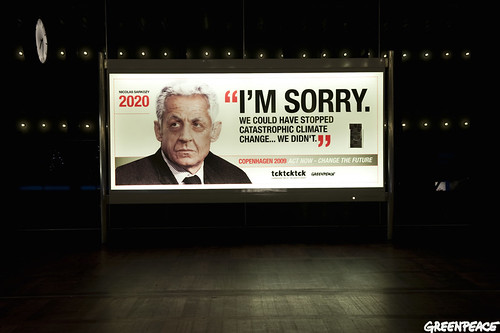
European NGOs and governments were united in their condemnation of the Copenhagen climate summit’s result this weekend, which failed to include any kind of binding agreement and was only able to muster an optional “accord”. Though the language the political leaders were using was obviously more diplomatic than that being used by the climate activists (Greenpeace’s director called Copenhagen a “crime scene”), the basic message is still the same: the summit failed. Swedish prime minister Frederik Reinfeldt, still holding the EU presidency, said the agreement, “will not solve the climate pressures, the climate threat to mankind.” Commission president Jose Manuel Barroso said, "The level of ambition is not what we were hoping for." The British leadership has been railing against the Chinese all weekend, pointing the finger of blame squarely in their court. Brown said that they were, "clinging to their version of what an international organisation should not do,” and British environment minister Ed Milliband delivered the extraordinary charge today that the Chinese hijacked the summit. If there is a mainstream European publication that did not use the word ‘failure’ today to describe the summit, I am not aware of it.
The Copenhagen Accord, finalised after hours of intensive negotiations, theoretically recognises a goal of limiting global warming to two degrees Celsius, but contains no targets to achieve that. There are no specific emission reduction actions by developing countries and no specific commitments on long term financing for mitigation and adaptation efforts. Not only is it non-binding, the agreement wasn’t even adopted by all UN countries. Instead it has just been 'noted', which means that countries recognise its existence but don’t necessarily agree with it.
European NGOs and governments were united in their condemnation of the Copenhagen climate summit’s result this weekend, which failed to include any kind of binding agreement and was only able to muster an optional “accord”. Though the language the political leaders were using was obviously more diplomatic than that being used by the climate activists (Greenpeace’s director called Copenhagen a “crime scene”), the basic message is still the same: the summit failed. Swedish prime minister Frederik Reinfeldt, still holding the EU presidency, said the agreement, “will not solve the climate pressures, the climate threat to mankind.” Commission president Jose Manuel Barroso said, "The level of ambition is not what we were hoping for." The British leadership has been railing against the Chinese all weekend, pointing the finger of blame squarely in their court. Brown said that they were, "clinging to their version of what an international organisation should not do,” and British environment minister Ed Milliband delivered the extraordinary charge today that the Chinese hijacked the summit. If there is a mainstream European publication that did not use the word ‘failure’ today to describe the summit, I am not aware of it.
Tuesday, 19 September 2006
Europe's Left Falling?
It's interesting that there seem to be simultaneous blows to Europe's left happening right now. Sunday's election in Sweden saw that country's conservative coalition claim an unbelievably narrow victory over the social democrats. The coalition has been running on a platform of tax cuts and drastic alterations to Sweden's cherished social model. This historically hasn't been a popular platform, as Swedes enjoy the highest quality of life in the world due to their generous social policies. Poverty is virtually non-existent, everyone has quality healthcare.
It was only by softening his party's stance that Fredrik Reinfeldt, the 41-year-old leader of the Moderate Party, who will become prime minister, was able to win Sunday. He ran on a platform of tax cuts and other pro-business incentives, but pledged to tweak, not uproot, the Swedish welfare system. His premise is that high taxes in Sweden discourage entrepreneurship and wealth accumulation. To fund the tax cuts, Reinfeldt is going to send Sweden on the most massive sell-off in its history, privatizing a host of now government-controlled companies including Nordea, a major bank; TeliaSonera, the largest phone company; OMX, the stock exchange operator; and SAS, a Swedish airline.
Subscribe to:
Posts (Atom)