Showing posts with label Meditterranean Union. Show all posts

Thursday, 10 March 2011

Can the EU rebuild the Arab world like the US rebuilt Europe?

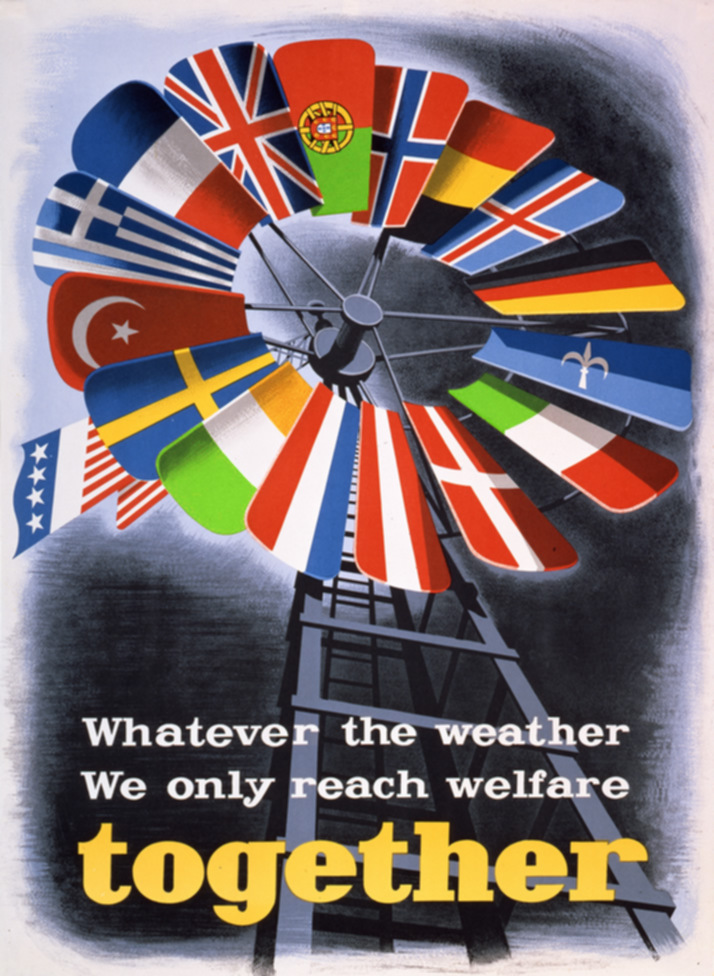
Spanish prime minister Jose Luis Rodriguez Zapatero has called on the West to create a new 'Marshall Plan for Arab states' in response to the current unrest. Such a plan, modeled on the wildly successful scheme launched by the United States in 1947 to rebuild war-ravaged Europe, would be designed to give new Arab governments the financial support they need to build stable democracies. More implicitly, it would provide a bulwark against Islamism in the same way that the Marshall Plan successfully provided a bulwark against Communism in Western Europe.

Europe is still still haunted by its failure to do anything to prevent the chaos that unfolded in its own backyard in the 1990s during the Balkan Wars. The calls for quick decisive action are coming from every corner. Most politicians now acknowledge that financial support is going to be needed, but there is disagreement about who should supply it. These thorny issues will be discussed tomorrow at a special summit of EU leaders in Brussels to discuss the crisis in Libya.

At the European Union level, there has now been begrudging admittance that the union's approach to its Southern neighbours has until this point been a misguided failure. Valuing stability and protection of Israel above all else has led to the European Union and the United States ploughing billions of dollars into despotic regimes over the past decades, earning them the enmity of the Arab street. For the EU, most of this aid was distributed through the European Neighbourhood Policy (ENP), which gives financial and political assistance to the EU's neighbours.

€2.8bn in assistance has already been pledged to the Middle East and North Africa over the next three years through the ENP. Now that it is clear that a much larger amount than this is going to be needed to support budding Democracy movements, there are questions over whether the ENP is the best tool to use. Southern European countries have long complained that the ENP was always more focused on the EU's Eastern neighbours than those to the South. Why not give the Southern Mediterranean its own new, dedicated assistance vehicle?

Thursday, 20 January 2011

Is David Cameron forming an Anti-European Union?

Nicolas Sarkozy's plans for a "Mediterranean Union" may be floundering, but at the other end of Europe British Prime Minister David Cameron is just getting started with plans to form a 'Northern European Union.'

The leaders of Britain, Sweden, Denmark, Norway, Finland, Iceland, Latvia, Lithuania and Estonia are all meeting in London today to discuss the potential for a grouping which Cameron is calling an "alliance of common interests". He wants to boost trade between the UK and the Nordic and Baltic countries, but also to increase the flow of ideas. These include ideas on technology and economic and social policy, areas in which Northern Europe has similarities and expertise that are not necessarily shared by many countries in other parts of Europe.

Cameron insinuated as much yesterday when he said a northern grouping could become an "avant garde" for economic growth in Europe. And of course, Northern European countries have deep historical ties as most were ruled by Denmark at one time or another. And before the EU came along the Nordics had their own attempted intergovernmental union, the Nordic Council.

Monday, 14 July 2008

Club Med: Levant Becomes the Focus

Though French president Nicolas Sarkozy's ambitious original plans for a Mediterranean Union have been dramatically scaled down, the group still had its first meeting yesterday in Paris.

Sarkozy was practically beaming after the meeting, calling his idea for the Mediterranean Union an “extraordinary concept,” and heralding the fact that the meeting was able to get Arab leaders and the Israeli leader in the same room. While it's still debatable what impact this new union will actually have, and whether it can really accomplish any of the goals it has set out, it was interesting to see where the media focus on the event seemed to fall.

From the time Sarkozy first suggested the concept during the French presidential campaign last year, the language was always about a union between the “North” and “South” Mediterranean, with seeming focus being on North Africa, the majority of which was formerly held by the French. But the media coverage of yesterday’s event was largely focused on the Levant. The Syrian and Lebanese leaders, both in attendance, said yesterday that the two countries might establish diplomatic relations for the first time in their history. And the Israeli leader said a peace deal with the Palestinians had never been closer. There was also a theoretical statement by the leaders saying they would like to keep the region “free of weapons of mass destruction.” Here's the coverage from ITN:


But there were also significant initiatives announced at the meeting that had nothing to do with the Middle East peace process, including a high-speed rail network from Casablanca to Istanbul, a plan to make the Mediterranean the cleanest sea in the world by 2020 and the development of a common emergency response force to deal with natural disasters in the region. For now though, it was the diplomatic aspects of the meeting that attracted most of the media attention.

Interestingly, with all the talk of the MidEast peace process and further governmental and economic ties, there was no talk about Democracy, or the lack of it, in the Middle East and North Africa. Perhaps such lecturing would have been counter-productive to the larger goal of bridging gaps between the North and South Mediterranean, but it was an interesting omission nonetheless.

Friday, 11 July 2008

Watered down at Club Med

Along with the pomp of the Bastille Day celebrations this weekend in Paris, the city will see another grand occasion: the first meeting of the “Mediterranean Union,” Nicolas Sarkozy’s pet project that he has made the centrepiece of France’s EU presidency. But the way Sunday’s meeting is being discussed, you’d think it was nothing more than a Camp David-style retreat. So is it the inaugural meeting of a new international body, or lip service to an idea that has failed to take flight?

Sarkozy’s vision of an alternative union has been watered down so much it is now almost unrecognizable from what he proposed during the French election campaign. What was originally intended to be a full-blown union offered as an alternative to the EU has now become a loose association that will be managed by the EU itself. It’s not surprising then that the union is now being labelled ‘Club Med,’ suggesting it is just a diplomatic association which will exchange pleasantries. Press reports looking ahead to Sunday’s meeting have focused almost entirely on the diplomatic aspect, noting that some of the world’s most bitter enemies will be sitting at the same table for the first time, including the leaders of Israel and Syria. Little is being said of what the union is supposed to accomplish because no one is quite sure at this point – the projects it has announced so far are little more than feel-good cooperation initiatives on things like cleaning up pollution and sharing solar panel technology.

Friday, 14 March 2008

Summit summaries

The European Union leaders’ summit has wrapped up in Brussels, and judging by the coverage it seems to have been a rather underwhelming affair. The FT’s Brussels Blog called it a “Ho-hum” affair. Yet there were two interesting developments from the summit, one involving French President Nicolas Sarkozy’s plan for a ‘Mediterranean Union’ and the other involving Gordon Brown’s frank words over the coming economic crisis.

Sarkozy played up the Mediterranean Union discussions as a triumph for France, but the reality is the original proposed plan by France has been so watered down by the other EU nations that it’s almost unrecognizable. Germany has been illogically insisting that it be given membership to such a union even though it has no Mediterranean coast, and they seem to have gotten their way even though Sarkozy has vociferously opposed it. The whole concept has been a continuing source of hostility between the two nations, with both distrusting the motivations of the other. The Germans have objected to a Meditteranean coast-exclusive group because they fear it would break up the EU.