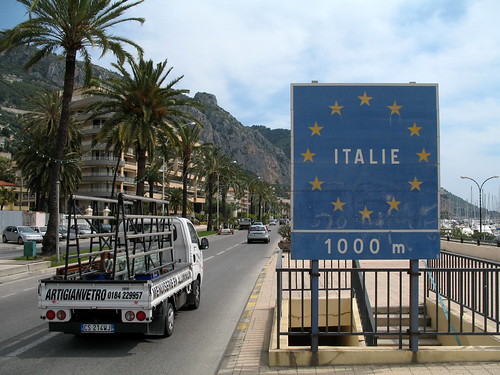
Usually it's the Northern European countries that are the ones clammoring for rollbacks on EU integration. But in a strange twist this week it's the reliable core stalwarts of France and Italy that are agitating for a step back in the EU integration project. The leaders of the two countries sent a letter to the European Commission yesterday asking for the ability to re-establish border controls between Schengen states in 'exceptional circumstances'.
The letter was sent after Nicolas Sarkozy and Silvio Berlusconi held a summit in Rome yesterday trying to diffuse the diplomatic crisis between the two countries. Italy has demanded help from its EU neighbours, saying that it can't handle the influx of economic refugees floating across the Mediterranean to escape the chaos in North Africa and landing on Italian shores.
Deciding that the EU wasn't acting fast enough to provide assistance, Silvio Berlusconi's government started issuing the migrants with "temporary residence visas" and telling them they could use them to seek work in other EU states, knowing full well that the French-speaking Tunisians and West Africans would go to France. The French were furious, and started stopping trains at the French-Italian border which they suspected of carrying the migrants. Each side is accusing the other of violating the EU's Schengen agreement, which allows passport-free travel between member states.
Showing posts with label Tunisia. Show all posts
Wednesday, 27 April 2011
Monday, 18 April 2011
Tensions flare at French-Italian border
France and Italy are locked in a war of words today after France stopped several trains from crossing the border between the two countries over the weekend. France, suspecting that Italy was trying to dump North African immigrants into the country, stopped the trains at the old border station between Ventimiglia and Menton, 20km east of Nice. Now, each country is accusing the other of violating the rules of the EU's passport-free Schengen Zone.
Since the pan-Arab uprising began in January in Tunisia, Italy has been sounding the alarm bell about an increase in migrants trying to cross the Mediterranean to escape the chaos in North Africa. The tiny Italian island of Lampedusa, just off the Tunisian coast, has been inundated with refugees washing up on its shores in makeshift boats. There are now more migrants housed in a refugee camp on the island than there are residents.
Italy has asked the EU for assistance in dealing with the migrants, most specifically through deployment of the EU's Frontex border patrol force. They have also asked other member states to contribute financially to the effort, saying that Italy can't afford to patrol the EU's borders all on its own. Because the Schengen Zone is a passport-free area, most of the migrants crossing into Italy are just trying to get into the EU. Once they get into Italy they can go to France, Sweden or Germany without facing a border check.
Since the pan-Arab uprising began in January in Tunisia, Italy has been sounding the alarm bell about an increase in migrants trying to cross the Mediterranean to escape the chaos in North Africa. The tiny Italian island of Lampedusa, just off the Tunisian coast, has been inundated with refugees washing up on its shores in makeshift boats. There are now more migrants housed in a refugee camp on the island than there are residents.
Italy has asked the EU for assistance in dealing with the migrants, most specifically through deployment of the EU's Frontex border patrol force. They have also asked other member states to contribute financially to the effort, saying that Italy can't afford to patrol the EU's borders all on its own. Because the Schengen Zone is a passport-free area, most of the migrants crossing into Italy are just trying to get into the EU. Once they get into Italy they can go to France, Sweden or Germany without facing a border check.
Thursday, 10 March 2011
Can the EU rebuild the Arab world like the US rebuilt Europe?
Spanish prime minister Jose Luis Rodriguez Zapatero has called on the West to create a new 'Marshall Plan for Arab states' in response to the current unrest. Such a plan, modeled on the wildly successful scheme launched by the United States in 1947 to rebuild war-ravaged Europe, would be designed to give new Arab governments the financial support they need to build stable democracies. More implicitly, it would provide a bulwark against Islamism in the same way that the Marshall Plan successfully provided a bulwark against Communism in Western Europe.
Europe is still still haunted by its failure to do anything to prevent the chaos that unfolded in its own backyard in the 1990s during the Balkan Wars. The calls for quick decisive action are coming from every corner. Most politicians now acknowledge that financial support is going to be needed, but there is disagreement about who should supply it. These thorny issues will be discussed tomorrow at a special summit of EU leaders in Brussels to discuss the crisis in Libya.
At the European Union level, there has now been begrudging admittance that the union's approach to its Southern neighbours has until this point been a misguided failure. Valuing stability and protection of Israel above all else has led to the European Union and the United States ploughing billions of dollars into despotic regimes over the past decades, earning them the enmity of the Arab street. For the EU, most of this aid was distributed through the European Neighbourhood Policy (ENP), which gives financial and political assistance to the EU's neighbours.
€2.8bn in assistance has already been pledged to the Middle East and North Africa over the next three years through the ENP. Now that it is clear that a much larger amount than this is going to be needed to support budding Democracy movements, there are questions over whether the ENP is the best tool to use. Southern European countries have long complained that the ENP was always more focused on the EU's Eastern neighbours than those to the South. Why not give the Southern Mediterranean its own new, dedicated assistance vehicle?
Monday, 14 February 2011
Tunisian refugees overwhelming Italy
Egypt may have stolen the spotlight from the revolution in Tunisia, but the situation there is still in chaos. Since the uprising that overthrew long-time President/Dictator Zine al-Abidine Ben Ali there have been strikes and clashes on the streets and a state of lawlessness still exists as many police officers have abandoned their posts.
Amid all of this Italy said this weekend a flood of Tunisian refugees coming across the Mediterranean Sea have overwhelmed the tiny Italian island of Lampedusa, just off the Tunisian coast. More Tunisian immigrants have arrived on the island in the past week there are residents of the island, they say.
But the situation seems to be mired in confusion and perhaps not a small amount of exaggeration. Though the Italian foreign minister claims that he asked for EU help in stemming the flow of migrants on Saturday, today a European Commission spokesperson said there has been no such request from Italy. In fact, he said, the EU offered Italy assistance but the Italian government refused it. So they were "surprised" by the foreign minister's comments, he said.
Amid all of this Italy said this weekend a flood of Tunisian refugees coming across the Mediterranean Sea have overwhelmed the tiny Italian island of Lampedusa, just off the Tunisian coast. More Tunisian immigrants have arrived on the island in the past week there are residents of the island, they say.
But the situation seems to be mired in confusion and perhaps not a small amount of exaggeration. Though the Italian foreign minister claims that he asked for EU help in stemming the flow of migrants on Saturday, today a European Commission spokesperson said there has been no such request from Italy. In fact, he said, the EU offered Italy assistance but the Italian government refused it. So they were "surprised" by the foreign minister's comments, he said.
Tuesday, 1 February 2011
Better the devil you know
Both Europe and the United States have been put in an awkward position this month by the unfolding political revolt in Egypt. On one hand, they want to be consistent in encouraging democratic values and they don't want to be seen to be propping up dictatorships. On the other hand, they are terrified of the instability that could be set off by a political meltdown in the Middle East's most populous country. This is not helped by the fact that the Muslim Brotherhood is the second most powerful political force in Egypt after the regime of president-for-life Hosni Mubarak.
As the saying goes, better the devil you know than the devil you don't. Thus, the statements coming out of Brussels and Washington this week have been tepid and non-committal, stressing the need for stability over any ideological talk of overthrowing tyrants. The west is no great fan of Mubarak, but his semi-dictatorial rule has kept Egypt's strong Islamist movement in check and kept the country at peace with Israel. If he goes, there's no telling who might replace him.
The EU has come under particular criticism, as political violence has unfolded around the Mediterranean, for its slow reaction to events in its own backyard. This has been a particular embarrassment for the EU because its new diplomatic arm, the EEAS, was supposed to make Europe more decisive and reactive to foreign policy issues. And yet as one riot after the other has unfolded across the Mediterranean over the past weeks, the EU has been very restrained in its reaction.
As the saying goes, better the devil you know than the devil you don't. Thus, the statements coming out of Brussels and Washington this week have been tepid and non-committal, stressing the need for stability over any ideological talk of overthrowing tyrants. The west is no great fan of Mubarak, but his semi-dictatorial rule has kept Egypt's strong Islamist movement in check and kept the country at peace with Israel. If he goes, there's no telling who might replace him.
The EU has come under particular criticism, as political violence has unfolded around the Mediterranean, for its slow reaction to events in its own backyard. This has been a particular embarrassment for the EU because its new diplomatic arm, the EEAS, was supposed to make Europe more decisive and reactive to foreign policy issues. And yet as one riot after the other has unfolded across the Mediterranean over the past weeks, the EU has been very restrained in its reaction.
Friday, 14 January 2011
Chaos around the Mediterranean
The explosion of violence this week in Tunisia, the smallest and most affluent country of North Africa, is just the latest unrest to affect the shores of the Mediterranean Sea. From East to West and North to South, the region seems to be on the brink of becoming a hot zone for political crisis.
Rolling riots have broken out against Tunisia's authoritarian president, and the government has cracked down on the protests in such a violent way that the country appears to be headed for political collapse. Across the sea, the government of Lebanon collapsed on Wednesday, and the situation threatens to descend into violence as the various factions vie for control.
Not too far away in Greece, the country is still reeling from massive protests against the government's austerity cuts that have been forced by the debt crisis that has plunged the country into political and financial chaos. And at the western end of the sea, Spain continues to face protests over its own austerity cuts in response to its debt crisis, and the country hangs by a thread as it desperately tries to avoid financial collapse.
Rolling riots have broken out against Tunisia's authoritarian president, and the government has cracked down on the protests in such a violent way that the country appears to be headed for political collapse. Across the sea, the government of Lebanon collapsed on Wednesday, and the situation threatens to descend into violence as the various factions vie for control.
Not too far away in Greece, the country is still reeling from massive protests against the government's austerity cuts that have been forced by the debt crisis that has plunged the country into political and financial chaos. And at the western end of the sea, Spain continues to face protests over its own austerity cuts in response to its debt crisis, and the country hangs by a thread as it desperately tries to avoid financial collapse.
Subscribe to:
Posts (Atom)