Showing posts with label EEAS. Show all posts

Sunday, 25 September 2011

Palestinian UN bid divides Europe

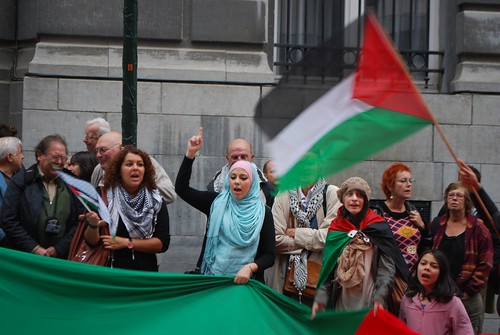
I'm at JFK about to fly back to Brussels, and all around the airport you can see signs of this week's general assembly at the United Nations. I saw several pro-Israel and pro-Palestine demonstrations scattered around the city over the past few days, mostly outside hotels where I assume diplomats and leaders were staying.

Despite the best efforts of the United States and her allies to convince him not to, Palestinian National Authority President Mahmoud Abbas went ahead on Friday with his request to have the UN recognise Palestine as a 'non-voting observer' member. The machinations around this have been described as a slow-motion "diplomatic car crash" by diplomats. Coming as it does in the middle of the 'Arab spring', the United States knows it will look bad if they use their veto in the security council to deny the request. On the other hand, their close alliance with Israel means that the US government believes it has no choice but to veto the move.

But will the US be the only one to issue the veto? And which US allies will support the bid in a full assembly vote? Europe is showing characteristic disunity on the issue. France, which also holds veto power on the security council, is supporting the Palestinian bid. Spain, Portugal, Greece, Belgium and Luxembourg have joined France with their support.

Tuesday, 1 February 2011

Better the devil you know

Both Europe and the United States have been put in an awkward position this month by the unfolding political revolt in Egypt. On one hand, they want to be consistent in encouraging democratic values and they don't want to be seen to be propping up dictatorships. On the other hand, they are terrified of the instability that could be set off by a political meltdown in the Middle East's most populous country. This is not helped by the fact that the Muslim Brotherhood is the second most powerful political force in Egypt after the regime of president-for-life Hosni Mubarak.

As the saying goes, better the devil you know than the devil you don't. Thus, the statements coming out of Brussels and Washington this week have been tepid and non-committal, stressing the need for stability over any ideological talk of overthrowing tyrants. The west is no great fan of Mubarak, but his semi-dictatorial rule has kept Egypt's strong Islamist movement in check and kept the country at peace with Israel. If he goes, there's no telling who might replace him.

The EU has come under particular criticism, as political violence has unfolded around the Mediterranean, for its slow reaction to events in its own backyard. This has been a particular embarrassment for the EU because its new diplomatic arm, the EEAS, was supposed to make Europe more decisive and reactive to foreign policy issues. And yet as one riot after the other has unfolded across the Mediterranean over the past weeks, the EU has been very restrained in its reaction.

Tuesday, 16 November 2010

David Cameron's lucky day

It's been a good day for UK Prime Minister David Cameron. This morning Britain's Prince William announced he will wed his long-time girlfriend Kate Middleton in a lavish royal wedding next year. Cameron was reportedly ecstatic when he announced the engagement to his cabinet, and it's not hard to see why. A royal wedding is exactly the sort of thing the Tories need to lift the spirits of the British public, who are suffering so much from the economic crisis and the budget cuts. In fact the engagement announcement already started fulfilling its role as a much-needed distraction today as it completely drowned out the simultaneous announcement from 10 Downing Street of a raft of new cuts including, ironically, the scrapping of legal aid for poor people getting a divorce. So while the royal family celebrates an upcoming wedding, their subjects learn it will now be harder for them to obtain an equitable separation.

Meanwhile over in Brussels, word came this morning that Cameron may get his wish for a complete freeze in the EU budget after all. Talks between member states and the European Parliament over the 2011 EU budget broke down last night. With no agreement in sight, it will mean that the 2010 budget will have to be used next year. Freezing the EU budget at 2010 levels was exactly what Cameron wanted, though this is probably not the way he wanted to get it. But Brussels was in despair today over the failure to reach an agreement, which will have very serious consequences for the EU. Both the commission and the parliament seemed to be shocked by the deliberate sabotaging of the budget that appears to have been led by the UK with the aid of their Dutch and Danish eurosceptic allies.

It was particularly shocking considering that parliament had broken precedent and completely capitulated to member states' demand that the budget not be raised by more than 3% (the parliament had originally called for a 6% raise). What appears to have happened is that certain member states are using the budget negotiations as a power play, seeking to sideline an increasingly assertive European Parliament that has sought to use the new powers it was granted by the Lisbon Treaty. The irony of the situation was lost on no one in Brussels today. The British Conservatives, who are constantly whining about the "democratic deficit" in the EU, are seeking to marginalise the only directly elected EU institution. And they are willing to play a dangerous game to do so.