The consequences of a shutdown would be dire. Unlike when a country has 'no government' - as has been the case in Belgium for about a year - a government shutdown literally means a shutdown of government services. 800,000 federal employees would be put out of work. "Essential workers" like soldiers and police officers would continue to work but would not be paid. National parks and museums would close. Government mortgages and small business loans would be halted. Economists are saying that a shutdown could put America's very fragile economic recovery in danger. Millions of people who depend on government services, like veterans or the disabled, will suddenly be on their own. And don't even try getting a passport to leave or a visa to enter the US during the shut down. All of these things will grind to a halt.
Showing posts with label budgets. Show all posts
Showing posts with label budgets. Show all posts
Thursday, 7 April 2011
US government on verge of shutdown
The consequences of a shutdown would be dire. Unlike when a country has 'no government' - as has been the case in Belgium for about a year - a government shutdown literally means a shutdown of government services. 800,000 federal employees would be put out of work. "Essential workers" like soldiers and police officers would continue to work but would not be paid. National parks and museums would close. Government mortgages and small business loans would be halted. Economists are saying that a shutdown could put America's very fragile economic recovery in danger. Millions of people who depend on government services, like veterans or the disabled, will suddenly be on their own. And don't even try getting a passport to leave or a visa to enter the US during the shut down. All of these things will grind to a halt.

Tuesday, 16 November 2010
David Cameron's lucky day

Meanwhile over in Brussels, word came this morning that Cameron may get his wish for a complete freeze in the EU budget after all. Talks between member states and the European Parliament over the 2011 EU budget broke down last night. With no agreement in sight, it will mean that the 2010 budget will have to be used next year. Freezing the EU budget at 2010 levels was exactly what Cameron wanted, though this is probably not the way he wanted to get it. But Brussels was in despair today over the failure to reach an agreement, which will have very serious consequences for the EU. Both the commission and the parliament seemed to be shocked by the deliberate sabotaging of the budget that appears to have been led by the UK with the aid of their Dutch and Danish eurosceptic allies.
It was particularly shocking considering that parliament had broken precedent and completely capitulated to member states' demand that the budget not be raised by more than 3% (the parliament had originally called for a 6% raise). What appears to have happened is that certain member states are using the budget negotiations as a power play, seeking to sideline an increasingly assertive European Parliament that has sought to use the new powers it was granted by the Lisbon Treaty. The irony of the situation was lost on no one in Brussels today. The British Conservatives, who are constantly whining about the "democratic deficit" in the EU, are seeking to marginalise the only directly elected EU institution. And they are willing to play a dangerous game to do so.
Monday, 9 August 2010
Is now the time for an EU tax?
 EU budget commissioner Janusz Lewandowski has caused some raised eyebrows in European capitals today after FT Deutschland published comments about imposing a new tax on EU citizens that would go directly to Brussels. As member states emerge from recession and are looking for cost-saving measures they will be more receptive to the imposition of this new tax, the commissioner said. But how would such an idea go down with the European public? No doubt it wouldn't be popular, but would Europeans still revolt against the tax even if it actually ended up saving them money?
Right now most of the EU budget is contributed to Brussels from member state governments, and there is no direct tax on EU citizens to pay for the bloc's administration. Taxpayers are already paying for the EU, but they do it through their taxes to the member state governments, which in turn then send money to Brussels. It would be as if in the US, you didn't pay any federal tax but only tax to your state, which then in turn sent a chunk of money to Washington each year.
What the commission may propose in September is to move some of that taxation directly to a transaction between the individual taxpayer and Brussels. It's still unclear what form this could take, but it could include an EU tax on luxury items, air travel or large financial transactions.
Tuesday, 3 August 2010
Finally the end of the road for Italy's Berlusconi?
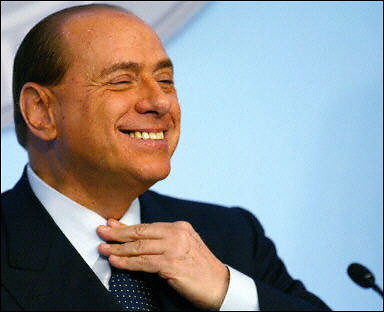
On Wednesday the flamboyant Italian leader will face a crucial vote in the Italian parliament that could finally dislodge him from power. Last week, Berlusconi had a very public falling out with Gianfranco Fini, co-founder of his own political party the conservative People of Freedom. The two men formed the party two years ago when Fini merged his Alleanza Nazionale party with Berlusconi’s Forza Italia. Fini is a former Fascist who moved to the political centre in order to be groomed by Berlusconi as his most likely successor. But in recent months tension has been brewing between the two.
By last week Berlusconi had apparently had enough. In explosive remarks to reporters in Rome, he called Fini a “traitor” who was trying to sabotage the party by stirring up dissent against Berlusconi. Fini has publicly voiced some tepid criticism of Berlusconi in the past months over the numerous sex and corruption scandals surrounding him. He has also not fully supported Berlusconi’s new rules limiting press freedom.
Tuesday, 10 March 2009
The French Strawman
 For decades, it's taken only one word to strike fear into the heart of Americans, and that word is France. Of course Americans aren't afraid of a new Napoleonic army invading the Western hemisphere, what they fear instead is the French economic model. In American political discourse, 'France' is often used not so much as a country but as an ideology; a boogey man representing a bloated welfare state with high taxation, widespread unemployment, overregulation and low productivity. It's a classic strawman argument.
Over the past two weeks, as debate has raged in the US over Barack Obama's revolutionary budget plan, the use of this anecdotal device has skyrocketed. Republicans are calling the proposed Budget the "final moves toward socialism," saying it will lead to the "Europeanization of America." Essentially, the proposed budget does three main things that have elicited this reaction:
-An introduction of higher taxes on the top 3% of income earners
-A funding mandate for definitive healthcare reform
-A massive expansion of the federal debt
David Leonhardt of The New York Times has called this budget, "nothing less than an attempt to end a three-decade era of economic policy dominated by the ideas of Ronald Reagan and his supporters. ... More than anything else, the proposals seek to reverse the rapid increase in economic inequality over the last 30 years." This editorial in the Wall Street Journal this week does a great job of breaking down the tax aspect of it.
Considering the changes afoot, it was only a matter of time before the F word started getting tossed around. On the March 2nd edition of Meet the Press, former McCain advisor Mike Murphy managed to work 'France' into the discussion over this budget a total of five times, no small feat for a short segment. According to Murphy, Obama can "hardly wait to turn us into France," and he is squandering his political capital on a "failed ideology." That ideology, a democratic social welfare state, is not only reviled by American conservatives but has also been deeply unpopular with Americans for decades, particularly after the Reagan revolution. Socialism in most Americans' minds is inseparable from Communism, which any American fifth grader can tell you was a failed ideology which the US triumphantly defeated in the cold war. So for some time the logic has been that if you can associate a policy with 'socialism,' or even better, with 'France,' you're going to have a pretty easy time making the policy unpopular with the American public (one only needs to look at the so-called "Death Tax" debate).
 But in invoking the old France cliches, are Republicans missing the way the winds are currently blowing? Isn't it a bit odd that, at the same time that Republicans are trying to scare the American population by saying Obama wants to turn them into France, across the Atlantic Sarkozy is proclaiming the death of the Anglo-Saxon model of capitalism and the vindication of the European social model? If the French economic system translates to more regulation on banks and financial firms, more safety-net protections for people who lose their jobs, and more government action to protect the economy, what exactly is it in that image that would scare an American in 2009? Considering that the current crisis was largely the result of a lack of regulation in the US, 'Anglo-Saxon style capitalism run amok,' if you will, it seems almost absurd for Republicans in the US to still be using the French boogeyman tactic. They seem to be saying, "Look out America! Or else you could become like that country where everyone has healthcare, job security and pensions!" I'm oversimplifying of course, and I don't usually find myself in the position of being a strident defender of the French economic model, but it seems to me that Republicans don't have much of a leg to stand on here if they want to keep using the France-baiting.
I was curious to get the reaction of some of my French friends to this kind of talk. After all, they must have an opinion on the fact that their country still stands as the antithesis of America's self-image, the boogeyman in the closet children remain terrified of at bedtime. "I think it's funny," one French friend who works for the EC told me after seeing some of the comments being made in the US media. "In France we do the same thing with America if we want to scare people about Sarkozy. They say he is 'Sarko the American' and that he's trying to make France become America. That scares the French probably as much as Americans are scared to become France."
As we edge closer to a hammering out of the new "Bretton Woods 2" agreement that will reshape the world's economic structure, this France-America ideological labelling is likely to get even murkier. The ideal solution, as with most things, is probably a happy medium somewhere between the two.
Subscribe to:
Posts (Atom)