Showing posts with label finance. Show all posts

Wednesday, 28 September 2011

EU banker tax? UK says no

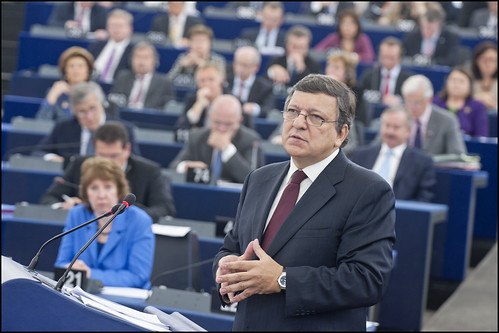
"In the last three years member states - I should say taxpayers - have granted aid and provided guarantees of €4.6 trillion to the financial sector. It is time for the financial sector to make a contribution back to society. That is why I am very proud to say that today, the Commission adopted a proposal for the Financial Transaction Tax."

With these words European Commission President Jose Manuel Barroso put forward what is bound to be an enormously controversial piece of EU legislation, a transaction tax on bankers and investors who invest in stocks, bonds and derivatives. Speaking to the European Parliament in Strasbourg today for his annual 'state of the union' address, Barroso said the tax would bring in €55 billion per year, starting from 2014.

The language used by the president was clearly populist in nature, emphasising a sense of fairness and responding to a public feeling that the bankers who caused the economic crisis of 2008 have never been called to account and have not been asked to contribute to the recovery from the pain they caused. Stock markets and investment firms have made remarkable recoveries over the past few years, and executive pay has steadily risen. But at the same time the economy as a whole has suffered enormously and continues to suffer.

Monday, 9 August 2010

Is now the time for an EU tax?

EU budget commissioner Janusz Lewandowski has caused some raised eyebrows in European capitals today after FT Deutschland published comments about imposing a new tax on EU citizens that would go directly to Brussels. As member states emerge from recession and are looking for cost-saving measures they will be more receptive to the imposition of this new tax, the commissioner said. But how would such an idea go down with the European public? No doubt it wouldn't be popular, but would Europeans still revolt against the tax even if it actually ended up saving them money?

Right now most of the EU budget is contributed to Brussels from member state governments, and there is no direct tax on EU citizens to pay for the bloc's administration. Taxpayers are already paying for the EU, but they do it through their taxes to the member state governments, which in turn then send money to Brussels. It would be as if in the US, you didn't pay any federal tax but only tax to your state, which then in turn sent a chunk of money to Washington each year.

What the commission may propose in September is to move some of that taxation directly to a transaction between the individual taxpayer and Brussels. It's still unclear what form this could take, but it could include an EU tax on luxury items, air travel or large financial transactions.

Thursday, 3 December 2009

France and Britain go to war over regulator

A war is looming between Britain and France, and Nicolas Sarkozy has his missiles pointed squarely at the City of London.

The French president made some unusually undiplomatic comments this week gloating over his Agriculture Minister, Michel Barnier, being appointed as European Commissioner for the internal market. That position is one of the most important in the EU, especially as the world recovers from the shock of the economic crisis.

He boldly and defiantly blamed the economic collapse on the “free-wheeling Anglo-Saxon” (aka British and American) economic model, saying, “I want the world to see the victory of the European model, which has nothing to do with the excesses of financial capitalism." He said the fact that a Frenchman had been appointed, while the EU had refused to even consider a Brit for the position - despite Gordon Brown’s pleading - reflected how discredited the Anglo-Saxon model has become. The bravado was an indication that Sarko intends to push Barnier hard to create a pan-EU financial regulator based on the continental European economic model that would have power over the City of London (London’s financial centre).

It was a remark seemingly calculated to elicit the most fury possible across the channel, and boy did it work. UK Chancellor Alistair Darling almost immediately put pen to paper to fire back in an editorial in the Times, saying:
"National supervisors, such as the FSA, must remain responsible for supervising individual companies…The reality is the real competition to Europe's financial centres comes from outside our borders. And that London, whether others like it or not, is New York's only rival as a truly global financial centre."
Darling signalled that he would go into Wednesday’s meeting of European finance ministers with an uncompromising stance against a pan-EU regulator that could supersede the British authorities. And thus the first Franco-British battle for economic reform commenced.

The first skirmish

The European Commission has drawn up plans for three new supervisory authorities to oversee banks, insurers and investment firms. In addition a separate body, the European Systemic Risk Board, would oversee the wider stability of the European financial system as a whole. Though the national regulators would be involved with it, it would be led by the European Central Bank. This last part would be highly controversial in Britain since it does not use the Euro and is currently not beholden to the bank in any way.

Yesterday’s meeting appears to have been a draw. Both Germany and France went in pushing hard for powerful EU supervisory bodies, but by all accounts Darling was equally fierce in his opposition to them. French finance minister Christine Legarde came out saying they had found a compromise, adding “Not everyone was on the same wavelength.”

Darling came out of the meeting insisting he had negotiated a guarantee that the EU regulator could not supersede national regulators, and it could not force states to pay up for taxpayer bailouts.

But in essence both his guarantees and Legarde’s calming words are premature. The ministers only agreed on the most general of outlines for the plan yesterday, and much still has to be worked out. The thought from some in parliament is that the big ‘macroeconomic’ authority and three ‘microeconomic’ groups are being split up as a purposeful distraction. Guy Verhofstadt, the leader of the Liberals in the parliament who favours a strong authority, indicated after the meeting that the parliament will attempt to bypass this “trick” by voting on both bodies as one. He said after the meeting:
"This "forced agreement" is difficult to understand. Member States are repeatedly saying they want a single market for financial services, but now that the time has come to agree on the basic principle of creating supra-national supervisory authorities, some of them appear totally reluctant". Moreover, by separating micro-prudential supervision from the macro-prudential one, Council tries to impose its own views and its own agenda. But the European Parliament as co-legislator will play its full role and has already decided to consider the proposals on micro and macro prudential supervision as a whole."
What comes out of this is anybody’s guess. A column in today’s Wall Street Journal suggested that the Square Mile was overreacting and taking Sarko’s bait, and the paper seems confident that in the end the city will not be regulated from Brussels. But if I were a betting man, I wouldn’t be putting my money on Britain winning this fight.

The UK already has dimished influence in Brussels because of its lack of engagement. And with a weakened government that will be preoccupied in the coming months with an election it is sure to lose, I don’t see them as being a very difficult foe to vanquish.

This is a shame really. As badly as financial reform is needed, Darling is correct to say that London is the leading financial centre of Europe and should have a significant say in new regulatory structures, regardless of the sins the city and its hedge funds have committed in the past to get us into this mess. One should keep in mind that Merkel and Sarko’s push for a strong EU financial regulator with power over the city is not entirely altruistic. Part of their motivation is a desire to scale down the city’s prominence in the European financial sector and give more power to Frankfurt and La Defense.

But as some commentators have pointed out, if the EU overegulates without some reform from its trading partners, there is a risk that financial services companies will flee Europe altogether. Rather than moving from Britain to France and Germany, they could be more likely to high tail it over to Switzerland.

And speaking of Switzerland, I’m about to get on a plane to fly there. My dad is having a belated Thanksgiving dinner. I’m wondering if the minaret ban vote will come up during the dinner conversation with his Swiss colleagues. It could be an interesting night!

Saturday, 4 October 2008

Verdict Is In: Europe will Respond Nationally

It looks like the question I posed in yesterday's post has been answered. In a press conference just now over at the Elysee Palace, the leaders of the European countries in the G8 laid out a very general plan for dealing with the crisis in Europe, after meeting all day to figure out what to do. And the verdict in, Europe will go forward with reforms on a national level, and there will be little in the way of a EU-wide policy. Sarkozy had reportedly been seeking an EU bailout fund similiar to the one just passed in the US, but apparently Angela Merkel was very opposed to any such plan. So European Commission President Jose Manuel Barroso announced that the EU will temporarily relax its competition rules to allow individual countries to undetake sweeping changes such as Ireland's decision last week to guarantee deposits in Irish banks.

So in the end, it appears the leaders decided the EU was just not ready to deal with a crisis of this magnitude. They said that the response by individual EU nations would be "coordinated," but they were short on details of what that might mean. At the same time, they were very specific about what they will be calling for when they meet with the wider G8.

Wednesday, 19 September 2007

EU slaps Microsoft, big energy

It’s been interesting to watch the very different coverage on either side of the Atlantic of the EU anti-trust ruling against Microsoft. While in Europe the ruling has been largely heralded, especially on the continent, in the US the coverage has been akin to something straight out of a World War I warning of the hun menace.

Even the New York Times coverage seems to suggest that the ruling is going to do tremendous damage to competition in the IT sector. The logic seems to be that big companies are the only companies that understand how to innovate or compete, and stifling them is going to cause a slowdown of growth.

On the other hand in Europe, there were huge sighs of relief coming from Brussels Monday. Considering the European Commission’s reputation as a crusader for consumers and competition, it would have been greatly damaged if the court hadn’t upheld their orders. Monday’s ruling is the result of nearly ten years of work by the EC to deal a blow to what they see as Microsoft’s monopoly over the software industry.

Monday, 17 September 2007

ECB on Northern Rock: What Northern Rock?

It’s official. The UK has become the first country to have a bank run caused by the current market turbulence. The run on Northern Rock bank that started on Friday and is continuing today is sending the public here into a panic. British commentators are speculating that there could be another Black Wednesday around the corner, while the Bank of England is trying to reassure the public that there’s nothing to be alarmed about.

Northern Rock is Britain’s fifth largest mortgage lender and is a massive bank here. So when news broke on Friday that the bank is going broke because of the worldwide credit crisis and the Bank of England has bailed it out with a limitless line of credit, the bank’s customers ran to the branches and started queuing to get their money out in cash. It was really insane, I walked by a branch on Friday and it was complete pandemonium, like that bank run scene in It’s a Wonderful Life.

Monday, 20 November 2006

The pitfalls of market regulation

Here's some interesting news this morning from London. The NASDAQ has made a proposal to buy the London Stock Exchange. The LSE has rejected the first offer, but analysts are saying they expect this deal to eventually go through.

This is interesting for a variety of reasons. This will now mean that two of the major stock exchanges in Europe will be owned by American exchanges. The New York Stock Exchange has just about completed its acquisition of the Euronext, a Paris-based Europe-wide exchange.

So at first glance this would look like bad news for Europe and good news for the US right? In fact, it’s the opposite. It’s important to point out that the reason these acquisitions are happening is not because the US is riding in on a white horse to prop up the European exchanges and help them grow. They’re grabbing them because the European exchanges have been so wildly successful in the past few years, outperforming their American counterparts.