The US claims the EU's Apple decision is “political”, but it is the American reaction that is guided by politics. And US disrespect for EU law has a long history.
In the summer of 2001, the US government was furious with the European Union.
Iconic American firm General Electric had just seen a multi-billion dollar merger with Honeywell, which had already been cleared by the US, blocked by the European Commission on competition grounds. US politicians were furious, business leaders were flabbergasted.
Two years later, the newly-emboldened Commission struck again. It slapped a €497 million fine on American tech giant Microsoft for abusing its dominant market position. Again, there was much sabre-rattling in Washington.
Showing posts with label taxes. Show all posts
Wednesday, 31 August 2016
Wednesday, 28 September 2011
EU banker tax? UK says no
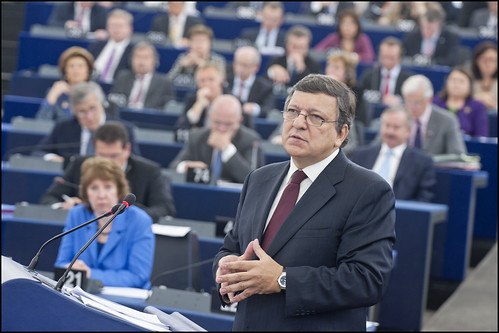
"In the last three years member states - I should say taxpayers - have granted aid and provided guarantees of €4.6 trillion to the financial sector. It is time for the financial sector to make a contribution back to society. That is why I am very proud to say that today, the Commission adopted a proposal for the Financial Transaction Tax."With these words European Commission President Jose Manuel Barroso put forward what is bound to be an enormously controversial piece of EU legislation, a transaction tax on bankers and investors who invest in stocks, bonds and derivatives. Speaking to the European Parliament in Strasbourg today for his annual 'state of the union' address, Barroso said the tax would bring in €55 billion per year, starting from 2014.
The language used by the president was clearly populist in nature, emphasising a sense of fairness and responding to a public feeling that the bankers who caused the economic crisis of 2008 have never been called to account and have not been asked to contribute to the recovery from the pain they caused. Stock markets and investment firms have made remarkable recoveries over the past few years, and executive pay has steadily risen. But at the same time the economy as a whole has suffered enormously and continues to suffer.
Wednesday, 18 May 2011
Merkel to Southern Europe: work more, play less
Workers in Southern Europe shouldn't enjoy more vacation and earlier retirement ages than their Northern European counterparts, German Chancellor Angela Merkel told a meeting of her Christian Democratic Union party last night. The comments, highly surprising coming from this usually cautious and analytical politician, have been greeted by applause from the right-leaning papers in Germany today."People in countries like Greece, Spain and Portugal should not retire earlier than in Germany. We should all make the same efforts, this is important," German press agency DPA quotes Merkel as saying. "We cannot have a common currency where some get lots of vacation time and others very little. That won't work in the long term."The notoriously early retirement ages in Southern Europe have been a cause of serious griping in Germany since the country was forced to foot most of the bill to bail out Greece and Portugal over the past year. In Greece and Italy, a person can retire as early as 57. In Germany a person can't retire earlier than 65, and Merkel's government has voted to raise that to 67 over the next three years. Part of the conditions of Greece receiving its EU-IMF bailout was that it introduce reforms to raise the retirement age to 63.
Thursday, 14 April 2011
When tax policy and climate change collide
Generally, there are few areas in which the fiercely eurosceptic English public thinks EU regulation serves a useful purpose. One of those areas has traditionally been climate change. Even the Conservatives, the most anti-EU of the three main British parties, have highlighted the constructive role EU legislation can play in Europe's efforts to fight climate change. The EU is good as a free trade block and as a way of pooling efforts on climate change, they say, but it should stay out of areas best dealt with by member states such as taxation, finance, immigration, health and safety, transport and human rights.
The problem is it isn't that simple. Efforts to combat climate change in a coordinated pan-European way must by definition spread into many sectors, including all of those mentioned above. This conundrum was evident yesterday when the European Commission presented its plans to revise the EU energy taxation directive in a way that would change fuel taxes to make them more in line with climate change goals.
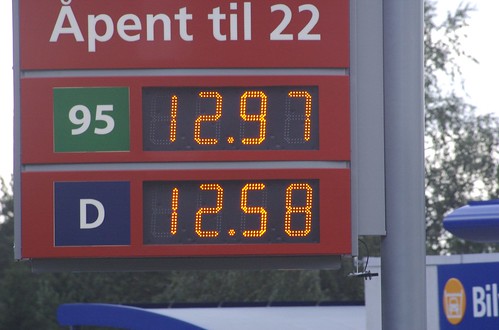
Saying the existing EU rules dating from 2003 are "outdated and inconsistent", the commission has proposed setting a minimum rate at which member states can charge fuel tax based on the carbon dioxide emitted and the energy produced rather than on the volume of the fuel. This would end the situation where renewable fuels are taxed the same as fossil fuels and some of the least energy-efficient fuels are taxed less than more energy-efficient ones. Fuel taxes have actually decreased by 10 cents per litre since 1999.
The problem is it isn't that simple. Efforts to combat climate change in a coordinated pan-European way must by definition spread into many sectors, including all of those mentioned above. This conundrum was evident yesterday when the European Commission presented its plans to revise the EU energy taxation directive in a way that would change fuel taxes to make them more in line with climate change goals.
Saying the existing EU rules dating from 2003 are "outdated and inconsistent", the commission has proposed setting a minimum rate at which member states can charge fuel tax based on the carbon dioxide emitted and the energy produced rather than on the volume of the fuel. This would end the situation where renewable fuels are taxed the same as fossil fuels and some of the least energy-efficient fuels are taxed less than more energy-efficient ones. Fuel taxes have actually decreased by 10 cents per litre since 1999.
Wednesday, 2 March 2011
Low taxation of company cars: a perverse incentive to pollute?
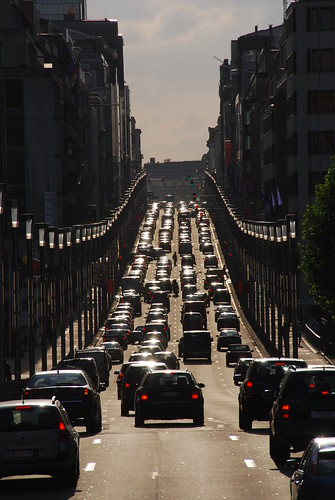
As residents of Brussels know all too well, this is a car city. Sure, there's an efficient metro system – but it has only two lines and doesn't cover large swathes of the city's more affluent areas, which are instead covered by glacially slow trams and buses. The city is small enough to be easily covered by bike, but the extremely poor quality of the roads, the hilly terrain and the lack of cycle lanes often make cycling here more of a nuisance than it's worth (take it from a cyclist). That leaves only driving by car, an activity I would say the vast majority of my friends here are engaged in.
I myself have never owned a car, having always lived in large cities with good public transport systems. I still don't own a car in Brussels, but after living here a year I can say I've never before felt such temptation to get one. Not necessarily because I have difficulty getting around here. Despite its flaws I find the public transport to be sufficient for my needs, and when it's not I go by bike. But I feel like a bit of an oddity sometimes for getting around the city by metro, tram and bike. Peer pressure? Car envy? I'm not sure, but the fact that most of my friends drive is making me suddenly want a set of wheels. By contrast, none of my friends in London or New York had cars.
But if the Brussels public transport system is sufficient, why do all of these white collar workers I'm friends with – many of whom are only in Brussels temporarily – have cars? The answer is simple – Belgium pays them to have one.
I myself have never owned a car, having always lived in large cities with good public transport systems. I still don't own a car in Brussels, but after living here a year I can say I've never before felt such temptation to get one. Not necessarily because I have difficulty getting around here. Despite its flaws I find the public transport to be sufficient for my needs, and when it's not I go by bike. But I feel like a bit of an oddity sometimes for getting around the city by metro, tram and bike. Peer pressure? Car envy? I'm not sure, but the fact that most of my friends drive is making me suddenly want a set of wheels. By contrast, none of my friends in London or New York had cars.
But if the Brussels public transport system is sufficient, why do all of these white collar workers I'm friends with – many of whom are only in Brussels temporarily – have cars? The answer is simple – Belgium pays them to have one.
Thursday, 27 January 2011
"Yes, but is it art?" EU says no
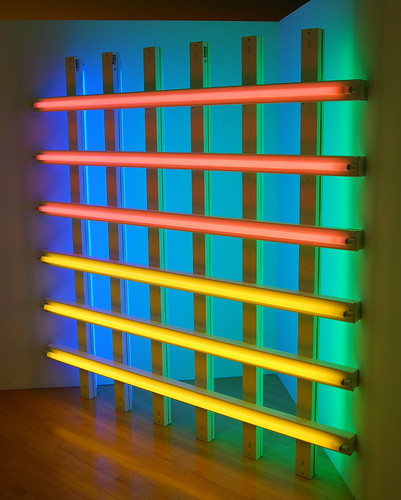
The art world is all aflutter this month after word got around that the European Commission has decided that a light installation by Dan Flavin that was on display in a London museum cannot be considered "art".
Back in 2006, an oddly-named London modern art gallery called Haunch of Venison decided to display Flavin's 1973 work Six Alternating Cool White/Warm White Fluorescent Lights Vertical and Centred along with Bill Viola's 1995 work Hall of Whispers. Both of these works had to be imported from the United States. They were shipped with the customs classification of 'works of art,' which benefit from a special EU value-added (sales) tax of 3.7%.
But when the works arrived at the UK border, Her Majesty's Revenue and Customs decided that the assortment of fluorescent lights and projectors that made up the installations were not art but rather light fittings and audiovisual equipment. They were charged the normal tax rate of 17.5%. But bizarrely, while classifying the materials as 'not art' for the purpose of their tax rate, they decided to assess the value of the components based not on their worth as light fittings and video equipment but on their market value as works of art - a huge amount of money.
Back in 2006, an oddly-named London modern art gallery called Haunch of Venison decided to display Flavin's 1973 work Six Alternating Cool White/Warm White Fluorescent Lights Vertical and Centred along with Bill Viola's 1995 work Hall of Whispers. Both of these works had to be imported from the United States. They were shipped with the customs classification of 'works of art,' which benefit from a special EU value-added (sales) tax of 3.7%.
But when the works arrived at the UK border, Her Majesty's Revenue and Customs decided that the assortment of fluorescent lights and projectors that made up the installations were not art but rather light fittings and audiovisual equipment. They were charged the normal tax rate of 17.5%. But bizarrely, while classifying the materials as 'not art' for the purpose of their tax rate, they decided to assess the value of the components based not on their worth as light fittings and video equipment but on their market value as works of art - a huge amount of money.
Wednesday, 8 December 2010
Is Obama the world's worst negotiator?
Barack Obama is being attacked by his own party this week after a massive capitulation to Republicans giving large tax cuts to the wealthiest two percent of Americans. For Democrats, two years of frustration over the president's frequent urge to compromise with the opposition while getting nothing in return seems to have bubbled over and exploded in a torrent of anger. From pundits to politicians, many Democrats were furious on Tuesday over what they see as Obama's lack of appetite for political fights. There was talk of a party revolt in the congress, with Democrats saying they would vote against the Obama-backed deal. The anger got so loud that the president was forced to summon a hastily arranged press conference where he forcefully defended himself against the accusations by his own party and insisted he is indeed a fighter. But his speech, which at times seemed dismissive of the disappointment felt by his own party, has done little to quell the fury. Take a look some choice clips from the speech in this video clip below.
Monday, 9 August 2010
Is now the time for an EU tax?
EU budget commissioner Janusz Lewandowski has caused some raised eyebrows in European capitals today after FT Deutschland published comments about imposing a new tax on EU citizens that would go directly to Brussels. As member states emerge from recession and are looking for cost-saving measures they will be more receptive to the imposition of this new tax, the commissioner said. But how would such an idea go down with the European public? No doubt it wouldn't be popular, but would Europeans still revolt against the tax even if it actually ended up saving them money?Right now most of the EU budget is contributed to Brussels from member state governments, and there is no direct tax on EU citizens to pay for the bloc's administration. Taxpayers are already paying for the EU, but they do it through their taxes to the member state governments, which in turn then send money to Brussels. It would be as if in the US, you didn't pay any federal tax but only tax to your state, which then in turn sent a chunk of money to Washington each year.
What the commission may propose in September is to move some of that taxation directly to a transaction between the individual taxpayer and Brussels. It's still unclear what form this could take, but it could include an EU tax on luxury items, air travel or large financial transactions.
Tuesday, 13 July 2010
Sarko pleads his case as l'Oréal crisis deepens
The scandal that has rocked the French political class for weeks came to a dramatic climax last night, as French President Nicolas Sarkozy took to the airwaves to assure the public he is innocent of the charges leveled against him. The allegations are part of a complicated web that originally sprang from a lawsuit involving France’s richest woman, l'Oréal heiress Liliane Bettencourt.In what the French press was calling the most important interview of his presidency, Sarkozy strongly denied, in vigorous and often aggressive terms, that his 2007 presidential campaign was partly financed by illegal donations of cash stuffed in brown envelopes from the 87-year-old heiress.
It is a scandal that has threatened to sink Sarko’s presidency, coming at a time when he is suffering the lowest poll ratings since he came to power and right before his big push to make major cuts to the French budget and raise the retirement age from 60 to 62. It is a push that has met with fierce opposition.
Thursday, 23 April 2009
Who's Going to Pay?
Yesterday was “budget day” here in the UK, a day of huge significance to the British calendar and psyche with events lasting the whole week. Whereas in the US the budget is usually unveiled without a whole lot of fanfare or media attention (with the notable exception of Obama’s first budget this year), in the UK there’s a big hullabaloo around it, with the Chancellor of the Exchequer (for the most part the equivalent of the treasury secretary in the US) walking from 11 to 10 Downing Street clutching a ceremonial briefcase containing the all-important document, which will by that point already have been ceremonially presented to the Queen the day before. He then delivers an address to the parliament which is the first public unveiling of the plan, and that evening he makes a televised speech to the nation explaining his rationale. This is followed the next several nights by speeches from the leaders of the opposition parties.It’s perhaps telling that yesterday’s budget day was so momentous and yet as usual, St. George’s Day today (England’s patron saint's day) was completely ignored. I didn’t even realize it was St. George’s Day until I happened to notice a sad little steel drum performance celebrating it in Hammersmith this afternoon while getting lunch.
Budget Day is always a big deal here, but this year it was attracting a particular amount of attention. Everyone knew that this was going to be a momentous budget, both in terms of the dire state of the economy the Labour government would have to reveal and in terms of the drastic measures everyone assumed were going to need to be taken. But despite being primed for eye-popping numbers by the bank bailouts last year, The City seemed to be absolutely shocked by the astronomical amount of debt Chancellor Alistair Darling announced yesterday. UK debt was set to reach a whopping £1.4 trillion in 2009 - equivalent to almost 80 per cent of the UK’s economy. Collapsing tax revenues, the chancellor admitted, will mean he will have to borrow £175 billion in 2009,12.4 percent of GDP. That will be the biggest annual deficit for the UK ever in peacetime.
And yet Darling seemed to offer little in the way of spending cuts or tax rises in order to pay off that debt. His announcement of a tax hike to 50 percent for people making over £150,000 may have raised eyebrows (while not uncommon on the continent such a tax rate in the UK hasn’t been seen in a very, very long time), but cynics in the UK suspected it was a cheap ploy to distract the media from the larger issue – the huge amount of debt announced. The budget included no rise in the tax rate for the middle class, and the reality is that those who make large sums of money are usually pretty adept at getting out of paying tax rises, so the 50% tax rate is likely to raise little revenue. The British media seems to have almost uniformly assumed that the Labour Party will not be in power much longer, but perhaps the real question now is what exactly will the Tories be inheriting if they take over the government next year? Eventually someone’s going to have to pay for all this expenditure, as necessary as it may be, and who is going to deliver the bad news to the middle class that they are going to have to chip in? It’s a surefire election loser, but with his plummeting poll numbers it would have been interesting to see Brown fall on his sword and broadly raise taxes to pay for the debt, knowing it would guarantee a Labour defeat in the upcoming election.
Tea-Bagging Across the Pond
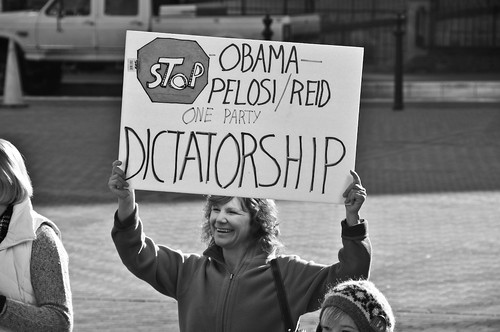
Interestingly, the same issue is being wrestled with across the pond in the US. Barack Obama’s budget will allow the Bush tax cuts on the rich to expire, and will increase the tax burden on the top two percent of income earners. The rest of the population will either see their tax rate remain the same or decrease. Of course this didn’t stop legions of blue-collar “tea-bagging” protesters from turning out on the streets last Wednesday (“tax day,” in the US, a day perhaps of equivalent symbolic importance to ”budget day” in the UK) to decry Obama as a fascist who will tax all Americans into oblivion. Left-leaning media outlets have been at lengths to point out that 99 percent of the people out at those protests won’t see their taxes go up at all under Obama’s plan (although the people organizing those protests, Fox News and lobbying groups like Freedom Works – which interestingly enough also represents AIG – will). The American left used to scream in frustration that the working class was being hoodwinked by Republicans who used an appeal to social issues to get the working class to vote against their own economic interest. Now with the tea-bagging protests, the left has been observing is disbelief that Republicans now seem to be able to convince them to vote against their own economic interest based on an appeal to economic issues somehow as well. It's a strange country.
But despite the left's dismissal of them as mindless sheep, perhaps the tea-bagging protesters are on to something. While it is true their taxes aren't going up right now, they know that with the huge amount of expenditure being spent to rescue the global economy from collapse, someone's going to have to pay for it. And really, why not the tea-baggers? More than a few people have pointed out that these are the same people who enthusiastically supported the Iraq War and the huge expansion of the government with the establishment of the Department of Homeland Security. Now they're taking to the streets to protest the fact that they might possibly be asked to pay for it.These are extraordinary times, and they will likely call for extraordinary levels of sacrifice from all people. Sooner or later, the middle class is going to have to contribute financially to solving the mess. The problem, on both sides of the Atlantic, is that nobody wants to be the one who has to tell them that.
Thursday, 19 February 2009
Switzerland Opens the Bank Floodgates
Since 1934 Switzerland has relied on a pledge of secrecy to fill the coffers of its massive banking system. According to the Swiss Banking Association, 27 percent of all privately held offshore assets are located in Switzerland. The result has been that the country's economy is heavily reliant on the banking industry, with two of the world's largest financial institutions, Credit Suisse and UBS, being the pride of the country. The US Internal Revenue Service had filed criminal charges against UBS, accusing it of helping Americans avoid paying US tax by opening Swiss bank accounts and demanding that it hand over client data. Under Swiss law UBS wasn't allowed to turn over those records, so UBS petititioned the government to allow it to do so, saying that if they didn't their very existence would be at risk. Yesterday the Swiss Financial Market Supervisory Authority said it would allow the release, throwing Swiss market analysts into a panic. Many are saying the government's decision was unnecessary and premature, and could put the whole Swiss banking system at risk.
But although Europe's been gunning for the tax havens for some time, it looks like it is the IRS that's delivered the knock-out punch. The Swiss government was at pains today to insist that the ruling is an isolated case and will have no bearing on such negotiations with the rest of Europe. But it's undeniable that the decision is likely to encourage the EU and individual countries to pursue similar criminal action against Swiss banks in order to force their hand. And now that the precedent has been set, it will be hard for the Swiss government to block those requests in the future. As the economic crisis continues to worsen, governments will be keen to grab additional revenue wherever they can. Some of that may now come from unpaid taxes sitting in Swiss banks.
Wednesday, 5 March 2008
Tax cheat focus continues
Following recent moves by Germany to force Liechtenstein to crack down on tax cheats, the European Union is going a step further, effectively declaring battle today with Liechtenstein, Monaco, Andorra and Switzerland in their ‘war on super-rich tax cheats.’
The EU's council of economics and finance ministers, or Ecofin, is meeting in Brussels today to hammer out a strategy to force Europe’s tax havens into submission. They plan to do so by strengthening the EU’s 2005 savings tax directive, through which the ‘tax haven nations’ have easily been able to find loopholes.
What they’re going after is the increasingly common practice of very wealthy citizens of European countries domiciling themselves in small nations outside the EU with loose tax laws. Germany has recently gone hard after the practice, led by finance minister Peer Steinbruck, who says the tax cheats cost Germany approximately €30 billion in lost revenue.
The EU's council of economics and finance ministers, or Ecofin, is meeting in Brussels today to hammer out a strategy to force Europe’s tax havens into submission. They plan to do so by strengthening the EU’s 2005 savings tax directive, through which the ‘tax haven nations’ have easily been able to find loopholes.
What they’re going after is the increasingly common practice of very wealthy citizens of European countries domiciling themselves in small nations outside the EU with loose tax laws. Germany has recently gone hard after the practice, led by finance minister Peer Steinbruck, who says the tax cheats cost Germany approximately €30 billion in lost revenue.
Monday, 3 March 2008
Liechtenstein licked?
An interesting story is developing over Switzerland's impending entry into a border-free Europe. It looks like its tiny neighbor Liechtenstein may see its status as a tax haven challenged as a result of the change.
Switzerland is not part of the European Union, but the treaty which has dismantled the internal borders of continental Europe actually has nothing to do with the EU. It is a separate treaty called the Schengen Treaty (named after the town in which it was signed) and membership in the so-called "Schengen Zone" is separate from membership in the EU.
Switzerland is set to enter the zone in November, so after then there will be two large non-EU nations in the zone (Switzerland and Norway) and two large EU nations not in the zone (the UK and Ireland). There will also be no border between Switzerland and its neighbors. Good thing my brother and I got this picture at the France-Switzerland-Germany border while we could!
Switzerland is not part of the European Union, but the treaty which has dismantled the internal borders of continental Europe actually has nothing to do with the EU. It is a separate treaty called the Schengen Treaty (named after the town in which it was signed) and membership in the so-called "Schengen Zone" is separate from membership in the EU.
Switzerland is set to enter the zone in November, so after then there will be two large non-EU nations in the zone (Switzerland and Norway) and two large EU nations not in the zone (the UK and Ireland). There will also be no border between Switzerland and its neighbors. Good thing my brother and I got this picture at the France-Switzerland-Germany border while we could!
Subscribe to:
Posts (Atom)