
Showing posts with label climate change. Show all posts
Showing posts with label climate change. Show all posts
Monday, 27 November 2017
The coalitions podcast: chaos in Berlin, calm in Bonn

Tuesday, 1 August 2017
Is Berlin overthinking dieselgate and Russia sanctions?
Friday, 28 July 2017
The German autostate

The allegations that have surfaced this month against German automakers seem to confirm the worst suspicions that many in Europe hold about the EU’s largest country: while they insist on rigid enforcement of rules for everyone else, Germans seem to think the rules don’t apply to them.
A report by Der Spiegel magazine last week alleged that Germany’s five biggest automakers - Volkswagen, BMW, Daimler, Porsche and Audi - have been colluding for two decades on pricing, suppliers and diesel technical standards, in order to give them leverage over foreign competitors. This week the European Union said it is investigating the issue, and has appointed a vice president to oversee the investigation.
Thursday, 20 July 2017
“Why are you still here?”

This week, the difficult negotiations over the UK’s exit from the European Union began in earnest in Brussels. David Davis, the UK’s chief negotiator, squared off against Michel Barnier, his EU counterpart.
Davis called for both sides to “get down to business” for arranging a swift British exit from the EU. He then promptly went back to London, 60 minutes later. He gave no explanation for his own swift departure, which left the EU negotiators perplexed. Just days earlier, Barnier had warned the UK that it is is running out of time to negotiate its exit, which must be completed by March 2019. “The clock is ticking” he said sternly.
Wednesday, 9 December 2015
Germany sticks its neck out again - this time on climate
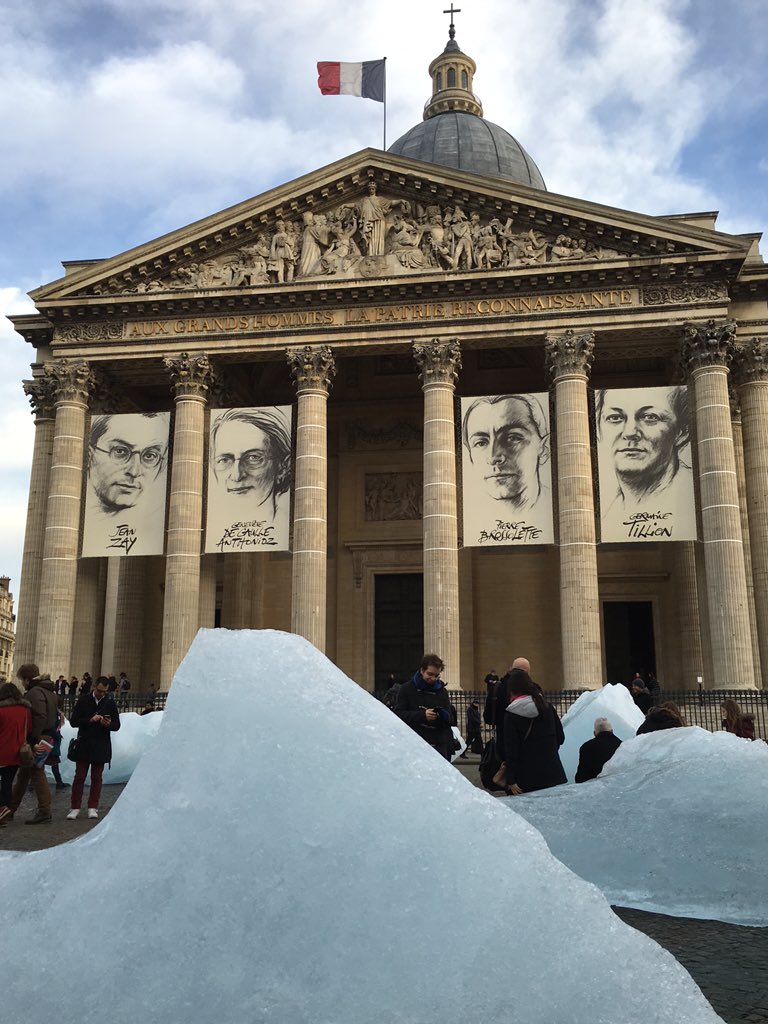
I'm in Paris this week for the big climate change summit, and it's very interesting to be here and compare it to Copenhagen five years ago. That summit, which notoriously collapsed in failure, was an absolute chaotic mess. This one, by contrast, is much calmer.
There are two reasons for this. For one, most of the groundwork has already been done before this summit. Secondly, the ambition level this time around is much lower - most notably because the reduction targets will not be legally binding.
Friday, 11 April 2014
The greenest government ever?

In May 2010, David Cameron, the UK's prime minister, made a bold claim. As he finalised talks on forming a governing coalition with the Liberal Democrats, he told an audience of civil servants that his would be “the greenest government ever”.
It is a claim that Cameron may have come to regret. Over the past four years, the quote has been repeatedly thrown back at him by environmentalists upset over a variety of issues – whether cuts to renewable energy subsidies or fracking for shale gas. Yet Cameron has maintained that his government is doing more to combat climate change than any previous UK government, and that the UK is playing a more constructive role in the climate fight than other European countries.
But green campaigners say this claim is hard to justify when you look at the voting record of Conservative members of the European Parliament. An analysis by campaign group CAN Europe published this week, scoring MEPs based on how they voted on ten key pieces of climate legislation over the 2009-14 term, ranks the British Conservatives among the worst parties in the Parliament for climate action.
Thursday, 9 January 2014
Target fatigue

The EU's attitude toward targets has changed dramatically over the past five years.
Back in the heady days of 2008, before the European Union
was plunged into a period of crisis around both its currency and its
legitimacy, setting hard targets for solving the climate change problem was all
the rage. Flash forward to 2014 and the world is a very different place.
The European Commission is planning to come forward later
this month with a proposal to set new climate targets for 2030. These would
follow the '20-20-20' package set in 2008: 20% emissions reduction based on
1990 levels, 20% share of renewable energy and 20% increase in energy
efficiency. The first two targets were binding, while the third was indicative.
For 2030, the Commission is going to try a different tact.
The emissions target strategy will remain roughly the same – a binding target
increased to 40% for 2030 (though this is still subject to some internal
wrangling in the Commission). But for the renewable energy target, there is
likely to be a shift in strategy. The draft proposal being submitted for review
within the Commission tomorrow will make the 2030 target non-binding, without
individual legally-enforceable targets for member states.
Wednesday, 4 December 2013
Caving in on the cave-in

The humiliating saga of the ETS aviation dispute has exposed the limits of respect for EU law, both outside and inside Europe.
It's not looking good for the European Commission's proposal to undo an EU law that would have charged all airlines for the emissions of flights taking off or landing in Europe. An increasing number of member states and MEPs are coming out in opposition. But they don't have a problem with the retreat. They say the Commission isn't retreating far enough.
Last week Germany, France and the UK told a meeting of member states that they want to change the proposal to a more complete surrender.
In October, in response to intense international pressure, the Commission proposed to change the law so that emissions that take place outside EU air space are exempt. But Germany, France and the UK want to exempt foreign airlines from the Emissions Trading Scheme (ETS) entirely - even for the portions of flights that take place within EU airspace - because anything less would not be politically acceptable to China, India, Russia and the United States.
Tuesday, 26 November 2013
Climate nationalism

Many having given up on the international process delivering solutions to climate change, and eyes are turning to national solutions to fill the void.
But travel upstairs to the ‘national pavilions' located at the top of the stadium, where individual countries hosted events and showcased their climate actions, and the mood couldn't be more different. The Chinese pavilion was exuberantly showcasing their regional emissions trading schemes. The Americans were trumpeting the new emissions standards for power plants. In the EU pavilion, individual member states were announcing new financial contributions to fighting climate change and deforestation left and right.
Tuesday, 12 November 2013
Torch the rainbow
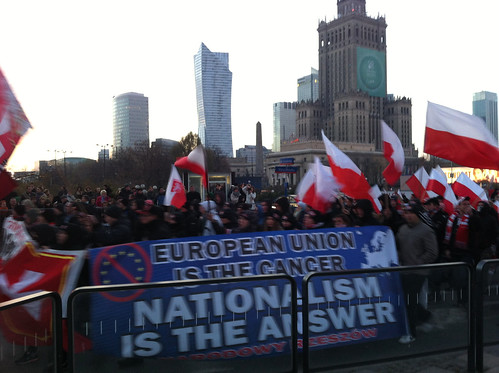
Chalk it up to some very unfortunate timing. Yesterday, as delegates arrived for this year's UN climate summit in Warsaw, they were warned to exercise caution and to stay out of the city centre. Violent demonstrations had broken out throughout the city.
The demonstrations actually had nothing to do with the climate summit. The meeting just happened to be opening on the same day as Polish national day, when far right and far left Polish groups have traditionally clashed in street brawls during demonstrations.
The violence isn't ordinarily noticed by the world's media. But given that international journalists have converged on the city this week for the climate summit, it was embarrassing timing for the Polish government.
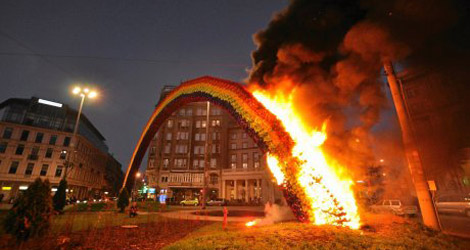
It didn't help that the most iconic image from the violence was the sight of a giant rainbow in central Warsaw burnt to the ground last night. Those in Brussels might recognize the rainbow shown burning in this photo. It was displayed in front of the European Parliament by the Polish government during their EU presidency in 2011.

Thursday, 17 October 2013
The car chancellor
So who's really pulling the strings? And how did we get here?
On Monday, Germany overturned a deal on car emission limits in some very unusual circumstances, somehow convincing several other member states to switch positions on a deal that had already been agreed in June.
On Tuesday, it was revealed that Merkel's Christian Democratic Union (CDU) party received a donation of €690,000 from the Quandt family, which owns 46.7% of BMW, just days before Monday's fateful meeting. The revelation has prompted German media to dub Merkel "the car chancellor" and question whether hers is a pay-for-play government.
A gift from a partial stakeholder of an automaker might not have raised eyebrows were it not for the very heavy-handed and unusual way Germany has gone about trying to avoid this emissions limit at the last moment - a limit the industry has known was coming since 2008.
In terms of how Germany has worked to change this EU proposal, the country has technically not violated any rules. But Berlin has become involved in this legislation at two highly inappropriate times that are outside the normal legislative procedure – during the Commission drafting of the proposal and during a vote to rubber-stamp an already-agreed deal.
Thursday, 12 September 2013
The pan-sceptic ticket

I was a bit taken aback on Wednesday when, during his response to President Barroso's State of the European Union speech in Strasbourg, UKIP leader Nigel Farage devoted almost the entirety of his speech not to warnings about the creeping European super-state, but to an impassioned denial of climate change.
The subject is nothing new for UKIP. The official party line is that there is no proof that climate change is man-made, and this is often brought up by UKIP MEPs. The party has been particularly vocal about renewable energy, blasting “ugly” wind turbines blotting the English countryside and biofuel subsidies it says are responsible for fuel poverty in the UK. This was made clear by UKIP MEPs during Monday's debate on biofuel legislation, which strangely put UKIP on the same side as the Greens.
But it was surprising to see Farage devote so much time to the issue during a big-picture debate on the EU that had nothing to do with climate change. The EU had fallen victim to a “green obsession”, he said. The resulting legislation had driven manufacturing away from the UK and forced people into fuel poverty.
Monday, 9 September 2013
Emotional debate

But what I'll be watching most closely is Wednesday's vote on what has been an enormously emotional issue – proposed new restrictions on biofuel in the EU.
When the EU devised its renewable energy legislation in 2008, biofuels were still in their relative infancy but were meant to be a savoir for weaning transport off of fossil fuel. The legislation required that by 2020, 10% of transport fuel would have to come from renewable sources, i.e. biofuels. But even then there were concerns within the Commission about the wisdom of this policy. What if the EU law created a rush for biofuel that caused food shortages by turning food to fuel? Or, more frustratingly, what if the process of clearing new land to make room for growing the biofuel crops actually caused more emissions than the biofuels abate?
Tuesday, 3 September 2013
Timetable diplomacy

If no deal on aviation emissions can be reached at this summit, starting on 24 September, the EU and its large global partners may be plunged back into a trade war over the question of whether the EU can charge airlines for emissions that took place outside EU airspace.
All emissions from planes taking off or landing in the EU were to be covered under the EU's Emissions Trading Scheme (ETS) from January 2012. But in November the EU suspended for a year its coverage of foreign air traffic after the US, China and others raised howls of protests over sovereignty issues.
Sunday, 11 December 2011
Last-minute surprise deal in Durban to save Kyoto

It was truly surprising news. As of Friday (the day the talks were supposed to end) it looked like they were going to collapse in failure. Though the EU had been able to convince Brazil and South Africa to sign the roadmap, the US, China and India were still refusing. There was fear that Durban would end with no deal, which would mean the end of any internationally binding emission reduction commitments. It would have essentially taken climate talks back to 1995 and made a mockery of the UN process.
The US and China did not participate in the 1997 Kyoto Protocol, which committed nations to binding emissions reductions by 2013. The Clinton Administration signed the Kyoto Protocol, but by the time it came up for ratification in the US the George W. Bush administration had taken over - and they refused to ratify it. They said they would not participate in a binding protocol that did not include China, now the US’s biggest competitor.
Wednesday, 26 October 2011
US-EU trade war looming over airline emissions
 This week the US House of Representatives passed a bill that would ban US airlines from participating in the EU's emissions cap-and-trade scheme. It is just the opening shot in what is likely to be a nasty trade war between the two blocs over the coming months. The winner will determine whether 72 million tonnes of CO2 are emitted into the Earth's atmosphere over the next eight years.
 While international climate talks have stalled the EU has pushed ahead with its own unilateral action on climate change, the keystone of which is the Emissions Trading Scheme (ETS). Under the scheme industries with heavy emissions are capped on the amount of greenhouse gases they can produce, and if they want to emit more they must buy credits from others who are using less than their cap. The scheme is already up and running, but starting in January airlines will be included. The decision to include airlines in the scheme was taken back in 2008.
This will mean all airlines that fly in or out of the EU must purchase carbon permits. The plan has not met with significant resistance from the European airline industry, but it has met ferocious resistance from American, Indian and Chinese airlines. US Airlines have challenged the law at the European Court of Justice, but the court has already indicated it will rule against them. So the airlines have now turned to the US Congress, and they have found a receptive ear.
Tuesday, 5 July 2011
Tory Euro-MPs defy Cameron on climate change

By a margin of ten votes, the parliament voted today to remove the call for the EU to up its commitment in UN negotiations from 20% to 30% from a resolution, prompting the resolution's collapse. Conservative British Prime Minister David Cameron could have swung the vote the other way if he had been able to convince even just a few of his 26 euro-MPs to support the call for 30%. But he was unable to do so, despite considerable effort. Cameron has made action on climate policy a cornerstone of his political platform and he took the lead among EU leaders in calling for the increased commitment.
Last week Cameron sent his energy minister to Brussels to tell the euro-MPs to vote for the measure, but they refused. It's an uncomfortable setback for the British leader and an indication of just how little control he has over his rebellious motley crew in Brussels. They are, as one London-based Tory told me, "completely beyond London's control". The political wild west in which Tory euro-MPs operate has caused problems for Cameron in the past, particularly when their actions seem to clash with the progressive social agenda Cameron has adopted in order to bring the party back into the British mainstream. He has been criticised in the past for allowing Tory euro-MPs to vote against pro gay rights resolutions in the European Parliament.
But the British Conservatives weren't the only ones bucking their party leadership on this issue. The centre-right leaders of Germany and France have also called for the EU to raise its commitment to 30%. But Merkel and Sarkozy's party members in Brussels also defied their party leaders' positions and voted with the centre-right grouping in the parliament to block the resolution. The seeming incongruity will be an awkward reality for those leaders as well. But neither of them have made the environment such a core issue of their political appeal like David Cameron has. And he is being heavily criticised by the left-leaning British press today as a result.
Wednesday, 22 June 2011
Here comes Poland: the EU's 'anti-environment' presidency?
Hungary eventually relented, a little, but the timing of the law's enactment meant that for the last six months the Hungarian presidency has been associated with media repression. Many were questioning how a country which seemed to be so far outside the European mainstream in respecting press freedom could lead the bloc. And really, these sorts of questions never went away - particularly as a new controversy erupted with the ruling party unilaterally drawing up a new constitution for the country.
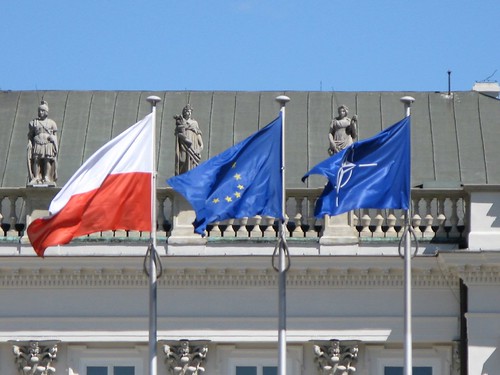
That pattern may be about to be repeated with the Polish presidency. Just nine days before Poland is set to take over the EU presidency, the Polish environment minister shocked his counterparts by announcing at an environment ministers meeting in Luxembourg yesterday that Poland would single-handedly block adoption of the EU's 2050 energy roadmap. The policy document sets a non-binding EU goal for a 40% cut in carbon emissions by 2030, a 60% cut by 2040 and an 80% cut by 2050, compared to 1990 levels. The Polish minister said it was just all too much for Poland, which generates 90% of its electricity from coal. "We expect higher solidarity in Europe, understanding the situation of particular Member States," the minister complained.
Thursday, 14 April 2011
When tax policy and climate change collide
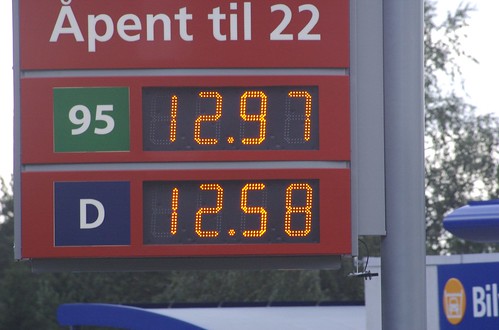
The problem is it isn't that simple. Efforts to combat climate change in a coordinated pan-European way must by definition spread into many sectors, including all of those mentioned above. This conundrum was evident yesterday when the European Commission presented its plans to revise the EU energy taxation directive in a way that would change fuel taxes to make them more in line with climate change goals.
Saying the existing EU rules dating from 2003 are "outdated and inconsistent", the commission has proposed setting a minimum rate at which member states can charge fuel tax based on the carbon dioxide emitted and the energy produced rather than on the volume of the fuel. This would end the situation where renewable fuels are taxed the same as fossil fuels and some of the least energy-efficient fuels are taxed less than more energy-efficient ones. Fuel taxes have actually decreased by 10 cents per litre since 1999.
Thursday, 17 December 2009
NGO fury after Copenhagen ban
 Yesterday’s decision by the UN to ban a large number of NGO delegates from the main venue of the Copenhagen climate change summit was, to say the least, unpopular on the ground.
Delegates from the green group Friends of the Earth arrived at the Bella Centre Wednesday morning to find their badges were no longer valid. This news apparently spread like wildfire both within the Bella Centre and among the protestors on the streets, stoking a feeling of resentment among the marchers. One delegate described to me his heartbreak as he saw a girl crying on the train, saying she had waited for years to attend the summit and was now being made to feel like an intruder.
The UN insists the move was necessary after it received word that FoE members were going to facilitate a security breach and let protesters into the centre. But yesterday’s move seems to be part of a wider strategy to block access to NGOs in the final day of the conference. This may be necessary as more heads of state and VIPs need to get into the centre.
According to reports NGOs have now been ordered to give up 35% of their access passes. Today the number observers allowed in was limited to a list of 300 names. Apparently the NGOs weren’t told before thge summit that thsi siphoning off of access would happen in the final days.
Subscribe to:
Posts (Atom)