National leaders, led by Emmanuel Macron, have refused a European Parliament demand that citizens should select the next EU president. The reasons have more to do with institutional rivalries than citizens’ interests.
“Don’t count your spitzens before they hatch,” tweeted Lithuanian President Dalia Grybauskaitė ominously as she entered Friday’s summit of EU leaders in Brussels. The Lithuanian president was referring to the so-called ‘spitzenkandidaten’ process, used in the last European Parliament elections in 2014 for the first time to select the European Commission President as a result of the public vote. National leaders of the 27 future EU member states (that is, all except the UK) were meeting Friday to decide whether to use the process again in next year’s election.
The far right has a poor history of working together in international forums. An alliance brokered by Geert Wilders and Marine Le Pen is seeking to reverse that trend.
"There is nothing harder to set up than a nationalists' international," wrote political scientists Michael Minkenberg and Pascal Perrineau when they analysed the performance of the radical right in the 2004 European Parliament elections. The latest attempt to disprove that truism was launched last week by Marine Le Pen, leader of France’s Front National (FN), and Geert Wilders, the Dutch maverick anti-Islam campaigner.
At a press conference held at the Dutch parliament in The Hague this week, Le Pen and Wilders announced a pact to work together to build an alliance in the next European Parliament to slay “the monster in Brussels” and wreck the Parliament from within. Given the patchy – to say the least – record of populist and nationalist groups’ attempts to join forces at European level, it was hardly surprising that scepticism dominated the initial reaction.
In the last Parliament, far-right groups briefly forged an alliance under the “Identity, Tradition, Sovereignty” group banner. But that pact fell apart after Romanian and Italian nationalists rowed over Alessandra Mussolini calling Romanians “habitual lawbreakers”. Perhaps it is not surprising that nationalists whose principal policy platform is being anti-foreigner have trouble co-operating with “foreigners”.
Nigel Farage's state of the union response suggests UKIP will make climate change denial a centrepiece of their European election campaign.
I was a bit taken aback on Wednesday when, during his response to President Barroso's State of the European Union speech in Strasbourg, UKIP leader Nigel Farage devoted almost the entirety of his speechnot to warnings about the creeping European super-state, but to an impassioned denial of climate change.
The subject is nothing new for UKIP. The official party line is that there is no proof that climate change is man-made, and this is often brought up by UKIP MEPs. The party has been particularly vocal about renewable energy, blasting “ugly” wind turbines blotting the English countryside and biofuel subsidies it says are responsible for fuel poverty in the UK. This was made clear by UKIP MEPs during Monday's debate on biofuel legislation, which strangely put UKIP on the same side as the Greens.
But it was surprising to see Farage devote so much time to the issue during a big-picture debate on the EU that had nothing to do with climate change. The EU had fallen victim to a “green obsession”, he said. The resulting legislation had driven manufacturing away from the UK and forced people into fuel poverty.
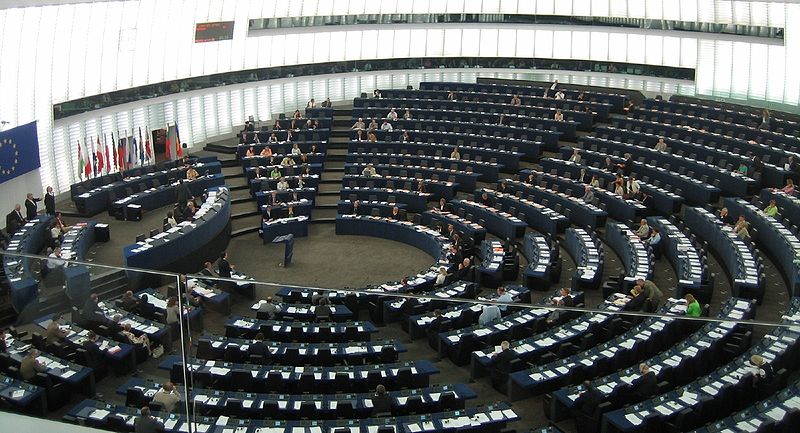
For any journalist who has previously covered the start of a national election, today's launch of the 2014 European Parliament elections was a different sort of animal. As I sat in today's launch in Strasbourg and watched the promotional video, I had to ask myself – what other parliament would have to sell its own existence at the same time as overseeing a campaign?
Indeed, where I come from, politicians are these days bending over backwards to criticise and disassociate themselves from the Congress they want to be elected to. Sitting at today's launch, one had the sense that a main job for MEPs campaigning will be to explain the virtue of the Parliament to their constituents. Or at the very least, to explain what the European Parliament is.
“Many do have the opposite opinion to what is actually happening,” Parliament vice president Othmar Karras told us. “It is incumbent on the members of this house to put the facts on the table so there are no more misunderstandings.”
At the moment, Europe is a conservative-dominated continent. The anecdotal evidence that Europeans have been veering to the right at this time of economic crisis has been evident for some time, especially in last year’s European Parliament elections where voters handed a strong majority to the conservative EPP. But the string of centre-right victories over the past few months has demonstrated clearly that the European public is gravitating toward conservative ideologies as their own economic situations become more uncertain. And looking at the geographic location of the few centre-left governments left in Europe, once can see that Europe’s Social Democrats are really in trouble.
This weekend Czechs went to the polls to select a new government. They faced a stark choice between the centre-left Social Democrats who promised during the campaign to increase spending and social benefits, and the centre-right Civic Democratic Party (ODS) who pledged to make drastic budget cuts and reduce the deficit. It is a battle economists have been waging as well. As most countries emerge from recession, is it better to maintain state spending to fuel the recovery or to make drastic cuts to tackle the large deficits and public debt?
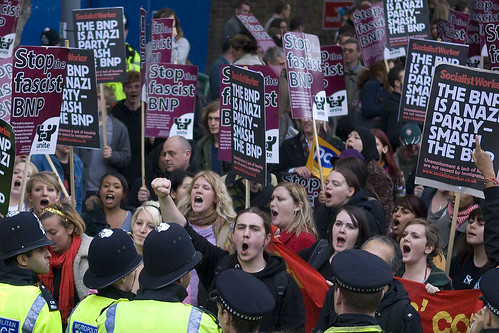
It was the dramatic conclusion of a month-long drama – Nick Griffin, the controversial leader of the whites-only British National Party, appeared on revered public affairs program Question Time last night amidst massive protests outside the studio, and the largest audience in the programme’s history glued to their TV sets at home.
There’s been much written today about what went on last night, but for me what was most interesting was what was not said on last night’s program. Almost unitarily focused on race, host David Dimbleby went out of his way to avoid any discussion of the institution Griffin was actually elected to in June, the European Parliament. I found this bizarre considering it was that election which the BBC says necessitated Griffin’s appearance on the programme in the first place. If it’s the June election that changed the equation in the BBC’s mind, why was the program unitarily focused on things that were said and done well before June 2009?
The level of public attention this program and the build-up to it received has been astounding. Griffin is the leader of the far right British National Party, which has advocated for an “all-white Britain.” His own extremist history has included membership in the violent Neo Nazi group National Front in the 1970’s, denying the holocaust and advocating the criminalisation of homosexuality, the deportation of British Muslims and the denunciation of multiculturalism. He has in the past professed admiration for both the Klu Klux Klan and Adolf Hitler.
Normally a person with such extreme views would not be featured as a guest on a major British public policy show, but the BNP has a significant electoral success in June, garnering one million votes in the European Parliament election which netted them two seats in that body, their first elected positions ever (Griffin and his deputy took up the seats). The BBC said now that Griffin has been elected to a national position by the British public, it cannot justify refusing to allow him on the broadcaster’s main programs – since it has a mandate as an unbiased public institution.
This sparked a huge outcry, culminating in a massive protest yesterday at BBC Television Centre during the taping of the episode. The show itself ended up being rather predictable. Both the other panellists and the audience took turns berating him for his racist views, and Griffin gave blathering incoherent responses that showed he is essentially a rather confused idiot. The program quickly turned into a game of cat and mouse – with Griffin working hard to project an image of a new moderated mainstream BNP which isn’t overtly “racist,” and the panellists and audience reminding him of all the racist things he’s said in the past, which he repeatedly denied saying.
Of course his excuses for why he had “changed his mind” about many of the odious things he’s said in the past were as inept as they were implausible. He twisted, laughed and clapped bizarrely as he was confronted by his past statements. And he seemed completely unprepared when presented with a quote from before the June election, on video, in which laid out a plan to pretend to moderate his beliefs on race and religion in order to make the BNP palatable and get it into office. Surely, if you’re planning some kind of Machiavellian coup like that, you probably shouldn’t talk about your plans on video!
The main aim of both the BBC and the panellists seemed to be to highlight Griffin’s racist views for the BNP voters at home who don’t consider themselves to be ‘racist’ but voted for them as a “protest vote.” The BNP has tried to gloss over their racist foundations with pamphlets full of images of British flags, happy families, proud soldiers and Churchill, Churchill, Churchill. The Tory representative, Baroness Sayeeda Warsi (herself British Asian), seemed to actually be making a concerted effort to steal away those “protest vote” BNP voters over to the Tory side. (Incidentally, I thought she and the Tories were the clear winners from last night’s show. She did a great job, though I was a little creeped out by her efforts to woo BNPers to the Conservative bosom).
Race-Baiting
But throughout it all Dimbleby was hell-bent on keeping the conversation focused on race and sexuality, as Griffin’s previous statements on those subjects are repugnant to the vast majority of British people. But the newly politically calculating Griffin refused to be drawn in, saying very few overtly offensive things during the conversation. In fact the most offensive thing he said was probably that Islam is an “evil” religion, a view I suspect many in Britain share (even many on the left). Throughout the whole discussion I kept thinking what some BNP-voter up in the East Midlands would be thinking watching this – a bunch of smug West Londoners seemingly putting racist words in the mouth of Griffin while he just sat there and said very little. For people who already feel alienated from the political system, this probably just played right in to their admiration of Griffin as an ‘underdog standing up for the working class’.
The fact is that outside its positions on race and sexuality, much of the BNPs political platform are grievances shared by an increasingly large swathe of the British public – xenophobic attitudes toward the EU, immigration and resource sharing. But Dimbleby was intent on steering the conversation away from those issues so the program could highlight Griffin’s differences with mainstream British opinion rather than the overlap. He didn’t want to highlight the aspects of the caged monster shared with the stone-throwing audience. But if Griffin’s opinions are supposedly so uniformly vile to the British public, how did he attract a million votes in the last election?
The omission was evidenced by the almost absurd non-inclusion of any discussion about the body Griffin was actually just elected to, the European Parliament. Toward the beginning of the program a questioner tried to ask Griffin about Europe and Dimbleby shut him down. “We’re talking about race!” he bellowed. “We’ll get to that later.”
Of course they did not get to that later. Clearly Dimbleby considered this to be an irrelevant question. Nevermind the fact that that Griffin is now representing the UK in the European Parliament!
The fact is probably many in the audience probably agreed with Griffin’s opinion that the EU is dangerous and tyrannical, and after all, finding commonalities between Griffin and the British public was not what this show was all about. No no, let’s stay focused on race so we can all boo and jeer Mr. Griffin’s medieval views (views which, by the way, have now been largely erased or covered over in the official BNP party platform). God forbid any of the audience, or on the panel, should look in the mirror to see how their assumption of British superiority over the rest of Europe, their subtle xenophobia rather than overt racism, informs their attitude toward European integration. That probably wouldn’t have been very comfortable for them, seeing their opinions mirrored in the spittle-flecked ramblings of a far-right nationalist.
It’s puzzling to see how, while Griffin has been a unitary obsession of the British media over the past month, his new position in Brussels has been almost completely ignored. The most egregious example came yesterday in this article from the Guardian, which called on the Question Time panel to grill Griffin about his views on climate change (he denies its existence except when warning of overpopulation). Of course the show should have asked him about climate change (they didn’t, as it’s not race-related). Griffin is now on the European Parliament’s Environment Committee, meaning he has a sizable influence over environmental policy affecting the UK (the majority of which comes from Brussels), far more influence than the vast majority of MPs in Westminster. Yet the Guardian article manages to not mention Griffin’s position on the Committee even once, even though the whole purpose of the article is to rail about Griffin’s views on climate change.
I don’t mean to be a one-trick pony here, but it really irked me that this very significant development – that Griffin is now representing Britain in the EU and has a particular influence on environmental policy, was completely ignored. Perhaps there was good reason to focus on Griffin’s racism since he is so keen to gloss over it. And perhaps it was better not to delve into an actual policy discussion with him for fear of legitimising his position. But from my vantage point it was just yet another example of the British public’s steadfast determination to ignore the existence of the EU at all costs.
The British Tancredo
But perhaps I’m too hard on the British. After all I have to say, as an American I’ve actually been quite impressed and heartened by the energetic resistance to the rise of Griffin’s ideology. Much of the BNP’s current platform (the cleaned-up version that omits the group’s overtly racist origins) is nearly identical to the platform of mainstream Republican politicians in the US. Griffin’s immigration policy, as expressed on Question Time last night, is very similar to that of Republican Congressman Tom Tancredo, who was a major contender for the 2008 Republican presidential nomination. That’s not to mention the BNP platform’s similarities to right-wing American television commentators like Glenn Beck and Lou Dobbs. And Griffin’s current stated view on homosexuality, though it was condemned by the representatives of all three major UK parties on the Question Time panel, would easily be at home in the Republican Party’s official platform. So it’s nice to see that I live in a country where these kinds of views, so common in my home country, are so reviled.
Also, Britain should keep in mind that it is hardly the first European country to send far-right politicians to the European Parliament, France beat them to that by many years. In fact the experience of France with far right Front Nationale leader Jean Marie Le Pen (also of the European Parliament) has been repeatedly brought up as a cautionary tale by British commentators. An invite by the French broadcaster for Le Pen to appear on the French equivalent of Question Time was equally controversial, and resulted in a doubling in the size of the party. Le Pen eventually rode that wave of popularity all the way to victory in the 2002 presidential race, when a fluke in the 1st round voting meant that the second round was a one-on-one contest between him and French President Jacques Chirac. There are fears that Griffin’s appearance on Question Time could lead to a similarly meteoric rise in the UK, but I just don’t see that happening.
By the way, the BBC has a great article here about how the media deals with far-right parties across Europe. It’s a very interesting side-by-side comparison, and I think helps to set all this within a larger context.
Of course, that would require some thinking about Europe, which as we learned last night, the Brits are loathe to do.
If you’re a Eurobarometre-trolling dork like I am, you may have noticed this fantastic set of polling numbers published this morning looking at why people did and did not vote in last month’s EU elections. A couple of news outlets today are headlining these results with a conclusion about voter apathy, but I actually think that’s probably the least interesting observation you could make about these numbers. “European voters are apathetic” – not exactly mind-blowing news.
Overall turnout in the EU this year came to 43%, continuing the trend of a decrease each cycle since elections began – but interestingly – the drop this year (from 45.5% in 2004) was less than in the past. And it should be noted that although people here go on and on about how low the parliament election’s voter turnout is, it still hasn’t sunk as low as the typical US midterm election (usually less than 40%). And considering that the midterm votes elect the entire US House of Representatives and 1/3 of the senate, let’s face it, they’re a hell of a lot more important than the EU parliament elections. But since there’s no US presidential race accompanying them, the lack of personality politics keeps many American at home. That can certainly be said for the EU Parliament elections. There’s only so much interest you’re ever going to be able to drum up for rather boring representative democracy.
Far more interesting than the overall turnout, I thought, was the profile of who voted. The survey, done shortly after the election, showed that men were more likely to vote than women, highly educated people were more likely to vote than people with a low level of education, and a smaller proportion of unemployed and working class people voted than that of senior management.
Why did people vote? Interestingly, the numbers show that party identification is playing an increasingly less significant role in voting patterns as Europeans become more and more disillusioned with the political class. Only 43% of respondents said they felt close or very close to a single political party (just 22% in the UK).
The majority of people who voted said they did so out of a feeling of duty of obligation rather than because they an ambition for change. 47% said they voted because it is their “duty as a citizen”, while 40% said they did it because they always vote. Only 19% said they thought they could make things change, and just 13% said they voted because they feel like a European or an EU citizen. Though at the same time, only 11% said they voted in order to express their disagreement with the EU.
I also found the section on which issues were important to ther voters interesting.Economic growth and unemployment were the two most important issues to people, while the role of the EU in the international scene ranked fairly low. The more educated a person was, the more importance they placed on the EU's role in the international scene as an issue.
Predictably, the UK had one of the lowest turnouts in June - but not the lowest. That honour went to Slovakia, for the second election in a row (do Slovakians not know how to operate a voting box?). Many of the new entrants of Eastern Europe had the lowest turnout actually, with Poland, the Czech Republic and Hungary all coming around the UK's 34% turnout. Also predictably, Luxembourg and Belgium had the highest turnout with around 90% (um, that's just weird...). Malta, Italy and Denmark all also had high turnouts.
***Addendum***
Thanks Enoka for pointing out that Belgium and Luxembourg have mandatory voting, that explains the high turnout. Actually that makes the fact that Belgium ranked fairly low for voter interest in the election pretty interesting. It was second to last for people reporting they had had exposure to the election campaign. Not exactly the most glowing argument for compulsory voting.
The European Parliament elections traditionally have a low level of interest in the UK, but David Cameron’s decision to form a new European grouping with far-right parties in Brussels may make next month’s elections a little more interesting.
The details are still being worked out, but it looks certain that Cameron will push ahead with a plan to take the Tories out of the European parliament’s centre-right grouping, the European People’s Party (EPP), and form a new eurosceptic party. The plan would unite the Tories with several far-right parties across Europe, one of which warns that homosexuality will cause the “downfall of civilisation.”
It’s a strange move considering that the Tories are not a far-right party but rather a centre-right one, and that some of the European parties they will be joining with more closely resemble philisophically the British National party (BNP) than themselves. It is even more strange considering the Tories are probably poised to take over the British government next year, and yet they are bolting from the EPP which is composed of the governments of Europe’s most important countries including the parties of Germany’s Angela Merkel and France’s Nicolas Sarkozy.
According to The Independent on Sunday, separation talks with the EPP have been completed and 20 MEPS from seven countries have signed on, giving the new grouping enough members to receive EU funding as a party. That grouping will include the Polish Law and Justice Party (PiS), the party of the infamous Kaczynski twins who until recently were president and prime minister of the country. That party has banned gay rights marches for being "sexually obscene” and a prominent member has warned that Barack Obama's victory would mean "the end of the civilisation of the white man". The grouping will also reportedly include a Latvian hardline nationalist party.
So what do all these parties have in common? Seemingly, only that they don’t think the EU should exist. The only problem is that Tory party is hardly of one mind on that subject. Cameron pledged to leave the EPP in his 2005 campaign for the Tory leadership, winning over the Conservative right wing and giving him the edge to defeat David Davis. So Cameron could be in hot water if he reneges on his promise. On the other hand many Tory MPs and MEPs are very worried about this decision to leave the EPP, fearing it will leave the Conservatives as an isolationist party outside the mainstream of Europe.
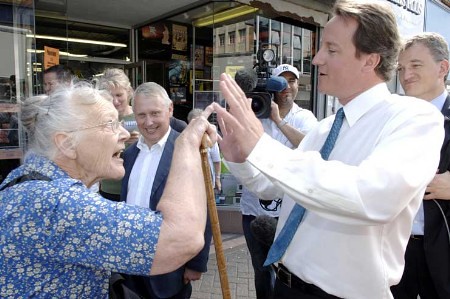
At the event launching the Conservative’s 4 June election campaign yesterday, Cameron was clearly trying to make the upcoming vote a referendum on Gordon Brown’s handling of the economic crisis. “With every Conservative vote, the message will be simple, 'Enough is enough - you're the past'," he sad at a community centre in north-east England, referring to Gordon Brown. "With every day that passes, this government is running our country into the ground. Borrowing eye-watering amounts of money, presiding over social decline, letting our politics descend into the quagmire.”
Labour would be wise to quickly educate voters about Cameron’s plans for the far-right European alliance, reminding them that though they may be dissatisfied with Labour, they may be cutting off their nose to spite their face by casting a vote that could indirectly create a new far-right block in Europe. However, considering the reticense of any British politician to talk about Europe (It was telling that Cameron’s speech today focused almost entirely on domestic issues in the local elections rather than the EP), I think it’s unlikely Labour will be able to get this message out clearly over the next month.
Much ink has been spilled over the accession of Romania and Bulgaria to the EU in 2007, and there are still many questions floating around over the decision. Should they have been admitted, or has the EU bit off more than it can chew in taking on two such poor countries? How can the EU effectively deal with the high level of corruption in the Bulgarian and Romanian governments? And when should the new EU entrants be given the full rights and privileges enjoyed by other EU citizens?
After spending last week in Bulgaria I am perhaps not qualified to offer a solid answer to these questions, but I have come to understand the country much more. For one thing, all this talk about 'Romania and Bulgaria,' as if they were one geopolitical block, seems strange to Bulgarians. When interviewing politicians and NGOs, I would often ask them if the factors they were mentioning in Bulgarian society were present in Romania. They would always respond that they had no idea, and even seemed a bit confused by the question. Though the countries tend to be talked about together now because they entered the EU at the same time with the same set of restrictions, in terms of culture, language and government they're quite different. In fact the photographer in our group was from Romania, and she said she doesn't necessarily feel any kind of strong connection to the country.
The event on Saturday went quite well. In addition to being an EU Debate on the Ground, it was also the official launch of CafeBabel Sofia. The event was hosted by a well-known local radio personality and was in Bulgarian, but the non-Bulgarian journalists had a great simultaneous translator. We had three MEPs there and the Bulgarian Minister for European Affairs, Gergana Grancharova (pictured above left). Essentially it was a debate between EU government officials and the public, designed to foster greater interaction between the European public and Brussels. Coming from Western Europe, it actually seemed to me that Bulgaria has a shockingly high level of interest in EU affairs. The attendees at the event were quite well-informed. Most of the major Bulgarian television networks showed up to film, and it made the nightly news. As I wrote last week, I learned on this trip that three times as many Bulgarians have faith in EU institutions as have faith in the Bulgarian government. This isn't surprising considering the level of dysfunction in the Bulgarian government, but as the MEPs mentioned at the event, the expectations of the Bulgarian public for the EU may need to be ratcheted down quite a bit. After all, the EU can't solve all of Bulgaria's problems, nor is that its intention.
Speaking with the French ambassador to Bulgaria on Friday, I learned this is an increasing concern for Western European nations. The high level of enthusiasm for EU integration in Bulgaria may be flattering for Brussels, but it will liekly lead to inevitable disappointment when the EU is unable to deliver, particularly as the economic crisis hits Bulgaria especially hard. The increasing trend of Bulgarian NGOs and business interests going directly to Brussels to get problems solved, bypassing the national government, is actually a worrying trend, he said. It is the dysfunction of the Bulgarian government that needs to be solved, and if it isn't, it will strengthen the increasingly popular far left and far right. The nationalist, anti-Turkish party Ataka (pictured left), is getting particularly popular, and it's thought that they will gain seats in the June national election as people cast a protest vote against the government.
Having only spent time in Sofia, I can't say I'm qualified to concretely answer any of the questions I posed in the first paragraph after my trip. I can say that while it was a bit rough around the edges, the level of development in Sofia didn't even resemble the post-apocalyptic picture often painted by the British media. As the poorest country in the EU, clearly Bulgaria has a long way to go before it enjoys the same standards of living as its Western counterparts. But at the same time Sofia looked like any other Eastern European capital. We felt perfectly safe walking around on the street at any time of day or night, and the modern conveniences were the same as most other capitals of the East. I'm told that Sofia is extremely different from the rural areas of Bulgaria, but of course that's true for any country.
So all in all it was a very interesting and fun few days, I'm glad I participated in the project. If you're interested in finding out if an EU Debate is coming to your city any time soon, check out the schedule.
The BBC has an interesting feature this week in which one of their Westminster-based reporters is going to spend a week as a UK Member of the European Parliament (MEP). Considering that the vast majority of people in the UK are unable to name their own MEP (if they know what an MEP is at all), it's an interesting project. Elections for the European Parliament are coming up in June, and British citizens will shortly be asked to chose a representative from a list of people they've probably never heard of for a job they probably don't understand.
The reporter, Brian Wheeler, is going to be blogging throughout the week, and this morning he hopped on the Eurostar over to Strasbourg to attend one of the monthly assemblies of the Parliament in that city. So for those of you wondering what an MEP actually does (and you have cause to be confused, it's hardly clear), this feature can shed some light on that topic. I know I'll be reading it with interest. This could be even better than the BBC Shipping Box!