Showing posts with label far right. Show all posts

Wednesday, 15 March 2017

Spectres of a Dutch past

Modern Holland sells itself as enlightened and peaceful, but this perception is not shared in Indonesia. Will today’s election return the Dutch to a more brutal era?

I’m flying somewhere over India at the moment, making my way to Amsterdam after a fascinating week on the Indonesian capital island of Java. Once I land in the morning I’ll be spending the day covering the Dutch election, and it’s safe to say the things I saw here on the other side of the world will be shaping my impressions.

The degree to which today’s election will say something about the direction Europe is heading has been a bit overstated in the English-speaking media. Headlines have declared breathlessly that far-right firebrand Geert Wilders is set to “win” the election and bring the Netherlands into the same axis of populism as the UK and US. But it's not quite that.

Friday, 2 December 2016

The EU may get its first far-right president. But does it matter?

Sunday may be a pivotal turning point for Europe, but not because of the presidential election in Austria. A referendum in Italy could bring the euro back to crisis point.

In May, when Austria held its first attempt at holding a presidential election, newspapers in the UK and the US were full of breathless coverage. "Austria is on the brink of electing Europe's first far-right president since WWII" they declared.

The BBC and The Guardian both used the occasion to run features about the 'rise of nationalism and populism in Europe', both of which curiously left out Britain's own UK Independence Party. 'Populism is other people' they convinced themselves. Now, after Brexit and Trump, the Anglo-American coverage is quite different.

And the coverage has returned, because the Austrian election is being re-run this Sunday, 4 December. 

In May, the far-right candidate Norbert Hofer, the leader of the Freedom Party, was beaten by Alexander Van der Bellen from the Green Party by just a few thousand votes. The two were facing each other in a shock second round after the country's main center-right and center-left candidates were eliminated. It was the first time a candidate from either the Greens or Freedom Party made it to the second round.

Monday, 5 September 2016

Merkel's far-right home state

The German chancellor has suffered an embarrassing electoral defeat as the dark cloud of nationalism spreads over Europe. But predictions of her political demise are premature.

Last month, I took a trip with some friends to the Northwest German island of Rügen in the Baltic Sea. It's a beautiful holiday island full of white chalk cliffs and rolling green hills. But when we were there, it was also full of sights of a more disconcerting variety - political ads for the far-right and racist messages splattered in graffiti. 

As we left Berlin on the train and travelled north through Mecklenburg-Pomerania, signs for the far-right Alternative for Germany (AfD) and the extreme-right (neo-Nazi) National Democratic Party (NPD) became more and more frequent. They were all over the island, and were an especially frequent site in the island's departure city, Stralsund. On the posters for the main centrist German parties, Angela Merkel's center-right CDU and the center-left SPD (who are currently governing the country in a coalition), was written a chillingly familiar word in graffiti: volksverräter (traitor to the nation).

The only ads not splattered with grafitti were those for the AfD and NPD, some of which called Germany's new arrivals "rapefugees".

This is Chancellor Merkel's home turf - the constituency which she represents in the German parliament. And like parts of neighbouring Poland, it is not a friendly place for people of color.

Tuesday, 24 May 2016

Why is the BBC afraid to call UKIP a nationalist party?


Populism is other people, according to the British media.

Austria's presidential election on Sunday, in which the country came within a hair's breadth of electing its first far-right head of state since World War II, has generated a new round of media coverage on the rise of extremist parties across Europe.

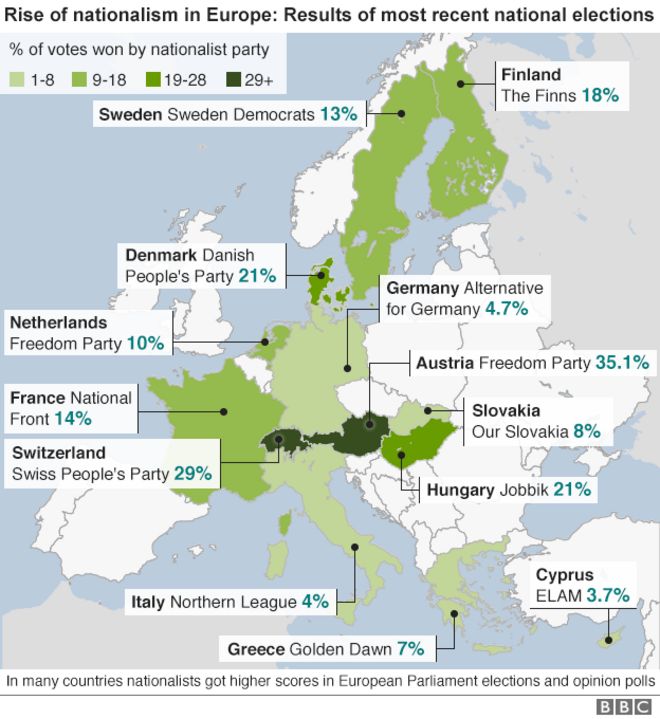
Today the BBC published an analysis of the 'Widespread revolt against the political centre', tracing the rise of these parties. It is accompanied by a map showing the percentage of votes won by "nationalist parties" in the most recent elections. 

Notice anything strange about this map? According to the BBC, the UK is either not part of Europe, or has no nationalist party. 

Friday, 15 November 2013

International nationalists

The far right has a poor history of working together in international forums. An alliance brokered by Geert Wilders and Marine Le Pen is seeking to reverse that trend.

"There is nothing harder to set up than a nationalists' international," wrote political scientists Michael Minkenberg and Pascal Perrineau when they analysed the performance of the radical right in the 2004 European Parliament elections. The latest attempt to disprove that truism was launched last week by Marine Le Pen, leader of France’s Front National (FN), and Geert Wilders, the Dutch maverick anti-Islam campaigner.

At a press conference held at the Dutch parliament in The Hague this week, Le Pen and Wilders announced a pact to work together to build an alliance in the next European Parliament to slay “the monster in Brussels” and wreck the Parliament from within. Given the patchy – to say the least – record of populist and nationalist groups’ attempts to join forces at European level, it was hardly surprising that scepticism dominated the initial reaction.

In the last Parliament, far-right groups briefly forged an alliance under the “Identity, Tradition, Sovereignty” group banner. But that pact fell apart after Romanian and Italian nationalists rowed over Alessandra Mussolini calling Romanians “habitual lawbreakers”. Perhaps it is not surprising that nationalists whose principal policy platform is being anti-foreigner have trouble co-operating with “foreigners”.

Tuesday, 1 May 2012

The battle for the May Day voter

The first of May is always a big deal in France. This year it’s taken on an even more politically charged tone, with groups of far-left and far-right demonstrators possibly coming into conflict during the course of today. But it might be hard today to differentiate between the two groups based on their rhetoric alone.

May Day, originally a pagan spring festival, became an international workers day in the late 19th century. Ironically this Socialist holiday is unknown in the United States, despite the fact that it actually commemorates the 1886 Haymarket Massacre in Chicago. An American ‘Labor Day’ was instead set in September so that it wouldn’t coincide with international workers demonstrations. The day has long since lost any association with workers rights in the US.

But in continental Europe, the 1st of May is still a public workers holiday during which labour unions and activists demonstrate in the streets. It is also known for anti-capitalist violence, particularly in Southern Europe.

In recent years, the increasingly mainstream far right in Europe has challenged the idea that May Day is the sole domain of the left. The National Front party in France has begun to stage May day marches to the Place de l’Opera in Paris. There they hold a rally in front of a statue of Joan of Arc, who they have adopted as a symbol. This year, following the record 18% showing of National Front leader Marine Le Pen in last Sunday’s first round of presidential elections, it is predicted that they will garner the largest turnout ever.

Friday, 16 September 2011

Denmark's election: is the Left clawing its way back?

The centre-left Social Democratic Party scored a victory in yesterday's closely-watched general election in Denmark, ending the 10-year reign of a conservative coalition that had been moving steadily further and further to the right.

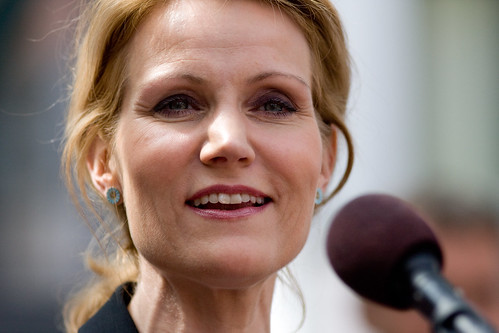
The campaign of the centre-left coalition, called the 'Red Bloc', was centred around a promise to raise taxes on the country's investment banks and wealthiest citizens, reversing a trend of decreasing corporate taxes led by the previous government. The victory for this message is a stinging rebuke to the current austerity crusade dominating the governments of Europe. The Social Democrats, led by Helle Thorning-Schmidt (pictured above), promised to actually expand Denmark's welfare system, which is already one of Europe's largest. They have also promised to use the proceeds from increasing taxes on investment banks and the wealthy to improve roads, schools and hospitals.

So is this a sign that Europe's hobbled left may be on it's way back? Are voters across Europe growing tired with the messages of the right and ready to turn to a new direction? Or are the circumstances of this change in direction limited to Denmark?

Friday, 29 July 2011

Where does the Norway shooting leave Europe’s conservatives?

Last week’s far right terrorist attack in Norway has prompted a lot of questions in European capitals, and many of the hardest questions are being asked inside the party headquarters of Europe’s center-right. Many of Europe's conservative parties have spent the last few years courting the far right vote, by co-opting some of their messages on immigration and cultural identity issues. In several countries including Denmark, Italy and the Netherlands the mainstream conservative parties have even allied themselves with the far right and invited them into governing coalitions. After the Norway attack, are those days over?

To answer this question, one must understand the current political balance in Europe, and why it has come about. Conservative parties now dominate the national governments of Europe as well as the EU institutions, relegating the left to just a few Southern countries. The Guardian put out a great interactive map today where you can trace Europe’s left-right balance over the past 50 years. Contrast the map just ten years ago in 2001 on the left with today’s situation in 2011 on the right (left-of-center in red and right-of-center, including Liberal parties, in blue). Considering that Spain and Greece now have their policies dictated to them by their conservative Northern European creditors, the left has effectively disappeared from Europe.


So why has Europe veered rightward at a time of economic crisis? There are probably many contributing factors – but the biggest cause is the complete disarray of the European left. From Scandinavia to Germany to France to Italy, European Social Democrats are in complete chaos, torn by infighting, a lack of enthusiasm and confusion over ideology. Europeans have voted conservative not because of some great ideological shift toward economic liberalism and laissez-faire capitalism. They have done so because the parties of the left have not offered any credible alternative for governance.

Sunday, 24 July 2011

Europe's Timothy McVeigh

Europe is in shock this weekend after Friday's horrifying act of terrorism in Norway that killed 76 people. Because of the stated aims of the perpetrator, it is already prompting questions over whether Europe has been looking the other way as the far right has grown in numbers and power.

When the news first broke on Friday that a car bomb had gone off outside the prime minister's office in Norway, many people assumed it was an act of Islamic terrorism. But soon after, news broke that the bombing had been followed by a shooting spree at a political youth retreat for the country's ruling Labour party. Then it was clear that this was unlikely to be an act of Islamic terrorism, since it seemed to fit the modus operandi of either a deranged lone gunman or an act of far-right domestic terrorism. In the end, it turned out to be the latter.

The man accused of orchestrating the attack, Anders Behring Breivik, reportedly carried out the attack on the ruling Labour party because he felt that their tolerant attitude toward Islam was destroying the country. It was an anti-government, far-right, fundamentalist Christian act of terrorism - similar to the Oklahoma City bombing in the US in 1995 committed by far-right extremist Timothy McVeigh.

Thursday, 7 July 2011

Poland fires warning shot over Denmark's 'nationalist' moves

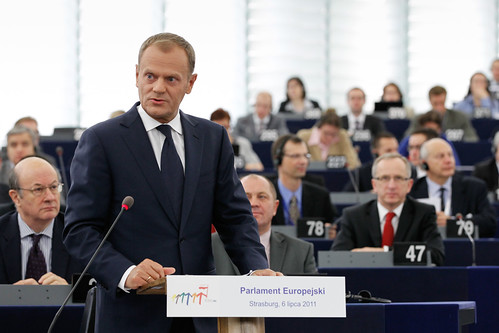
Poland is not usually known as a very pro-EU country. In fact, it has gotten the reputation as the most Eurosceptic of the new member states. But yesterday Polish Prime Minister Donald Tusk lambasted recent moves by Denmark, France and Italy to undermine the European project. He signalled he intends to halt the current slide, led by those Western countries, toward reintroducing border controls at internal EU borders.

Tusk was speaking to the European Parliament in Strasbourg to mark the start of Poland's presidency of the EU, which will last the next six months. "The answer to the crisis is more Europe," he said, not less. He indicated that he will fight against efforts to further erode EU principles, and suggested he was unhappy with the deal reached among member states last month to allow temporary internal border patrols to deal with increased immigration.
"I am against any barriers to internal free movement under the pretext of dealing with migration problems. What Denmark is doing is a concern for anybody who thinks that free movement is going to be restricted even further," he told the parliament. "Europe, with its institutions, its budget and its objectives, is not the source of this crisis. And following those who say the opposite would be a fatal mistake. Undoing the European construction at this time and turning to nationalism as an answer to the crisis would be a very big mistake."
It was a fairly unusual move for the incoming presidency to take such a political stance against what other member states are doing, because the presidency is supposed to be a neutral negotiator in the council. But Poland has always marched to the beat of its own drummer when it comes to the EU.

Wednesday, 29 June 2011

Dutch to ban halal and kosher animal slaughter

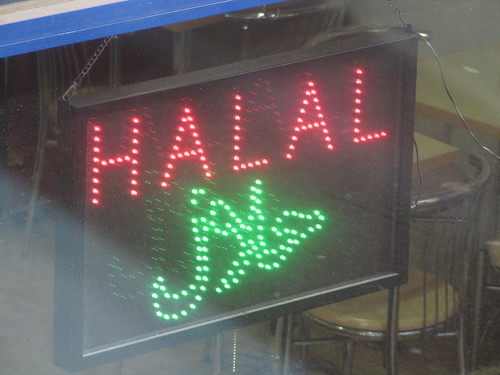
The Dutch parliament has voted overwhelmingly to ban ritual slaughter of livestock that does not stun the animal beforehand. This would ban the production of halal and kosher meat in the country, which is the only kind of meat that can be consumed by strictly religious Muslims and Jews, respectively.

The fight has made for some strange bedfellows. The campaign against the bill has seen an unprecedented unification of the country's Muslim and Jewish populations, who both say the bill puts animal rights ahead of human rights. On the other side stands an unusual pairing of animal rights activists and the country's anti-Islamic far right.

The controversy over the bill, which came despite its widespread support in the parliament, persuaded the Dutch government to promise that no ban would go forward without the approval of the Senate (an approval not legally necessary in this case). They also inserted a provision which would allow religious groups to apply for a permit to kill animals without stunning them first. But this would only be granted if they can prove that the animals do not suffer more than in ordinary killing. But legal experts say this would be nearly impossible for the halal and kosher butchers to prove, and the burden of proof is on them. Agricultural bodies such as the British Farm Animal Welfare Council have concluded that halal and kosher killing causes severe suffering to animals.

Tuesday, 24 May 2011

Berlusconi: Milan will be 'full of Muslims and Gypsies' if Left takes power

Italian prime minister Silvio Berlusconi may have outdone even himself with his latest inflammatory comments. Rallying supporters in Milan ahead of local elections later this month, he warned people that if the centre-Left candidate for mayor wins, the city will be handed over to Muslims and Gypsies. According to Italian news agency AKI he told the Milanese,
"Milan can't become, on the eve of the Expo 2015, an Islamic city, a city of Gypsies, full of Roma camps and swamped by foreigners, a city that gives voting rights to immigrants in municipal elections."
The comments, which were not an off-the-cuff remark but rather part of a prepared speech that was also posted on the website of Berlusconi's conservative People of Freedom party, were met with open-mouthed disbelief by the leader of Italy's largest centre-left opposition Democratic Party. "Your words are laughable..you're going to need to wear a burqa to avoid people recognising you in the street," he told the Italian leader.

Friday, 15 April 2011

Angry birds: Are 'True Finns' about to stage a revolution?

Those who have been tracing the recent rise of the European far right will have their eyes trained on Finland this Sunday, as that country holds a national election. According to recent opinion polls the Finnish nationalist party the "True Finns" could ride a wave of populist fervor to unprecedented electoral success on Sunday.

A Gallup poll last month put the True Finns in second place at 18.3% of the vote, just behind the ruling centre-right National Coalition Party. Led by MEP Timo Soini, the party has all the ingredients of today's far right in Europe: anti-immigration, anti-EU and pro-nationalism. They also display all the anomalies of today's far right: pro social welfare (but for ethnic Finns only), relatively pro gay rights, and working hard to project a respectable, PR-friendly image.

It is the same formula that has led to success for the Sweden Democrats in neighboring Sweden, the Danish People's Party in Denmark, the Freedom Party in the Netherlands, the National Front in France and the British National Party in the UK. And in the same way as all of these other countries, the main parties of Finland have been working to co-opt much of the far right's message in order to blunt their electoral impact.

Monday, 10 January 2011

America unhinged

Perhaps the only thing more depressing than this weekend's assassination shooting of US Congresswoman Gabrielle Giffords was the fact that it was so utterly unsurprising. The shooting, which for the moment remains an attempted assassination as its intended target fights for her life in hospital, so far has a death toll of six out of 20 people shot. For many observers in the US, the shooting is the culmination of two years of incendiary rhetoric from the right, an episode of far-right violence that people have been warning was coming soon. When you have mainstream American politicians telling people that the government is trying to establish "death panels" in its healthcare legislation and that there has been a "Socialist takeover" of the government that can only be brought to an end using "second amendment remedies", it was only a matter of time before some unhinged person on the far right acted out in violence.

The motives of the shooter, Jared Lee Loughner, are not yet clear. In fact authorities are looking into the possibility of a second shooter. It is not yet known whether Loughner had any specific ties to the Tea Party movement, whether he was an admirer of Sarah Palin, or whether he was a fan of incendiary Fox News hosts such as Glenn Beck and Bill O'Reilly. But from his online postings and notes, it already seems clear that Loughner subscribed to far right ideology. His online postings and YouTube videos rant against government tyranny, using language that is eerily reminiscent of the language the mainstream right has been increasingly using. In one of his postings, Loughner refers disparagingly to 'currency that's not backed by gold or silver' - an idea that is the subject of regular rants on Mr. Beck's show (right before his commercials for gold investment). This idea that a non-gold-backed currency is unconstitutional was also a main focus of the anti-government 'patriot movement' of the 1990's that was responsible for violence in the middle part of that decade. Loughner also went on long rants about immigration, particularly Hispanic immigrants in Arizona.

Monday, 29 November 2010

Is Switzerland becoming the black sheep of Europe?

 The Swiss People's Party may have scored another victory yesterday in their campaign against the "black sheep" within Swiss society, but judging by the reaction of the European press today it may be the Swiss themselves who are becoming the real black sheep. In a referendum held Sunday, 53% of the Swiss endorsed a far-right initiative to automatically expel foreign residents who have committed a crime, following their time served in a Swiss prison.

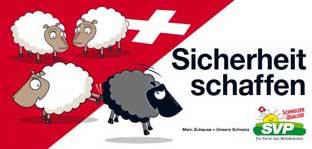
According to the AFP, Austrian website news.at announced the news with the headline, "Switzerland is now the black sheep -- majority for tougher rules against foreigers." The headline is a reference to the notorious advertising used by the far-right Swiss People's Party (SVP) showing a group of white sheep kicking a black sheep out of Switzerland. The imagery, which helped propel the SVP to a huge election win in 2007, was again brought out in the SVP's campaign for the expulsion initiative (but this time with a new twist, one of the white sheep has been stabbed!). The Austrian press wasn't the only one criticising the referendum outcome. Belgian newspaper Le Soir noted today that the Swiss are increasingly choosing a "radical road". German newspaper Sueddeutsche Zeitung wrote that once again Switzerland is "sending a signal to the world that it doesn't care what others think of it." Many of the papers are noting that the vote comes exactly one year after the Swiss voted to ban minarets on mosques.

Friday, 1 October 2010

Hard-Right Holland

You know we've entered a different era when Spain has become the leading progressive voice in Europe while the Netherlands has come under the sway of a hard-right party. If you had posited this scenario to someone in the early 1970's they would have thought you were crazy. But Holland's years-in-the-making drift toward hard-right conservatism was again demonstrated this week when a conservative coalition government was finally formed – with the participation of the far-right Freedom Party (PVV) of Geert Wilders. The new coalition is set to ban the veil and limit the number of "non-Western" immigrants allowed to come into the country.

Dutch elections were held back in June, but the two centre-right parties did not achieve enough of a majority to form a stable government on their own. The PVV, meanwhile, greatly increased their share of the vote. After months of negotiations, this week the centre-right parties concluded a deal with the far-right PVV, led by the controversial anti-Islam crusader Wilders, that will allow them to form a government with Mark Rutte as prime minister.

Monday, 20 September 2010

The mainstreaming of Europe's 'stealth far-right'

The results from yesterday’s general election in Sweden are in – and continuing the narrative of European elections over the past five years, the results are bad news for the left. The centre-left Social Democrats lost 17 seats in the parliament – just the latest blow for a party that until recently had dominated Swedish politics.

But the ruling centre-right coalition, who will hold on to power, weren’t exactly jumping out of their seats last night in celebration. Only Prime Minister Fredrik Reinfeldt's party managed to gain seats, while his three coalition partners all lost seats. This left the coalition just short of a majority, and they will have to ally with the Swedish Greens in order to put them over the threshold. So if everyone seemed to lose seats, where did the votes go? They went to the far-right Sweden Democrats (SD), who will now enter the parliament for the first time after winning 20 seats in yesterday’s election. It's a stunning development for a historically left-of-centre country like Sweden.

Friday, 23 October 2009

Race-Focused 'Question Time' Ignored Griffin's Europe Role

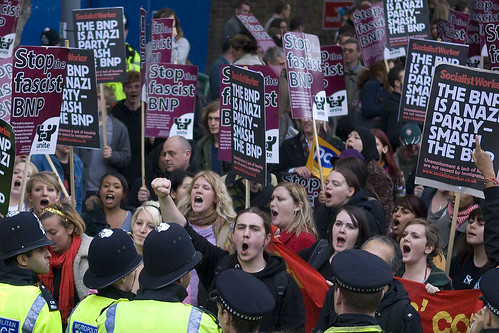
It was the dramatic conclusion of a month-long drama – Nick Griffin, the controversial leader of the whites-only British National Party, appeared on revered public affairs program Question Time last night amidst massive protests outside the studio, and the largest audience in the programme’s history glued to their TV sets at home.

There’s been much written today about what went on last night, but for me what was most interesting was what was not said on last night’s program. Almost unitarily focused on race, host David Dimbleby went out of his way to avoid any discussion of the institution Griffin was actually elected to in June, the European Parliament. I found this bizarre considering it was that election which the BBC says necessitated Griffin’s appearance on the programme in the first place. If it’s the June election that changed the equation in the BBC’s mind, why was the program unitarily focused on things that were said and done well before June 2009?

The level of public attention this program and the build-up to it received has been astounding. Griffin is the leader of the far right British National Party, which has advocated for an “all-white Britain.” His own extremist history has included membership in the violent Neo Nazi group National Front in the 1970’s, denying the holocaust and advocating the criminalisation of homosexuality, the deportation of British Muslims and the denunciation of multiculturalism. He has in the past professed admiration for both the Klu Klux Klan and Adolf Hitler.

Normally a person with such extreme views would not be featured as a guest on a major British public policy show, but the BNP has a significant electoral success in June, garnering one million votes in the European Parliament election which netted them two seats in that body, their first elected positions ever (Griffin and his deputy took up the seats). The BBC said now that Griffin has been elected to a national position by the British public, it cannot justify refusing to allow him on the broadcaster’s main programs – since it has a mandate as an unbiased public institution.

This sparked a huge outcry, culminating in a massive protest yesterday at BBC Television Centre during the taping of the episode. The show itself ended up being rather predictable. Both the other panellists and the audience took turns berating him for his racist views, and Griffin gave blathering incoherent responses that showed he is essentially a rather confused idiot. The program quickly turned into a game of cat and mouse – with Griffin working hard to project an image of a new moderated mainstream BNP which isn’t overtly “racist,” and the panellists and audience reminding him of all the racist things he’s said in the past, which he repeatedly denied saying.

Of course his excuses for why he had “changed his mind” about many of the odious things he’s said in the past were as inept as they were implausible. He twisted, laughed and clapped bizarrely as he was confronted by his past statements. And he seemed completely unprepared when presented with a quote from before the June election, on video, in which laid out a plan to pretend to moderate his beliefs on race and religion in order to make the BNP palatable and get it into office. Surely, if you’re planning some kind of Machiavellian coup like that, you probably shouldn’t talk about your plans on video!

The main aim of both the BBC and the panellists seemed to be to highlight Griffin’s racist views for the BNP voters at home who don’t consider themselves to be ‘racist’ but voted for them as a “protest vote.” The BNP has tried to gloss over their racist foundations with pamphlets full of images of British flags, happy families, proud soldiers and Churchill, Churchill, Churchill. The Tory representative, Baroness Sayeeda Warsi (herself British Asian), seemed to actually be making a concerted effort to steal away those “protest vote” BNP voters over to the Tory side. (Incidentally, I thought she and the Tories were the clear winners from last night’s show. She did a great job, though I was a little creeped out by her efforts to woo BNPers to the Conservative bosom).

Race-Baiting

But throughout it all Dimbleby was hell-bent on keeping the conversation focused on race and sexuality, as Griffin’s previous statements on those subjects are repugnant to the vast majority of British people. But the newly politically calculating Griffin refused to be drawn in, saying very few overtly offensive things during the conversation. In fact the most offensive thing he said was probably that Islam is an “evil” religion, a view I suspect many in Britain share (even many on the left). Throughout the whole discussion I kept thinking what some BNP-voter up in the East Midlands would be thinking watching this – a bunch of smug West Londoners seemingly putting racist words in the mouth of Griffin while he just sat there and said very little. For people who already feel alienated from the political system, this probably just played right in to their admiration of Griffin as an ‘underdog standing up for the working class’.

The fact is that outside its positions on race and sexuality, much of the BNPs political platform are grievances shared by an increasingly large swathe of the British public – xenophobic attitudes toward the EU, immigration and resource sharing. But Dimbleby was intent on steering the conversation away from those issues so the program could highlight Griffin’s differences with mainstream British opinion rather than the overlap. He didn’t want to highlight the aspects of the caged monster shared with the stone-throwing audience. But if Griffin’s opinions are supposedly so uniformly vile to the British public, how did he attract a million votes in the last election?

The omission was evidenced by the almost absurd non-inclusion of any discussion about the body Griffin was actually just elected to, the European Parliament. Toward the beginning of the program a questioner tried to ask Griffin about Europe and Dimbleby shut him down. “We’re talking about race!” he bellowed. “We’ll get to that later.”

Of course they did not get to that later. Clearly Dimbleby considered this to be an irrelevant question. Nevermind the fact that that Griffin is now representing the UK in the European Parliament!

The fact is probably many in the audience probably agreed with Griffin’s opinion that the EU is dangerous and tyrannical, and after all, finding commonalities between Griffin and the British public was not what this show was all about. No no, let’s stay focused on race so we can all boo and jeer Mr. Griffin’s medieval views (views which, by the way, have now been largely erased or covered over in the official BNP party platform). God forbid any of the audience, or on the panel, should look in the mirror to see how their assumption of British superiority over the rest of Europe, their subtle xenophobia rather than overt racism, informs their attitude toward European integration. That probably wouldn’t have been very comfortable for them, seeing their opinions mirrored in the spittle-flecked ramblings of a far-right nationalist.

It’s puzzling to see how, while Griffin has been a unitary obsession of the British media over the past month, his new position in Brussels has been almost completely ignored. The most egregious example came yesterday in this article from the Guardian, which called on the Question Time panel to grill Griffin about his views on climate change (he denies its existence except when warning of overpopulation). Of course the show should have asked him about climate change (they didn’t, as it’s not race-related). Griffin is now on the European Parliament’s Environment Committee, meaning he has a sizable influence over environmental policy affecting the UK (the majority of which comes from Brussels), far more influence than the vast majority of MPs in Westminster. Yet the Guardian article manages to not mention Griffin’s position on the Committee even once, even though the whole purpose of the article is to rail about Griffin’s views on climate change.


I don’t mean to be a one-trick pony here, but it really irked me that this very significant development – that Griffin is now representing Britain in the EU and has a particular influence on environmental policy, was completely ignored. Perhaps there was good reason to focus on Griffin’s racism since he is so keen to gloss over it. And perhaps it was better not to delve into an actual policy discussion with him for fear of legitimising his position. But from my vantage point it was just yet another example of the British public’s steadfast determination to ignore the existence of the EU at all costs.

The British Tancredo

But perhaps I’m too hard on the British. After all I have to say, as an American I’ve actually been quite impressed and heartened by the energetic resistance to the rise of Griffin’s ideology. Much of the BNP’s current platform (the cleaned-up version that omits the group’s overtly racist origins) is nearly identical to the platform of mainstream Republican politicians in the US. Griffin’s immigration policy, as expressed on Question Time last night, is very similar to that of Republican Congressman Tom Tancredo, who was a major contender for the 2008 Republican presidential nomination. That’s not to mention the BNP platform’s similarities to right-wing American television commentators like Glenn Beck and Lou Dobbs. And Griffin’s current stated view on homosexuality, though it was condemned by the representatives of all three major UK parties on the Question Time panel, would easily be at home in the Republican Party’s official platform. So it’s nice to see that I live in a country where these kinds of views, so common in my home country, are so reviled.

Also, Britain should keep in mind that it is hardly the first European country to send far-right politicians to the European Parliament, France beat them to that by many years. In fact the experience of France with far right Front Nationale leader Jean Marie Le Pen (also of the European Parliament) has been repeatedly brought up as a cautionary tale by British commentators. An invite by the French broadcaster for Le Pen to appear on the French equivalent of Question Time was equally controversial, and resulted in a doubling in the size of the party. Le Pen eventually rode that wave of popularity all the way to victory in the 2002 presidential race, when a fluke in the 1st round voting meant that the second round was a one-on-one contest between him and French President Jacques Chirac. There are fears that Griffin’s appearance on Question Time could lead to a similarly meteoric rise in the UK, but I just don’t see that happening.

By the way, the BBC has a great article here about how the media deals with far-right parties across Europe. It’s a very interesting side-by-side comparison, and I think helps to set all this within a larger context.

Of course, that would require some thinking about Europe, which as we learned last night, the Brits are loathe to do.

Tuesday, 3 February 2009

May you live in interesting times

I've spent the past few days getting settled here in Brussels, and so far things have gone quite well. I've got a great apartment right in Centre Ville next to the Grand Place, and my intensive French class is fantastic. It's an advanced class and there's only seven of us, each from a different country.

Last night I had drinks with a French friend who lives here in Brussels, and we were talking about different things going on the EU these days. There wasn't a shortage of things to discuss. Toward the end of the conversation, we remarked on what a crazy time this is to be living in Brussels reporting on the EU. It feels like we're on the precipice of something, particularly in Europe. Things are about to change, we speculated, and they could possibly go in extreme directions. It looks like we've all been victims of that old purported Chinese curse, "may you live in interesting times." But to continue with the 'mangled cliches claiming to be proverbs theme', the Chinese character for crisis also means opportunity! Could the economic crisis lead to a strengthening of pan-European institutions, or could it just as easily lead to the disintegration of the entire EU project?

Friday, 24 October 2008

Austria's Far-Right Gay Secret: History Repeating?

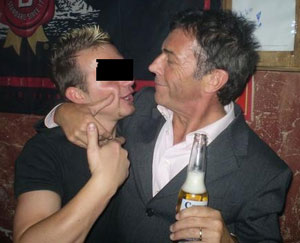
The death of far-right Austrian politician Jörg Haider took an interesting twist today. The huge outpouring of mourning and sympathy which Haider's death inspired has received much press coverage in Europe over the past two weeks, but the biggest open secret about Haider has not - the fact that he was gay. That is until yesterday, when his lover of five years Stefan Petzner publicly acknowledged their relationship in a tearful confession.

What has followed has been some hesitation from European media about whether it is appropriate to cover the sexuality of Haider, who is married with two children, as a news story. The issue has been further complicated by the fact that his sexuality was hardly inconsequential in the details of his death. He died in a car crash driving home drunk from a gay bar he had been at with his lover. But before Petzner's televised admission, that detail was left out of all press reports in Austria. It's not hard to see why, when the reality of Haider's personal life are so inconsistent with the public image of the party he led - the far-right Alliance for Austria's Future (BZÖ). After his admission, Petzner was fired from his position as leader of the BZÖ. He had already attracted attention at Haider's funeral after television cameras caught him loudly weeping more than Haider's wife and two daughters combined. Petzner said in his interview that Haider's family was aware of their relationship.

The revelation has put the party into full damage-control mode, fearing that the news will scare off the core conservative voters in Southern Austria that make up the group's voters. The hugely popular Haider had recently led the party to great success, ushering in a victory scoring 8 percent in last month's general election. Now that this news might throw the party into disarray, there has been speculation it may merge with the populist Freedom Party (FPÖ). That merger would create the second-strongest political party in Austria.

So, the revelation about Haider's sexuality is hardly inconsequential. But still, Austrian media outlets have remained extremely hesitant to cover it. In fact, it was Germany's Bild newspaper that forced the details surrounding the circumstances of Haider's death into some of the Austrian press. Austria is one of the most conservative countries in Western Europe (many would say the most conservative) and has a particularly bad reputation for gay rights (though it does not have a form of civil partnership). The rest of the European media is full of criticism today for Austria's press, questioning why the country's media seemed to show such deference to the far-right leader in not reporting his homosexuality, which seemed to blatantly contradict the policy goals of his party. However the Austrian media has defended itself by pointing out that though the party's official platform demonized gays, Haider himself was never heard to utter any criticism of homosexuality amidst his attacks on foreigners and his praise for Nazis.

I can't help but wonder what effect all of this will have on the public perception of Austria in the rest of Europe, already badly damaged by the recent string of bizarre imprisonment cases, most notably the horrific tale of Josef Fritzel. That last case was also notable for the shocking way in which people 'looked the other way.'

Fascist leaders who lived secret gay lives while publicly condemning gay people to death is a familiar theme in Europe's history. As Austria slides further and further to the right, revelations such as these are bound to make people pretty uncomfortable, especially due to its almost creepy historical parallels.