Showing posts with label BBC. Show all posts

Tuesday, 24 May 2016

Why is the BBC afraid to call UKIP a nationalist party?


Populism is other people, according to the British media.

Austria's presidential election on Sunday, in which the country came within a hair's breadth of electing its first far-right head of state since World War II, has generated a new round of media coverage on the rise of extremist parties across Europe.

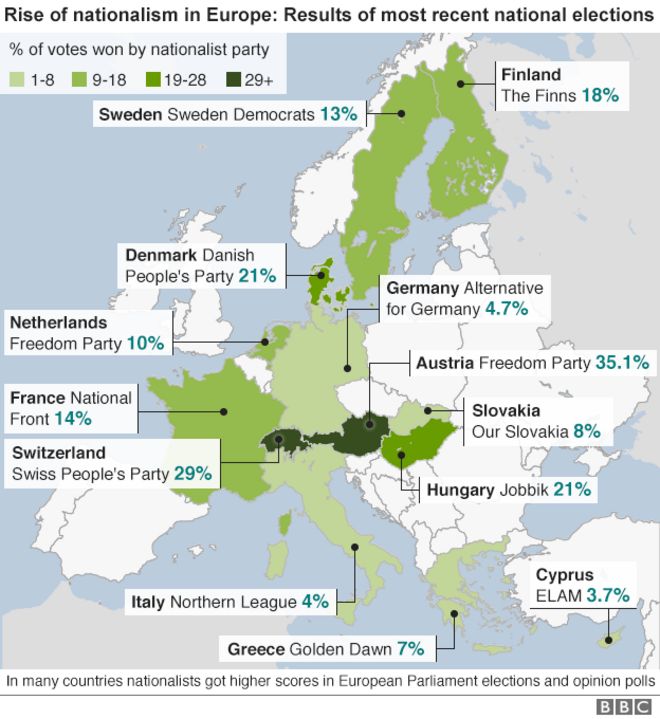
Today the BBC published an analysis of the 'Widespread revolt against the political centre', tracing the rise of these parties. It is accompanied by a map showing the percentage of votes won by "nationalist parties" in the most recent elections. 

Notice anything strange about this map? According to the BBC, the UK is either not part of Europe, or has no nationalist party. 

Monday, 7 March 2011

Germany still world's most popular country

The figures are in, and Germany has again taken the top spot in the BBC's annual poll of nations' popularity - with 62% of those surveyed ranking its influence as positive for the world. The UK was the next most-loved country, rising to second place in its highest ever placing in the annual poll.

But while Germany and the UK sit at the cool kids' table in the world lunchroom, over in the losers corner sit Iran, North Korea, Pakistan and Israel, all ranked as the most unpopular countries. The United States was ranked seventh in popularity out of the 16 countries respondents had to choose from, polling behind Canada, France, Japan and Brazil.

Monday, 20 September 2010

The mainstreaming of Europe's 'stealth far-right'

The results from yesterday’s general election in Sweden are in – and continuing the narrative of European elections over the past five years, the results are bad news for the left. The centre-left Social Democrats lost 17 seats in the parliament – just the latest blow for a party that until recently had dominated Swedish politics.

But the ruling centre-right coalition, who will hold on to power, weren’t exactly jumping out of their seats last night in celebration. Only Prime Minister Fredrik Reinfeldt's party managed to gain seats, while his three coalition partners all lost seats. This left the coalition just short of a majority, and they will have to ally with the Swedish Greens in order to put them over the threshold. So if everyone seemed to lose seats, where did the votes go? They went to the far-right Sweden Democrats (SD), who will now enter the parliament for the first time after winning 20 seats in yesterday’s election. It's a stunning development for a historically left-of-centre country like Sweden.

Wednesday, 30 September 2009

"Das ist Deutschland Hier"

Oh SNAP! One expects this kind of thing from the French, but from the Germans??

Here is video of the new German foreign minister Guido Westerwelle admonishing a BBC reporter who asked him a question in English on Monday, snapping: "We're in Germany here."

The snippy retort has raised eyebrows in Germany and across Europe, most notably because Germany has long been one of the European countries with the least “language pride”, happy to operate in English as the ‘lingua franca’ of international diplomacy and business. Westerwelle’s comments are particularly surprising coming from a soon-to-be foreign minister, who presumably will need to use his command of English frequently when meeting with foreign dignitaries from around the world.

And incidentally, this BBC reporter was actually reporting for the World Service, which is an English language global news service that doesn't broadcast within the UK, but rather across the world to Africa, Asia, Europe and the Americas.

The French are notorious for this kind of defensive language pride. Could this be a sign that the Germans are starting to feel more confident about defending their own national identity? The BBC reporter’s question was about how German foreign policy would change with Westerwelle as foreign minister. Though he grumpily refused to directly answer the question, his rant may have revealed plenty about how Germany's foreign policy will change under his leadership. Was this a calculated signal to the international community, or a momentary bout of crankiness?

Germany is now the largest and most economically powerful country in Europe by far. Yet Germans are also renowned for their humble and realistic approach to their relative size and importance on the world stage. They have historically accepted the fact that German is not a world language and that English is the lingua franca (hence even though there are three co-equal working languages of the EU – English German and French – German is not often used in an official working capacity). This has set them apart from the French who many view as delusional about the importance of their language in the world. Germany, because of it’s WW2 legacy, has for the past half-century been very self-effacing and accommodating – particularly with English. As is often noted, 'it's not allowed to have German pride'.

Does Westerwelle’s rant signal the rebirth of a newly assertive Germany?

Monday, 18 December 2006

Lessons not learned

One of the most commonly heard defenses heard from people who voted for the Iraq war resolution is that they with the “widely-held” belief at the time suggesting that Saddam Hussein possessed weapons of mass destruction and had links to Al Qaeda, and with the American media swallowing this excuse unquestioningly, I think it’s time for a reality check.

Despite David Kay's insistence that we were “all wrong” in Iraq, the evidence says otherwise. Many of the assertions that Bush and Blair made in the run-up to the war were highly dubious and viewed with a high degree of skepticism around the world, particularly in Britain. In the UK the media reported on these doubts in the run-up to the war. This is partly why the war was and has remained so unpopular there, prompting the largest public demonstration in London’s history right before the invasion.