Sunday may be a pivotal turning point for Europe, but not because of the presidential election in Austria. A referendum in Italy could bring the euro back to crisis point.
In May, when Austria held its first attempt at holding a presidential election, newspapers in the UK and the US were full of breathless coverage. "Austria is on the brink of electing Europe's first far-right president since WWII" they declared.
The BBC and The Guardian both used the occasion to run features about the 'rise of nationalism and populism in Europe', both of which curiously left out Britain's own UK Independence Party. 'Populism is other people' they convinced themselves. Now, after Brexit and Trump, the Anglo-American coverage is quite different.
And the coverage has returned, because the Austrian election is being re-run this Sunday, 4 December.
In May, the far-right candidate Norbert Hofer, the leader of the Freedom Party, was beaten by Alexander Van der Bellen from the Green Party by just a few thousand votes. The two were facing each other in a shock second round after the country's main center-right and center-left candidates were eliminated. It was the first time a candidate from either the Greens or Freedom Party made it to the second round.
Showing posts with label Austria. Show all posts
Friday, 2 December 2016
Tuesday, 24 May 2016
Why is the BBC afraid to call UKIP a nationalist party?
Populism is other people, according to the British media.
Austria's presidential election on Sunday, in which the country came within a hair's breadth of electing its first far-right head of state since World War II, has generated a new round of media coverage on the rise of extremist parties across Europe.
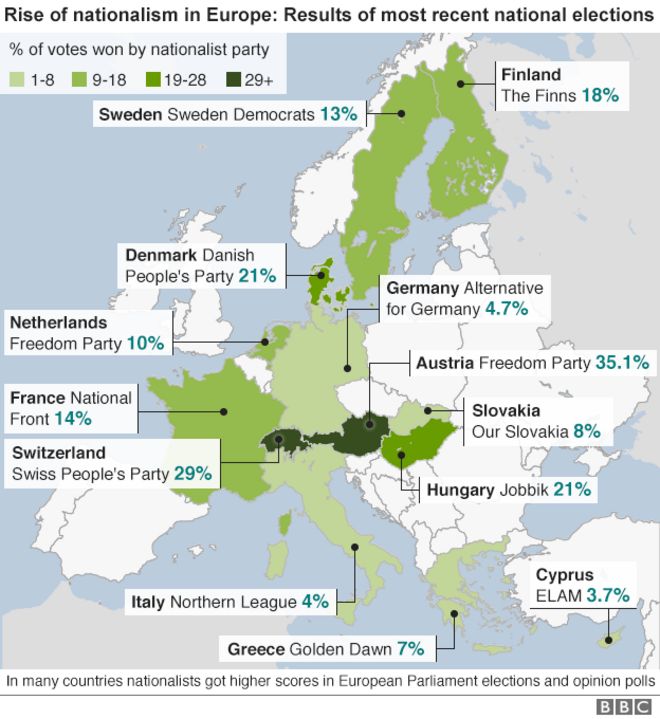
Today the BBC published an analysis of the 'Widespread revolt against the political centre', tracing the rise of these parties. It is accompanied by a map showing the percentage of votes won by "nationalist parties" in the most recent elections.
Notice anything strange about this map? According to the BBC, the UK is either not part of Europe, or has no nationalist party.
Austria's presidential election on Sunday, in which the country came within a hair's breadth of electing its first far-right head of state since World War II, has generated a new round of media coverage on the rise of extremist parties across Europe.
Today the BBC published an analysis of the 'Widespread revolt against the political centre', tracing the rise of these parties. It is accompanied by a map showing the percentage of votes won by "nationalist parties" in the most recent elections.
Notice anything strange about this map? According to the BBC, the UK is either not part of Europe, or has no nationalist party.
Wednesday, 25 November 2009
Vienna - Back to the Start
It’s interesting visiting a city again after a ten year absence. I’m on a bunpy flight back to London at the moment, after a very nice few days in Vienna. I hadn’t been there since I went on a trip with my high school band in 1998. Vienna was actually the first city I had ever visited in Europe. Given that this city was my first ‘introduction’ to this continent, it was interesting to go back there now that I’ve lived in Europe several years and have travelled extensively through it. Needless to say, my impressions were far different this time around.I don’t remember much about that first visit – actually the main impression I remember from it was of a city full of sex. I was just 17 at the time and I remember me and the other high schoolers being amazed when we turned on our TV the first night in the Vienna hotel and saw – get this – breasts! We couldn’t get over it, there were breasts on a main Vienna network! Then we looked out of our window and saw a real live prostitute – or at least a person who we convinced ourselves was a lady of the night. Exploring the city I remember us seeing a few scattered sex shops and thinking truly Vienna was some kind of throbbing sex-obsessed mecca.
It’s amusing to look back on because in reality, Austria is one of the most conservative countries in Europe, and Vienna is known as one of the continent’s more staid and prudish major cities. But to some band geek teenagers from conservative America, it seemed pretty wild!During the year I lived in Prague in 2002 I kept meaning to take a train down to Vienna but I never made it, which was a shame because I was there studying Central European history. Much like Prague, Vienna is a city reflecting many different eras of European history, from the glory days as capital of the enormous Habsburg empire to its awkward cold war role as a supposedly neutral zone. Because if this Cold War confusion Austria has never really had a period of national soul-searching about its Nazi past, unlike Germany. It remains a staunchly conservative country with an especially hostile attitude toward foreigners. It maintains the toughest asylum rules in Europe and getting a visa to work there is notoriously difficult.
Vienna is a bit like Prague on steroids. It's jam-packed with massively intimidating counter-reformation architecture. But thought it may look like Prague architecturally, the vibe is very different. Miraculously spared the ravages of Soviet domination through sheer luck, Austria is a prosperous country that maintains the third highest GDP in the EU. Despite the fact that it was once part of the same country as its Central European neighbours to the North and East, Austria today bears much more resemblance to Switzerland than to Hungary or the Czech Republic. The two Alpine countries are both beautiful, efficient, prosperous and, above all, uncompromisingly conservative. Austria had to be dragged kicking and screaming into the EU in 1995, and public approval ratings of Brussels remain among the lowest in continental Europe. Obsessed with its Catholic Habsburg heritage, Austria is also one of the more religious countries in Europe.
Over the past few days I couldn’t help continuously comparing Vienna to Zurich, where my father lives. Though the ethos and culture may be very similar, of course the size of Vienna dwarfs that of Zurich, as does the monumental scale of its public buildings. Switzerland, after all, was never the centre of an empire. The Habsburgs left some monumental mementos from the days in which they ruled over nearly 70 million Europeans. It’s often been said that if Martians came to Earth, they would mistake Vienna as the capital of the world.At the same time there were plenty of reminders of the Swiss mentality, particularly in all the Christmas markets around the city serving Gluhwine. It made me excited that I’ll be in Zurich next weekend for a Thanksgiving dinner at my dad’s house. Zurich at Christmastime is beautiful, and the gluhwine aint half bad either!
So all in all it was a good trip. I spent a near fortune though – museums in Vienna are not cheap. I’m looking forward to a few days at home back in London before Thanksgiving in Zurich next weekend.
Saturday, 29 November 2008
Britain's Fritzl: is Austria off the hook?
Back in April, as the details of the notorious case of Josef Fritzl in Austria became public, the world became instantly fascinated. The details of the case were absolutely horrific: A man had imprisoned his daughter in his family's basement and repeatedly impregnanted her over 20 years, hiding the children she bore in the basement with her and never letting any of them see the light of day.
At the time many in the media (including myself) sought answers to the incredibly bizarre circumstance within the culture in which they took place. A lot of ink was spilled about how the case reflected the "look the other way" culture in Austria, a traditionally conservative society that highly values privacy.
But now details are emerging about a case in Britain that may throw that argument on its head. This week a man in Sheffield received 25 life sentences for getting his two daughters pregnant 19 times during almost 30 years of rape and physical abuse. The case has eery similarities to the Fritzl case, but the numbers involved in the story are even worse in the UK case. Instead of 20 years, the raping went on for 30 years. Instead of impregnanting one daughter, this man impregnanted two. And rather than hiding his daughters and their children, this family was living out in the open, and even received visits from British social workers.
At the time many in the media (including myself) sought answers to the incredibly bizarre circumstance within the culture in which they took place. A lot of ink was spilled about how the case reflected the "look the other way" culture in Austria, a traditionally conservative society that highly values privacy.
But now details are emerging about a case in Britain that may throw that argument on its head. This week a man in Sheffield received 25 life sentences for getting his two daughters pregnant 19 times during almost 30 years of rape and physical abuse. The case has eery similarities to the Fritzl case, but the numbers involved in the story are even worse in the UK case. Instead of 20 years, the raping went on for 30 years. Instead of impregnanting one daughter, this man impregnanted two. And rather than hiding his daughters and their children, this family was living out in the open, and even received visits from British social workers.
Friday, 24 October 2008
Austria's Far-Right Gay Secret: History Repeating?
What has followed has been some hesitation from European media about whether it is appropriate to cover the sexuality of Haider, who is married with two children, as a news story. The issue has been further complicated by the fact that his sexuality was hardly inconsequential in the details of his death. He died in a car crash driving home drunk from a gay bar he had been at with his lover. But before Petzner's televised admission, that detail was left out of all press reports in Austria. It's not hard to see why, when the reality of Haider's personal life are so inconsistent with the public image of the party he led - the far-right Alliance for Austria's Future (BZÖ). After his admission, Petzner was fired from his position as leader of the BZÖ. He had already attracted attention at Haider's funeral after television cameras caught him loudly weeping more than Haider's wife and two daughters combined. Petzner said in his interview that Haider's family was aware of their relationship.
The revelation has put the party into full damage-control mode, fearing that the news will scare off the core conservative voters in Southern Austria that make up the group's voters. The hugely popular Haider had recently led the party to great success, ushering in a victory scoring 8 percent in last month's general election. Now that this news might throw the party into disarray, there has been speculation it may merge with the populist Freedom Party (FPÖ). That merger would create the second-strongest political party in Austria.So, the revelation about Haider's sexuality is hardly inconsequential. But still, Austrian media outlets have remained extremely hesitant to cover it. In fact, it was Germany's Bild newspaper that forced the details surrounding the circumstances of Haider's death into some of the Austrian press. Austria is one of the most conservative countries in Western Europe (many would say the most conservative) and has a particularly bad reputation for gay rights (though it does not have a form of civil partnership). The rest of the European media is full of criticism today for Austria's press, questioning why the country's media seemed to show such deference to the far-right leader in not reporting his homosexuality, which seemed to blatantly contradict the policy goals of his party. However the Austrian media has defended itself by pointing out that though the party's official platform demonized gays, Haider himself was never heard to utter any criticism of homosexuality amidst his attacks on foreigners and his praise for Nazis.
I can't help but wonder what effect all of this will have on the public perception of Austria in the rest of Europe, already badly damaged by the recent string of bizarre imprisonment cases, most notably the horrific tale of Josef Fritzel. That last case was also notable for the shocking way in which people 'looked the other way.'Fascist leaders who lived secret gay lives while publicly condemning gay people to death is a familiar theme in Europe's history. As Austria slides further and further to the right, revelations such as these are bound to make people pretty uncomfortable, especially due to its almost creepy historical parallels.
Tuesday, 29 April 2008
The incest imprisonment: why Austria?
Across the world the media is in breathless shock over the extraordinary case of an Austrian man who kept his daughter imprisoned in his basement for 24 years, fathering 7 secret children with her. The attention is not surprising, this is a truly bizarre story. But what does it all mean for Austria, especially considering this is the third such instance in just two years?To recap, Josef Fritzel, a 73 year old retired engineer in the town of Amstetten in Austria, has confessed to drugging his daughter Elisabeth at the age of 18, imprisoning her in his windowless basement, and then keeping her and the subsequent children he fathered with her chained in this secret lair for 24 years. The story is so complex the news broadcasts on the subject have had to use charts to explain the various players in it.
Apparently Elisabeth’s mother, Rosemarie Fritzel, had no idea about any of this, Mr. Fritzel having told her in 1984 that Elisabeth had run away and joined a cult. Over the next two decades Fritzel had seven children with his captive daughter, three of whom he kept locked in the basement with her. Extraordinarily, the other three he brought to the surface, raising them in the main house as normal children. Fritzel told his wife they had been left at the doorstep by Elisabeth, with a note saying she couldn’t take care of them.
Tuesday, 8 April 2008
Skiing in Tyrol
Last week I went on a ski trip to the Austrian Alps. Yes I know, I feel as if I’ve been on a bit of Alps overload over the past year. I’ve now driven through them in four different countries and just the previous weekend I had taken a train through the Goddard Pass to Venice. This was supposed to be the year of Southern Europe!We started our journey by flying to Munich, another place I’ve been way too many times. It’s a beautiful city though, I must admit, though I still find Bavarians a little off-putting. We spent one night in the city and then drove our rental car down to Sőlden, the resort in the Ötz valley where we skied. On the way we stopped at Neuschwanstein Castle, the fairy tale palace built by mad King Ludwig, the second to last king of Bavaria, in the mid 19th century.
Friday, 18 January 2008
Europe’s far right calls for ban on mosques
Belgium's far-right Vlaams Belang has joined with radical groups from Austria and Germany to launch a Charter to, “fight the Islamisation of West-European cities.” They announced their new coalition Thursday in the Flemish city of Antwerp. Vlaams Belang’s Filip Dewinter told Radio Netherlands Worldwide, “"We are not opposed to freedom of religion but we don't want Muslims to impose their way of life and traditions over here because much of it is not compatible with our way of life."
Tensions between Muslim communities and the majority populations in Western Europe have been growing in recent years as these largely secular societies struggle to absorb populations with deeply held religious beliefs. The crisis has been exasperated by incidents such as the 2004 murder of Dutch filmmaker Theo Van Gogh (a relative of Vincent Van Gogh) by a jihadist after Van Gogh made a movie dealing with violence against women in Islamic societies. Tensions between Muslims and the secular Dutch have been particularly strong since then.
Subscribe to:
Posts (Atom)