Can Germans convince other Europeans to feel as strongly about data privacy as they do? A new documentary tries to make the case.
Last night I attended the Berlin premier of Democracy, a documentary about the European Union's proposed data privacy regulation. The director, David Bernet, has been following the main actors involved in the legislation since it was first proposed in January 2012.
The film strives to be a call-to-arms for Europe as a whole, drawing attention to the threat posed by data surveillance and the current make-or-break moment for this legislation which would put controls on snooping. It opens and closes with shots of the Parthenon in Athens, with an ominous-looking government helicopter flying overhead. The not-so-subtle message: all democracy is under threat from unrestrained data surveillance.
But despite the pan-European scenes, the film seems to be coming from a very German perspective on these issues. And as somewhat of a privacy-sceptic, I came away feeling that while film told me what is happening with the legislation, it didn't tell me why I should support it.
Showing posts with label privacy. Show all posts
Saturday, 7 November 2015
Thursday, 26 January 2012
Europe’s SOPA?
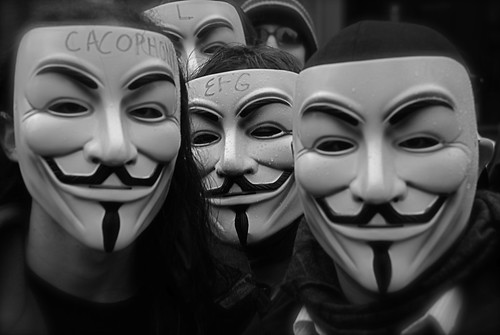
The European Parliament’s website has been shut down by hackers today, allegedly in a denial-of-service attack from Anonymous in protest of imminent anti-piracy legislation restricting internet freedom. But as the IT folks in parliament scramble to fix the problem, the functionaries are sitting around scratching their heads in confusion. Did we pass internet piracy legislation?
Their confusion is warranted. By all accounts the EU has been on the internet-freedom-lovers side during this debate. During the fallout from the Wikipedia ‘blackout’ last week, US politicians weren’t the only ones beating a path to the door to distance themselves from the now toxic SOPA legislation on internet piracy. On Friday the EU’s Digital Agenda Commissioner Neelie Kroes tweeted that she was “glad the tide is turning on #SOPA,” adding “speeding is illegal too: but you don't put speed bumps on the motorway”.
Home Affairs Commissioner Cecilia Malmström also tweeted against the US legislation, noting that ‘sopa’ in Swedish means garbage. Notably, no public statements about the US anti-piracy bills had been made before the Wikipedia blackout. It’s quite unusual for the EU to make comments about US legislation. But such was the effect of the blackout – which was, after all, global (Eurocrats felt quite helpless without Wikipedia last week!), that even politicians not involved in US lawmaking felt the need to make a statement about it.
Their confusion is warranted. By all accounts the EU has been on the internet-freedom-lovers side during this debate. During the fallout from the Wikipedia ‘blackout’ last week, US politicians weren’t the only ones beating a path to the door to distance themselves from the now toxic SOPA legislation on internet piracy. On Friday the EU’s Digital Agenda Commissioner Neelie Kroes tweeted that she was “glad the tide is turning on #SOPA,” adding “speeding is illegal too: but you don't put speed bumps on the motorway”.
Home Affairs Commissioner Cecilia Malmström also tweeted against the US legislation, noting that ‘sopa’ in Swedish means garbage. Notably, no public statements about the US anti-piracy bills had been made before the Wikipedia blackout. It’s quite unusual for the EU to make comments about US legislation. But such was the effect of the blackout – which was, after all, global (Eurocrats felt quite helpless without Wikipedia last week!), that even politicians not involved in US lawmaking felt the need to make a statement about it.
Friday, 5 November 2010
EU to create "right to be forgotten"
As the public's concern over internet privacy violations on sites like Facebook continues to grow, the EU unveiled new proposals yesterday to give people more control over how their online personal data is collected and used. The new update to EU privacy laws would oblige service providers to make personal information and user-supplied content easily and quickly deletable. Citing the effect such information can have on a person's professional and private life, the European Commission says the issue is important enough to take EU-wide action. The commission says it has even received complaints from its own staff about Facebook's privacy policy. And that must be a big deal, because most of the people I know who work for the commission are on Facebook all day!
Perhaps the most interesting thing about the proposal is that it would create a new right for EU citizens, a so-called "right to be forgotten." The original EU data protection rules date back to 1995, when such issues of online privacy did not yet exist. In theory the right to control over one's own personal stored information is already enshrined in EU law, but the commission said yesterday its applicability to the online world has been patchy and unclear.
Wednesday, 16 September 2009
Move over Somalia, Sarko's after the cyber-pirates Now
My twitter erupted with activity yesterday as news spread that the French lower house had at long last passed the much-maligned Hadopi bill, the hugely controversial legislation that would ban people from using the internet if they are caught repeatedly downloading files illegally.This was the third attempt to pass the measure, but the third time was the charm and since it’s already passed the French senate, Sarkozy’s piracy-busting measure will now become law. It will be the toughest anti-internet piracy legislation in the world. The slow journey of this legislation has been closely watched by other European countries and now that the precedent has been set, they will now likely enact their own similar laws.
The bill, named after the new anti-piracy government agency it will create, would permit authorities to impose a variety of penalties on people caught downloading illegally including cutting off their internet connection for a year, imposing fines of hundreds of thousands of euros, and even jailing them for two years.
Tuesday, 29 April 2008
The incest imprisonment: why Austria?
Across the world the media is in breathless shock over the extraordinary case of an Austrian man who kept his daughter imprisoned in his basement for 24 years, fathering 7 secret children with her. The attention is not surprising, this is a truly bizarre story. But what does it all mean for Austria, especially considering this is the third such instance in just two years?To recap, Josef Fritzel, a 73 year old retired engineer in the town of Amstetten in Austria, has confessed to drugging his daughter Elisabeth at the age of 18, imprisoning her in his windowless basement, and then keeping her and the subsequent children he fathered with her chained in this secret lair for 24 years. The story is so complex the news broadcasts on the subject have had to use charts to explain the various players in it.
Apparently Elisabeth’s mother, Rosemarie Fritzel, had no idea about any of this, Mr. Fritzel having told her in 1984 that Elisabeth had run away and joined a cult. Over the next two decades Fritzel had seven children with his captive daughter, three of whom he kept locked in the basement with her. Extraordinarily, the other three he brought to the surface, raising them in the main house as normal children. Fritzel told his wife they had been left at the doorstep by Elisabeth, with a note saying she couldn’t take care of them.
Subscribe to:
Posts (Atom)