Showing posts with label terrorism. Show all posts

Thursday, 28 July 2016

Despite a gruesome week, Germans keep calm and carry on

Reports in American media of German 'panic' are greatly exaggerated. Most still believe Merkel's refugee policy is the right thing to do.

Over the past week, as Germany was struck by a string of four violent attacks in a row, German Chancellor Angela Merkel stayed on holiday.

It might seem strange for people in other countries. It stands in stark contrast to the political reaction in neighboring France, where French President Francois Hollande rushed to the scene of recent attacks there and made dramatic pronouncements and new policy promises. 

It has matched the general tone of the measured response here in Germany, both from the media and from politicians. There has been no hysteria.

Of course, this is largely because the scale and scope of the French and German attacks were very different. The German terrorist attacks were failures, killing no one but the perpetrator. While the attacks in Belgium and France were co-ordinated large-sale attacks by ISIS cells, the events in Germany have been small attempts by lone wolves. While the other attacks have had clear links with ISIS, the Germany links are tenuous or non-existent.

Thursday, 19 May 2016

How a memorial meant to be a symbol of Belgian resilience became a symbol of Belgian dysfunction

For two months after the Brussels attacks, the impromptu memorial at Place de la Bourse was left to decay. It will finally be cleaned up tomorrow.

In the hours immediately after the terrorist attacks in Brussels on 22 March, people were unsure what to do. It seemed safest to stay indoors, but as the afternoon developed without incident people wanted to come outside to show their solidarity.

Unable to reach the locations of the attacks themselves, they came to Brussels' most well-known meeting point to pay their respects: the steps outside the giant Leopold-era stock exchange, The Bourse. They began laying flowers and candles on the street in front of the steps, writing messages in chalk on the building and draping flags over the intimidating lions guarding the entrance.

Monday, 25 April 2016

Is Brussels dead?

Media coverage in the aftermath of the terrorist attacks in Brussels have had a crippling effect on the city's economy. But it's only the latest setback for this unloved and underdeveloped city.

There have been reports in the Belgian media that over the past month, as many as 600 cafes, restaurants and hotels have filed for bankruptcy in Brussels. The normal amount is 40 per month.

The reports seem to reaffirm what people in Brussels have seen with their own eyes over the past weeks. Since the terrorist attacks of 22 March, Brussels city centre has been eerily quiet.

I have been mostly in Brussels over the past month rather than in Berlin, and I can confirm that the atmosphere has sometimes resembled a ghost town. At first, people were blaming it on the Easter break. "Brussels would always be empty at this time of year," they insisted. As the weeks wore on, their continued insistence that Easter was the culprit seemed less and less plausible.

Thursday, 24 March 2016

Would an EU Intelligence Service fix weak links like Belgium?

Europeans have lost confidence in the ability of Belgium’s fractured government to deal with jihadists exporting terror to neighboring states.

For reporters trying to cover the Brussels terrorist attacks this week, it has been a frustrating few days. As in any unfolding crisis, incorrect information been quick to spread. But in Belgium, the amount of conflicting information has had a surreal quality. 

Information about whether suspects have been apprehended, or who blew themselves up where, has all depended on which Belgian authority you talk to. And in usual Belgian fashion, the authorities are not communicating with one another. 

Yesterday the Turkish President said his country had arrested one of the suicide bombers last year and deported him, telling the Belgian embassy that he was a foreign terrorist fighter. The Belgian justice minister’s response today? “It’s only normal that a justice minister doesn’t know what happens in embassies. We could not know this.”

Tuesday, 22 March 2016

International targets

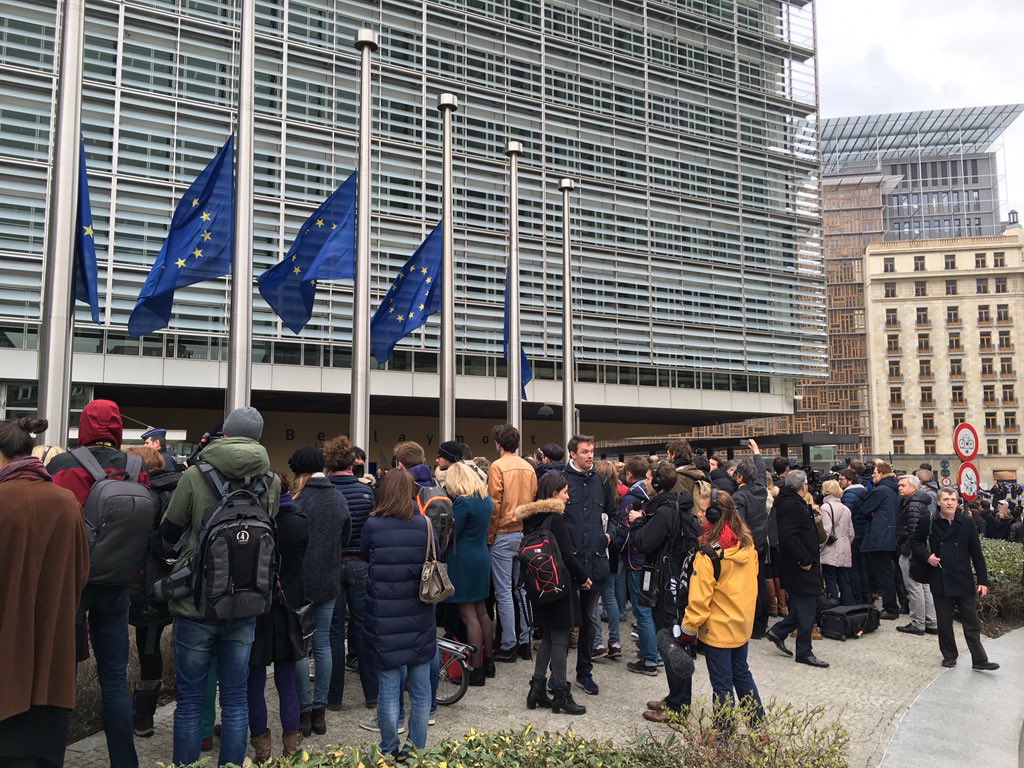
The locations of today's bomb blasts in Brussels were more international in nature than in November's Paris attacks. Was that the intention?

Across Belgium, people are extremely shaken up by the gruesome terrorist attacks today which took the lives of at least 34 people. But perhaps none more so than the people in Brussels' expat community.

The two targets in today's attacks are extremely public spaces - an airport departures hall and a metro station. But these two particular spots are ones that are visited over and over by the people working in and around the institutions of the European Union.

Monday, 4 January 2016

Will the Öresund become a symbol of European disintegration?

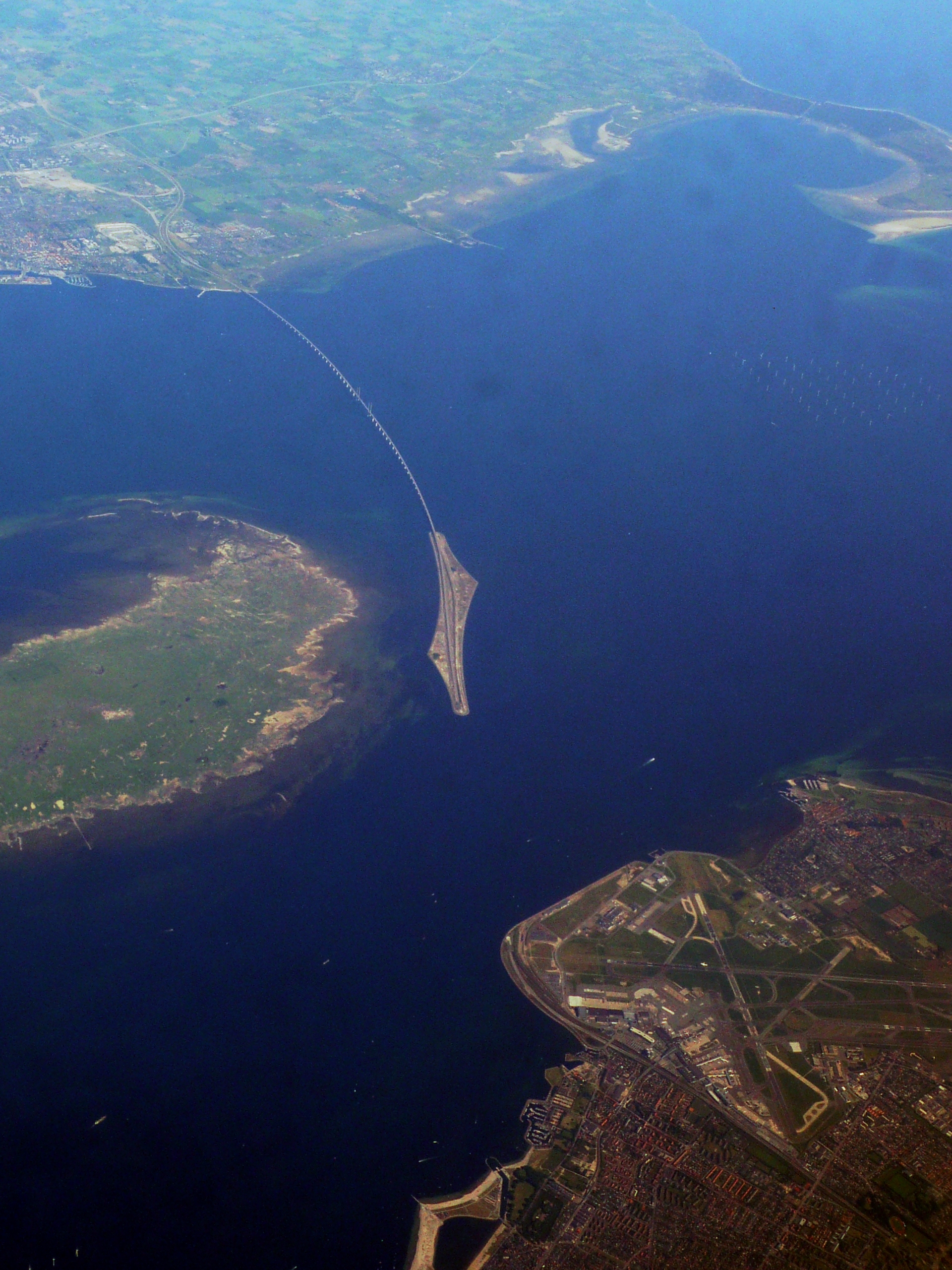
For the first time in six decades, Sweden has installed controls at its border with Denmark.

This morning, border checks took effect on the Öresund Bridge, which connects with countries of Sweden and Denmark. 30,000 people use this bridge to commute between the cities of Copenhagen and Malmo each day. For comparison, imagine New York and New Jersey setting up ID checks on the George Washington Bridge


The news might not seem particularly remarkable to British or American readers. After all, they have to go through a passport control to get to any other country, so why shouldn't Swedes or Danes? 

Monday, 28 December 2015

Processing a tragedy

The lockdown in Brussels last month reminded me of the days following the 9/11 attacks in New York.

I'm home in the US for the holidays, and over the weekend I discovered a treasure trove of old videos from high school and college in my parents' basement.

Among the VHS copies of my public access sketch comedy show in high school (don't worry I won't embarrass anyone by posting those videos!) I came across some footage I shot during the 9/11 attacks in New York City. I had completely forgotten about it.

Thursday, 26 November 2015

For the first time, I'm considering leaving Europe

Europe and America are both facing problems, but Europe's governing structures are more vulnerable and seem ready to collapse. It's left me pondering my future.

Since I first moved to Europe ten years ago, I've been surprised by how often I am asked one particular question - "will you ever move back to America?"

It always struck me as unusual, because I don't think a European who moved to America would get that question all the time. But in the four European cities I've lived in, people have seemed genuinely perplexed about why I'm here. Why would someone prefer to be in Europe rather than the United States? The question always annoyed me, and my answer was resolute.

"No, I'm not planning to move back," I responded. "I have a better quality of life here, I'm no longer in an American bubble separated from the rest of the world and, most importantly, I feel more hopeful for the future here than I did in the United States."

As we come to the end of 2015 I have to ask, is there reason for me to feel hopeful for Europe any more?

Monday, 23 November 2015

Brussels in 'lockdown'

Brussels is a lot tougher than people unfamiliar with the city might think.

I was in Brussels during the intense events of the last few days, and I would be lying if I said I didn't feel quite a bit of relief to be back in Berlin today. 

At the same time, I'd have to say that the situation in Brussels wasn't quite as terrifying as the international media has made it out to be. And Brusselers are far more used to this kind of thing than one might assume.

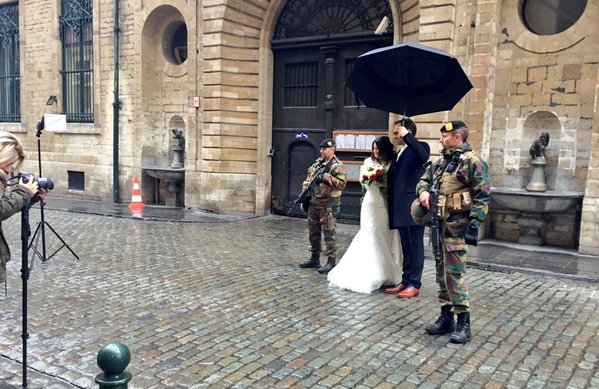
The reports have been full of the same tired clichés that I often here about Brussels - that it's a quiet town "usually associated with the somnolent activity of the European Union", as the New York Times put it. In truth, the roar of helicopters, the whir of constant sirens and the sight of military personnel on the streets of Brussels is not an unusual sight. The city is, don't forget, the home of both the EU and NATO and therefor requires intense security for visiting leaders.

Tuesday, 17 November 2015

Why is Brussels a terror nexus?

The combination of balkanised authorities and a marginalised North African population has made Brussels a natural terrorism hub. 

I’m here in Brussels this week, doing a few TV spots and moderating some conferences. As soon as I arrived at the airport last night, I could sense the tension in the city as a result of this weekend's terrorist attack in Paris. 

As I rode the nearly empty tram to my Brussels apartment, a group of young North African men got on the tram, engaged in a heated argument amongst themselves about the recent attacks (they were debating whether or not it was justified). I stopped into my local kebab joint and found another discussion between the Moroccan owners and a white Belgian customer, about how the authorities should respond. Outside, sirens wailed as police searched the city for one of the attackers believed to be on the loose in the city.

Friday, 23 March 2012

Don’t mention the Gaza

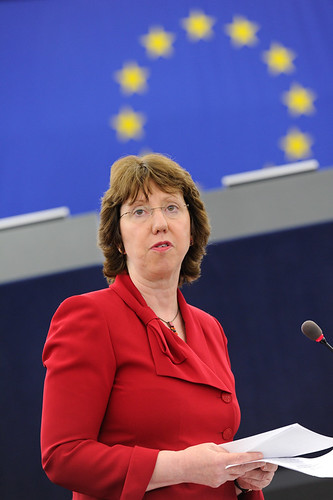
EU foreign policy chief Catherine Ashton was the object of fury in Israel this week - with the press, the pundits and even the prime minister all calling for her immediate sacking. Her crime? Mentioning the fact that children have been killed in Gaza.

Ashton was attending a Brussels conference on the subject of Palestinian children refugees on Monday when news came that three children had been shot and killed at a Jewish school in Toulouse, France. When she took to the podium to address the conference, Ashton broke the news. She then talked about how sad it is when a child loses a life, bringing up last week’s bus accident in Switzerland where 22 Belgian children were killed.
“The Belgian children have lost their lives in a terrible tragedy. And when we think of what happened in Toulouse today, when we remember what happened in Norway a year ago, when we know what is happening in Syria, when we see what is happening in Gaza and Sderot [Israel], in different parts of the world — we remember young people and children who lose their lives,” she told the audience (video here).
 When news of her comments reached Israel, the reactions were swift and furious. Israeli papers said her comparison of the shooting of innocent Jewish children with the deaths of Palestinian children during Israeli shelling of Gaza was “grotesque”. They labelled Ashton as anti-Semitic, people compared her to a Nazi, and the papers demanded her immediate removal from office.

Sunday, 24 July 2011

Europe's Timothy McVeigh

Europe is in shock this weekend after Friday's horrifying act of terrorism in Norway that killed 76 people. Because of the stated aims of the perpetrator, it is already prompting questions over whether Europe has been looking the other way as the far right has grown in numbers and power.

When the news first broke on Friday that a car bomb had gone off outside the prime minister's office in Norway, many people assumed it was an act of Islamic terrorism. But soon after, news broke that the bombing had been followed by a shooting spree at a political youth retreat for the country's ruling Labour party. Then it was clear that this was unlikely to be an act of Islamic terrorism, since it seemed to fit the modus operandi of either a deranged lone gunman or an act of far-right domestic terrorism. In the end, it turned out to be the latter.

The man accused of orchestrating the attack, Anders Behring Breivik, reportedly carried out the attack on the ruling Labour party because he felt that their tolerant attitude toward Islam was destroying the country. It was an anti-government, far-right, fundamentalist Christian act of terrorism - similar to the Oklahoma City bombing in the US in 1995 committed by far-right extremist Timothy McVeigh.

Friday, 6 May 2011

Europe uncomfortable with US Bin Laden celebrations

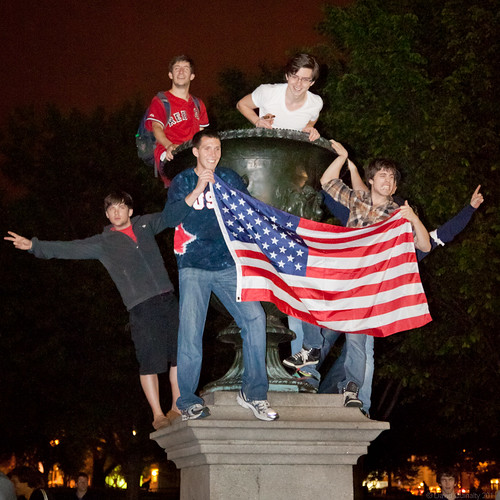
I've had a rather surreal experience this week watching reaction to the news that Osama Bin Laden was killed by American forces. On Monday morning I woke up and opened Facebook (before anything else, naturally), and saw a string of cryptic statuses chanting things like "USA! USA!" or "I'm so proud to be American today". But for whatever reason none of them said what had actually happened. So I had to open up Google News to learn what had inspired these rather unlikely chants from my "liberal elitist" friends in New York City.

The news was, of course, that Osama Bin Laden had been killed. The announcement by President Obama Sunday night prompted sudden exuberant celebrations in cities across America, the biggest outside the White House and in Times Square. It was reminiscent of the Victory Day celebrations at the end of World War II, a cathartic celebration unleashing a decade of angst Americans had felt since the 9/11 attacks. I found the magnitude of the celebrations a little surprising, but perhaps I had underestimated the effect that America's inability to capture Osama Bin Laden has had on the US psyche. A profound sense of anxiety and humiliation seems to have been lifted from Americans' minds with this killing. And both the left and right are jubilant over it. The American media seems to have regarded these celebrations as a universal good, heralding the way they have brought left and right together and united Americans in the same way that they were united after 9/11. The question does not seem to be asked whether Americans can be 'unified' in a counter-productive instinct.

Monday, 2 May 2011

A royal weekend of symbolism

Wow, what a weekend – a royal wedding, beatification of a saint and now a martyrdom. What century are we living in again?

Last night's news that after a decade of efforts the United States has at long last killed Osama Bin Laden is just about the only news story people are talking about today. This is to be expected for such a symbolically important event – regardless of its actual real-world impact. The news finished off a weekend when the US was paying more attention than normal to events going on abroad, with the royal wedding in London and the huge mass in Rome that declared Pope John Paul II ready to be a saint. All three of these events were short on real-world impact but high on symbolic value.

Wednesday, 20 April 2011

Koran burning: US and Europe have different ideas on free speech

The US military is still struggling to quell violence across Afghanistan and elsewhere caused by a Florida pastor's public burning of the Koran. The burning, which took place on 20 March, came months after the same pastor had decided to cancel his first planned book-burning after everyone from senior US military figures to President Obama told him not to do it. They said such a burning would incite violence across the Arab world and put US troops in danger.

In the end, he went ahead and did it anyway. So far at least one US military death is thought to be linked to the protests sparked by the Koran burning, but of course this is difficult to prove directly But throughout all of the warning issued to the pastor by the US military and politicians in the run-up to the burning everyone was keen to stress one thing – though the burning would put the lives of US troops at risk, the pastor had every legal right to burn the Koran under the freedom of speech entitled to him by the first amendment of the US constitution. So, the pastor faces no legal consequence for the Koran-burning he staged. And he is now planning more burnings starting on Good Friday in Michigan.

Contrast this to how a similar incident was handled across the pond in the UK. A man staged a public burning of the Koran at a shopping centre in Carlisle on 19 January. He was arrested, and yesterday a judge sentenced the man to 70 days in jail for religiously aggravated harassment. The judge called his stunt "theatrical bigotry".

Friday, 11 March 2011

IRA-supporting US congressman launches terrorism hearings

In order to not be considered a terrorist, Muslims in America don't just have to not participate in terrorist activities – they need to actively renounce terrorism and fight to end it. So says Republican Congressman Peter King, the new head of the Homeland Security Committee in the House of Representatives. King is leading hearings this week investigating the "radicalisation of the American Muslim community," calling Muslim religious and business leaders before congress to test their loyalty to the United States.

The hearings, which to many are reminiscent of the anti-communist hearings conducted in the 1950's by Senator Joseph McCarthy, are proving enormously controversial in the United States. Democratic Congressman Mike Honda, who was interned in Japanese internment camps in California during World War II as a little boy, wrote in an editorial this week that King's intent is, "to cast suspicion upon all Muslim Americans and to stoke the fires of anti-Muslim prejudice and Islamophobia."

Keith Ellison, who is on the homeland security committee and is one of two Muslims in congress, shed tears on the opening day of the hearings as he said the hearings may "increase suspicion of the Muslim American community, ultimately making us all a little less safe." But King has been outspoken in his defence of the hearings, saying they are completely necessary as more and more American Muslims become radicalised. He has asserted that the "vast majority" of mosques in the US are run by radicals.

Wednesday, 16 February 2011

European airports to end restrictions on liquids in 2013

If Europeans were just starting to accept as a permanent part of reality the fact that you can't bring liquids onto a plane, they're going to feel like they've stepped back in time come April 2013 when the restrictions on liquids in airplanes is lifted in Europe.

Yesterday EU transport commissioner Siim Kallas confirmed to MEPs in Strasbourg that the EU will begin the transition back to the era of cruising the skies with as much liquid as you want in two months. The first phase will begin on 29 April this year, when travellers coming from outside the EU but connecting flights within the union will be able to keep liquids purchased at the original airport of their departure in their carry-on luggage. This should end the confusing situation where travellers were being told in countries outside the EU that they could carry their purchased liquids all the way to their final destination, only to have it confiscated at the EU airport they were transferring through. This is only the first step toward an eventual complete end to the ban two years later.

Monday, 4 January 2010

Nudie Pics at the Airport?

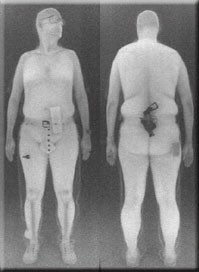
I’ve just touched down in London after a whirlwind tour through the US, and I think I’ll be happy to not see another plane again for a long while. Flying back from Chicago to London I could already see the effects of the attempted Christmas terrorist bombing – what looked like full cavity searches for every person coming into the US. And from what I read this morning it sounds like we’ll all be shooting naked videos of ourselves at Heathrow within a few weeks time. Welcome to the new age of air travel.

I flew Air Canada back and forth to the US, despite major misgivings given their abysmal reputation for delays. My initial reluctance proved well founded. Out of four flight legs each was delayed by at least two hours. I say this after every time I fly them but this time I mean it – never again!

As I was transferring through the airport in Montreal I could see down through the glass wall into the entranceway for people transferring to flights to the US – and it was a madhouse. There was a massive hall of pat-down stations. Every single person flying to the US is now getting a full body search, and there was a queue stretching back for what seemed like miles as each person entered this massive hall to be individually meticulously searched. Lucky for me, those flying away from the US didn’t have to do that (though I’m not sure I understand the logic there…)

Tuesday, 25 August 2009

Libya and the Devolution Discord

Over the past few days Brits have been approaching me in hushed, frightened voices to ask the question that seems to be occupying everyone’s minds here right now – “Are they really going to boycott us?”

It would seem everyone is terrified of ending up like France, which was on the receiving end of a notorious boycott campaign (not to mention the renaming of “freedom fries” and “freedom toast”) when they refused to participate in the Iraq war in 2003. But beyond the fact that the 2003 France boycott was actually not economically significant in the slightest, I can assure you that the level of anger in the US about the premature release of the Lockerbie bomber isn’t anywhere near the height of vitriol against France in the run-up to Iraq. Still, the anger is real, and the incident has really gone a long way to illustrate the very deep gulf that exists between Americans and Brits on issues of criminal justice and punishment.

People here in the UK have tended to have mixed opinions about the decision to release the only person convicted of the 1988 Lockerbie airplane bombing, with most people I know defending the decision to release of Abdelbaset Ali Mohmed Al Megrahi on compassionate grounds - because he is suffering from terminal cancer and has three months to live. My Scottish friends in particular have been insisting that Scottish law has a long tradition of compassion, and that it shows how civilized they are as a society that they would let him go. But you’d be hard pressed to find one person in the US who agrees with this analysis. They are, quite frankly, enraged. Most Americans probably don’t understand why he’s even still alive at all (Texas would have killed him 6 times over by now). Even Chuck Schumer, one of the most liberal members of the US senate, was railing against the decision on Meet the Press on Sunday, calling it a "disgrace".

I must confess maybe it’s the American in me, but I also find myself perplexed by this decision by Scottish Justice Minister Kenny MacAskill. Megrahi was given a life sentence, not a ‘life sentence unless you get sick’. Even if MacAskill felt that it would be cruel to make the convicted terrorist die in prison, surely there was a hospice or hospital in Scotland he could have been taken to. Why on earth did he have to be taken to Libya?

As with most big decisions, you know there’s got to be some more complicated factors at work here. I have no doubt that MacAskill probably genuinely believes it would have been cruel to allow Megrahi to die in prison, but the fact is this probably has more to do with two larger issues – Scottish nationalism and Britain’s diplomatic relations with Libya.

Devolution D'oh!
Yesterday the BBC24 presenters were speaking with a Time Magazine reporter in Washington about the threats of boycotts against the UK, and one of them asked her in seeming expasperation something like, ‘Surely the Americans realise that this is the Scottish government taking this decision, not the UK.’ The Time reporter seemed a bit bemused (or maybe actually confused) by the question. Brace yourselves for a shock, but most Americans aren’t too versed in the latest news on Scottish devolution – which, after all, is a recent development.

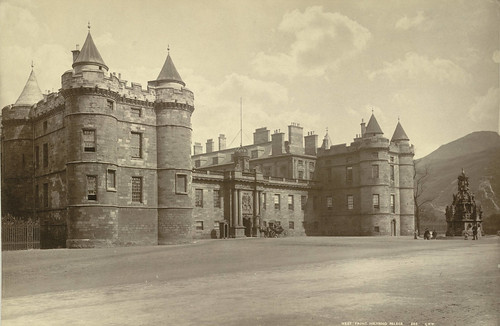
So for my American readers – a bit of backstory. Scotland is obviously part of the United Kingdom, but through a kind of curious accident of history it has always been a separate entity from England and Wales, with its own separate civic institutions – most notably its legal system. The Act of Union in 1707 shut down the separate Scottish parliament and merged it with that of England, but Scotland’s separate institutions persisted. In the early 20th century there were calls for Scotland to be granted home rule along with Ireland, but in the end it didn’t get its own parliament again until 1997, when Labour leader Tony Blair campaigned with a promise to give Scotland a semi-autonomous status through a system known as devolution. Wales and Northern Ireland were eventually also given their own parliaments through devolution, though they have considerably less independence than Scotland. Devolution has led to the bizarre situation today where every ‘country’ of the UK has local parliaments except England (effectively giving every Scottish, Welsh and Irish UK citizen double the representation of any English citizen).

So who is this Kenny MacAskill, and why is Gordon Brown claiming the British government has no control over what he does? MacAskill is a member of the Scottish National Party, which advocates for the complete secession of Scotland from the UK. The SNP was elected into a majority in the Scottish Parliament (known as ‘Holyrood’) in 2007 – an election result largely seen as a rebuke to New Labour. Therefor all the Scottish ministers are now SNP members - beyond the control of the Labour government in London. The comparable US analogy would be if Texas were to be granted semi-autonomous powers and was not subject to the final authority of Washington. The ‘Texas Independence Party’ could then be elected there and make decisions (in some areas) that Washington would have no control over. In Scotland, law is one of those areas.

(it should be noted that the centre-left Scottish National Party should not be confused with the far-right British National Party, which bans membership for nonwhites and won two seats in the European Parliament in the British Euroelection in June).

In theory, areas of foreign policy and diplomatic relations shouldn’t be at all under the authority of the Scottish government. But in this particular case the area of law had a huge impact on foreign relations, something Labour perhaps didn’t anticipate when they set this up in 1997. Washington sees this as a UK decision, and Gordon Brown’s silence on the issue has been seen as, if not callous, downright incompetent. Yet in actuality, because of devolution, there was nothing Brown could have done about it.

Back Room Deal?
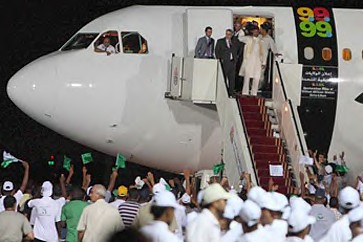

Of course, that’s just one way of looking at it. But there is a much more nefarious theory making the rounds in the US – that the release was part of a secret deal to secure lucrative business contracts with Libya. Only time will tell if that allegation is true, but at the very least it is certain that the detention of Megrahi was a festering sore in relations between Libya and the UK.

The fact is, the majority of people and governments in the Middle East and North Africa believe Megrahi is innocent. Megrahi himself has all along insisted on his own innocence, and his conviction for the terrorist act was both controversial and razor thin. His co-accused was found not guilty, and the evidence against Megrahi was anything but airtight. He was in the middle of a long process appealing the decision when he was released last week. You’d be hard pressed to find any Libyan who thinks he’s actually guilty, and most have viewed him as a political prisoner. It is feasible to believe that there are those in the Libyan political and business community who were refusing to do serious business with the UK until the Megrahi question was settled, particularly as he is so popular in his home country.

Many British people share this view. In fact a number of the Lockerbie victims’ families believe Megrahi is innocent, saying theyblieve that the US and UK governments railroaded through a false conviction in 2002 out of embarrassment at not being able to figure out who was really responsible. Many in Scotland are defending MacAskill’s decision on the basis of their belief that Megrahi is “probably innocent” and therefore doesn’t deserve to die in prison.

Of course if he is indeed innocent, the appeals process is the appropriate venue to prove that case. MacAskill’s decision not only leaves open the question of who actually perpetrated the Lockerbie bombing, it also appears to circumvent the proper exercise of justice.

It’s a mess all around, and now there is even speculation that the controversy could bring down the SNP government. An emergency session of the Scottish Parliament was called yesterday, bringing MSPs back from their summer recess early, so that members could demand that MacAskill explain his actions. He and his fellow party members were defiant, couching the decision in 'Scottish values' and appearing to hope that by presenting this as an ‘us versus them’ question of Celts versus the Anglo-Saxon English and Americans, they can stave off a revolt that would bring down their government. But considering their majority technically rests on just one seat, this strategy may not work. One thing’s for sure, it’s going to be an interesting week in Edinburgh.

Thursday, 27 November 2008

India's 9/11

The news coming out of Mumbai today has really been horrific, and the tragedy is still unfolding. I don't have much to write about it, but I think it will be interesting to see exactly what actually happened once this is resolved. This attac was shockingly brazen. There's a massive army training facility right next to India gate in the bay, so if its true that they landed next to Gateway of India by boat, that means they sailed right past it. If the details of how this unfolded last night are accurate, truely this is an attack unlike any other the world has seen. This is India's 9/11, and perhaps the most significant attack the world has seen since 9/11 in its introduction of a new, unthought of type of terrorism.

I was at the Taj hotel almost exactly a year ago during a business trip to India, and its really shocking to think that terrorists could take over such a massive landmark like this. The Taj is one of the most famous hotels in India, comperable to the Ritz or the Park Plaza. And there are still people barricaded in their rooms more than 24 hours after this all started. It's really stunning.fff