Showing posts with label national borders. Show all posts

Thursday, 7 July 2011

Poland fires warning shot over Denmark's 'nationalist' moves

Poland is not usually known as a very pro-EU country. In fact, it has gotten the reputation as the most Eurosceptic of the new member states. But yesterday Polish Prime Minister Donald Tusk lambasted recent moves by Denmark, France and Italy to undermine the European project. He signalled he intends to halt the current slide, led by those Western countries, toward reintroducing border controls at internal EU borders.

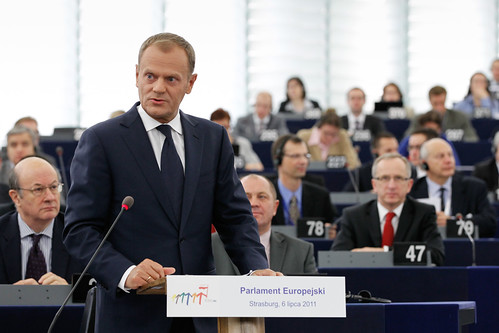
Tusk was speaking to the European Parliament in Strasbourg to mark the start of Poland's presidency of the EU, which will last the next six months. "The answer to the crisis is more Europe," he said, not less. He indicated that he will fight against efforts to further erode EU principles, and suggested he was unhappy with the deal reached among member states last month to allow temporary internal border patrols to deal with increased immigration.
"I am against any barriers to internal free movement under the pretext of dealing with migration problems. What Denmark is doing is a concern for anybody who thinks that free movement is going to be restricted even further," he told the parliament. "Europe, with its institutions, its budget and its objectives, is not the source of this crisis. And following those who say the opposite would be a fatal mistake. Undoing the European construction at this time and turning to nationalism as an answer to the crisis would be a very big mistake."
It was a fairly unusual move for the incoming presidency to take such a political stance against what other member states are doing, because the presidency is supposed to be a neutral negotiator in the council. But Poland has always marched to the beat of its own drummer when it comes to the EU.

Friday, 24 June 2011

Commission laments 'rising xenophobia' as Schengen unravels

The June summit of EU leaders has wrapped up here in Brussels – the blockades are being removed from the streets and the whirl of helicopters overheard is slowly starting to dissipate. As expected, the council voted to establish a "safeguard mechanism" in the Schengen passport-free travel zone that would allow member states to reintroduce internal EU border controls in exceptional circumstances.

The final text adopted today says the border checks should only be reintroduced "as a very last resort" in a "truly critical situation where a member state is no longer able to comply with its obligations under the Schengen rules as concerns the prevention of illegal immigration of third country nationals."

Such a mechanism was demanded by Italy and France earlier this year when the two got into a row over illegal immigration happening as a result of the Arab spring. France accused Italy of deliberately sending Tunisian migrants to France and issuing them bogus identity cards because they wanted to get them out of Italy as soon as possible. France said it should be allowed to set up border controls with neighboring countries who are failing in their duties to protect the EU external border. But existing rules forbid member states from imposing border controls at internal EU borders. Italian PM Silvio Berlusconi wholeheartedly agreed, as if to say "Yes, we're completely incompetent. Please allow France to set up protections against us."

Thursday, 23 June 2011

'Baby steps' toward a real EU border patrol

The EU institutions and member states reached an agreement last night to beef up the EU's border patrol agency, Frontex. The news, coming just before the summit of EU national leaders today and tomorrow in Brussels, shows how much immigration concerns are at the centre of the political agenda right now. While the populist rhetoric in member states is more often calling for less EU rather than more of it these days, an agreement to expand the EU's border patrolling powers was easily reached.

The deal will allow Frontex to buy its own equipment, so that it will be less dependent on helicopters and vehicles leased from member states. It will also make it binding for member states who have pledged personnel to the agency to deliver on their promises. The Frontex patrols will now be coordinated into "European border guard teams" that will be swiftly brought in if a member state is struggling to control it's external EU border – but still only on the invitation of the member state. To date, the only EU member state that ha summoned a significant number of Frontex forces is Greece.

Friday, 13 May 2011

A return to walls in Europe

There's something rotten in the state of Denmark, and the rot is spreading fast throughout the European Union. Brussels is in shock today following yesterday's announcement by Denmark that it will reintroduce border controls with neighbouring Sweden and Germany.

The move is a violation of the bloc's Schengen passport-free rules and a worrying sign as EU ministers meet in Brussels today to discuss possible changes to the Schengen rules. The plan would set up the first border control between Sweden and Denmark in more than 50 years.

The move is no doubt intended as a pre-emptive strike ahead of today's negotiations, a message to the EU that if the ban on internal border controls isn't loosened member states are going to ignore it and unilaterally re-impose passport checks. Denmark likely feels confident enough to take this bold unilateral move because of the letter sent to the European Commission by Nicolas Sarkozy and Silvio Berlusconi two weeks ago.

The letter demanded that member states be allowed to reimpose internal EU borders in "exceptional circumstances." They believe that the current increase in migrants trying to come to Europe from North Africa qualifies as one of these circumstances. Denmark clearly feels that this letter from two large member states gives them cover to unilaterally impose their own border control. It is the first country ever to reimpose permanent border checks in the history of the Schengen Zone, and there is now fear of a 'chain reaction' that would see the reintroduction of controls at all internal borders.

Wednesday, 27 April 2011

Berlusconi and Sarkozy slam on the brakes

Usually it's the Northern European countries that are the ones clammoring for rollbacks on EU integration. But in a strange twist this week it's the reliable core stalwarts of France and Italy that are agitating for a step back in the EU integration project. The leaders of the two countries sent a letter to the European Commission yesterday asking for the ability to re-establish border controls between Schengen states in 'exceptional circumstances'.

The letter was sent after Nicolas Sarkozy and Silvio Berlusconi held a summit in Rome yesterday trying to diffuse the diplomatic crisis between the two countries. Italy has demanded help from its EU neighbours, saying that it can't handle the influx of economic refugees floating across the Mediterranean to escape the chaos in North Africa and landing on Italian shores.

Deciding that the EU wasn't acting fast enough to provide assistance, Silvio Berlusconi's government started issuing the migrants with "temporary residence visas" and telling them they could use them to seek work in other EU states, knowing full well that the French-speaking Tunisians and West Africans would go to France. The French were furious, and started stopping trains at the French-Italian border which they suspected of carrying the migrants. Each side is accusing the other of violating the EU's Schengen agreement, which allows passport-free travel between member states.

Monday, 10 January 2011

Mexico on the Aegean

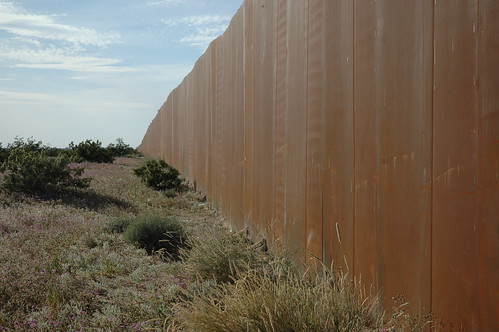
Is there anything more controversial than a wall? From Berlin to Palestine to Mexico, border walls have often proven to be as incendiary as they are ineffective. Recently, Greece signaled to the European Union that it wants to build a wall along its border with Turkey similar to the wall that has been partially built along the US-Mexico border. But the European Commission was quick to shoot down the idea last week, saying walls and barriers are merely short-term measures that cannot solve the EU's immigration problems.

Greece has been struggling to deal with a huge influx of illegal migrants trying to cross its land border with Turkey after the EU cracked down on illegal sea crossings from Africa to Europe via the Mediterranean over the past two years. According to the Greek government, 200 illegal migrants are crossing its land border with Turkey every day. These migrants aren't Turkish, instead they have crossed through Turkey from countries further afield in Central Asia and Africa. And since Greece is in the passport-free Schengen Zone, once the migrants get in they can travel to almost all other EU countries (with the notable exception of the UK and Ireland who have opted out of Schengen) without having to show identification.

Wednesday, 10 November 2010

EU to crack down on Schengen border violations

Today the European Commission announced a crackdown on member state compliance with the Schengen passport-free area rules, and during the press conference I couldn't help but smile to myself. The other week I had a bit of a rant with my friends after I encountered a British woman on a airport shuttle bus in Prague who didn't know what Schengen was. Since then the joke has been that I'm obsessed with Schengen. So naturally, I had to write a blog entry about the new proposal.

So, the Prague airport story. I was taking the airport shuttle to the airport and we were just pulling in to terminal 1 (the "international" terminal with flights to the US, China, etc) when an announcement came on saying that this terminal was for non-Schengen countries, and the following terminal would be for Schengen Area countries. I had my headphones on but I could see that there was a woman a few seats away from me with a confused expression on her face asking her neighbour something. By the time I took my headphones off we were already on our way to terminal 2, but I could then hear that the woman was frantically asking people what Schengen was. Apparently her neighbour, also a Brit, had reassured her "Oh Schengen means EU. You're going to London? Then terminal 2, definitely."

Friday, 12 December 2008

Happy 'Switzerland Joins Schengen' Day!

After so much anticipation, I rose early this morning at dawn to creep down to the fireplace and see if I had received a visit from Schengen Clause. I gasped with joy to find it was true, he'd come! The border check with Germany had disappeared!

Ok I can't really see the German border from my dad's house in Zurich (although I can see the border with the next Canton), but I did eagerly check the news this morning to see if it had indeed come to pass. I have no idea why, but the moment which countries open their borders with other countries really excites me.

At midnight CET this morning Switzerland joined the Schengen Zone, the 25-member European block that allows passport-free travel between the member states. Switzerland is not technically in the EU, but it has a series of bilateral treaties with the EU which make it in many ways a "virtual member," bound to follow EU regulation although it has no representation in the EU parliament.

Friday, 21 December 2007

Today Eastern Europe wakes to no borders

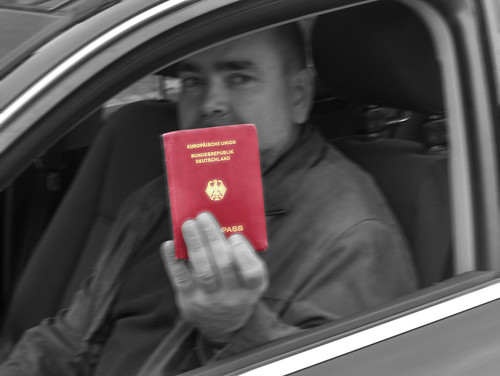
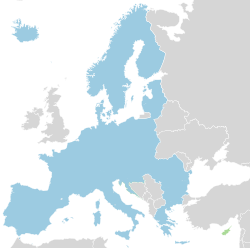
It’s official. As of this morning you can now drive from the Russian border in Estonia to the Atlantic beaches of Portugal, across 24 countries, without passing through a single border crossing. As of midnight, the 2004 EU entrants are now part of the Schengen Zone, the border-free area that allows you to pass through European countries as easily as if you were going from Indiana to Illinois.

Considering the post-cold war implications of this day (all but one of the 2004 entrants are former Warsaw Pact countries), the scenes last night were dripping with symbolism. As Canada’s Global Mail reports, at the border of Germany and Poland the guards spent yesterday removing kilometres of tall steel fence, leaving unmarked and unguarded fields between them. Fireworks lit up the border bridge between Poland and Germany in Frankfurt on Oder early this morning. On the road between Vienna and Bratislava, Austrian and Slovakian leaders met to saw through border-crossing barriers. And in Estonia, the government put its border-inspection stations up for auction. Perhaps nowhere was the scene more striking than on the Czech-Slovak border, as the countries were split apart just in 1993 and now find themselves without a border between them once again.

Friday, 13 April 2007

Just say no to EU roaming

This is funny, I’ve been complaining for the last week about how Europeans should demand an end to roaming mobile charges within the EU, and then the issue goes before the EU parliament today.

The assembly voted to restrict the amount that mobile phone carriers can charge EU consumers for roaming in other EU countries. Right now, if I wanted to use my phone when I go to France next weekend, for instance, I would have to pay over a dollar a minute to make or receive a call. Same with text messages or internet use.

I’ve been complaining about this because I gave in last week and signed up for a monthly mobile plan. I really shouldn’t have one, I don’t like talking on the phone very much (I really just have short conversations to make plans) so I don’t use many minutes, pay-as-you-go would have been the better system for me. But I really wanted the new N95, and without signing up for a plan it would have been $1,000.

I also got the free unlimited internet and GPS locating. But what’s annoying is that the times when I’ll most want to be using it, namely when I’m traveling, I can’t use it. Since the UK is a tiny country, when I’m traveling I’ll most likely be in a different country in Europe. At those times the rate for going online or using GPS would be outrageous, as would be any attempt to make a call.

I’ve been trying to get my British friends to understand how unfair and frustrating this is. In the US, when you travel you are most likely staying within the country. That means anywhere you go, you are never roaming. I can take a trip to LA, Seattle, Denver, Chicago, New Orleans, Miami, anywhere I like, and I will never be roaming. And, it isn’t any extra to call numbers in those places either. Every cell phone plan comes with nationwide calling, no long distance anywhere domestic, ever. That means when I moved around so much the past few years I was able to keep my New York number, because it wasn’t any extra for people in Chicago to call me.

This wasn’t always the case. When cell phones first came out most plans were just regional, meaning that if you left your individual coverage area (Connecticut, for instance) you were roaming. But eventually the market took action, one company offered nationwide coverage, and soon they all followed. Once again, the large unified market of the US worked to the benefit of consumers.

What angers me is that all of the big mobile carriers in Europe, TMobile, Vodaphone, and Orange for instance, operate all over the country. I have TMobile. But if I use the TMobile network in Germany, I get charged roaming. I think that’s pretty outrageous. So I’ve been asking, since the EU is trying to encourage open borders and an open trade zone, shouldn’t the force the mobile carriers to allow their customers to use their entire network?

Now I guess they’ve taken a step in the right direction by voting to cap roaming rates at 40 Euro cents a minute to make a call and 15 Euro cents a minute to receive one. If it passes the final hurdle the changes will hopefully go into effect by this summer.

While I welcome this decision, I think it doesn’t go far enough. I think the major carriers should be forced to allow consumers to use their entire network within the EU. I really don’t understand why one of them hasn’t done it. Think about it, if TMobile suddenly said we’re going to open up our entire European network, they would get tons of people switching to it. It would shut down their small local competitors and give them a huge edge in every market.

For all you Eurosceptics out there this is just another example of how not having a single market hurts you as a consumer. Think about the myriad advantages Americans have because we have such a gigantic open market. This point is rarely made by politicians here, but it would go a long way in swaying the public toward the EU project.
Wednesday, 19 July 2006

Turkey invading Iraq?

As if things in the Middle East weren't bad enough, today it was revealed that Turkey may take a page from the Israeli playbook and invade Northern Iraq, one of the disaster scenarios that was posited before the war began.

The North of Iraq, which is predominantly Kurdish and controlled as an autonomous zone, has been the most stable and nonviolent part of the country since the occupation. This has mainly been because Kurds are sitting back and watching Sunni and Shia Arabs kill each other, hoping that if they wait it out eventually the country will break apart and an independent Kurdestan will be formed.

It would not be in their interest right now to attack American or Iraqi troops (neither of which can be found in great number in the North anyway). But it is in their interest to antagonize Turkey, because many Kurds hope that an independent Kurdestan will also include the Kurdish areas of Turkey and Iran.