Showing posts with label UK. Show all posts

Monday, 5 October 2009

Ireland Rejects British Influence

As news breaks that the UK will soon be shut out of a new G4 group of major economies and could lose its seat on the board of the IMF, the bizarre reaction to the Irish referendum by much of the British press continues to look more and more out of touch with the realities of the modern world.

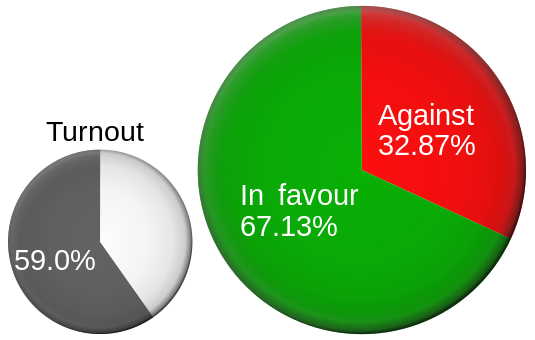
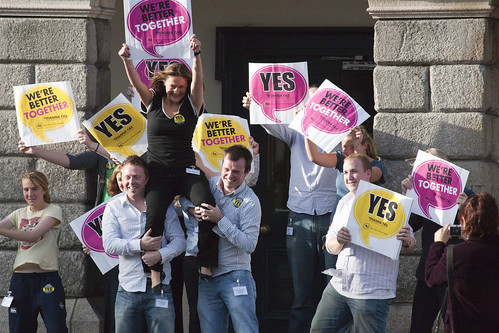
Europe-wide ratification of the Lisbon Treaty is imminent following Ireland’s massive endorsement of the EU reform agreement with a ‘yes’ vote of 67%. It looks as if Czech President Vaclav Klaus has lost his nerve and is ready to end his grandstanding talk of refusing to sign the ratification passed by the Czech parliament – a move which would have been constitutionally questionable anyway. So barring any unforeseen complications, it looks like this long effort to reform the EU to something more appropriate for its current size has been completed.

If the British media is to be believed, after rejecting the treaty in the first referendum in June 2008 Ireland voted yes this time around out of fear. Terrified by their vulnerability in the global economic downturn, the British narrative goes, the Irish have allowed themselves to be bullied into accepting dominance by Brussels, having lost confidence in their own ability to govern themselves. Under this narrative, the Irish made a courageous choice in the 2008 referendum when the treaty was, as the British press frequently puts it, “resoundingly defeated” (never mind the fact that the 2008 ‘no’ vote actually just squeaked by with 53%). Apparently in 2008 a slight majority indicated massive popular will by courageous people against an oppressive super-state, but in 2009 a large majority is the illegitimate result of misguided voters swayed by fear and intimidation. The Irish, it would seem, are only right when they agree with the British.
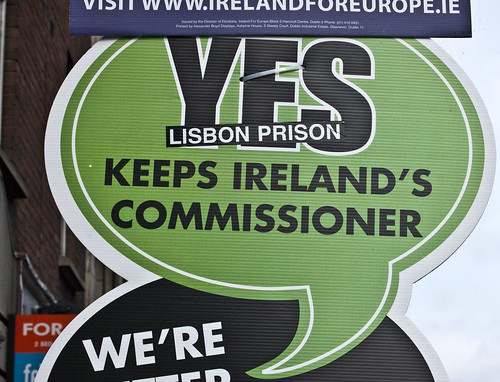
What is never mentioned in the British press is that after the June 2008 result Ireland has been given a basket of concessions and guarantees – the most significant being that the proposal to shrink the size of the European Commission from 27 commissioners to a more manageable size of around 20 has been abandoned. Under existing treaties each country is guaranteed a commissioner in the EC – even though commissioners are not supposed to represent national interests but rather fulfil a specific role of expertise such as trade, environment or energy. The large number of new member states that have joined in the past 10 years has meant there is now an excessive number of commissioners, with new remits for them being invented such as “Commissioner for Information Society and Media” and “Commissioner for Multilingualism”.

However even though it is supposed to be irrelevant which countries these commissioners come from that does not always prove true in practice, and the Lisbon solution to rotate a certain number of Commission seats between the small member states had caused some concern. There was a lot of misinformation spread in the 2008 ‘no’ campaign in Ireland, but this issue was one of the verifiable legitimate concerns that the ‘no’ campaign had – fearing the treaty would lessen the influence of small states in the EU’s executive body. So they won this concession, there will remain 27 commissioners.

While it is true that the actual text of the treaty has not changed (doing so would have required re-ratification by all 27 states and would have held up passage by another five years) the Irish have been given binding guarantees that these changes will be inserted at the time of the next Europe-wide ratification issue, likely the accession of Iceland and Croatia.

The British press also doesn’t mention that this time around there was a much more extensive education campaign on what is actually contained in the treaty – a response to the fact that the exit polling in the 2008 referendum revealed that the most frequently cited reason for voting ‘no’ was a lack of information on what the treaty is. Turnout this time around was also about 10% higher than before.

The British roots of the ‘no’ campaign were also more exposed this time around, making the claim that a ‘no’ vote was a vote for the spirit of dead Irish republicans seem laughable. As the Guardian pointed out in an article last week before the vote, the ‘no’ campaign was full of Brits who flew over to urge a rejection of the treaty, led by Tory lobbyists and Rupert Murdoch’s newspapers. All this prompted fears that a ‘no’ vote would result in what Irish Labour leader Eamon Gilmore called a “two-speed Europe” where there would be “a mainland Europe and the British Isles, where we fall under the influence of Britain." So much for a ‘no’ vote honouring the dead Republicans who fought against the British.

The Tories’ Eurochaos

The ‘yes’ vote was exceedingly bad timing for British Conservative leader David Cameron, as it means the Conservative Party conference this week will be dominated by the ‘Europe issue’, a quagmire that continues to cause rifts between different factions of the party. Cameron had promised to hold a referendum on the treaty in the UK if it remained unpassed by the time they (most likely) come into power next April. However now it looks like the treaty’s changes will be adopted by the EU by the end of the year – and the British parliament already ratified the treaty.
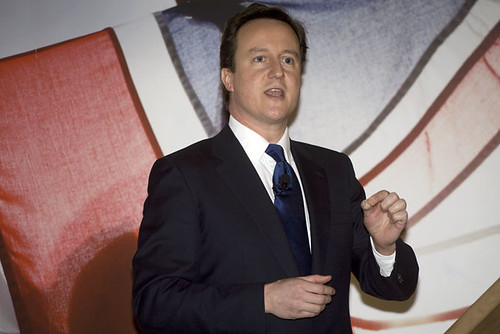
The Eurosceptic wing of the Conservative party is demanding that Cameron hold a referendum on the treaty anyway, asking the public whether Britain should retroactively pull out of a treaty it already signed and which has already gone into effect. The problem is this would not only be illegal under international law, it would also be impossible. If Cameron were to hold such a referendum and the result is ‘no’ (which is the position he has advocated), there is no longer a ‘treaty’ to vote on, the treaty has become the EU. So at that stage, a ‘no’ vote on the Treaty would be a ‘no’ vote on the EU, and the British would have to secede from the union.

This is not an issue Cameron wants to put to a referendum, as the risks of a ‘no’ vote would be too great. Britain pulling out of the EU, as I’ve written about before, would mean it would have to completely renegotiate almost all of its international treaties in trade, labour and markets. It would very likely cause an immediate collapse in the pound, and investors would flee the UK like rats fleeing a sinking ship.

So Cameron has an uncomfortable reality to deal with this week. Trying to throw a bone to the Eurosceptic wing, he has hinted ahead of the conference that the Tories will launch a “public consultation” instead of a referendum, with the aim of moving significant powers away from Brussels and back to Westminster. Party insiders are saying he will announce this week an intention to “repatriate” powers involving social powers, employment and justice to a national level. Of course what he effectively would be asking for are more UK opt-outs, which would be almost impossible to attain retroactively, requiring the approval of all 27 member states. Many of those member states would surely question why the UK deserves special treatment, and would laugh any Tory who demanded such a concession out of the room. Considering Cameron has already enraged the French and German conservative governments by leaving the mainstream centre-right EPP grouping in the European Parliament to form a new alliance with the Eastern European hard right, he has few friends in Brussels or other Western European capitals these days.

UK Shut Out of World Bodies
All of this Tory talk seems particularly incongruous with reality considering that just this weekend it emerged that, following the death of the G8, the US is planning to form a new G4 group of the world’s leading economies that will not include the UK. The new group would be composed of the US, China, Japan and the Eurozone. The Eurozone, remember, does not include the UK because it does not use the Euro currency. Alistair Darling has reportedly been begging for the new group to instead include all of the EU rather than the Eurozone, but US officials have reportedly rebuffed this request saying that the member needs to be able to control a unified monetary policy. The news comes at the same time that Britain is fighting to maintain its seat on the board of the International Monetary Fund.

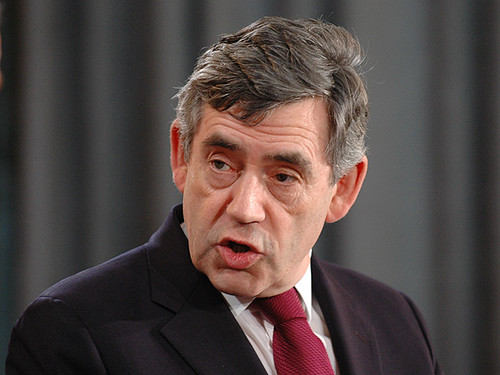
It was amusing to see the Daily Mail try to spin this as Gordon Brown’s fault, rather than the fault of the isolationist impulse the Daily Mail and papers like it have championed over the past two decades. The fact that it is inevitable that the UK by itself will not be able to justify its seat on these international bodies in the 21st century seems to be lost on them. The paper declines to mention the fact that were the UK on the euro, it would have a seat on this new G4 body and could maintain a board seat in the IMF. Nor does it mention that France and Italy are also in the same boat now that the G8 is being dissolved, yet they will have a major place in the G4 and IMF because they are part of the Eurozone. The comments below the story would be hilarious if they weren’t so jaw-droppingly ignorant, with each commenter deciding that this news is somehow evidence that the UK should leave the EU. Come again?
It will be interesting to see how the ‘Europe issue’ is handled at this week’s Conservative Party conference. Considering Cameron’s populist tendencies, he could probably just get up on the podium and say ‘Europe’ and have the whole hall boo and jeer in order to have a successful day. But Cameron’s crowd-pleasing rhetoric on Europe is on a collision coarse with reality. His recent defection from the EPP is probably but a first instance of this.

Hopefully, Europe can now put this treaty nonsense behind it and focus on more important things, getting on to the real work of guiding the continent through the economic recovery and leading the world in the effort to combat climate change. That is, if the Tories can let a sleeping dog lie.

Tuesday, 8 September 2009

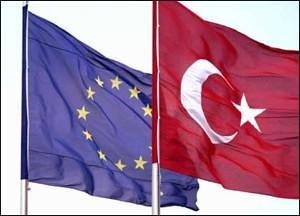
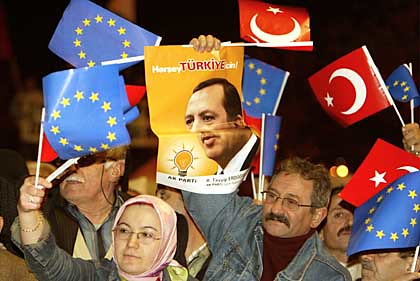
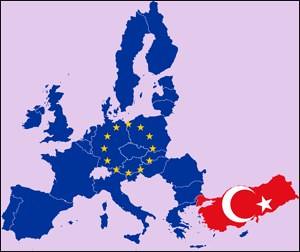
Should Turkey Join the EU?

Yesterday’s much-anticipated report from a high-level commission blasting Brussels for its handling of the Turkey accession issue was predictable in many ways. It was perhaps even a little tiresome in the way it relied so heavily on the oft-repeated claim that racism and xenophobia are what drive opposition to Turkey’s membership. But even more predictable still was the very different way the British and continental media covered the report.

The Independent Commission on Turkey’s denunciation of Brussels’ foot-dragging was a headline-generator in the British media. Yet it received scant attention on the continent - even in France, the country which took the most punches in the document. Google news English finds 30 stories about the report, while Google News French finds only three working links (one of which is actually a blog). France24, Le Monde, and Le Figaro all seem to have ignored the news. Perhaps not surprising considering the continental powers are opposed to Turkey’s membership, while the UK is in favour. Those national media outlets on the continent that did cover it took a very different angle than their British counterparts, proving much more sceptical of the report’s conclusions.

The commission condemns the EU for delaying accession talks with Turkey, saying it is violating its previous promises that Turkey will eventually become a member while many (perhaps most) in Brussels have no intention of ever seeing this become a reality, preferring to string Turkey along in order to make it friendly to EU interests and more inclined to push through pro-Western reforms at home. The report accuses national political leaders (read: Sarkozy) for coming out strongly against Turkey’s membership in order to exploit domestic concerns about immigration, job security and Islam. It even goes so far as to say that this contradiction between what the EU had previously publicly avowed in the 1990’s and what its national leaders are saying today “put in question EU credibility, reliability and the principle…that agreements are to be honoured.”

To an outsider it might seem bizarre that the traditionally euroskeptic UK would be the one pushing most vocally for Turkey to enter the EU. Indeed, in the British media the issue is often presented as a no-brainer. Of course Turkey should enter the EU, people here seem to think. Any efforts to keep them out, according to the Brits, are just due to continental (read: French) racism and Islamophobia.

So it isn’t surprising that I find most people here are a bit confused about the debate, and some of the larger issues involved. So, I thought I’d make a little Q&A based on some of the questions someone was asking me last night. Whether or not Turkey should join is a very complex issue that essentially goes to the heart of the larger question about what the EU should be – a federal union or a free trade zone. Countries have therefore split on Turkey’s accession based on their feelings about European federalism – the idea that the EU should have supranational power in areas outside of trade. The fact is that the day Turkey joins the EU is the day the dream of a federal Europe is over. A federal Europe is simply not possible in a union with Turkey as a member.

Questions? Shoot.

Is Turkey part of Europe?


A very small part of Turkey (about 5%) is geographically within what has historically been considered Europe. Of course, the issue gets a little tricky because unlike its ocean border to the west, Europe’s eastern border is not as clearly defined (owing to the fact that geologically speaking it is more accurately part of a larger Eurasian continent). But the traditional border has been understood to run from the Mediterranean and Aegean, through the Dardanelles and the Bosporus straight, across the Black Sea, and North along the Ural mountains in Russia. This makes Turkey and Russia the only two countries straddling the two continents of Europe and Asia. However the 10% of Turkey that lies in Europe is relatively sparsely populated because it is not very hospitable terrain.

Some argue that because the Ottoman Empire (Turkey’s progenitor) at one time controlled all of the Balkans up to Vienna, it is culturally part of Europe. However this is a tenuous claim because if such logic were applied across the board the states of North Africa should also be invited to join, as their progenitors once controlled Spain. Historically speaking it would have been a tough sell to convince the Austrian emperor (or anyone else in 15th century Europe for that matter) that the Ottomans were “European”. The successful defence of Vienna which halted the Ottoman advance into Western Europe gave the city the nickname as the ‘savior of Europe’ at the time. Their motivations may have been racist or religionist, but there can be no doubt that during the Ottoman Empire’s many centuries of existence, few in Europe would have considered the Turks to be “European”.

Additionally, the Ottomans never took much of an interest in actively governing their Balkan or Greek territories, preferring to leave the actual administration to local rulers. They were much more preoccupied with their Middle Eastern and North African territories, which constituted the majority of the empire.

As a secular nation, isn’t Turkey more linked to Europe than to the Middle East?

It is true that the Turkish state founded by Ataturk is rabidly secular, but unlike in Europe, that secularism has had to be enforced through repression and authoritarianism. To this day religious practice is heavily restricted in Turkish public life by law. Ataturk and his successors have considered this necessary because there is a significant amount of the country that is fervently religious, which the ruling class (mainly the military) fears. The rural population is growing increasingly religious with time, following the revival of Islam that has occurred across the Middle East in the past two decades. The recent success of the openly Islamic AKP party demonstrated how much more powerful Islam is becoming as a political force in the country. The fact that secularism has always hung by a thread in Turkey and has had to be guarded by authoritarian means reflects the fact that Turkish secularism does not even resemble the secularism of Europe, which has arisen naturally among the population and not been enforced by the state.

Turkey is the only stable Muslim democracy in the Middle East. Wouldn’t it integrate seamlessly into the EU?

To hear the proponents of Turkey’s accession talk, you would think Turkey was some kind of earthly paradise of humanism and democracy. But while it is true that Turkey is a democracy, it is anything but stable, particularly at the moment. The country is still involved in two ongoing conflicts, one against Kurdish separatists in the East and the other in the Turkish occupation zone of Cyprus to the west, both still unresolved issues. And just this week Turkey took the first move to establish diplomatic ties with its neighbour Armenia for the first time. That tension is unlikely to be resolved any time soon because Turkey still refuses to acknowledge the genocide of ethnic Armenians that took place during World War I.

Turkey doesn’t just have instability in its foreign relations. Its domestic politics are teetering on a wire at the moment as well. With the Islamist AKP taking civilian power in 2007, there is a constant risk of the army staging a coup to preserve Turkey’s secularist code. In the mean time the country maintains one of the Western World’s most authoritarian regimes in the area of human rights. Press freedom is still severely limited in Turkey, where it is still a crime to insult “Turkishness”. Just yesterday Turkey decided it would be the only country in Europe to refuse to sign a resolution in support of a jailed reporter in Kazakhstan, because it contained a provision which stated that journalists, “should be free to report on all issues of interest to the public, including commentary on how the state is run.” Turkey of course couldn’t sign it, because it can technically be a crime in Turkey to criticize how the state is run.

But the EU is taking in Eastern European countries that also have corruption and human rights problems, but who happen to be Christian. Isn’t this hypocrisy?


It is true that the EU took on the countries of Romania and Bulgaria in 2007 despite complicated corruption problems, with an eye to providing support and guidance to those countries to help them transition to being transparent and stable democracies. This has been referred to as the “transformative” strategy of EU enlargement and has been very controversial as an idea in and of itself, especially now that the appetite for enlargement has waned. But though Sarkozy and other opponents of Turkish entry have said that enlargement should stop for now, they have held the door open for Croatia, Serbia, Bosnia, Macedonia and Albania (a Muslim country, by the way) to join eventually. Obviously, these are countries with some fairly significant, and recent, problems.

But there is one key difference between all of these post-communist countries and Turkey, and it’s not just that they are Christian or all indisputably in Europe. They also all have very small populations. They are therefore more easily manageable for an EU that is taking on a “transformative” role. Additionally, these countries’ entry would not make a big demographic difference to the EU.

Turkey, on the other hand, has a population of 75 million, larger than either Britain or France. If it entered the EU it would become the second biggest member of the block. And given that Turkey’s population is expected to reach 85 million or more by 2020, by the time it could feasibly enter it would probably be the largest member and have the largest voting block in all decisions of the European Parliament.

So this isn’t just a question of saying, “Oh well, it’s Europe-ish, they respect human rights ok I guess, sure let them in, why not?” Turkey’s entry would fundamentally change the nature of the union itself, leading to the bizarre situation where the most powerful country in the EU has only 5% of its territory actually in Europe! There’s no way the rest of the EU member states would accept that scenario in a federal Europe, therefore Turkey’s entry into the EU would mean a federal EU is an impossibility, and it would have to be scaled back to be just a free trade zone like NAFTA. Of course, British Euroskeptics would like nothing more than to see this happen.

So when I see the British media go on and on about how Germany and France’s objection to Turkish entry is motivated by racism and Islamophobia, I’m left rather perplexed. If the Independent Commission on Turkey was being a bit more intellectually honest, they really should have pinned more of the blame for the EU’s Turkey double-speak on the British, who are really the ones stringing the Turks along. Using Turkish entry as a backhanded way of changing the EU is hardly a fair thing to do to Turkey, considering that they are promising them membership in a union that would cease to exist as a result of their very entry.

The commission is right about one thing – Brussels needs to stop stringing Turkey along and give them a firm yes or no. But it is wrong in concluding that the recent vocal objection to Turkey’s entry is some kind of populist political ploy by national leaders. It is a legitimate concern and goes to the very heart of what the EU is meant to be. And in that way, this debate really had very little to do with Turkey and much more to do with the conflict between federalists and euroskeptics. And until that conflict is resolved, it is likely Turkey will continue to be unfairly strung along.

Thursday, 3 September 2009

Ye Olde York

Driving up the A1 motorway yesterday, my friend and I had our eyes glued to the horizon, each of us hoping to be the first one to see the giant steel angel come soaring into the sky from beyond the hill. Considering my friend was driving, we realized this gazing perhaps wasn’t the smartest strategy as he had to slam on the brakes to avoid a rapid traffic slowdown ahead of us. Searching for angels in the sky can be dangerous!

Eventually the massive Angel of the North, which has come to be a symbol of Northern England since it was erected outside Newcastle in 1998, did at last emerge. If I’m honest, I was a bit underwhelmed. Having been told that with its wingspan it’s as wide as the Statue of Liberty is tall, I was expecting something much bigger. I suppose it was big, sure, but not BIG! Perhaps that’s just my American expectations creeping in.

We were approaching Newcastle, the last stop on an eight-city tour of the Northern England, usually referred to in the UK both affectionately and derisively as just “the North.” It’s a strange land of rolling green meadows, windy moors and bulging dunes – a place where the local accent changes every 10 miles and people cling to their locality and roots with a fierce pride rarely seen in the South. It’s also a land of striking contrasts. This was the industrial heart of Victorian England, a place whose abundance of raw materials gave rise to a rapid overdevelopment, turning small villages like Manchester, Liverpool and Middlesbrough into bulging metropolises virtually overnight. That flurry of industrial activity has long since faded away, leaving the relics of a poverty-stricken rust belt concentrated around the Mersey river on the Irish Sea coast and the Tees river on the North Sea coast.

At the same time the North, particularly Yorkshire, played a hugely important part in British history before industrialisation, and in between the urban conurbations lies some of the most beautiful, history-filled countryside in Britain. It was that contrast that I wanted to discover on this road trip.

Proud Manchester

I made the journey with two American friends who I know from New York but who are now fellow ex-pats in London with me. We first took a train up to Manchester, exploring the city Saturday morning before being entertained by the festivities of the annual Manchester Gay Pride in the afternoon. It’s universally acknowledged as Britain’s biggest and best pride celebration, and I have to say that description bore true. The dinky little London pride paled in comparison to this, and the city’s relatively small size meant that the pride celebration almost seemed to take it over. It was also clearly an activity for the whole city, with lots of straight families turning out for the parade and plenty of straight people at the pride celebration on Canal Street. Actually the whole area around Canal Street ws closed off and you had to pay 20 quid to get in! I had never heard of having to pay to get into Pride festivities, but my friend Lori says that's the way it's done in DC.

There were those in the parade who weren’t so happy with the increasingly celebratory/commercialised nature of gay pride, coming as it does now with corporate sponsorships and such. But when you take a step back, tt is pretty amazing how different a gay pride parade is in the UK than in Eastern Europe, for example, where the parades are still largely an expression of protest and are often met with violence (as happened last year in Budapest). I can sympathise with these marchers’ (pictured left) frustrations about the increasing commercialisation of the gay community and the phenomenon of the ‘pink pound’, but perhaps if they considered the alternative it wouldn’t seem so bad.

Beyond the Pride festivities, which were great, I was very impressed with Manchester as a city. Once a rotting industrial corpse just 15 years ago, today the city’s undergone a complete renovation that has made it England’s unrivalled second city. We went down to the old canals, which in the 19th century would have been heaving with ships bringing coals in to the factories, to find them completely fixed up into a beautiful business and entertainment district. The massive intersection of train tracks, roads and canals at Castlefields is actually quite beautiful, a truly stunning site hovering over the ruins of an ancient Roman fort. And though parts of the interior of the city have been turned into massive indoor shopping complexes, they were architecturally interesting and forgivable. The conversion of city centre spaces into massive indoor shopping malls was to be a theme for the rest of the trip.

On the Road

On Sunday we rented a car to begin our slow journey northeast, diverting first over to Liverpool. Although some redevelopment has been undertaken, notably along the waterfront in preparation for the city’s year as a “European Capital of Culture” in 2008, the city is still a marked contrast to Manchester because it has retained much of its post-industrial squalor. Albert Dock has been the main focus of regeneration, and the area is now rife with Beatles kitsch. In addition to seeing a performance by the ‘Cheatles” right on the dock (pictured) you can also take a Beatles tour of the city to see the houses in which the Liverpool lads grew up (we declined, though we did go to the Beatles experience museum). We also visited the Tate Liverpool, which was otherwise unremarkable save for an AWESOME floor where you listened to disco music in headphones while looking at sexually suggestive sculptures, surrounded by countless disco balls, flashing lights, and even a light-up disco floor in the centre. I kind of wanted it to be my apartment.

Aside from the dock, the other main thing to see in the city is the two cathedrals, one Anglican and one Catholic, facing each other on opposite ends of Hope Street. They were both built at a feverish pace during a time of increasing conflict between Anglican Protestants of Liverpool, native English, and the Roman Catholics, descendants of the Irish immigrants who had flooded into the city during the industrial revolution (cousins of the Irish who left at the same time for America during the potato famine). Both the cathedrals are massive, with the two sides desperate to outdo each other. But looking at the two today, it’s clear who won. Though it is the fifth largest cathedral in the world, the Anglican Liverpool Cathedral is pretty bland and uninteresting, clearly trying to mimic older architectural styles even though it was just completed in the 1950’s. The Catholic Metropolitan Cathedral of Christ the King, on the other hand, is a stunning modernist achievement. The outside is rather strange-looking, with locals often deriding it as the “Liverpool funnel”, but I thought the inside was beautiful. It has a theatre-in-the-round style, with stunning lighting leading up the interior of the cone to the roof. I was very impressed. I have to say, the most interesting modernist cathedrals I’ve seen in Europe have all been Roman Catholic – defying that denomination’s reputation for a staid rigidity in embracing new ideas.

We then checked out the inevitable massive indoor shopping centre complex next to the water, completed just a year ago. My friend Josh, who is an architect, was eager to see it. However it was pretty uninspiring, and in some parts heinously ugly.

However if we thought that was bad, we hadn’t seen anything yet. Our next stop was Leeds, which I can report has to be one of the most characterless cities I’ve ever seen in Europe. Like some of its Northern neighbours, Leeds has also undertaken a redevelopment project. However theirs has involved turning the city centre into a giant shopping mall. Almost the whole place has been turned into the massive indoor complexes. We arrived at night around six when the indoor centres were all closed. We found to our frustration that all of the restaurants were actually located inside the malls, so we had a hell of a time finding anywhere to eat. All we could find was street after street of bland high street chain stores, all closed. I suppose if you needed to do a whole lot of shopping in one day, Leeds would be a good place to go. Otherwise, the city seemed like a total waste of time to me. But then again, I don’t like shopping.

I enquired of my friend Josh if any rust belt cities in the US were considering turning their empty city centres into indoor shopping malls. “What city centres?” he responded. It’s true, Americans don’t want to go into a city centre even if it’s to buy things, they prefer their shopping malls to be out in the suburbs where they live. And judging by the results of such a redevelopment in Leeds, I’m not sure I would endorse such a plan for cities in the US. Josh says the problem is that all these redevelopment plans are centred around shopping, and when something like the recession hits it puts the breaks on the whole project. It’s not that the developers can’t get financing any more. Since the only thing they’ve planned for development are shops, the plan is going to hit a hurdle when people stop shopping. From what we saw of Leeds, it appears the recession is having a pretty bad effect on the city. The place was deserted.

Winding, Windy Moors

Nearby the city of York, our next stop, couldn’t have been more of a contrast. A hugely important city from the 11th to the 18th century, it was almost entirely bypassed by the Industrial Revolution and remains remarkably preserved. Even the city walls (pictured) remain standing, as do an original Norman castle and a stunning, massive cathedral. It’s all a bit Disney, but it is truly beautiful.

The Romans founded York about 2,000 years ago, and since then it’s had a sucession of rulers – first the Anglo-Saxons, then the Vikings, then the Normans. Each of the four rulers left their mark on the city (and progressively changed its name along the way – from Eboracum to Eoforwic to Jorvik to York. It was without a doubt the highlight of the trip, and a particular delight for us New Yorkers – an interesting view of the former glory of our city’s namesake.

We also stopped off at Harrogate, a town that was the first thing out of everyone’s mouths when I asked them what they recommended to do in Yorkshire. I have to say I don’t get why everyone was recommending it. It’s cute I guess, but there’s nothing to do there. We stopped and had the requisite tea and scones at Betty’s, and then headed over to the Royal Baths only to find the building had been taken over by a Chinese restaurant! So we headed out. Harrogate- am I missing something?

From York we drove up to Castle Howard, the sprawling estate of one of Yorkshire’s most famous aristocratic families. The grounds are massive – I particularly enjoyed frolicking with the cows next to the ‘Temple of the Four Winds’. The Howard family still lives in the castle, though most of it has now been opened to visitors. As we entered the main staircase we learned about the current owner of the house, the Baron Howard who lives there with his wife and two daughters (he’s in the portrait on the left in the photo below in a rather funny aristocratic outfit). Later on the tour the guide remarked casually as he looked out the window, “ah there he is now.” Sure enough, there was the guy from the portrait out in front of the house playing with his dog. Weird!

Like many aristocratic families, the current owner’s father Baron George Howard opened up the house to the public in the 1960’s, knowing it was the only way to be able to maintain ownership of it. For the most part, those aristocratic families who didn’t open up their massive estates for public viewing back in the 50’s and 60’s later found that it was too late to do so and had to sell them to the state. Interesting foresight on George Howard’s part. He came back from fighting in WW2 to find his estate burned down and his two surviving brothers dead. He decided to open up the house to the public and to this day the family still lives there. I guess the lack of privacy for the Howard family is a small price to pay to live in such an amazing home.

Next we drove through the North York moors, which were stunningly beautiful. I still don’t quite understand what a moor is, I just know that the Kate Bush song ‘Wuthering Heights’ refers to them as being wild and windy. I’ve never read the book but I’m thinking maybe I should. At least now I can picture the landscape in which it takes place. Or maybe I’ll rent the movie. The film Brideshead Revisted was shot at Castle Howard, so many I can watch the two of them some time as some kind of Yorkshire double bill.

We got the full moors experience at a little village called Hutton-le-Hole, where we stopped and had yet more tea and scones. The place was literally crawling with sheep, not fenced in or anything. One came up behind me while we were taking our tea and let out a deafening “BAAAAA!” right in my ear. It nearly scared the guts out of me.

We also stopped at Rievaulx Abbey in the moors as well, which was pretty amazing. It was established in the 12th century by a group of Cistercian monks from France, shortly after the Norman conquest. The ruins are in surprisingly good shape, and you’re really able to get a feel for the layout of the monastery as you walk around. The abbey was destroyed during the reformation by Henry VIII after he split from the Roman Catholic church and confiscated the property from most of the monasteries. This seemed to have a traumatic effect on the North akin to the “harrying of the North” by the Normans judging by the way it is described by the guides at the churches and monasteries up there. They all seemed ready to spit at the ground every time they mentioned Henry VIII’s name.

Northumbrian by Nature

As we headed further North, the local accents became more and more difficult to understand. We had already been struggling to understand Manc, Scouse, and Tyke accents, and we were hardly prepared for the Teesside, Pitmatic and Geordie accents waiting for us in the Northeast. Luckily I recently discovered this handy guide to the 37 different English accents in the UK) The Teesside accent we encountered in Darlington was particularly difficult to understand. The whole Tees Valley was kind of a nasty place, a blighted post-Industrial conurbation.

We spent the next night in Durham, another old city first set up by the Normans, with a remarkable Norman Castle and Cathedral. The Castle is in surprisingly good shape, but it is completely owned by the university at Durham and options to see it are fairly limited. As a town Durham was kind of underwhelming, it’s a university town and the fall term hasn’t yet started. Durham is considered the third best British university with a collegiate system (after Oxford and Cambridge), often derided as a fallback choice for people who didn’t get in to the first two (what we call “safety schools” in the US). I have to say if you were planning to go to Oxford or Cambridge and ended up at Durham instead, it would probably be a bit of a disappointment. The town is alright, but it just doesn’t compare to Oxford or Cambridge (and is obviously a lot further to London!).

We spent the first half of our last day looking at the ruins of Hadrian’s Wall, the defensive ramparts that marked the Northern boundary of the Roman Empire. The wall basically runs straight west from Newcastle to Carlisle, in the neck section of Great Britain that gets quite narrow before it becomes Scotland. We explored the ruins of a Roman Fort at Chesters, one of the border crossing points on the wall that would have served as a sort of immigration check and customs house of Celtic travellers wishing to enter and leave the Empire. Looking at the wall I thought a bit of the US-Mexico border, trying to imagine this line as the dividing point between wilderness and the greatest empire the world had ever seen to that point. The comparison probably isn’t too apt though because Mexico isn’t exactly barbarian wilderness, and even the areas to the South of the wall were still dangerous, wild places during Roman times. In fact the better comparison looking at the fort would probably have been to a small US base in Afghanistan, an outpost in the middle of a dangerous wilderness where the empire tried to recreate the comforts of home for the Roman troops. The bathhouse of the fort, located just to the side and by the river, is remarkably well-preserved. One can only imagine what the native Celtic population thought of these strange Romans and their bathing rituals. Perhaps it’s the same as what Afghanis think of the supermarkets and movie theatres set up on American bases. From my brother’s description of his time at Bagram Air Force Base, this is what it sounds like anyway.

The last stop was Newcastle, where we encountered the slightly underwhelming Angel offering us a greeting. Newcastle was pretty grimey, but they have made clear efforts to fix up the riverfront section along the Tyne. They’ve built this massive concert hall on the Gateshead side of the river that looks like some kind of giant glass worm. Neither me my architect friend cared for it.

The thing in Newcastle that will stick in my head the most though is the bizarre situation of the Norman Castle, which gave the town its name when it was built as a “new castle” by William the Conquerer’s son shortly after the Norman conquest (an event featured in the Bayeux Tapestry). However all that is left of the castle today is the central keep, and it is now surrounded by a dizzying intersection of Victorian-era railway bridges, under which it is almost lost (pictured below). It would be a bit as if the only thing left of the Tower of London complex was the central keep (the tower itself), and the City of London completely surrounded it with motorways and rail tracks. Not exactly picturesque! Still, it was interesting to go inside, and to learn about all of the various strange uses the Geordies have put it to through the centuries (it at various points held a barber shop, brothel, mansion home, cess pit and trash heap).

We then took the three-hour train ride back, which I mostly spent grumbling about the lack of high-speed railways in Britain. People often fly from Newcastle to London actually, as absurd as that may seem.

All in all it was a great trip, and I was able to experience a part of the UK I had very little knowledge of before. Living in London it often feels like you’re not really in England, and you can often feel like you’re in a little bubble separated from the rest of the country. So it’s good to get out into real Britain every once in awhile and see the sights.

View Larger Map

Friday, 28 August 2009

Road Trip Up North

I'm off to the North of England for the next week, doing a road trip with two American friends to further our knowledge of this crazy place we live in. I've wanted to do this road trip forever, as the North was the big gap in my visitation of Britain. I've been to most places in Southeast England, Wales and Scotland - but never to the North.

We're starting in Manchester, taking a train up there tonight. We'll spend all day tomorrow in Mancs before renting the car on Sunday and spending the day in Liverpool. We'll then drive to Leeds where we'll spend Sunday night, before heading out to do Yorkshire on Monday, taking in Harrogate and York (the old one). Tuesday we're going to do some Yorkshire castles and then head up to the North York Moors. We'll then drive up to Northumbria and spend Tuesday night in Durham, and then on Wednesday we'll head up to the ruins of Hadrian's Wall, the ancient dividing line between Roman Britain and the great Celtic beyond (later the border between England and Scotland). We'll finish out the day in Newcastle before taking a train back to London that night.

It should be interesting, I'm looking forward to seeing both the gritty industrial Northwest as well as the bucolic moors and dales of the Northeast. I'm also looking forward to hearing all the crazy accents they have up there - we'll be hearing Scouse in Liverpool, Manc in Manchester, Tyke in Yorkshire, Teesside in Middleborough, Pitmatic in Durham and Geordie in Newcastle. It's incredible that such a small area could have so many different accents - we're travelling less than 300 miles! Just goes to show how incredibly different the UK is from the US in terms of accents.

If anyone will be in any of these cities while I am let me know!

View Larger Map

Friday, 17 July 2009

Britain’s Education Omission

This week I undertook a little experiment, asking friends across Europe if and where they learned about how the European Union functions. The response from the British was, if perhaps not surprising, still incredible. And they go a long way in explaining some of the things I’ve observed over the past week.

This week was the first assembly of the new European Parliament in Strasbourg, at which I got to witness the media circus as Nick Griffin, the newly-elected leader of the far-right, whites-only British National Party, took his seat as a UK MEP. The British media had their knickers in a twist on Tuesday as they breathlessly reported the act of a man sitting down in a chair. But in Strasbourg it was clear this event wasn’t of much interest to anyone except the throng of British reporters. After all, Mr. Griffin will be joining a dozen other far-right racist MEPs from countries across Europe, including France.

The continent wasn’t all that concerned about Mr. Griffin, they were more interested in the big decisions being taken at this week’s session – the selection of the new parliament president and committees. But I grew frustrated over the course of the day, charged with reporting on the developments in this first meeting of the new parliament, and coming up with only articles about Nick Griffin in my English-language searches on Google News. As far as the British media was concerned, this was apparently just a Nick Griffin-sitting ceremony.

The fact is once the British media stops focusing on Mr. Griffin’s activities in Brussels and Strasbourg he will probably stop showing up. After all, his main purpose in being there is to get himself more attention back in blighty. I really doubt he has much interest in the Environment Committee, to which he was appointed this week.

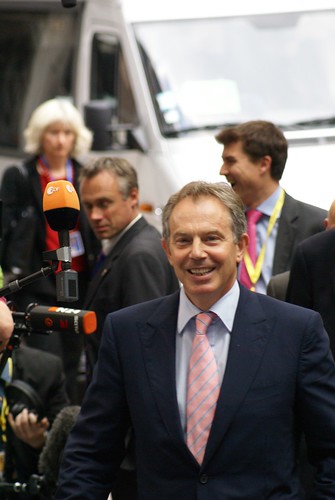
It was yet another illustration of how much the British media don’t understand how the EU works. Faced with the challenge of having to explain the complexities in the formation of a new parliament, they preferred to go with the easy “British fascist takes a seat” story. Their inclination for the easy story was again born out later in the week when Gordon Brown is nominating Tony Blair to be the first “president of Europe” (should such a position be created by the passing of the Lisbon Treaty) further demonstrated the astonishing ignorance of the British on all things European. Last night on Question Time, an audience member asked the guests whether Tony Blair would make a good European president. The panel, composed of senior politicians and journalists, proceeded to descend into a string of bizarre statements that betrayed the fact that they actually didn’t know what the new president position is. For that matter, they didn’t seem to know much of anything about the EU at all.

The “president of Europe” position, as the British media have dubbed it, is actually merely the presidency of the European Council – one of the three governing EU institutions which is made up of the leaders and top ministers from all the member states. That position already exists, but is currently held by entire countries on a rotating basis for 6-month terms. At the moment, the President of the Council is Sweden. That means that the council’s informal meetings are held in Sweden, and Sweden controls the agenda and the message of the council for that period. For instance next week Sweden is hosting a Council meeting on the environment that I’ll be attending in the resort town of Ã…re, where all the Environment Ministers (Ed Milliband from the UK) will meet.

So the Treaty of Lisbon will change this position so that instead of being held by a country for six months, it’s held by a single person for 2 1/2 years. That is the position Tony Blair is being nominated for. It is mostly symbolic, and therefore it’s important to get someone in there who has a high profile. However the president won’t specifically make policy, he or she will merely loosely control the agenda of the European Council which is NOT the executive branch of the EU. The executive branch of government in the EU is the Commission, which has a president (currently Jose Manuel Barroso) who serves a five year term. That position is the only thing that comes close to really resembling a “president of Europe”, and it’s already existed for decades.

Last night on Question Time British MP Margot James responded to the Blair question by saying that she doesn’t think there should be a president position because the British public are already funding too many government positions and so one more shouldn’t be created. I found it to be an odd comment, because this European Council presidency position already exists, and in fact by changing it to be one person rather than moving it to a new country every six months at enormous expense, I assume the EU will actually be significantly reducing the cost of the European Council presidency (though the rotating country designation will still exist in abridged form for the council of ministers, thanks Andreas!). I also find it strange for James to blame the EU for having too many government officials when the number of Euro MEPs has actually just been significantly reduced, while the British Parliament continues to heft at a grotesque 1,384 members representing just 62 million people. The European Parliament has 736 members representing 500 million people.

The fact that this panel of high-ranking MPs and media figures seemed to have little idea how the European Union works reflects just how widespread “EU ignorance” is across Britain. In any society the poor and undereducated are likely to know little about the structures which govern them, but what I’ve been shocked by is the almost complete lack of EU knowledge from educated, intelligent people in the UK. Most of my intelligent British friends have no idea what the European Commission is, even though it effectively dictates probably about 40% of the laws that govern them. These same people could tell me inside and out how the American government works, in fact they are probably better versed in American civics than most of my friends in the US. Yet if I talk about anything related to the EU I’m met with a blank stare and a shrug.

Bad Education?

So why is this? I’ve lived across Europe and I’m not labouring under any kind of delusion that people on the continent know their EU civics inside and out. But in my experience intelligent people on the continent tend to know what the Commission is and how it functions with the other two branches. So why do they know this? I’ve been asking a few of my European friends to find out.

A French friend from Paris, who doesn’t work in politics but takes a marginal interest in it, says his knowledge of the EU (which is good) is shaped by what he reads about it in the media. Ah, there’s the rub. The British media do a notoriously horrible job reporting on Europe. The EU is hardly ever mentioned in British news outlets, and when it is, the reports on it are rife with inaccuracy. By contrast the French media does cover important EU stories, when a piece of legislation will directly effect French people in an important way. But still, EU stories can be fairly boring, and I would be imagine it would be pretty easy for even intelligent French people to tune them out or give them only cursory attention. So that can’t be the entire explanation of the difference.

A German friend from Hamburg told me that though he doesn’t usually read articles about the EU in newspapers (he’ll usually skip them because he thinks they’re boring), he does know the fundamentals of how the EU works because he learned it in school. I tested his knowledge a bit and found that yes, he does have a good mastery of the basics of how the EU works, so I asked him when he learned this. He said he learned it in secondary school, in a required class that was coupled with a course on German civics. Social Studies 101 basically.

Ah ha, so there’s the rub. Education. I suppose it’s understandable that people my age wouldn’t have had extensive education on the EU, as when they were in any secondary school civics course it had only recently become a real significant entity. So I quizzed a few of my British friends on what kind of education they received in school about the structure of the EU.

Again, I was met with blank stares.

I asked several people, and all of them told me they had never received any education in how the EU works, not even as part of a general civics course on British government.

I figured I was getting closer to my answer. British people were never educated in how the EU works and they don’t hear anything about it from their media, so how on earth are they supposed to know what it even is? Yet this is now a body which affects vast areas of their daily life. Education is always a catch-up game I suppose. Perhaps this just takes time to change. Surely young students now must be being taught about how the EU works, given its rapid increase in importance over the past 10 years.

So I asked a friend of mine who teaches in a secondary school here if EU civics is now being taught in school. I was shocked by his response. “Nope, nothing,” he answered matter-of-factly. “Not even in a civics class? Or a government course?” I asked. “I’ve definitely never heard of it being taught,” he answered.

This situation seems rather incredible to me. This may be a hyperbolic example, but it would be like a school system in Texas teaching students only how the Texas state government operates, and completely ignoring the federal government in Washington as if it didn’t exist. It’s a huge disservice to the students who will have to live in a framework where those laws made at the federal level will have a huge impact on their lives, and they will have no idea how they’re made.

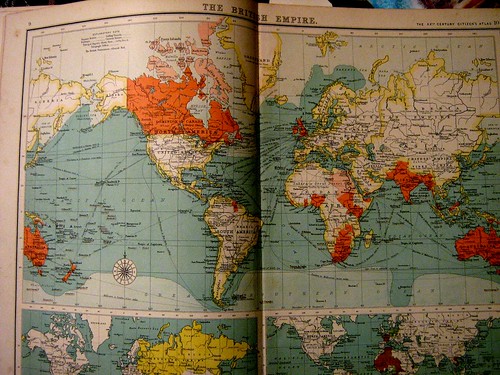
I suppose it’s reflective of the general attitude of educated Britain toward the EU. Deep down they may know its necessary, they may not want to leave it, but they would prefer to just ignore it because to acknowledge that they need it is just too damaging to their national pride. Perhaps it would just be too humiliating for a British history teacher to transition from telling his students about the glories of standing astride the world as the British Empire to telling them the modern reality of being one part of a European coalition. Maybe it’s just a symptom of post-imperial trauma. After all, they say the second stage of any trauma is denial.

But in the mean time, it seems to me the British education system is doing young people a real disservice if they really are ignoring the EU.

Thursday, 4 June 2009

My first vote in Europe

This morning I voted in my first European election, a right newly available to me now that I have my Italian passport. An EU citizen can vote for an MEP in any EU country they live in. It was a fairly uneventful affair. Though it was 8:45am and hence prime commuting time, I was actually the only person at the Chelsea polling station.

In the UK they still use paper balloting, so they hand you a sheet, you take it over to a little desk, mark off a big x, and slip it into a box. It seemed very old-timey to me, as where I’m from in Connecticut they haven’t used paper balloting since before I was born. Even the big pull-lever voting machines with the automatic curtains - which seemed so cool to me as a child when I would go into the booth with my parents - now seem antiquated in the US with the advent of electronic voting machines. Funny enough, the paper I was given this morning was about a metre long, making it appear as if I had a lot to vote on. But in reality there was only one X to be made, next to the party you were choosing. Each party though has to list the six candidates it would field if it wins, making the list quite long with all of the small parties. It’s done on a proportional allocation basis, with the winning parties getting to put forward a certain number of MEPs based on how much of the vote they got in each district. The UK and Holland are the only countries voting today, the rest of Europe will vote on Sunday and the British results won’t be revealed until then.

I won’t say who I voted for but I will say it was a tough decision. In Brussels they complain that one of the (many) problems with the European parliament is that people vote on purely national issues, which are mostly irrelevant to the issues being considered by the European Parliament. Even knowing this, I have to admit that national political considerations in Britain probably contributed about 50% to my decision. It’s just really hard to ignore the national politics when so often the most immediate and tangible result of these euroelections is the verdict they deliver on the national party in power.

Off with their Heads!

Owing to the economic crisis, this ‘verdict’ element is more prevalent this year than ever before. Across Europe there are several countries where the governments are teetering on the brink of collapse, and a poor performance in the EP elections could topple them from power. Across Europe the parties in power are expected to do poorly while the opposition parties are expected to do well (with the bizarre exception of Italy where, though their leader is embroiled in a sex scandal involving a 17-year-old girl, it is expected that his hard-right ruling coalition will do unprecedentedly well). In Greece, where the conservative government is weak following violent demonstrations against the economic crisis, a big win for the Pan-Hellenic Socialist Movement on Sunday could cause the collapse of the current government and a general election. Similarly in Spain, a big win for the conservative Popular Party could trigger a no-confidence vote for the ruling government of the Socialist Workers Party. In Germany and Portugal, big wins from the opposition would have a dramatic effect on upcoming scheduled elections in the fall. It seems that across Europe, whether the right or the left is in power, the verdicts delivered by Sunday’s election could be the opening shot of a coup by the rival ideology.

But nowhere is the euroelection being watched more closely as a barometer than in Britain, where it is being held concurrently with many local council elections across England. Gordon Brown’s government is in freefall this week. The ongoing expenses scandal has caused Brown’s already weak government to fall apart, and each hour that passes seems to get worse. The last two days have seen the resignations of several cabinet ministers, and it is thought that Chancellor Alistair Darling will be sacked within days. Brown will have to form a new cabinet next week, but if Labour MPs refuse to serve on his cabinet, he will have to step down as Labour leader. A new Labour leader would then be selected by the party, who would inevitably have to call a general election that Labour will almost certainly lose. It is thought that Labour MPs are waiting for the result of today’s vote to make their decision. If Labour does dismally (some are predicting they could even come in fourth or fifth behind the far-right British National Party) then they will force his resignation by refusing to serve on his new cabinet.

It is expected that the Tories will probably receive the largest share of today’s EP vote, thought the majority of people almost certainly don’t realize what they’re voting for with that decision. David Cameron is set to take the Tories out of the parliament’s main centre-right EPP grouping shared by Angela Merkel and Nicolas Sarkozy and form a new Eurosceptic fringe grouping by allying with far-right parties of Eastern Europe. This issue has received almost no coverage from the British media, so it is certain that most of today’s Tory voters aren’t aware that they’re voting for a coalition that will include the anti-gay, climate-denying Polish nationalist Law and Justice party. That said, perhaps even if they knew they wouldn’t be bothered by it.

Rock Stars and Royalty

Of course there are interesting non-government-toppling things to look out for in Sunday’s results as well. In the Netherlands, for instance, the country is rife with speculation over the performance of controversial populist Geert Wilder’s anti-Islam Party for Freedom, which many are expecting to do quite well. In France, people are watching to see if the newly solidified Socialist Party leadership of Martine Aubrey will give people confidence that Sarkozy’s opposition is back in the game and safe for a vote after a year of chaos and in-fighting. I think that’s unlikely and they will probably do quite poorly, especially considering that Communist Olivier Besancenot’s new Anti-Capitalist Party is expected to do well and will probably siphon off votes from them. But just how well they will do is a matter of speculation, and I imagine it will keep Sarkozy up quite late Sunday night if they have a good result.

Then of course there’s the amusing MEP entries of this year’s election. The European Parliament, often half-jokingly maligned as a refuge of freaks, cast-aways and has-beens, has attracted its fair share of celebrity candidates this year. Slovakia, which was mortified after the last EP election five years ago when it had the lowest turnout in all the EU at just 17%, has pulled out all of the stops to try to get people to the polls this year, fielding an African-born pop singer, a fitness trainer and a former ice hockey star. Who knows that their objectives for Europe are, but I suspect the main intent with fielding them was just to make sure Slovakia doesn’t come last in turnout again.

Another interesting one to watch will be Sweden’s Pirate Party, a group formed entirely in reaction to the recent prosecutions in that country of file-sharing site managers. The candidates actually dress as pirates and have used pirate speak when campaigning (and they’re expected to gain some seats on Sunday!). There’s also Elena Basescu - Romania's equivalent to Paris Hilton – who is expected to win a seat as she is the daughter of the Romanian president. Other quirky candidates include a former Czech astronaut; a Finnish racing champion and a Bulgarian Taekwondo idol.

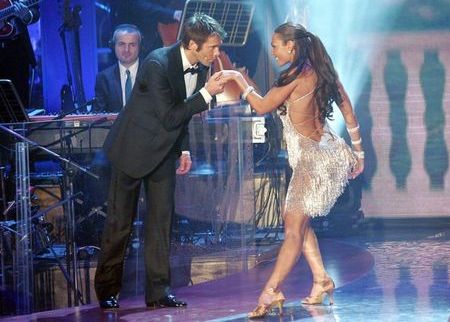
And of course my nerdy European history fascination can’t help but be interested in the fact that the reigning heirs of two of Europe’s formerly most powerful but today ousted (and banned) monarchies – the Habsburgs and the Savoys – are both in the running in Austria and Italy respectively. The candidacy of “Prince of Venice and Piedmont” Emanuele Filiberto in Italy is particularly interesting as he was banned from entering Italy his whole life (oweing to the expulsion of members of the former Italian monarchy when the Republic was declared in until Berlusconi lifted the restriction for him and his father in 2002. Shortly after that he celebrated his triumphal return to his family’s former kingdom by entering Italy’s version of Dancing with the Stars.

Asked why he would make a good MEP, he said, "I was in exile for 31 years and I know Europe well. I speak five languages. I know half of the current heads of state personally, and the other half I'm related to." It’s an argument any Royalist could agree with!

Check out this BBC site for real-time election results on Sunday and Monday. I'll be in Berlin this weekend, but will certainly be keeping tabs on it from there!

Tuesday, 3 February 2009

May you live in interesting times

I've spent the past few days getting settled here in Brussels, and so far things have gone quite well. I've got a great apartment right in Centre Ville next to the Grand Place, and my intensive French class is fantastic. It's an advanced class and there's only seven of us, each from a different country.

Last night I had drinks with a French friend who lives here in Brussels, and we were talking about different things going on the EU these days. There wasn't a shortage of things to discuss. Toward the end of the conversation, we remarked on what a crazy time this is to be living in Brussels reporting on the EU. It feels like we're on the precipice of something, particularly in Europe. Things are about to change, we speculated, and they could possibly go in extreme directions. It looks like we've all been victims of that old purported Chinese curse, "may you live in interesting times." But to continue with the 'mangled cliches claiming to be proverbs theme', the Chinese character for crisis also means opportunity! Could the economic crisis lead to a strengthening of pan-European institutions, or could it just as easily lead to the disintegration of the entire EU project?

Wednesday, 19 December 2007

Pan-Europe healthcare plan delayed

Though proposals were expected today on the controversial new plan that would make it easier for patients in Europe to travel to other EU countries to receive healthcare, a European Commission spokesman said this morning the proposals have been put off, citing “agenda reasons.”

The idea behind the plan is that patients should essentially be able to “shop around” Europe for their healthcare, having operations done in countries where the wait time and expertise most suits their needs, and then having their home healthcare system foot the bill. So, for example, a UK resident who needs a surgery but is facing a 4 year wait to do it at an NHS hospital, could travel to France and have the operation done sooner (and maybe better), and then get the NHS to foot the bill.
But the plan has been enormously controversial, and the UK is particularly opposed to it because some fear it will spell the “end of the NHS” because the system would be forced to transition to a more insurance-based continental system.

For this reason the proposals have been hitting consistent delays, being drafted and redrafted, and the proposals today were expected to offer countries like the UK the option to pre-approve such out-of-country treatment and to opt-out. Of course, the proponents of the plan say this would negate the very purpose of it.

Mark Mardell had an interesting package on the BBC last night about a woman who faced a four year wait for gastric bypass surgery in the UK, so she opted to have the operation performed in Belgium where there was no wait for £5,000 (insert joke about the weight difference between continentals and Brits here). He's detailed more about this issue in his Euroblog today.

Tuesday, 25 September 2007

UK election next month?

It’s party conference season here in the UK. If you took the word ‘conference’ out of that phrase it would sound a lot more fun. But from what I heard from my friend Francis about the Lib Dem conference down in Brighton, these things are actually a raucous good time.

Party conference season refers to the three weeks in the fall when the three main political parties in the UK each have a big event outlining their platform for the coming year. They’re a bit like the national conventions in the US, except that they happen every year rather than every four years and are not expressly for the purpose of choosing a candidate to run for the country’s leadership (although sometimes such a leadership change is made).

Monday, 17 September 2007

ECB on Northern Rock: What Northern Rock?

It’s official. The UK has become the first country to have a bank run caused by the current market turbulence. The run on Northern Rock bank that started on Friday and is continuing today is sending the public here into a panic. British commentators are speculating that there could be another Black Wednesday around the corner, while the Bank of England is trying to reassure the public that there’s nothing to be alarmed about.

Northern Rock is Britain’s fifth largest mortgage lender and is a massive bank here. So when news broke on Friday that the bank is going broke because of the worldwide credit crisis and the Bank of England has bailed it out with a limitless line of credit, the bank’s customers ran to the branches and started queuing to get their money out in cash. It was really insane, I walked by a branch on Friday and it was complete pandemonium, like that bank run scene in It’s a Wonderful Life.

Wednesday, 27 June 2007

Big British Butt Ban

SATURDAY SATURDAY SATURDAY, the Big British Butt Ban goes into effect!

From Jul 1 you will no longer be able to smoke anywhere indoors in England. I’m so curious to see how this unfolds. Having been in New York in ’02 when the smoking ban went into effect there, I’m interesting to see how this city’s reaction will differ. Frankly I’m surprised that they’ve chosen to do the switchover in the summer like NYC did, because that ended up causing quite a problem.

The first state in the US to start a smoking ban was California (which tends to be on the forefront of things like this). There it worked quite well, and there weren’t any problems during the changeover.

So when mayor Bloomberg passed the same ban in New York City, they expected it would go off just as smoothly. But they were forgetting on difference between New York and the main cities in California (LA, San Diego and San Francisco). Because of the warmer climate, many (if not most) bars in California have some kind of outdoor section or courtyard. In contrast, this is quite rare in NYC, as space constraints would make a courtyard very expensive and weather makes it financially impractical (why pay extra rent for a space you can only use 5 months out of the year?)