Showing posts with label British politics. Show all posts

Friday, 11 January 2013

Obama warns Cameron over his dangerous EU game

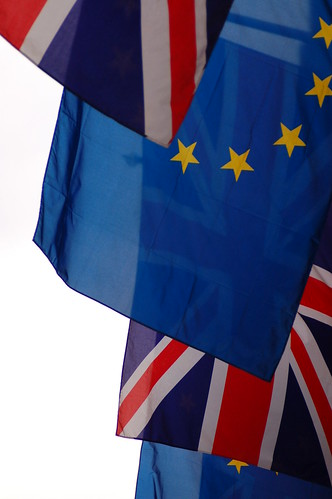
The British eurosceptic right, normally known for their fawning obsession with America, have been in a strange state of cognitive dissonance this week after the Obama Administration delivered this frank warning to British Conservatives on Wednesday: if the UK leaves the EU, it could doom itself to international irrelevance.

Philip Gordon, the US assistant secretary of state for European affairs, said in a speech in London that the UK leaving the EU would be a mistake, implying that Britain’s relationship with the US (and, presumably, most other major global players) would be damaged as a result.
"We have a growing relationship with the European Union as an institution which has a growing voice in the world – and we want to see a strong British voice in that European Union. That is in the American interest," he said. "When Europeans put their resources together and have a collective decision-making function they end up playing a major role in the world…And for the UK to be a part of that stronger, more important voice in the world is something I know a lot of British people welcome."
It isn’t just an academic debate. At the end of this month, British prime minister David Cameron will deliver a speech in The Hague on Britain’s future relationship with the EU. It is expected that he will announce a public referendum on EU membership that will take place in 2018 – well after the next general election and most likely after Cameron is out of office. Cameron has found it increasingly difficult to assuage the demands of a significant contingent of his increasingly anti-European party for a referendum on Britain leaving the EU.

Wednesday, 28 July 2010

Do-it-yourself policing and garbage cleanup in Britain?

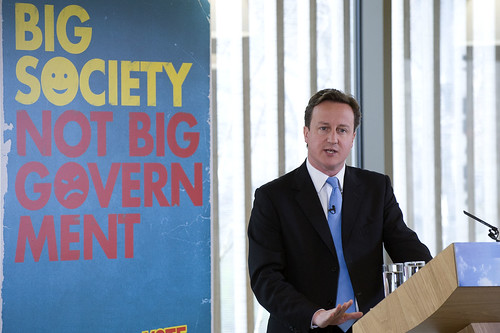
The "big society" initiative, which the new British prime minister David Cameron first came up with during the campaign, has gained sudden prominence in recent weeks. Apparently, it wasn't just a feel-good campaign slogan. The plan, which would devolve local services to voluntary citizens initiatives, managed to take the British media by surprise when it was officially unveiled last week. The plan would entail much more action and restructuring than anyone had expected out of what was thought to be simply campaign rhetoric, and has serious implications for how the UK may organise itself in the future.

"So what's this now," the media is asking, "big society is actually a real thing?" It would be as if Barack Obama, after becoming presient, had set up a "Hope Task Force" in order to monitor and manage the levels of hope in local communities. The media didn't know what to make of it at first, but within days the consensus seems to be that this scheme is merely a cover-up for the massive budget cuts that are about to be made on local community services. Or is it?

Monday, 5 October 2009

Ireland Rejects British Influence

As news breaks that the UK will soon be shut out of a new G4 group of major economies and could lose its seat on the board of the IMF, the bizarre reaction to the Irish referendum by much of the British press continues to look more and more out of touch with the realities of the modern world.

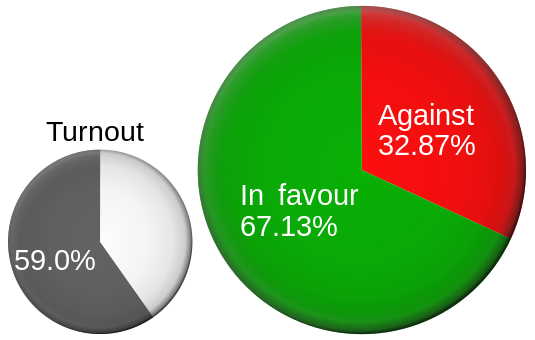
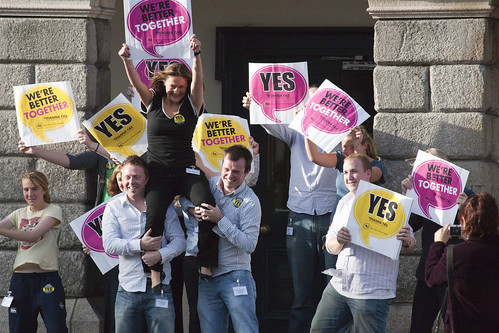
Europe-wide ratification of the Lisbon Treaty is imminent following Ireland’s massive endorsement of the EU reform agreement with a ‘yes’ vote of 67%. It looks as if Czech President Vaclav Klaus has lost his nerve and is ready to end his grandstanding talk of refusing to sign the ratification passed by the Czech parliament – a move which would have been constitutionally questionable anyway. So barring any unforeseen complications, it looks like this long effort to reform the EU to something more appropriate for its current size has been completed.

If the British media is to be believed, after rejecting the treaty in the first referendum in June 2008 Ireland voted yes this time around out of fear. Terrified by their vulnerability in the global economic downturn, the British narrative goes, the Irish have allowed themselves to be bullied into accepting dominance by Brussels, having lost confidence in their own ability to govern themselves. Under this narrative, the Irish made a courageous choice in the 2008 referendum when the treaty was, as the British press frequently puts it, “resoundingly defeated” (never mind the fact that the 2008 ‘no’ vote actually just squeaked by with 53%). Apparently in 2008 a slight majority indicated massive popular will by courageous people against an oppressive super-state, but in 2009 a large majority is the illegitimate result of misguided voters swayed by fear and intimidation. The Irish, it would seem, are only right when they agree with the British.
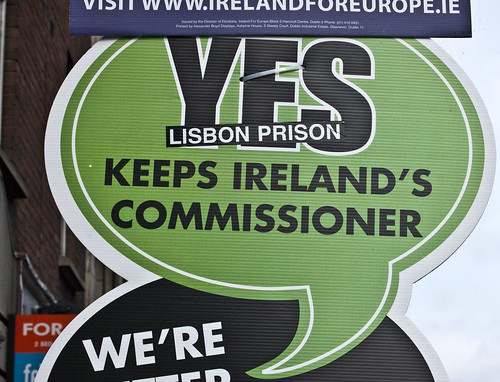
What is never mentioned in the British press is that after the June 2008 result Ireland has been given a basket of concessions and guarantees – the most significant being that the proposal to shrink the size of the European Commission from 27 commissioners to a more manageable size of around 20 has been abandoned. Under existing treaties each country is guaranteed a commissioner in the EC – even though commissioners are not supposed to represent national interests but rather fulfil a specific role of expertise such as trade, environment or energy. The large number of new member states that have joined in the past 10 years has meant there is now an excessive number of commissioners, with new remits for them being invented such as “Commissioner for Information Society and Media” and “Commissioner for Multilingualism”.

However even though it is supposed to be irrelevant which countries these commissioners come from that does not always prove true in practice, and the Lisbon solution to rotate a certain number of Commission seats between the small member states had caused some concern. There was a lot of misinformation spread in the 2008 ‘no’ campaign in Ireland, but this issue was one of the verifiable legitimate concerns that the ‘no’ campaign had – fearing the treaty would lessen the influence of small states in the EU’s executive body. So they won this concession, there will remain 27 commissioners.

While it is true that the actual text of the treaty has not changed (doing so would have required re-ratification by all 27 states and would have held up passage by another five years) the Irish have been given binding guarantees that these changes will be inserted at the time of the next Europe-wide ratification issue, likely the accession of Iceland and Croatia.

The British press also doesn’t mention that this time around there was a much more extensive education campaign on what is actually contained in the treaty – a response to the fact that the exit polling in the 2008 referendum revealed that the most frequently cited reason for voting ‘no’ was a lack of information on what the treaty is. Turnout this time around was also about 10% higher than before.

The British roots of the ‘no’ campaign were also more exposed this time around, making the claim that a ‘no’ vote was a vote for the spirit of dead Irish republicans seem laughable. As the Guardian pointed out in an article last week before the vote, the ‘no’ campaign was full of Brits who flew over to urge a rejection of the treaty, led by Tory lobbyists and Rupert Murdoch’s newspapers. All this prompted fears that a ‘no’ vote would result in what Irish Labour leader Eamon Gilmore called a “two-speed Europe” where there would be “a mainland Europe and the British Isles, where we fall under the influence of Britain." So much for a ‘no’ vote honouring the dead Republicans who fought against the British.

The Tories’ Eurochaos

The ‘yes’ vote was exceedingly bad timing for British Conservative leader David Cameron, as it means the Conservative Party conference this week will be dominated by the ‘Europe issue’, a quagmire that continues to cause rifts between different factions of the party. Cameron had promised to hold a referendum on the treaty in the UK if it remained unpassed by the time they (most likely) come into power next April. However now it looks like the treaty’s changes will be adopted by the EU by the end of the year – and the British parliament already ratified the treaty.
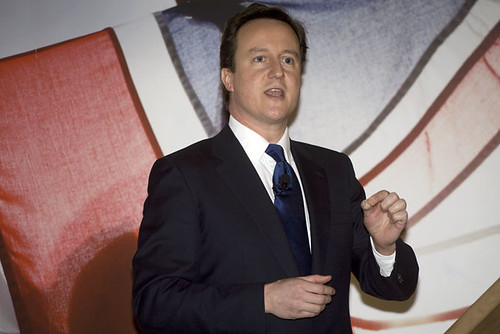
The Eurosceptic wing of the Conservative party is demanding that Cameron hold a referendum on the treaty anyway, asking the public whether Britain should retroactively pull out of a treaty it already signed and which has already gone into effect. The problem is this would not only be illegal under international law, it would also be impossible. If Cameron were to hold such a referendum and the result is ‘no’ (which is the position he has advocated), there is no longer a ‘treaty’ to vote on, the treaty has become the EU. So at that stage, a ‘no’ vote on the Treaty would be a ‘no’ vote on the EU, and the British would have to secede from the union.

This is not an issue Cameron wants to put to a referendum, as the risks of a ‘no’ vote would be too great. Britain pulling out of the EU, as I’ve written about before, would mean it would have to completely renegotiate almost all of its international treaties in trade, labour and markets. It would very likely cause an immediate collapse in the pound, and investors would flee the UK like rats fleeing a sinking ship.

So Cameron has an uncomfortable reality to deal with this week. Trying to throw a bone to the Eurosceptic wing, he has hinted ahead of the conference that the Tories will launch a “public consultation” instead of a referendum, with the aim of moving significant powers away from Brussels and back to Westminster. Party insiders are saying he will announce this week an intention to “repatriate” powers involving social powers, employment and justice to a national level. Of course what he effectively would be asking for are more UK opt-outs, which would be almost impossible to attain retroactively, requiring the approval of all 27 member states. Many of those member states would surely question why the UK deserves special treatment, and would laugh any Tory who demanded such a concession out of the room. Considering Cameron has already enraged the French and German conservative governments by leaving the mainstream centre-right EPP grouping in the European Parliament to form a new alliance with the Eastern European hard right, he has few friends in Brussels or other Western European capitals these days.

UK Shut Out of World Bodies

All of this Tory talk seems particularly incongruous with reality considering that just this weekend it emerged that, following the death of the G8, the US is planning to form a new G4 group of the world’s leading economies that will not include the UK. The new group would be composed of the US, China, Japan and the Eurozone. The Eurozone, remember, does not include the UK because it does not use the Euro currency. Alistair Darling has reportedly been begging for the new group to instead include all of the EU rather than the Eurozone, but US officials have reportedly rebuffed this request saying that the member needs to be able to control a unified monetary policy. The news comes at the same time that Britain is fighting to maintain its seat on the board of the International Monetary Fund.

It was amusing to see the Daily Mail try to spin this as Gordon Brown’s fault, rather than the fault of the isolationist impulse the Daily Mail and papers like it have championed over the past two decades. The fact that it is inevitable that the UK by itself will not be able to justify its seat on these international bodies in the 21st century seems to be lost on them. The paper declines to mention the fact that were the UK on the euro, it would have a seat on this new G4 body and could maintain a board seat in the IMF. Nor does it mention that France and Italy are also in the same boat now that the G8 is being dissolved, yet they will have a major place in the G4 and IMF because they are part of the Eurozone. The comments below the story would be hilarious if they weren’t so jaw-droppingly ignorant, with each commenter deciding that this news is somehow evidence that the UK should leave the EU. Come again?
It will be interesting to see how the ‘Europe issue’ is handled at this week’s Conservative Party conference. Considering Cameron’s populist tendencies, he could probably just get up on the podium and say ‘Europe’ and have the whole hall boo and jeer in order to have a successful day. But Cameron’s crowd-pleasing rhetoric on Europe is on a collision coarse with reality. His recent defection from the EPP is probably but a first instance of this.

Hopefully, Europe can now put this treaty nonsense behind it and focus on more important things, getting on to the real work of guiding the continent through the economic recovery and leading the world in the effort to combat climate change. That is, if the Tories can let a sleeping dog lie.
Monday, 1 June 2009

Where are the Ideas for Britain?

I’ve written before on this blog about a general lack of ambition in Europe, the noticeable absence of a strong desire from Europeans for themselves or their country to achieve success. Nowhere has this been more apparent than in the reaction of the British public to the unfolding expenses scandal which may be hours away from causing the resignation of the Chancellor.

The British media has been telling us that the public is “enraged” by the unfolding scandal, which is precipitating a “revolution” that could topple not just the current leadership but the entire system of British government. But judging by the reaction I’ve seen from ordinary Brits, this seems a highly dubious claim. In fact all I’ve heard so far is a whole lot of whinging, but very little ideas about what should be done about the problem. We can laugh that, of course, this is the stereotypical British way of dealing with everything. But in the end it’s a real problem, especially right now.

A friend of mine who is a journalist covering Westminster made this observation: as he’s been doing the “man on the street” interviews that every reporter is required to do while a scandal like this is unfolding, the reactions of people are all the same. “They’re all a bunch or crooks aren’t they?” “They should string ‘em up from the rafters, the lot of ‘em!” “All of the MPs have been on the gravy train!” But when my friend asks a follow-up question on their opinion of the system itself – like whether they believe MPs should be given a raise instead of using expenses, whether the number of MPs should be cut, or whether the House of Lords should be abolished – people just stare back at him blankly. “Oh, I don’t have any opinion on that” they say. Well hang on, a second ago you were just calling for all MPs to be hung from the top of Big Ben, but who exactly would replace them in this great plan of yours, Average Joe?

I may be accustomed to apathy having grown up as part of America’s Generation X, but this strange combination of indignation and cynicism I find in the UK is truly bizarre to me. Everyone is completely disgusted with the UK parliament – across all party lines – but nobody has any ideas or ambition to change things. Throughout all of the media analysis I’ve seen, as commentators go on and on about how “furious” everyone is, I have yet to hear a real discussion about ideas for reform. And I have yet to see one member of the public who really seems “furious”. I know that this sort of understated composure is the British way, but it’s hard to see how anything is going to change when nobody seems to care all that much. I mean, where is this fury the media has been describing? Where are the protestors outside the houses of parliament? If the definition of “fury” in the UK translates to a couple of people in the audience of Question Time making some half-hearted boos, I think all this talk about a “revolution” is premature, if not downright fantasy.

This country just doesn’t seem to have any plan for its own future, which worries me. And it never ceases to amaze me that British people will complain about too much power being handed over to Brussels on matters that should be dealt with by national MPs in Westminster, and then in the next breath go on to talk about how inept and corrupt British MPs in Westminster are. So let me get this straight – you think your own government is corrupt and dysfunctional, so as a consequence you want them to be in charge of more things? But interrupt a Brit’s rant about the EU to ask them their opinion about reforming the British system of government and they don’t’ have much to say. They’re simply not interested.

It’s shocked me that this week, in the run-up to the European Parliament elections on Thursday, people here are still going on about MEPs abusing their system of expenses in Brussels. Are they really serious? The shocking level of excess from British parliament MPs uncovered over the past several weeks makes the limited about of Brussels MEP abuse in a transparent expenses system look like child’s play. And nevermind the fact that it was UKIP MEPs, who were elected on an anti-EU platform saying Brussels was full of crooks, who ended up being the ones abusing the system!

It goes to the heart of the problem this country faces. Britain is suffering from a drought of ideas, wandering in a period of post-imperial trauma where it hasn’t figured out its place in the world, and doesn’t seem to be in any hurry to do so. While dithering over small, insignificant issues like MP salaries and expenses, nobody here is thinking about the big issues or engaging the public in a real honest conversation about Britain’s future.

And that, in the end, is the real crime being perpetrated by this country’s leaders against its people.

Wednesday, 20 May 2009

Panic at the Parliament

I woke this morning to my clock radio blasting some BBC commentators hailing the “revolution” unfolding this week in the UK. Nothing jolts you out of bed like a little social unrest! While all this talk about how the expenses controversy is going to completely change the way the British government works may be a bit of hyperbole, after hearing a first-hand account of yesterday’s tumultuous events from The Times’ parliamentary sketch writer Ann Treneman last night, it does seem that, just maybe, a little political earthquake is indeed unfolding this week in Westminster.

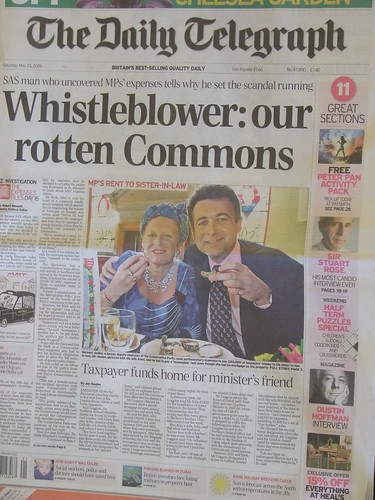
Treneman had stopped by a gathering of young journalists in Soho, fresh from watching the dramatic resignation of the Speaker of the House of Commons Michael Martin. The announcement was the result of increasing demands from a paniced parliament in the face of a steady drip-drip-drip of news about the ‘second home allowance’ expenses British MPs have claimed over the past four years. The revelations, being published in the Telegraph newspaper, are the result of a years-long effort by journalists to get access to the data under the newly-enacted Freedom of Information Act in the UK (sidenote – not called a “foya” here, but instead an “F.O.I.” – crazy Brits!). The parliament fought tooth and nail to resist releasing the list of expenses claims, a fight led by the Speaker of the House, who oversees the finances department that approves the expenses. But in the end the media won, the expenses are being published, and resignations could turn from the trickle seen thus far to an avalanche. Already it looks like Gordon Brown could lose a big chunk of his front-benchers, and the other parties seem equally culpable. Tory leader David Cameron called an emergency press conference early in the week to compel all members of his party to immediately write checks paying back the taxpayer for their expenses, or be immediately expelled from the party.

But no matter howThe Speaker of the House position in the British House of Commons is not akin to its American equivalent, a position currently occupied by Nancy Pelosi. The British speaker is in charge of the functioning of the house but not its policy, deciding when and for how long people can speak and running the everyday procedural minutia of the Houses of Parliament, in which he lives. It’s generally considered to be a neutral role above politics. But as the shocking revelations about expenses came pouring in, there was increasing pressure for parliament to do something, anything, to quell the growing tide of public anger. They chose to take the speaker’s head on a platter to the bleating mob. In reality, this is unlikely to satisfy them.

Through the allowance designed for work-related expenses for the MPs to maintain a second home in London (in addition to their house in their home constituency), it’s been revealed that MPs have claimed thousands of pounds for big-screen TVs, remodelling, vibrating chairs, Persian rugs and even “moat maintenance”. In the most egregious cases, several MPs have been shown to have made a profit off the taxpayer by expensing the mortgage on one home, then switching the “second home” status to their other house, selling the first home and making a tidy profit.

American Comparison

From my vantage point I can’t decide which I find more absurd, the ridiculous claims made by a minority (the British media seems to have lost this detail) of MPs, or the ridiculous system of remuneration this country has designed for its governing officials. The trouble really started back when the last Conservative government, unpopular and heading for a likely election defeat in the mid ‘90s, didn’t have the political courage to give MPs a necessary inflationary pay raise. So they instead invented a clandestine system of expenses for MPs to pay for their accommodation in London. MPs today make £64,766, not exactly poverty level but certainly not enough to maintain two homes. Compare this to the $174,000 (£120,000) made by their counterparts across the pond in Washington. And here’s where my inevitable American comparison begins.

I have to say I’ve learned about the second home allowance system here with a mixture of bemusement and incredulity. It’s a little confusing to me why all of the MPs need a London home at all. This is a (comparatively) tiny country, and most of its citizens live in the Southeast region around London. Certainly at least a third of the MPs live within a distance at which it is not unreasonable to expect them to commute in three or four days a week. Yet these MPs, even some of the ones who represent London, have actually been charging taxpayers for a second home!

In the US congressmen and women represent constituencies literally thousands of miles from Washington. In fact the nation’s capital doesn’t even have a voting member of congress (as it is a district and not part of any state), so unlike London there isn’t a single voting congressman who lives and works in the same city (compare that the UK – where 73 out of the 646 MPs represent London).

But despite the geographic distances that all 535 American congressmen and senators have to travel to be in Washington, guess how many of their Washington homes are covered by the US taxpayer? Zero. There is no such thing as a “second home allowance” in the US. Instead, US congressmen must pay for their DC residences out of their own pocket. If they want a nice second home in DC and they have the private financial resources to do it, they’re welcome to. But most opt for makeshift accommodation in DC which they rent, not own. In fact many congressmen live together in modest apartments. The most famous example is the four high-powered senators Chuck Schumer, William Delahunt, Richard Durbin, and George Miller that share a house together.

The only items US congressmen are able to expense from the taxpayer are costs for their offices, not their homes. This would include their constituency offices in their home state, the personnel to run them, and postal charges for official business. All of those expenses are available to public scrutiny.

Now granted, politics in the US is big business in a way that it is not in the UK. Quite a few members of the US Congress were millionaires before they entered office, as increasingly that is the kind of money required to get one elected in America. Rather than amassing their fortunes from the taxpayer, US politicians often amass them from corporations in the form of campaign contributions. And everyone knows that the time a US congressman really makes money is once he leaves office and takes a lucrative position at a lobbying firm, using his connections and the rule allowing all former congressmen access to the house and senate floors. But efforts to fix these issues are currently underway by the Obama administration, including a mandatory waiting period of several years before an exiting congressman can work for a lobbying firm.

Today a new system is being debated in the House of Commons that would reform the expenses system, but its hard to see how any reform can work without a pay increase for the MPs. With the toxic atmosphere toward parliament on the part of the public and the media at the moment, its hard to see how any such pay raise could be voted in. Yet as the Times’ Daniel Finkelstein pointed out yesterday, it is counter-intuitive that the public seems to be, “looking at the MPs we've got, deciding they are all inadequate and determining that therefore we should be paying them less.” As the saying goes, you get what you pay for.

Thursday, 6 March 2008

A new Europe strategy for Labour?

Well it’s official, the UK has ratified the Lisbon treaty. Brussels can breathe a big sigh of relief. It was a fiery scene in the commons yesterday as they debated the ratification. Tory leader David Cameron was doing his best to sufficiently rattle his saber to appease the tabloid press.

But Cameron’s predictable bravado was hardly the most interesting thing about the proceedings. Rather it was the behavior of the other two party leaders, Labour’s Gordon Brown and the Liberal Democrats’ Nick Clegg.

As The Times’ Peter Riddell pointed out in his column today, Gordon Brown seems to have finally “seen the light” when it comes to Europe. That, or he’s adopted a fundamental (and perhaps politically necessary) shift in strategy on how to deal with the European question. During the commons debate yesterday Brown was passionate and unequivocal in not only his defense of the treaty but in the wider benefit of membership in the EU. At a time when few politicians have had the courage to present the case for Europe to the British public, Brown seems to have suddenly shifted his tone. Having always been reticent to talk about Europe before, he suddenly was emphasizing the need for Britain to take a leading role in the union in order to achieve prosperity in security in a globalised world.

Thursday, 24 January 2008

Janet Daley on the UK's obsession with the US election

This was a very funny piece on NPR's On the Media this week. The Daily Telegraph's Janet Daley gives her take on why the UK has been obsessed with this presidential election. You can listen to it here:


But there's three important things I think Daley didn't mention:

1) The UK isn't alone in its fascination with this election cycle, this has been a world-wide phenomenon and especially true in Europe.

2) The UK's foreign policy is inextricably linked to that of the US, insofar as the UK has to do whatever the US tells it to. So Brits have a huge stake in this election.

3) The US election result in 2004 was a complete shock in the UK. For whatever reason, all of the media coverage here in the runup to the vote was saying that Bush was finished. I remember all my British friends talking at the time as if it was a sure thing Bush would be voted out, when the reality was it was anything but certain. So this time around, the Brits are making an effort to pay closer attention so they don't have the rug pulled out from under them again.

I wonder if the inordinate amount of US election coverage here will make some Brits think about how unfortunate it is that the outcome of an election in which they are not allowed to participate will have a huge effect on their lives. Or, perhaps it will result in a hunger for a new kind of politics in Westminster, as Daley seems to be suggesting here.