Showing posts with label British Parliament. Show all posts

Thursday, 5 May 2011

Today Britain votes on how to vote

Today's the big day in the UK – the nation goes to the polls for a referendum on whether the country's voting system should be changed from a US-style first-past-the-post method to something closert to a European-style proportional system.

Polls going into the voting today indicate that the likely result will be a 'no', which would be a crushing blow for the Liberal Democrats who made this referendum their central demand for entering into a governing coalition with the Conservatives. Then again, so much about this referendum depends on who actually turns out, and voter interest in this referendum is incredibly low. No matter how people have been responding to the pollsters, it may only be the people who are enthusiastic about switching to a new system that turn out today.

Monday, 1 June 2009

Where are the Ideas for Britain?

I’ve written before on this blog about a general lack of ambition in Europe, the noticeable absence of a strong desire from Europeans for themselves or their country to achieve success. Nowhere has this been more apparent than in the reaction of the British public to the unfolding expenses scandal which may be hours away from causing the resignation of the Chancellor.

The British media has been telling us that the public is “enraged” by the unfolding scandal, which is precipitating a “revolution” that could topple not just the current leadership but the entire system of British government. But judging by the reaction I’ve seen from ordinary Brits, this seems a highly dubious claim. In fact all I’ve heard so far is a whole lot of whinging, but very little ideas about what should be done about the problem. We can laugh that, of course, this is the stereotypical British way of dealing with everything. But in the end it’s a real problem, especially right now.

A friend of mine who is a journalist covering Westminster made this observation: as he’s been doing the “man on the street” interviews that every reporter is required to do while a scandal like this is unfolding, the reactions of people are all the same. “They’re all a bunch or crooks aren’t they?” “They should string ‘em up from the rafters, the lot of ‘em!” “All of the MPs have been on the gravy train!” But when my friend asks a follow-up question on their opinion of the system itself – like whether they believe MPs should be given a raise instead of using expenses, whether the number of MPs should be cut, or whether the House of Lords should be abolished – people just stare back at him blankly. “Oh, I don’t have any opinion on that” they say. Well hang on, a second ago you were just calling for all MPs to be hung from the top of Big Ben, but who exactly would replace them in this great plan of yours, Average Joe?

I may be accustomed to apathy having grown up as part of America’s Generation X, but this strange combination of indignation and cynicism I find in the UK is truly bizarre to me. Everyone is completely disgusted with the UK parliament – across all party lines – but nobody has any ideas or ambition to change things. Throughout all of the media analysis I’ve seen, as commentators go on and on about how “furious” everyone is, I have yet to hear a real discussion about ideas for reform. And I have yet to see one member of the public who really seems “furious”. I know that this sort of understated composure is the British way, but it’s hard to see how anything is going to change when nobody seems to care all that much. I mean, where is this fury the media has been describing? Where are the protestors outside the houses of parliament? If the definition of “fury” in the UK translates to a couple of people in the audience of Question Time making some half-hearted boos, I think all this talk about a “revolution” is premature, if not downright fantasy.

This country just doesn’t seem to have any plan for its own future, which worries me. And it never ceases to amaze me that British people will complain about too much power being handed over to Brussels on matters that should be dealt with by national MPs in Westminster, and then in the next breath go on to talk about how inept and corrupt British MPs in Westminster are. So let me get this straight – you think your own government is corrupt and dysfunctional, so as a consequence you want them to be in charge of more things? But interrupt a Brit’s rant about the EU to ask them their opinion about reforming the British system of government and they don’t’ have much to say. They’re simply not interested.

It’s shocked me that this week, in the run-up to the European Parliament elections on Thursday, people here are still going on about MEPs abusing their system of expenses in Brussels. Are they really serious? The shocking level of excess from British parliament MPs uncovered over the past several weeks makes the limited about of Brussels MEP abuse in a transparent expenses system look like child’s play. And nevermind the fact that it was UKIP MEPs, who were elected on an anti-EU platform saying Brussels was full of crooks, who ended up being the ones abusing the system!

It goes to the heart of the problem this country faces. Britain is suffering from a drought of ideas, wandering in a period of post-imperial trauma where it hasn’t figured out its place in the world, and doesn’t seem to be in any hurry to do so. While dithering over small, insignificant issues like MP salaries and expenses, nobody here is thinking about the big issues or engaging the public in a real honest conversation about Britain’s future.

And that, in the end, is the real crime being perpetrated by this country’s leaders against its people.

Friday, 22 May 2009

Should Britain Become America?

As the debate over the “complete overhaul” of British democracy has unfolded this week, I’ve been surprised (ok maybe not all that surprised) at how quickly the conversation has turned to starry-eyed wistful gazing across the pond toward Washington. Despite there being plenty of examples of democracies that function better than Britain’s just across the English Channel, it seems that virtually every article about the possibility of a “quiet revolution” in the UK following the expenses crisis now contains an inevitable comparison to the US system. An increasing number of (mostly Tory) MPs are also making the comparison. Considering the fact that it took an enterprising American journalist to finally expose the expenses system for what it is, perhaps its not surprising that the British are looking across the pond for guidance at this humiliating time. But is it a productive exercise?

Putting aside the fact that I’m not sure how helpful it is to be comparing a parliamentary system to a congressional system, I’ve also noted a lot of inaccuracies being stated about the supposedly awe-inspiring success of American democracy. Granted, I’ll be the first to admit that American government is much more efficient, logical, stream-lined and accountable than UK government. But considering the dysfunctional state British democracy has found itself in, I’m not sure that’s saying much! Still, I thought it would be helpful to look at the arguments comparing the two governments. To be honest I think it might be more productive to do a side-by-side comparison with some continental parliamentary democracies like Germany’s or the Netherlands’, but I’m not exactly an expert on those – plus you’ve got to give your readers what they want!

Argument: A written constitution as in the US would prevent power concentration
My Response: Yes and no

Much of the trouble with British government is that it is the only democracy in the world that is completely uncodified. It is also the mother of modern democracy, and because it was formed slowly over centuries and inventing as it went along, it operates on a set of assumptions and traditions rather than on a constitution. Therefore the Queen is the head of state and technically can still wield some significant power, but it is ‘understood’ that she won’t use it.

The effect of this over the long term has been that the lack of a constitution has allowed governments to make up the rules as they go along. Since World War I, prime ministers have taken more and more power away from the broader parliament and concentrated it in the hands of the government. The result has been the emergence of a sort of “presidential prime minister” who has most of the same powers of a unitary executive yet is not directly elected, instead being nominated by his party. This has left backbench MPs with pretty much nothing to do, functioning just as a rubber stamp for the government. I can tell you it makes British politics pretty boring to watch, because there isn’t any conflict on an executable level. There is one government - composed of the prime minister and his cabinet - which makes all the decisions. The rival parties merely form “shadow cabinets” with no actual power, so all they can do is say what they would do if they were in power. The monarch no longer executes any authority, leaving the prime minister as the sole, unchecked authority. The UK doesn’t even have a Supreme Court to check the government’s power!

Many in Britain have pointed out that in the US, the constitution has acted as a bulwark against those who would wish to monopolize power, maintaining a system of checks-and-balances with three theoretically co-equal branches of government - the executive (president), the legislative (congress) and the judicial (the Supreme Court). While it is true that this has been the sacred formula of US government, it is also true that the presidency has grown unprecedentedly powerful since World War II, turning into the so-called “imperial presidency”. More and more power has been taken away from congress and instead given to presidential agencies, and more and more is done these days by executive order. And when you have an acquiescent congress of the same party as the president - as existed during the Bush Administration - congress becomes in practice little more than a rubber stamp itself. Still, the rubber-stamp congress of the past eight years was more of an anomaly, whereas the rubber-stamp nature of the British parliament seems to be built into the system.

Argument: There are too many people in the British parliament
My Response: Well duh!


Here’s an embarrassing comparison for you - there are 535 members of the US congress representing 307 million people, and there are 1,384 members of the UK parliament representing 62 million people. Seems a little screwy no? In fact, British citizens are the most over-represented people in the world. And it gets worse. The majority of those parliamentarians (738) serve in the House of Lords, a historically unelected, hereditary institution for the landed aristocracy. The UK’s method of dealing with this strange relic over the past century, rather than majorly reforming the House of Lords or getting rid of it, has been instead to just strip it of almost all its powers and giving them to the House of Commons. Today the House of Lords is basically useless (other than a select few “Law Lords”, the UK equivalent of the Supreme Court), and its seats are handed out to anybody who have donated money or composed some catchy tunes.

Most of the members of the House of Lords don’t even bother to show up to the chamber. Many have called for the House of Lords to be replaced with a US-style popularly-elected regional senate. I would point out, however, that US Senators weren’t popularly elected until the mid-20th century. Before that, they were chosen by their individual state’s legislatures. At the time it was thought that this kept them out of the dog-and-pony show that is political campaigning and made the upper chamber a more deliberative, intelligent body. Personally, I think the US senate would function better if members were elected by state legislatures once again.

Argument: British MPs should be as independent as their American counterparts.
My Response: Maybe

It might surprise some Americans to learn that British MPs marvel at the way American congressmen and women are allowed to be so independent of their party. It may not seem like it sometimes, but the US congressional system actually allows independent lawmakers to vote their conscience in a way that would be impossible in the UK. The whips in the British parliament are extremely powerful, and it’s basically impossible to vote against your party. In fact on the rare occasion that party members vote against their leader in a parliamentary democracy it often causes the downfall of the government. Many here in the UK have been arguing over the past week that the independence of US congressmen makes them more directly accountable to their constituents. While this may be true, rogue lawmakers can often make passing legislation extremely difficult, and a lack of party unity can slow progress in the US congress to a glacial pace. I would strongly disagree with the some in the British media who have claimed this week that the US congress works much quicker than the British Parliament. On the contrary, my observation has been the many independent egos needing to be wooed in the US means legislation can be much harder to pass than in the UK where an all-powerful government can railroad things through with a simple rubber stamp from MPs. While this may seem anti-democratic, it does mean that the UK government can act (and respond to crises) much quicker than in the UK.

Argument: MP candidates should be selected by a popular primary as in the US, rather than by the party.
My Response: This leads to celebrity politics and mob rule


Another increasing demand this week is that MP candidates should be selected in party primaries like in the US, rather than being put forward by the party to which they belong. After this exciting (and egregiously long) US presidential season of two years, I can see why Brits might be a little jealous that they don’t get the excitement of these primaries deciding party candidates by public votes. But I would posit that these primaries do not result in the selection of the best, most able candidates but rather the most recognized, attractive, personable and pandering. The whole idea of public primaries was another thing that didn’t emerge until the mid-20th century in the US. Before then candidates were selected by local party officials just like in the UK. Slowly various state parties started offering the public the chance to cote for the nominee, and after public pressure soon every state had followed suit. In my view this has lead to an increase in personality-driven politics, the selection of candidates based on their ability to charm people or their name recognition rather than on their actual skills and merits.

Some here in the UK have argued that forcing sitting MPs to undergo a challenge to their seat in a local primary would make them more accountable to voters and dislodge the complacent or ineffective. But this has not been the case in the US. With the exception of the 2006 and 2008 elections, which were in extraordinary circumstances, usually 98% of sitting congressmen are re-elected in each US election.

Argument: The prime minister should be popularly elected and serve a fixed term.
My Response: Don’t throw the baby out with the bath water.

Gordon Brown has now been prime minister for nearly two years, and yet he was never directly elected by the British people as a whole. That’s because no prime minister in any parliamentary system is ever popularly elected to that position, he or she is chosen by the MPs of whichever party obtained a majority in the election. Because Tony Blair led Labour to a re-election in the 2006 elections (and then stepped down in the summer of ’07 handing the reigns to Gordon Brown), Labour does not have to call another election until June of 2010. Many have argued that allowing leaders to pick and choose when they’re going to call an election gives them an unfair advantage (because they can call it whenever would be most politically advantageous) and allows leaders to serve without a mandate from the public.

I’ve been increasingly hearing this rather silly argument from people, but what they’re proposing is giving the UK a president. But that’s a different system of government! The fact is the prime minister does operate with a mandate from the public whether he was the face of the party during the last election or not, because the people elected the party and he is the representative of that party.

When people propose this idea, I don’t fully understand what it is they’re suggesting. The UK is a parliamentary democracy, like every other country in Europe with the exception of France. This is the way parliamentary democracies work. And in my opinion, a system in which elected MPs select the leader of a country rather than the public is better able to place the most skilled, able people into the leadership rather than the most attractive, personable or convincing. One only needs to look at the last eight years in the US to see how the public can often make very bad decisions when selecting a leader, preferring someone they could “have a beer with” (the famous quote from exit polling of people who voted for Bush in 2000) over someone who seemed smarter than them. Increased direct democracy – as Tory MP Douglas Carswell is advocating for - does not always lead to a better-functioning democracy. In fact it usually ends up being much worse. Just look at the paralysis of government in Switzerland, or California’s inability to pass desperately needed budget cuts by public referendum this week.

In the end, it would be hard to argue that the British government doesn’t need reform badly. And the reform should really come in the drastic category and not through the little tweaks that some MPs are suggesting. There’s differing theories on which of the party leaders would be best-equipped to do this (Brown is universally acknowledged to have basically no chance of winning the next election, so why not drive home drastic reforms in the next year as long as he’s got nothing to lose?). But in any event, Britain would be best advised to look to other parliamentary democracies for ideas rather than to the US. Parliamentary democracy can and does work. At the moment, it just doesn’t work in Britain.

Wednesday, 20 May 2009

Panic at the Parliament

I woke this morning to my clock radio blasting some BBC commentators hailing the “revolution” unfolding this week in the UK. Nothing jolts you out of bed like a little social unrest! While all this talk about how the expenses controversy is going to completely change the way the British government works may be a bit of hyperbole, after hearing a first-hand account of yesterday’s tumultuous events from The Times’ parliamentary sketch writer Ann Treneman last night, it does seem that, just maybe, a little political earthquake is indeed unfolding this week in Westminster.

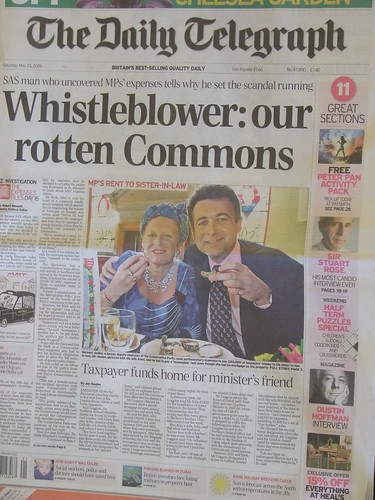
Treneman had stopped by a gathering of young journalists in Soho, fresh from watching the dramatic resignation of the Speaker of the House of Commons Michael Martin. The announcement was the result of increasing demands from a paniced parliament in the face of a steady drip-drip-drip of news about the ‘second home allowance’ expenses British MPs have claimed over the past four years. The revelations, being published in the Telegraph newspaper, are the result of a years-long effort by journalists to get access to the data under the newly-enacted Freedom of Information Act in the UK (sidenote – not called a “foya” here, but instead an “F.O.I.” – crazy Brits!). The parliament fought tooth and nail to resist releasing the list of expenses claims, a fight led by the Speaker of the House, who oversees the finances department that approves the expenses. But in the end the media won, the expenses are being published, and resignations could turn from the trickle seen thus far to an avalanche. Already it looks like Gordon Brown could lose a big chunk of his front-benchers, and the other parties seem equally culpable. Tory leader David Cameron called an emergency press conference early in the week to compel all members of his party to immediately write checks paying back the taxpayer for their expenses, or be immediately expelled from the party.

But no matter howThe Speaker of the House position in the British House of Commons is not akin to its American equivalent, a position currently occupied by Nancy Pelosi. The British speaker is in charge of the functioning of the house but not its policy, deciding when and for how long people can speak and running the everyday procedural minutia of the Houses of Parliament, in which he lives. It’s generally considered to be a neutral role above politics. But as the shocking revelations about expenses came pouring in, there was increasing pressure for parliament to do something, anything, to quell the growing tide of public anger. They chose to take the speaker’s head on a platter to the bleating mob. In reality, this is unlikely to satisfy them.

Through the allowance designed for work-related expenses for the MPs to maintain a second home in London (in addition to their house in their home constituency), it’s been revealed that MPs have claimed thousands of pounds for big-screen TVs, remodelling, vibrating chairs, Persian rugs and even “moat maintenance”. In the most egregious cases, several MPs have been shown to have made a profit off the taxpayer by expensing the mortgage on one home, then switching the “second home” status to their other house, selling the first home and making a tidy profit.

American Comparison

From my vantage point I can’t decide which I find more absurd, the ridiculous claims made by a minority (the British media seems to have lost this detail) of MPs, or the ridiculous system of remuneration this country has designed for its governing officials. The trouble really started back when the last Conservative government, unpopular and heading for a likely election defeat in the mid ‘90s, didn’t have the political courage to give MPs a necessary inflationary pay raise. So they instead invented a clandestine system of expenses for MPs to pay for their accommodation in London. MPs today make £64,766, not exactly poverty level but certainly not enough to maintain two homes. Compare this to the $174,000 (£120,000) made by their counterparts across the pond in Washington. And here’s where my inevitable American comparison begins.

I have to say I’ve learned about the second home allowance system here with a mixture of bemusement and incredulity. It’s a little confusing to me why all of the MPs need a London home at all. This is a (comparatively) tiny country, and most of its citizens live in the Southeast region around London. Certainly at least a third of the MPs live within a distance at which it is not unreasonable to expect them to commute in three or four days a week. Yet these MPs, even some of the ones who represent London, have actually been charging taxpayers for a second home!

In the US congressmen and women represent constituencies literally thousands of miles from Washington. In fact the nation’s capital doesn’t even have a voting member of congress (as it is a district and not part of any state), so unlike London there isn’t a single voting congressman who lives and works in the same city (compare that the UK – where 73 out of the 646 MPs represent London).

But despite the geographic distances that all 535 American congressmen and senators have to travel to be in Washington, guess how many of their Washington homes are covered by the US taxpayer? Zero. There is no such thing as a “second home allowance” in the US. Instead, US congressmen must pay for their DC residences out of their own pocket. If they want a nice second home in DC and they have the private financial resources to do it, they’re welcome to. But most opt for makeshift accommodation in DC which they rent, not own. In fact many congressmen live together in modest apartments. The most famous example is the four high-powered senators Chuck Schumer, William Delahunt, Richard Durbin, and George Miller that share a house together.

The only items US congressmen are able to expense from the taxpayer are costs for their offices, not their homes. This would include their constituency offices in their home state, the personnel to run them, and postal charges for official business. All of those expenses are available to public scrutiny.

Now granted, politics in the US is big business in a way that it is not in the UK. Quite a few members of the US Congress were millionaires before they entered office, as increasingly that is the kind of money required to get one elected in America. Rather than amassing their fortunes from the taxpayer, US politicians often amass them from corporations in the form of campaign contributions. And everyone knows that the time a US congressman really makes money is once he leaves office and takes a lucrative position at a lobbying firm, using his connections and the rule allowing all former congressmen access to the house and senate floors. But efforts to fix these issues are currently underway by the Obama administration, including a mandatory waiting period of several years before an exiting congressman can work for a lobbying firm.

Today a new system is being debated in the House of Commons that would reform the expenses system, but its hard to see how any reform can work without a pay increase for the MPs. With the toxic atmosphere toward parliament on the part of the public and the media at the moment, its hard to see how any such pay raise could be voted in. Yet as the Times’ Daniel Finkelstein pointed out yesterday, it is counter-intuitive that the public seems to be, “looking at the MPs we've got, deciding they are all inadequate and determining that therefore we should be paying them less.” As the saying goes, you get what you pay for.

Thursday, 6 March 2008

A new Europe strategy for Labour?

Well it’s official, the UK has ratified the Lisbon treaty. Brussels can breathe a big sigh of relief. It was a fiery scene in the commons yesterday as they debated the ratification. Tory leader David Cameron was doing his best to sufficiently rattle his saber to appease the tabloid press.

But Cameron’s predictable bravado was hardly the most interesting thing about the proceedings. Rather it was the behavior of the other two party leaders, Labour’s Gordon Brown and the Liberal Democrats’ Nick Clegg.

As The Times’ Peter Riddell pointed out in his column today, Gordon Brown seems to have finally “seen the light” when it comes to Europe. That, or he’s adopted a fundamental (and perhaps politically necessary) shift in strategy on how to deal with the European question. During the commons debate yesterday Brown was passionate and unequivocal in not only his defense of the treaty but in the wider benefit of membership in the EU. At a time when few politicians have had the courage to present the case for Europe to the British public, Brown seems to have suddenly shifted his tone. Having always been reticent to talk about Europe before, he suddenly was emphasizing the need for Britain to take a leading role in the union in order to achieve prosperity in security in a globalised world.

Thursday, 30 August 2007

London's statue status


Yesterday a statue of Nelson Mandela went up in Parliament Square, and it got me thinking. In a city with more statues than dentists, at what point do we start reevaluating the ones that are already here?

I mean logic would tell you that, on a practical level, if this city keeps putting up statues at the rate it has been they’ll be no room left in the public parks for anyone to walk around. But on a more sentimental level, one has to note that the kinds of people we’re chiseling into stone today are quite different from the people we immortalized a century ago.

Take the new Mandela statue for instance. When I went to visit it last night I saw that it faces a statue of Jan Smuts, who was the South African prime minister at the inception of white rule. Winston Churchill, perhaps the most well-known statue in the square today, helped to draw up the du-jour segregation plan at the outset of South Africa’s independence.