Showing posts with label Hillary Clinton. Show all posts

Thursday, 4 May 2017

Le Pen and Trump: politics-as-entertainment

The French presidential debate echoed last year's US debates. Like Trump, LePen laughed while she bullied and mocked her opponent. We are living in an age of clowns.

Last night marked the one and only debate between the two candidates who will participate in Sunday's final round of French presidential elections, far-right nationalist Marine Le Pen and centrist internationalist Emmanuel Macron. For me, it had eery similarities to last year's Trump-Clinton debates in the United States.

Donald Trump had a way of getting under his opponents' skin. He would mock them, call them names, and laugh in their face. Marco Rubio was "Little Marco". Ted Cruz was "Lyin' Ted". Hillary Clinton was "Crooked Hillary". He dragged the Republican presidential primary into the mud, as his opponents desperately tried to counter his popularity by sinking to his level. Trump even goaded Rubio, a US Senator, into challenging his penis size.

Sunday, 4 September 2016

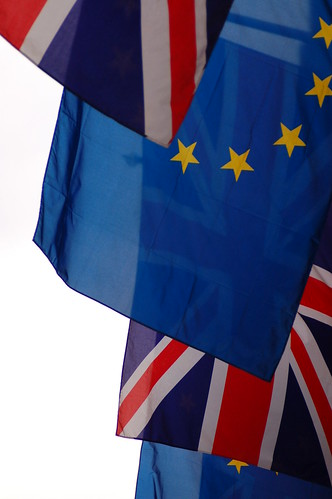
"The UK is over?" - America's view of Brexit

The UK's vote to secede form the EU is still an object of fascination in the US, where views range from pity to bemusement.

Last week, standing at a bar in Savannah, Georgia and drinking a 40-ounce of Miller Light, I found myself engaged in a most unlikely conversation.

I had just been introduced to the roommate of an old friend. He was telling the story of a recent unsuccessful date, aborted because of a lack of intellectual heft. "I mean, he didn't even know what Brexit was," he said incredulously.

I had to check my surroundings to remind myself of where I was. I've been working as a journalist covering EU politics in Europe for a decade now, and it's been rare indeed that I've encountered much interest in the topics I cover during my twice-yearly visits home.

Wednesday, 21 October 2009

US Alarmed by Cameron’s Europe Moves

It looks like worries about a future Tory government aren’t limited to Paris and Berlin. Reports are circulating today that US Secretary of State Hillary Clinton expressed concern last week during her visit to Europe over David Cameron’s increasingly combative stance toward the EU, saying the US is worried that the “direction of travel” from what will most likely be the next governing party of the UK could lead to a rupture between Britain and the rest of Europe.

Her concern is not in isolation. The Obama administration has been increasingly questioning the wisdom of Tory leader David Cameron’s recent hostile moves toward Europe, including his decision to take the Tories out of the main centre-right grouping in the European Parliament to form a new alliance with hard-right Eastern European parties and his antagonism toward the Lisbon Treaty. The Times reports today that the US Ambassador to Britain has also been voicing alarm over Cameron’s Europe plans, and that Jewish groups within the Democratic Party are expressing alarm over Cameron’s new ties to anti-Semitic politicians in Poland.

The concerns are further evidence that the Obama administration considers the so-called “special relationship” (a term I’ve never heard used in the US, though it is used almost obsessively in the UK) to be obsolete, and would prefer a united Europe to deal with in foreign policy. This is a sea change from the previous US administration, which notoriously used the idea of the “special relationship” to drive a wedge between the UK and Europe in the run-up to the Iraq war. As The Times notes,

“[Obama] believes that Britain should be at the heart of Europe — a position that has been put in doubt by French and German anger over Mr Cameron’s decision to sever ties with the federalist centre right grouping in the Strasbourg Parliament. Mr Obama is enthusiastic about the idea of a permanent EU president to replace the revolving chairmanship of the EU council, a measure opposed by the Conservatives.”
Wheras the Bush administration was hostile toward the EU and seemed to repeatedly seek to undermine it, the Obama administration has so far been an enthusiastic supporter, as demonstrated by Hillary Clinton’s speech in Brussels earlier this year. In fact I think I could without hyperbole call Obama a European federalist. He wants a strong, united Europe as a partner in combating terrorism, dealing with the financial crisis and providing a counterweight to China.

The administration’s reported comments seem to suggest that Obama has little patience for European leaders who cow-tow to old instincts of nationalism and divisiveness. And he has also demonstrated impatience with some of the more archaic, slow-moving aspects of the EU, and is likely eager for the streamlined reforms the Lisbon Treaty will bring about. Of course this is just speculation, but it’s what his administration’s statements and behaviour seem to suggest.

Friday, 6 March 2009

The EU Comes Clinton-Approved

This afternoon's town hall meeting with Hillary Clinton at the European Parliament was quite interesting to watch. I think it's safe to say that no visiting diplomat from the US has delivered such high-profile, specific, and glowing praise of the EU institutions and the integration project. It was as if Clinton was giving the EU her "seal of approval," something which could prove to be important in Ireland, where Clinton remains popular because of the Clinton administration's Northern Ireland work.

Secretary Clinton opened with glowing praise of the EU project, calling it a "miracle" which could replicate the success of the United States by creating a whole much greater than the sum of its parts. She went on to reaffirm and underline that the Obama administration intends to improve the United State's relationship with Europe, and she acknowledged the damage that has been done by the last eight years. Indeed I was struck by the sometimes decidedly undiplomatic language used by both herself and European Parliament President Hans-Gert Pottering to describe the previous administration.

But more than anything I was struck by the fact that the audience seemed to be hanging on her every word. There was definitely a sense that having this "seal of approval" for the EU institutions from someone with Clinton's celebrity status was hugely important. Pottering was certainly not exaggerating at the end of the town hall when he said the questions could have continued for hours.

EuroParlTV has the video from the town hall, and Adriano from CafeBabel was liveblogging the speech as well. I would recommend taking a look at it, whether you're European or American. It was a really interesting discussion.

Thursday, 5 March 2009

Hillary Fever: Catch It!

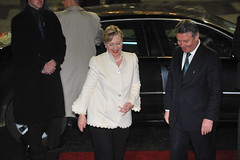
Hillary Clinton has touched down in Brussels, and already the city seems to be abuzz with excitement. I think I have a pretty good idea of where she's staying thanks to some pretty heavy security I noticed earlier tonight, but apparently journalists aren't supposed to talk about where she is, so I won't mention it! I was at a conference earlier today and all of the journalists were asking the same thing: Are you going to the big Hillary public debate at the European Parliament on Friday? I'm not, but I was speaking with a few people tonight who are and they're pretty excited. The debate is going to take place with European Parliament President Hans-Gert Poettering and apparently quite a motley crew has been invited to attend, including several young bloggers. It's a shame yours truly wasn't invited! But I did already get a chance to interview her back when I was working as a radio reporter in Washington.

Of course I wasn't here in Brussels for any previous US secretary of state visits but I doubt they generated the kind of buzz the Clinton visit is. It's all the rather strange byproduct of having a celebrity US Secretary of State, and it will be interesting to see how that dynamic affects US foreign policy. But it's safe to say few visitors to Brussels generate this level of buzz, and probably the only person who could match it would be President Obama himself.

So what's all the fuss about? Well this is Mrs. Clinton's first trip to Europe as Secretary of State, and it's a chance to lay down the ground rules for the Obama Administration's relationship with the EU. There was much speculation about who would be the first European leader to meet with President Obama, but that was fairly quickly answered. And really, was there ever any real doubt that it would be Gordon Brown? But as Brown meets with Obama in Washington, it's significant that Secretary Clinton's first visit to Europe in her new role is to Brussels to meet with EU institutions. It shows she intends to take the EU seriously as voice in foreign policy, something Condoleezza Rice and Colin Powell never seemed to be too enthusiastic about.

The debate on Friday is going to be broadcast on the European Parliament's new video portal web site EuroParlTV, and the gossip going around today was that the whole debate is just a marketing ploy to get people to visit the new site. I have no idea if that's the case, but it seems to me fairly unlikely Hillary's handlers would donate her limited time to a promotional gimick. Then again if that was the intent it seems to have done it's job; everyone today was talking about this debate.

Of course the debate won't be on the forefront of the new secretary's mind. Top on the agenda for Clinton's meetings over the next two days are relations with Russia, European cooperation in Afghanistan and the US missile shield program in Eastern Europe. Tonight Clinton held "transatlantic dinner" with European leaders, and tomorrow she will attend a Nato ministerial meeting. It is expected that at this meeting Clinton will make a formal request for greater European participation in the Nato mission in Afghanistan. It will be interesting to see what sort of official response this receives. Increasing troop presence in Afghanistan is going to be a hard sell for the European public.

On Friday, Mrs. Clinton will meet with European Commission President Jose Manuel Borroso before taking place in the public debate at the European Parliament, and following that she will go to Geneva to meet with her Russian counterpart Sergei Lavrov. Many in Europe are eager to see an easing in the Russia-US tensions that have built up over the past eight years, and this meeting in Geneva should give a pretty good first indication of whether that's a realistic expectation.

Friday, 23 May 2008

The end of New Labour?

As much as the London mayoral election was heralded as a sign of impending doom for Gordon Brown, yesterday’s UK by-election (an election between major polls in a small area) result in Crewe will certainly now overshadow it. The crushing defeat of Labour saw a massive 17.6 percent swing away from Labour toward the Tories, much more than had been predicted by any pollster I know of. It’s safe to say the Tories expected to win, but they probably never dreamed they would win by this much.

This morning the Conservatives are basking in their triumph with some aggressive and confident talk from Tory leader David Cameron, who is heralding this victory as “the end of New Labour.” If a 17.6 percent swing were to be replicated in the next general election, it would be enough to hand over the government to the Tories.

Cameron may be indulging in a bit of overconfidence. After all, this election was more about working class voters punishing Brown for his recent abolition of the 10 percent tax rate than it was about their wholehearted embrace of the Tories. The district of Crewe and Nantwich has been solid Labour territory for decades, and while they may have wanted to send a message of dissatisfaction with Gordon Brown in this by-election, that doesn’t necessarily mean such working class voters would want to hand the government over to the Tories in a general election. The message to Labour from the working class may just be “don’t take us for granted.”

Wednesday, 16 April 2008

Obama and elitism: a view from the UK

As the whole ‘bitter’ flap continues to engulf the US presidential election, I thought it might be interesting to provide some insight into what the controversy looks like from across the Atlantic.

To review, last weekend Barack Obama answered a questioner at a “closed-door private fundraiser in San Francisco” (a detail both Clinton and McCain have managed to describe in the past week as if it were akin to a puppy-killing festival) who asked him why he’s had a hard time winning over white blue collar Democrats. Speaking off the cuff, he said:

“You go into some of these small towns in Pennsylvania, and like a lot of small towns in the Midwest, the jobs have been gone now for 25 years and nothing's replaced them. And they fell through the Clinton administration, and the Bush administration, and each successive administration has said that somehow these communities are gonna regenerate, and they have not. So it's not surprising then that they get bitter, they cling to guns, or religion, or antipathy to people who aren't like them, or anti-immigrant sentiment, or anti-trade sentiment as a way to explain their frustrations."

Thursday, 24 January 2008

Janet Daley on the UK's obsession with the US election

This was a very funny piece on NPR's On the Media this week. The Daily Telegraph's Janet Daley gives her take on why the UK has been obsessed with this presidential election. You can listen to it here:


But there's three important things I think Daley didn't mention:

1) The UK isn't alone in its fascination with this election cycle, this has been a world-wide phenomenon and especially true in Europe.

2) The UK's foreign policy is inextricably linked to that of the US, insofar as the UK has to do whatever the US tells it to. So Brits have a huge stake in this election.

3) The US election result in 2004 was a complete shock in the UK. For whatever reason, all of the media coverage here in the runup to the vote was saying that Bush was finished. I remember all my British friends talking at the time as if it was a sure thing Bush would be voted out, when the reality was it was anything but certain. So this time around, the Brits are making an effort to pay closer attention so they don't have the rug pulled out from under them again.

I wonder if the inordinate amount of US election coverage here will make some Brits think about how unfortunate it is that the outcome of an election in which they are not allowed to participate will have a huge effect on their lives. Or, perhaps it will result in a hunger for a new kind of politics in Westminster, as Daley seems to be suggesting here.

Friday, 11 January 2008

Obama's loss: the view from Europe

Given that I wrote about Europe's reaction to Obama's win in Iowa last week, I thought it logical to now write about its reaction to his loss this week. Just from personal observation, I've been surprised at the huge level of relief being expressed by most people I know here in the UK. It seems that though they were impressed with and surprised by Barack's win, they are still rooting for Hillary to win the Democratic nomination. In fact I don't know a single European who actively wants Obama to win.

Part of this of course is that they know Hillary, they adored Bill Clinton and are eager to see a return to the Clinton years. They know almost nothing about Obama, and being removed from the domestic situation in the US they can't quite understand the enthusiasm for a man who has outlined little of his actual platform or policy plans.

Tuesday, 8 January 2008

Obamania: the view from Europe

It’s been interesting to watch the European coverage of Barack Obama’s mammoth victory in Iowa over the past few days. Beyond the fact that it is such big news here, what has been notable is what the European press is emphasizing in their coverage.

Had the Iowa caucus passed without any extraordinary result, say with a Hillary and Mitt win, it still would have been a major focus here. After all, US presidential elections are followed worldwide with great attention, and this is particularly true in Europe. With the US being the world’s lone superpower, it’s just a bizarre quirk of history that the decisions made by a few thousand people in Iowa every four years have a dramatic effect on the entire globe. Yet the European coverage of the primary season has switched into hyperactive gear this year not only because the continent is so eager for new leadership in the US, but also because of the surprise ascendancy of two previous unknowns in the first contest.

Of course, the fact that Huckabee and Obama won the Iowa caucuses wasn’t a huge surprise to many living in the US, as this result was largely expected weeks before the vote (though the margin of the victories was a surprise). But here in the UK, for instance, nobody knew who Huckabee was until Thursday and only the most current events-savvy Brits knew much about Obama. In fact the presumption here has been that Hillary Clinton was guaranteed to be the next US president.

Friday, 4 January 2008

Iowa: what it all means

For everyone in London who is asking me - yes, I was as surprised by the Iowa primary result as you all were! For the past several days I’ve heard speculation that Hillary was going to come in third in the first US primary in Iowa but I didn’t believe it. After all, Hillary has been the natural front-runner for the entire contest up to this point, and the recent assassination of Benazir Bhutto was only supposed to shore up her inevitability as she portrayed herself as the candidate of strength and experience.

But the result I woke up to this morning is truly shocking, and has to have sent the Clinton camp into a tail spin. But it isn’t there mere fact that she placed third that has to have them in a panic, it’s the sheer magnitude of the way she was beaten. In fact when you look at the exit polling, the numbers are truly astonishing.