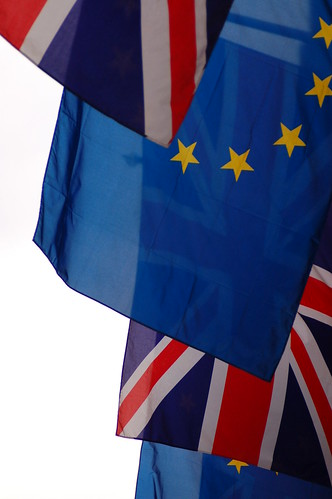
Showing posts with label Special Relationship. Show all posts

Saturday, 23 April 2016

Obama bursts Britain’s post-imperial hubris

The crux of the Brexiters' argument is an anglosphere alliance. Yesterday the US president told them it’s not going to happen.

That sound you heard yesterday across the United Kingdom was the collective wince of a nation finally made to accept an uncomfortable truth – he’s just not that into you.

Americans are largely unaware of what’s happening with the Brexit debate, but whether they know it or not they are central to the case for the UK seceding from the European Union. They are also largely unaware that they are in a “special relationship” with the UK, a term which, as I’ve written before, is obsessed over in the UK but unknown in the US.

For years US politicians have indulged the British in their fantasies of a two-way relationship between equal partners. But in light of the severe risk a Brexit presents, Barack Obama had no choice but to fly to the UK and finally break the bad news to the Brits.

Wednesday, 25 May 2011

He likes us, he really likes us!

Barack Obama has just concluded an unprecedented address to both houses of the British Parliament in Westminster Hall, and the British press is already elated. He's the first US president to ever give a speech in this ancient coronation spot of kings and queens. From the adulation being heaped upon him by the British press, one might think Obama had a coronation of his own. But the reaction shows just how much the British, and Europe in general, needed to hear those three magic words from the US president- 'I like you'. After a series of snubs, Europe was beginning to doubt his affection.

Today's speech was the key communication of Obama's six-day, four-nation European fence-mending (and domestic politicking) tour. The centerpiece is tomorrow's G8 meeting in Deauville, France. But today's visit to the UK was all about reassuring the Brits that they still enjoy a 'relationship' with America - though the exact nature of that relationship seems to be being redefined.

The British press and political class spends an inordinate amount of time fretting about whether their country still has a "special relationship" with the United States. In the US, this term is virtually unheard of (which should answer their question). Earlier this year the British media was sent into a tizzy when Obama said during a state visit by French president Nicolas Sarkozy, “We don’t have a stronger friend and stronger ally than Nicolas Sarkozy and the French people.”

Monday, 17 January 2011

Britain hurt over Obama's warm words to France

A compliment from President Barack Obama used for his French counterpart Nicolas Sarkozy during a state visit in Washington last week has raised more than a few eyebrows in the UK.

Speaking after his meeting with Sarkozy, Obama told assembled journalists that, “We don’t have a stronger friend and stronger ally than Nicolas Sarkozy and the French people.” Almost immediately the British press went ballistic. After all, the UK is supposed to be America's number one ally in the world through their so-called "special relationship" (a term used ad nauseum in Britain, but one I've never once heard in the US). The Daily Mirror wrote, "It shatters the idea that Britain still has a special relationship with the US." The Daily Mail wrote that the words are "evidence that Mr Obama does not cherish the special relationship." An editorial in The Telegraph wrote that the statement, "represents an extraordinary sea change in US foreign policy," adding that "such a remark is not only factually wrong but also insulting to Britain, not least coming just a few years after the French famously knifed Washington in the back over the war in Iraq."

By contrast, in France the statement barely registered with the media. The only thing the French media reported about the comments was that Obama called France an "exceptional partner". Any gloating about France supposedly overtaking its long-time rival as America's best friend was absent from the French press.

Wednesday, 21 October 2009

US Alarmed by Cameron’s Europe Moves

It looks like worries about a future Tory government aren’t limited to Paris and Berlin. Reports are circulating today that US Secretary of State Hillary Clinton expressed concern last week during her visit to Europe over David Cameron’s increasingly combative stance toward the EU, saying the US is worried that the “direction of travel” from what will most likely be the next governing party of the UK could lead to a rupture between Britain and the rest of Europe.

Her concern is not in isolation. The Obama administration has been increasingly questioning the wisdom of Tory leader David Cameron’s recent hostile moves toward Europe, including his decision to take the Tories out of the main centre-right grouping in the European Parliament to form a new alliance with hard-right Eastern European parties and his antagonism toward the Lisbon Treaty. The Times reports today that the US Ambassador to Britain has also been voicing alarm over Cameron’s Europe plans, and that Jewish groups within the Democratic Party are expressing alarm over Cameron’s new ties to anti-Semitic politicians in Poland.

The concerns are further evidence that the Obama administration considers the so-called “special relationship” (a term I’ve never heard used in the US, though it is used almost obsessively in the UK) to be obsolete, and would prefer a united Europe to deal with in foreign policy. This is a sea change from the previous US administration, which notoriously used the idea of the “special relationship” to drive a wedge between the UK and Europe in the run-up to the Iraq war. As The Times notes,

“[Obama] believes that Britain should be at the heart of Europe — a position that has been put in doubt by French and German anger over Mr Cameron’s decision to sever ties with the federalist centre right grouping in the Strasbourg Parliament. Mr Obama is enthusiastic about the idea of a permanent EU president to replace the revolving chairmanship of the EU council, a measure opposed by the Conservatives.”
Wheras the Bush administration was hostile toward the EU and seemed to repeatedly seek to undermine it, the Obama administration has so far been an enthusiastic supporter, as demonstrated by Hillary Clinton’s speech in Brussels earlier this year. In fact I think I could without hyperbole call Obama a European federalist. He wants a strong, united Europe as a partner in combating terrorism, dealing with the financial crisis and providing a counterweight to China.

The administration’s reported comments seem to suggest that Obama has little patience for European leaders who cow-tow to old instincts of nationalism and divisiveness. And he has also demonstrated impatience with some of the more archaic, slow-moving aspects of the EU, and is likely eager for the streamlined reforms the Lisbon Treaty will bring about. Of course this is just speculation, but it’s what his administration’s statements and behaviour seem to suggest.