Judging by the public discourse, you might think Tony Blair was a dictator who railroaded the UK into war in 2003. But he was just one part of a foreign policy orientation incapable of saying no to the United States. Today the long-awaited results of the Chilcot Enquiry into the UK's involvement in the 2003 Iraq War, the consequences of which the world is still living with, were finally published. Like the 9/11 Commission's report in the United States in 2004, it contains little in the way of bombshell revelations. Instead it paints an overall damning picture of the leadership of Tony Blair, the centre-left politician who was prime minister at the time. It gives ammunition to those who want to see Blair prosecuted. Perhaps the most memorable line of the report's executive summary is this:
"I will be with you, whatever."
These words were in a 2002 private memo between Blair and US President George W Bush. The line seems to vindicate a long-held perception in the UK that Blair was Bush's poodle. Indeed, the memo suggests that even a year before the war's launch, Blair had decided to go along with whatever the American president proposed. The entirety of the media coverage of the report today has centred on Blair. But as I've written before, I find the UK's myopic focus on Blair in the aftermath of the Iraq disaster to be counter-productive. Why personalise it so? Was it really Blair who was Bush's poodle? Or was it the UK that was America's poodle?
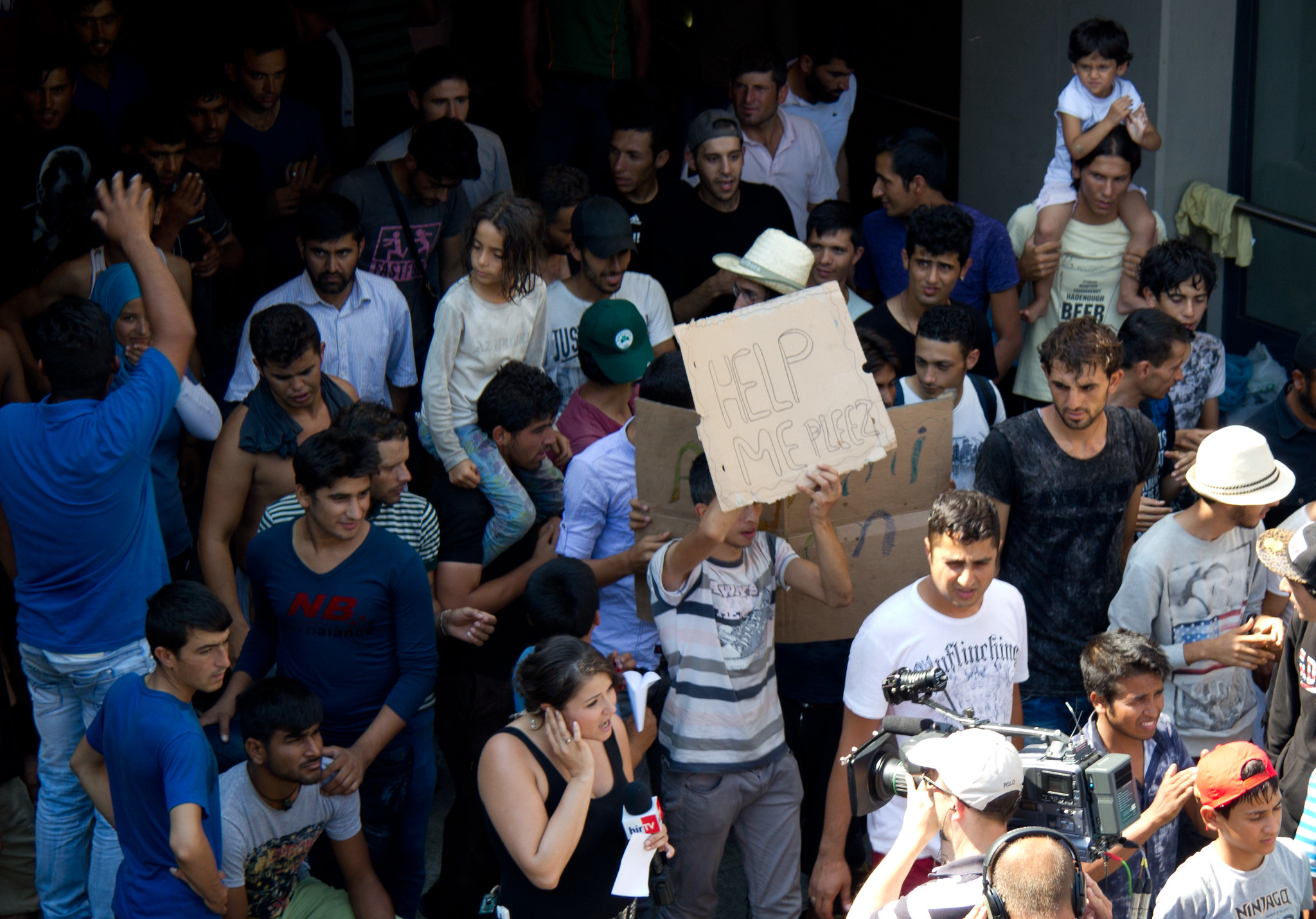
Hungary, Poland, Spain and the UK were willing to invade Iraq in 2003, but they are unwilling to deal with the refugee crisis which that invasion has spawned 12 years later. Germany and France are the countries shouldering the responsibility. Today I bought a ticket for the overnight train from Berlin to Budapest, to interview people next week for a radio story I'm working on about the disappearance of Europe's cross-border rail routes. As I was making the booking at the DB ticket office, the woman gave me a look of concern. "That train is going from Hungary to Germany," she said. "Be careful." Despite watching the news reports about what is happening at Budapest Keleti Station the past few days, it did not occur to me until that moment that I am going to be on one of these international trains next week. This international train travel piece could end up being very different from what I had planned. The images of Middle East refugees trampling each other trying to get onto trains to Western Europe in Budapest broadcast today were truly horrific. I'm still a bit unclear about whether these are regularly scheduled trains or specific migrant trains, and whether or not my Budapest-Berlin train will be affected at all. But it's hard to imagine it won't be.
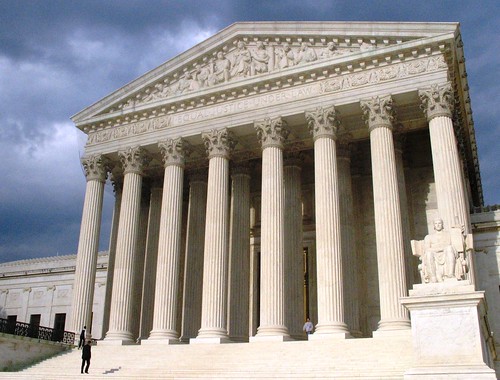
Europe could be forgiven for thinking that now that Americans have put their government entirely in the hands of Democrats, the nation itself has made some sort of fundamental ideological shift. But as the opening stages of President Obama’s Supreme Court nomination show, the American political spectrum is still firmly grounded to the right.
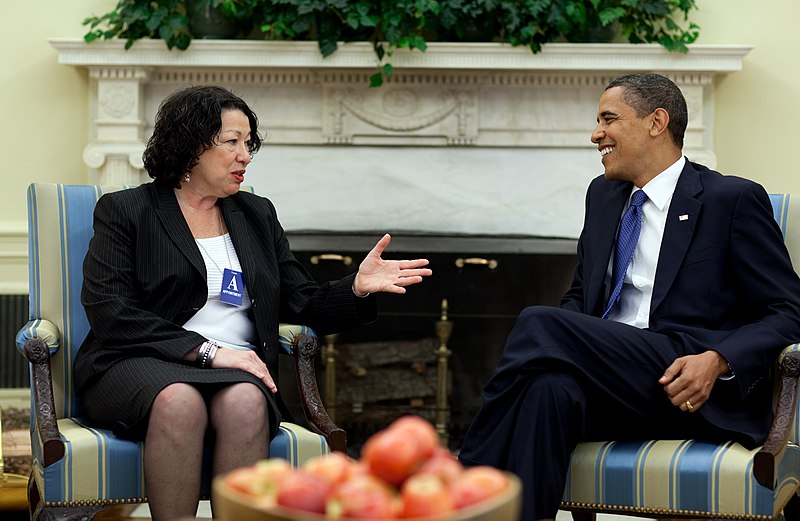
Following the retirement of Justice David Souter, generally considered to be on the left side of moderate in his votes on the court, Obama has nominated Sonia Sotomayor, a moderate appellate court judge who would be entering the highest court in the land with more experience on the bench than any of the current justices. The media has focused largely on Sotomayor’s personal history, having been born to Puerto-Rican parents on a housing estate in the Bronx. She would be the first Hispanic person to serve on the court, and only the third woman.
Bizarely the right has latched on to this detail of her background to make the case that she is a “liberal activist judge,” even though her judicial record, largely moderate or unclear, doesn’t seem to reflect this. Apparently for the right, the fact that she is a Hispanic woman who was born poor means she'll make it illegal to be a white man and redistribute wealth. Obviously!
Funny enough, when arch-conservative justice Clarence Thomas was up for confirmation, his history of having been born a poor black man was considered an asset by the right.
Perhaps this kind of talk from the hard right was inevitable. In fact it wouldn’t even be worth talking about were it not for one other interesting development – in selling their supreme court nominee, the Obama Administration’s talking points have been actively stressing Sotomayor’s conservative credentials.
The Obama administration has wove a conservative narrative around Sotomayor, using much of the same language as Bush did to sell his supreme court nominees, in order to appeal to middle America. The administration has been at pains to point out how moderate she is, pointing out at every opportunity that she voted with conservative judges 95% of the time. They’ve also pointed out her anti-abortion rulings, such as when she upheld a ban on federal funds going to family planning groups that provided abortions overseas, or when she ruled in favour of a group of Connecticut anti-abortion protesters who asserted that police used excessive force against them at a demonstration.
Does anyone else find this a little bizarre? Barack Obama was elected in a landslide victory. The American public kicked the Republicans out of both the House and the Senate, handing the entire government over to the Democrats. Currently only 21% of Americans identify as Republicans. You would think that was a pretty big mandate for change right? So why does the Obama administration (and Congressional Democrats, as evidenced by their recent cave on closing Guantanamo Bay) seem to be bending over backwards to please a practically non-existent Republican party?
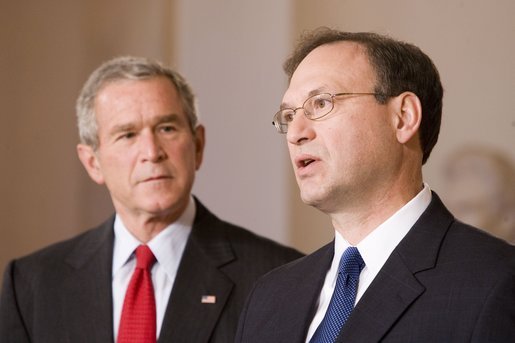
Can you imagine George W. Bush, when he nominated his two Supreme Court Justices, issuing talking points about how frequently they voted with their liberal colleagues, or highlighting cases in which they voted for abortion rights? The very idea is laughable. When the Bush administration went to sell their nominees they used the language of their base, talking about how Alito and Roberts represented “solid American values” and touting the conservative credentials, especially when working to sell the nominees to the religious right (at some points they even seemed to be implicitly promising that the two would vote to overturn Roe v. Wade).
And yet George W. Bush entered office having lost the popular vote, put into office by a Supreme Court ruling. By the time he was nominating his justices he was already spiralling down to the lowest approval rating of any US president in history. But was there serious talk of him selecting a moderate justice as a copromise with liberals? None.
And even though W appointed two unabashedly conservative justices (to join the other two ultra-conservative justices Scalia and Thomas already on the court), it seemed to go without saying before Obama made his selection that an unabashedly liberal justice wouldn’t even be a consideration. Given that following Bush’s appointments the court is now skewed fundamentally to the right (4 conservatives, 2 liberals and 2 moderates without Souter), adding another moderate to the mix isn’t going to significantly change the conservative direction of the court. If it’s unquestioned that a Republican president can appoint a conservative justice but a Democratic president can only appoint a moderate, it won’t be long before the idea of a “liberal justice” goes the way of the dodo. Rachel Maddow had a funny metaphor discussing this on her show Tuesday night.
This isn’t an isolated incident. Throughout the Obama presidency it’s been incredible to watch how many times the Democratic president and congress have caved in to an imaginary opposition. But here’s the explanation – while the political opposition may be imaginary – the popular opposition is not.
On a global political spectrum, the US political spectrum is still positioned firmly to the right. For instance in Europe, the Democrats would be centre-right and Republicans would be the hard right (and sometimes even the far right). This pretty much reflects the political ideology of Americans, a formula which has long favoured Republicans in US elections. This is, after all, a country where “liberal” and “Left” are still dirty words that most Democrats are loathe to identify themselves as. Even after Bill Clinton’s New Democrats shifted the party to the right (followed by Tony Blair doing the same with Labour across the pond) the Democrats seem to constantly be on the defensive, unable to stand up for progressive policies even when they occupy the presidency. Now that the Democrats control both the legislative and executive branches for the first time since the Carter administration, it seems their old curse is again rearing its ugly head. Even when they’re in power, Democrats are unable to push progressive policies on a fundamentally conservative population.
So Europeans shouldn’t fool themselves into thinking that the American political spectrum is inching back their way. For 40 years the only thing that’s gotten Democrats elected into the White House is the ineptitude and corruption of their predecessors (two Bushes and a Nixon), and once they've put him there there’s been little achieved for the Left.
Strangely, even when the American left is in power, they remain isolated, ineffective and ignored.
With the amount of worldwide press coverage that the US election has been getting, it’s easy to forget that there are still eight months left in George W. Bush’s presidency. Amid all of the excitement over Clinton, Obama and McCain, the unpleasant reality is that over the next 2/3 of a year the world is going to be living with the most handicapped lame duck US presidency in living memory. It’s something that the global community, and Europe in particular, should be feeling more than a little anxious about.
‘Lame duck’ periods are of course a repeating phenomenon in the United States, happening every time a president approaches the end of their term (if they are not running for reelection). During this period media attention shifts away from the current president and the administration is unable to propose any new initiatives. Diplomats are able to speak with less authority because they may be replaced in a matter of months, and the White House may not bother filling vacancies and instead wait for the new administration to make appointments. Because people know that everything is about to change in a matter of months, very little gets done during this period. It’s an impractical system, but it’s something that the US has come to live with.
However this year is different. Normally these periods last a few months, not the year and a half that has happened this cycle. And the widespread scorn for this outgoing administration is at unprecedented levels. Never in the past century has the US seen a presidency so delegitimized with so many months left in it. Bush’s disapproval rating, at 70 percent, is now higher than for any president in US history. It is even higher than Richard Nixon’s post-Watergate numbers immediately before his resignation (66 percent).
It’s been interesting to watch the European coverage of Barack Obama’s mammoth victory in Iowa over the past few days. Beyond the fact that it is such big news here, what has been notable is what the European press is emphasizing in their coverage.
Had the Iowa caucus passed without any extraordinary result, say with a Hillary and Mitt win, it still would have been a major focus here. After all, US presidential elections are followed worldwide with great attention, and this is particularly true in Europe. With the US being the world’s lone superpower, it’s just a bizarre quirk of history that the decisions made by a few thousand people in Iowa every four years have a dramatic effect on the entire globe. Yet the European coverage of the primary season has switched into hyperactive gear this year not only because the continent is so eager for new leadership in the US, but also because of the surprise ascendancy of two previous unknowns in the first contest.
Of course, the fact that Huckabee and Obama won the Iowa caucuses wasn’t a huge surprise to many living in the US, as this result was largely expected weeks before the vote (though the margin of the victories was a surprise). But here in the UK, for instance, nobody knew who Huckabee was until Thursday and only the most current events-savvy Brits knew much about Obama. In fact the presumption here has been that Hillary Clinton was guaranteed to be the next US president.
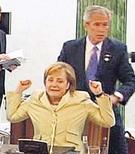
Well as the world waits anxiously to see if the Lebanon crisis will lead to World War III, our president is busy feeling up the German chancellor.
This has got to be the funniest thing I’ve seen in awhile. Meeting with leaders of the eight industrialized nations at the G8 summit in St. Petersburg, Bush strides into the room, make a bee-line for German Chancellor Angela Merkel and proceeds to massage her neck!
Watch the video, it’s hysterical. Merkel looks so creeped out, she at first recoils and makes this uncomfortable face, then she throws her hands back and pushes him off.
There's an interesting article in today’s Financial Times about the emerging European assertiveness toward the US. It is clear that the wounds of the Iraq war are not going to heal any time soon, and a change in Washington’s tone toward Brussels isn’t going to bring Old Europe back into the “lapdog camp.”
Nowhere was this more evident than in today’s fiesty exchange between Bush and European reporters during Bush's visit to Vienna to meet with EU leaders. Although he opened his statements with an emphasis on how far he had come from the days in which his administration had shown disdain for Europe and its diplomacy, pointed questions from reporters soon drove him into a defensive posture, the following being two of the more nasty retorts:
Some interesting language used in today’s simultaneous speeches/press conferences by George W. and Tony Blair.
The US Media seems to have picked up mainly on the answer W gave to a reporter about how long troops will be in Iraq, saying, “"That, of course, is an objective. And that will be decided by future presidents and future governments of Iraq." This of course, led to today’s headlines of, “Bush: Troops to stay in Iraq through '08” in the US media. I’m pretty sure this headline will shock a lot of people across the country.
Bush’s statement, of course, is a fairly obvious conclusion. There’s no reason to presume troops will have left by 2008. In fact it’s hard to see how the US could possibly withdraw before then without leaving the country in ruin and chaos.