Showing posts with label treaty. Show all posts

Thursday, 4 December 2008

Ireland's Road Trip

As Britney Spears makes her whirlwind tour of Europe (she hit the British, French and German versions of American Idol in quick underwhelming sucession last week), she isn't the only one criss-crossing the continent in the hope of redemption. This week Irish prime minister Brian Cowen is coming hat in hand to the European capitals delivering his proposed solution to the Lisbon standoff. By most indications, it looks like Ireland is going to have another referendum before June.

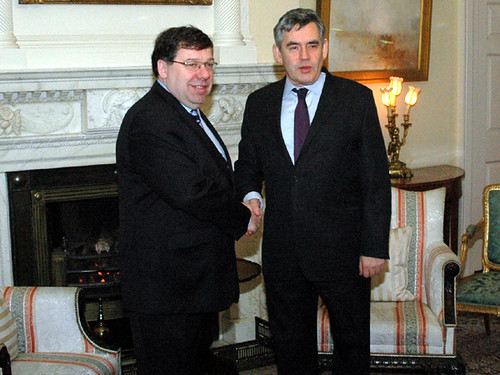
So far Cowen has been in Luxembourg and Germany. Today he's in London with Brown and tomorrow he'll be in Paris with Sarkozy.. At the same time, his Europe minister is visiting the small countries to tell them of Ireland's plans. The two of them are coordinating with the leaders for next week's proposal to the European Councilon what to do about the situation. According to reports, that solution is going to be another vote. But what they have to come up with is a way to say that this is not the exact same vote done over, but rather a different vote that will be palatable to the Irish people.

Surveys have been done over the past few months that have indicated that if the Irish government were to get specific guarantees for key areas - namey abortion, neutrality - the referendum would pass. Of course there was nothing affecting these two areas in the treaty anyway, but it is thought that if the Irish were to have the issues spelled out in disclaimaers. This will surely not be enough for the dedicated no campaigners - since their beef is with the EU itself, but it may be enbough to convince some of the fence sitters.

The revote would be a big gamble, particularly for Cowen whose government hangs by virtually a thread at home. But it is thought now that the economic turmoil has set in, it is thought voters will be more receptive to argument sthat Ireland shouldn't cut off its ties to the safety net of the European Union. The Irish may have been feeling a bit overconfident about their economy during the last vote, no doubt their optimism about whether Ireland needs the EU has changed over the past few months.

So as much as the first referendum was watched, the second one will be even more so. If Ireland votes no again, there are only two options: Scrap the treaty and allow the EU to operate in disfunction, or or go ahead with the treaty and kick Ireland out of the union. Considering that the current economic crisis means that the EU's institutions must function properly as soon as possible, the second option is perhaps the more likely. And I think that this time around, in these uncertaint times, EU leaders won't be above using this as a threat before the vote.

Wednesday, 31 October 2007

The referendum reality

Is Labour calling Cameron's bluff?

Mark Mardell had an excellent post on his BBC Euroblog yesterday on the trouble with all these calls for a referendum on the reform treaty in the UK. Cameron is now being pressed by Labour to promise that if he were prime minister he would call a referendum on the treaty, even if it had been voted through by the House of Commons. Of course Cameron can’t make any such promise because he knows it was idiotic for Labour to promise a referendum on the constitution in the first place because that’s what’s giving them trouble now. Given that he’s making political hay about calling this a “trust” issue, he would be incredibly short-sighted to set himself up for the same trap.

Because you see he can’t put the vote to a referendum either, because no matter which way it turns out it would hurt him as a new prime minister. The assumption is that were the treaty voted on in the UK the result would be ‘no,’ not on the actual merits of the treaty but because the British public is widely sceptical of EU expansion. But if the referendum were to result in a yes, it would look like a political defeat for Cameron right at the start of his leadership (assuming the Conservatives push for a no vote).

Wednesday, 17 October 2007

Lisbon Looming

There's just one day until Brown goes off to Lisbon to endorse (or maybe not endorse) the Lisbon Treaty, and news reports like these should be making some people in Brussels awfully nervous.

Now that the disastrous election fiasco has delivered a firm punch in the jaw to Brown, the Conservatives are eager to continue the momentum and renew demands that he put the treaty endorsement to a referendum. The British tabloid press has also got in on the act.


On its Web site, the British tabloid The Sun has superimposed Brown's face onto a picture of Winston Churchill, turning around Churchill’s tribute to British airmen in World War II, "Never in the field of human conflict was so much owed by so many to so few,” into a jibe at Brown, saying, "Never have so few decided so much for so many." The graphic was accompanied by an online poll.

Tuesday, 25 September 2007

UK election next month?

It’s party conference season here in the UK. If you took the word ‘conference’ out of that phrase it would sound a lot more fun. But from what I heard from my friend Francis about the Lib Dem conference down in Brighton, these things are actually a raucous good time.

Party conference season refers to the three weeks in the fall when the three main political parties in the UK each have a big event outlining their platform for the coming year. They’re a bit like the national conventions in the US, except that they happen every year rather than every four years and are not expressly for the purpose of choosing a candidate to run for the country’s leadership (although sometimes such a leadership change is made).

Thursday, 5 July 2007

Pesky Poland

I had an interesting conversation with a Polish person I met last night, and it shed a bit of light into the Polish character and why the country has been such a thorn in Brussels' side over the past few weeks.

To recap, the big news in Europe over the last month has been the meetings over the new treaty being hammered out to replace the EU constitution, which died when it was voted down by referendums in France and The Netherlands two years ago. There were two member states that were the biggest obstacles to progress in the talks. The first was, predictably, the UK, which has been the most historically uncooperative member and wanted all sorts of special exemptions from the treaty for itself. But the second was Poland, a new member state that was admitted just three years ago.

Poland is currently run by a pair of eccentric, very conservative twins. They caused quite a stir at the meetings by demanding that the EU adopt a voting system in which each country gets an amount of votes proportional to the square root of the population, rather that proportional to the actual population. This would give smaller countries more voting power and bigger ones less, and would essentially give Poland (population 38 million) the same voting power as Germany (population 82 million). The twins were intractable on this, and although all the other members states warned them that this type of hard-headed obstinacy doesn’t work in the EU and they should use softer diplomacy, in the end I guess they were wrong because the twins won and got no permanent decision on the voting system for at least another seven years, even though all 26 other members were opposed to this. The twins are now claiming that there was an “oral agreement” for further concessions to Poland and they want to redo the deal that was finally worked out.

Monday, 25 June 2007

'We Have a Treaty'

Well the EU treaty has been drafted, and Tony Blair can walk away feeling quite pleased with himself, having won on virtually every ‘red line’ demand the British were making. Those who dream of a federalist state, however, will be bitterly disappointed by this compromise.

That’s not to say the
Eurosceptics in the UK won’t kick up a fuss about it, but they don’t have much of a leg to stand on now. Though the conservatives will demand one, there is no way Gordon Brown is going to hold a referendum on the treaty in the UK. And the reality is, even if David Cameron manages to defeat Gordon Brown in the next election, it is very unlikely that Cameron would put it to a referendum either. Because even this lukewarm treaty would be voted down by a British population generally hostile to Europe, and Cameron doesn't really want to be single-handedly responsible for either destroying the union or wresting the UK from it. Much like the gay marriage issue in the US, playing on the xenophobia of the Brits might win you elections, but it doesn't work as actual rational policy.

So who won here? Certainly not the federalists, and certainly not the Eurosceptics. It would be, I suppose what one could call the “moderates,” those who want to keep Europe moving forward and get it out of the quagmire it has found itself in since the constitution was voted down, even if it means making many sacrifices.

Just to explain a bit of the context, this treaty was made necessary when France and the Netherlands voted against passage of the original EU Constitution in 2005. Although 18 countries had already ratified the constitution, all it took was one state and the whole project came to a grinding halt. Europe has been trying to figure out what to do next for the last two years. When Germany assumed the rotating presidency of the EU this year (a policy which will thankfully be ended by this treaty), Angela Merkel made it her mission to revive the constitution, and she’s found a like-minded ally in newly-elected French president Nicholas Sarkozy. Both are pragmatists, and knew that they couldn’t just submit the same constitution to the public again. So all mentions of the word “constitution” were banned from the European political lexicon, and instead we get a “treaty.”

Eurosceptics here in the UK however will argue that the “treaty” is different from the “constitution” in name only, but the reality is there are some significant changes that dilute the power and efficacy of the original document. There is an opt-out for Britain from the Charter of Fundamental Rights (sort of like our Bill of Rights) so Britain can go ahead and torture as it pleases if it so chooses. There will not be a single foreign minister for Europe, so individual countries will still set their own foreign policy. And there won’t be any changes to the voting system until 2014. This last stipulation should keep Poland happy, which was clamoring for a “square root” voting system that would have given them as much voting power as more populous countries like Germany and France.

Of course the treaty still has to be approved by the individual countries, and each one gets to decide whether it will be put to a general referendum or voted on by the parliaments. Blair and Brown are saying the document doesn’t give any new power to Brussels so it doesn’t need a referendum. But neighboring Ireland is putting it to a referendum. The reason why is fairly obvious. In Ireland it will pass overwhelmingly. In Britain it would not.

So it will be interesting to see how this unfolds and which countries will go for direct referendums and which will not. To be honest I have no idea how long that will take. But if you want my two cents, I don’t think European governments should have to make up disingenuous excuses for why they’re not putting this to a referendum. I think all direct referendums are a bad idea, all the time, without exception. California horrifies me actually, with its constant and insane referendums constantly on the ballot. We live in representative democracies. People elect politicians because those politicians can become fully educated and involved in what’s going on. That’s why we entrust our representatives with making decisions for us. The idea that Joe Q. Public is well-equipped and knowledgeable enough to make these kinds of decisions is absurd, and worse yet it smells of mob rule. In this case, the British public is woefully misinformed about what the EU actually is and what it intends to do. The sheer insanity of the “Euromyths” that abound here never ceases to astonish me. What’s more, the British public unfortunately seems to let their smug sense of superiority overrule a rational, realistic assessment of how their country can remain relevant in the 21st century.

Politicians at least have the ability to see the forest for the trees. So it will be interesting to see who will be making the decisions on this treaty. But it is at least heartening to see Europe moving ahead again and perhaps moving out of the stagnation and pessimism of the last few years.