Showing posts with label China. Show all posts

Wednesday, 11 January 2017

If it comes to US vs China, will Trump make Australia choose a side?

Militarily dependent on America but economically dependent on China, Australia could be the biggest loser in a coming trade war.

I'm in the middle of a three-week visit to Australia, currently on a flight to Brisbane after a fascinating week in Sydney. As I expected, as an American I have spent the week fielding confused and exasperated questions about Donald Trump.

The sentiments have largely echoed what I read in last month's 'Dear America, why did you let us down?' New York Times op-ed by Australian doctor Lisa Pryor. "You may not know us, the people beyond your borders, but we know you," she wrote. "And here we Australians are on the edge of Asia, a small and loyal ally of the United States, caught between our strategic alliance with you and our economic future with China. We feel worried, lucky — and alone."

Friday, 30 December 2016

Could the US have a military coup?

The military is the only American institution left with public trust, and that trust is enormous. As a new era dawns, the previously unthinkable is on the table.

Each year, I come home to the United States for an extended break over the Christmas holiday. Ordinarily it’s a time to relax, recharge, and spend some quality time with family. But this year a dark cloud is hanging over my visit.

I’m from the New York area, so it’s no surprise that people here are still feeling a sense of shell shock about November’s election result. But this isn’t the same disappointment people felt during the George W era. This isn’t about politics. There is a palpable sense of anxiety and fear in the air. Nobody knows what’s coming next.

There is a sense that everything people thought they knew about their own country has suddenly evaporated. More than one person has described the feeling as being one of a “living nightmare” that they still expect to wake up from. Someone else told me that the sudden shock of having the world you thought you knew come tumbling to the ground gave him “the same feeling as on September 11th”.

Sunday, 11 December 2011

Last-minute surprise deal in Durban to save Kyoto

Chaos may be erupting at home in the European Union, but in South Africa news came this morning that the EU has scored a surprising success in international climate talks. A binding roadmap for a globally binding agreement by 2015, which the EU had demanded in exchange for continuing the existing commitments of the 1997 Kyoto Protocol, was signed this morning by all greenhouse gas emitters – including the US and China. It is the first time all major emitters have agreed, in principle at least, to binding emissions reductions.

It was truly surprising news. As of Friday (the day the talks were supposed to end) it looked like they were going to collapse in failure. Though the EU had been able to convince Brazil and South Africa to sign the roadmap, the US, China and India were still refusing. There was fear that Durban would end with no deal, which would mean the end of any internationally binding emission reduction commitments. It would have essentially taken climate talks back to 1995 and made a mockery of the UN process.

The US and China did not participate in the 1997 Kyoto Protocol, which committed nations to binding emissions reductions by 2013. The Clinton Administration signed the Kyoto Protocol, but by the time it came up for ratification in the US the George W. Bush administration had taken over - and they refused to ratify it. They said they would not participate in a binding protocol that did not include China, now the US’s biggest competitor.

Thursday, 27 October 2011

Just Lips service?

So the Euro is saved, for now. At 4am European leaders finally emerged from their talks to tell the fatigued journalists that after hours of very difficult negotiations, they had come to an agreement that will give the markets what they are demanding.

Perhaps it was the late hour, or the fact that the Polish presidency had closed the press bar at 11pm, but the journalists covering the summit initially greeted the announcement with scepticism. Many questioned whether the "bazooka" just unveiled really had the firepower to shield Spain and Italy from collapse. After all, this was not the first time the press had been held captive until late into the night in the Justus Lipsius building - or 'Just Lips' as I like to call it - to be told at the break of dawn that the euro would be saved. So in the end, was this just lip service? Or was this the decisive action the markets needed to see?

The agreement has three prongs:
  • Private banks holding Greek debt will accept a loss of 50% on their Greek bonds
  • The eurozone's main bailout fund (the European financial stability facility or EFSF) will be leveraged to €1 trillion.
  • Italy will implement reforms to bring down the country's staggering debt, including a lowering of the retirement age.

Wednesday, 23 September 2009

Angry Europeans and Embarrassed Americans in New York

There's no doubt about it, this week's UN climate change meeting in New York has been a humbling experience for America. Being shown up by China in the field of environmental protection isn't exactly a shining moment for the US, but it may be a harbinger of the century to come.

European diplomats at the summit are reportedly seething at US inaction, and their reaction to Obama's almost completely substanceless speech yesterday was nothing short of incredulity. But with the climate bill stalled in the US senate and the healthcare fight likely to push it off the agenda until after the hugely important Copenhagen summit in December, Obama's hands are tied. With no climate bill passed by December, the US will likely not be able to commit to the post-Kyoto framework being worked out at the December summit, considered by Europe to be the "last chance" to save the world from the effects of climate change. Though just a year ago it was thought India and China would be the biggest obstructionists to reaching a global agreement, this week it has become clear: the US may be the lone force standing in the way of fighting climate change.

China, on the other hand, unveiled some big commitments this week. Yesterday China's President Hu committed China to getting 15% of its power from non-fossil sources by 2020, planting enough forest to cover an area the size of Norway and limiting the growth of carbon emissions as a percentage of the country's gross domestic product. I'm also hearing word that today at 2pm there will be an announcement at the New York Stock Exchange that China will launch a carbon valuation system called the "Panda Standard", where companies have a certain carbon allowance and can buy or sell credits as they need to. I've even heard that this announcement later today by China may be followed by an announcement setting up a Chinese cap and trade system like Europe's Emissions Trading Scheme (ETS). I would be truly shocked if they do announce that, but if they do it would be hugely embarrassing for the US, which still has no cap and trade system or even a voluntary standard.
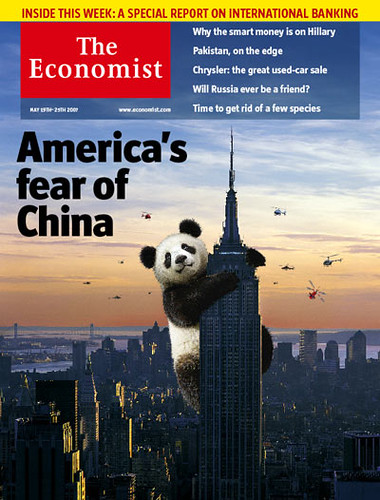
Once the Chinese government became convinced of the reality of climate change about a year ago, they have acted dramatically and rapidly with new environmental measures that now put them ahead of the US in several ways. They’ve restructured their development plans to cut down on high-emissions projects, and within two years they have phased out 54 million kw of coal-fired power capacity by small polluting power plants. Last year the issued new rules on the construction sector for the use of renewable products. They’ve poured money into the development of public transport and the promotion of environmentally-friendly vehicles. Also last year the government ordered retailers to stop providing free plastic shopping bags. China now has the world’s largest hydropower generating capacity and is currently the fourth largest wind power producer after the United States, Germany and Spain – and it’s catching up quickly. Last year renewable energy accounted for about nine percent of the country's energy total, surpassing the US.

Of course, with a top-down command economy China can afford to do these things at this speed. As Thomas Friedman has lamented, if only the US could be "China for a day". But no matter how they've attained these rapid results, the Chinese are putting the Americans to shame.

Needless to say with all the hope that was placed in Obama by Europeans, this has been a disappointing day across the pond. Newspapers over here have been questioning Obama's ability to deliver on climate change, with one particularly scathing article from the Guardian called 'Obama the Impotent' making the email rounds. The Guardian writes:
"On the campaign trail, Barack Obama promised to reverse the Bush administration's terrible ecological record. Yet so far the world has seen more symbolic gestures from the Obama administration than accomplishments. Its biggest achievement so far has been a disappointment. President Obama signed an executive order to increase US motor vehicle mileage standards – but only to a level that will push fuel efficiency by 2020 to a level that European and Japanese cars reached several years ago, and even China has already achieved."
However one consistent theme has been that the European papers are not blaming Obama himself for the inaction, but rather the government system he has the misfortune of having to lead. Writes the Guardian:
"Thwarting Obama on a regular basis is an unrepresentative senate where "minority rule" prevails and undermines what a majority of the country may want. With two senators elected per state, regardless of population, California with more than 35 million people has the same number of senators as Wyoming with just half a million residents. This constitutional arrangement greatly favours low population states, many of which tend to be conservative, producing what one political analyst has called "a weighted vote for small-town whites in pickup trucks with gun racks."
It should be no surprise that China is beginning to surpass the United States in several ways, after all this is slated to be the "China century," which will see a return to a two-superpower world with the US and China competing for power. But the fact that China is now surpassing the US in the fight against climate change should be a big wake-up call to Americans, especially liberals.

Sunday, 2 March 2008

Hong Kong

I'm back in London now and slowly getting over my jet lag. Overall my Hong Kong trip went very well, both for my work activities and for my leisure time.

Though I was nervous about it, my on-stage interviews at that conference went fine. I was fortunate enough to have a fairly engaging and outspoken guy as my interviewee, so he was able to keep the conversation lively and engaging. The panel I moderated about frontier markets also went well, though it was hard to link the disparate geographic regions we were discussing into larger themes. But I got good feedback from the audience afterwards.

Monday, 25 February 2008

China

I'm in Hong Kong this week on a business trip, my first trip to East Asia. So far it's been very interesting.

I came in early for the weekend to see my friend from grad school Liz, who is living and working in Shenzen. The first thing I noticed about the area is the big difference between Hong Kong and the mainland. Of course for all of its history as a city until 1997 Hong Kong was under the control of the British, and it was just a little over ten years ago that it was handed over to the Chinese, but with special stipulations. Hong Kong became the Hong Kong Special Administrative Region under the "one country, two systems" policy, continuing to operate as a seperate country for most intents and purposes until 2047.

Monday, 18 February 2008

The world's newest country

It’s official, Kosovo is now an independent state. Or is it?

On Saturday a long-awaited vote by Kosovo’s parliament declared it to be an independent state and no longer part of Serbia. In reality, Serbia hasn’t controlled Kosovo for nine years. The territory has been run by the United Nations and NATO since 1999 when NATO intervened to stop a Serbian crackdown on the separatist movement there, a crackdown which sometimes took the form of ethnic cleansing and genocide. Kosovo is today dominated by ethnic Albanians, but is the historic heartland of the medieval Serbian state.

However the road to nationhood isn’t as simple as just a proclamation. Serbia vehemently opposes the move, and its leaders say they will fight to the end to prevent Kosovo’s independence. Serbia filed legal charges against Kosovo's leadership Monday for creating a "false state" and vowed to block any attempts to allow Kosovo to join international associations. It has also declared the new state invalid and illegal. Serbia’s traditional ally Russia has said it also rejects the move and will use its seat on the UN security council to block the body from recognizing the country. The US, Britain, France and Germany are expected to recognize the state within days.

Saturday, 6 May 2006

Cheney's Russia Rant

At the “Common Vision for a Common Neighborhood” (sounds very common) conference in Lithuania yesterday,Vice President Dick Cheney essentially told a gathering of former Soviet and Eastern Bloc countries that Russia is an anti-democratic menace to Democracy and has a decision to make very soon: to be either an ally or an enemy to the West.

"From religion and the news media, to advocacy groups and political parties, the government has unfairly and improperly restricted the rights of the people," Cheney bellowed. He talked of the problems facing a country that, “has compromised the rule of law” and has “little official respect for human rights, a corrupt beaurocracy, and an intimidated press corps.”

Cheney knows that Russia-bashing is a popular sport in the former Eastern Bloc countries. For the last 15 years the former Eastern Bloc countries have been worshipfully devoted to the United States in a misconception that America single-handedly ended Soviet domination over them. But as they join the EU, neo-cons are increasingly concerned that they will fall into the European camp of geopolitical thought and develop interests contrary to those of the United States over the long term. These eastern bloc and ex-soviet countries were some of the most vocal and demonstrative supporters of the Iraq war, for instance. But of late that support has been slipping.

Tuesday, 25 April 2006

Best Gas Price Medicine? Build Public Transportation

Americans need to get something through their heads. The price of gas is not going to go down to $2 a gallon again. Ever. Period.

The emergence of China as a global power has and will fundamentally change our world, and we need to adjust to it. And part of that adjustment will be paying real prices for oil.

Congress is getting all in a tizzy about these gas prices, pointing their fingers this way and that. But Republicans seem to be forgetting about the enormous gift they gave the oil industry last year, an energy bill that gave huge subsidies and tax breaks to big oil. Last year the five largest oil companies, Exxon Mobil, BP, Royal Dutch Shell, Chevron Corp. and ConocoPhillips took home more than $111 billion in profits. As CNN’s John Roberts noted recently, that's greater than the GDP of 174 of the world's countries

To a large degree the US has brought this upon itself by not investing in an even rudimentary public transporation system. We are a nation obsessed with the car. So much so that in all the recent news reports asking how high gas would have to go before Americans stopped driving, noone’s thought to point out the obvious: They can’t stop driving no matter how much you charge for gas, because they have no other way to get around. Gas could go up to $20 and they’d still have to pay it.