Yesterday was “budget day” here in the UK, a day of huge significance to the British calendar and psyche with events lasting the whole week. Whereas in the US the budget is usually unveiled without a whole lot of fanfare or media attention (with the notable exception of Obama’s first budget this year), in the UK there’s a big hullabaloo around it, with the Chancellor of the Exchequer (for the most part the equivalent of the treasury secretary in the US) walking from 11 to 10 Downing Street clutching a ceremonial briefcase containing the all-important document, which will by that point already have been ceremonially presented to the Queen the day before. He then delivers an address to the parliament which is the first public unveiling of the plan, and that evening he makes a televised speech to the nation explaining his rationale. This is followed the next several nights by speeches from the leaders of the opposition parties.
It’s perhaps telling that yesterday’s budget day was so momentous and yet as usual, St. George’s Day today (England’s patron saint's day) was completely ignored. I didn’t even realize it was St. George’s Day until I happened to notice a sad little steel drum performance celebrating it in Hammersmith this afternoon while getting lunch.
Budget Day is always a big deal here, but this year it was attracting a particular amount of attention. Everyone knew that this was going to be a momentous budget, both in terms of the dire state of the economy the Labour government would have to reveal and in terms of the drastic measures everyone assumed were going to need to be taken. But despite being primed for eye-popping numbers by the bank bailouts last year, The City seemed to be absolutely shocked by the astronomical amount of debt Chancellor Alistair Darling announced yesterday. UK debt was set to reach a whopping £1.4 trillion in 2009 - equivalent to almost 80 per cent of the UK’s economy. Collapsing tax revenues, the chancellor admitted, will mean he will have to borrow £175 billion in 2009,12.4 percent of GDP. That will be the biggest annual deficit for the UK ever in peacetime.
And yet Darling seemed to offer little in the way of spending cuts or tax rises in order to pay off that debt. His announcement of a tax hike to 50 percent for people making over £150,000 may have raised eyebrows (while not uncommon on the continent such a tax rate in the UK hasn’t been seen in a very, very long time), but cynics in the UK suspected it was a cheap ploy to distract the media from the larger issue – the huge amount of debt announced. The budget included no rise in the tax rate for the middle class, and the reality is that those who make large sums of money are usually pretty adept at getting out of paying tax rises, so the 50% tax rate is likely to raise little revenue. The British media seems to have almost uniformly assumed that the Labour Party will not be in power much longer, but perhaps the real question now is what exactly will the Tories be inheriting if they take over the government next year? Eventually someone’s going to have to pay for all this expenditure, as necessary as it may be, and who is going to deliver the bad news to the middle class that they are going to have to chip in? It’s a surefire election loser, but with his plummeting poll numbers it would have been interesting to see Brown fall on his sword and broadly raise taxes to pay for the debt, knowing it would guarantee a Labour defeat in the upcoming election.
Tea-Bagging Across the Pond
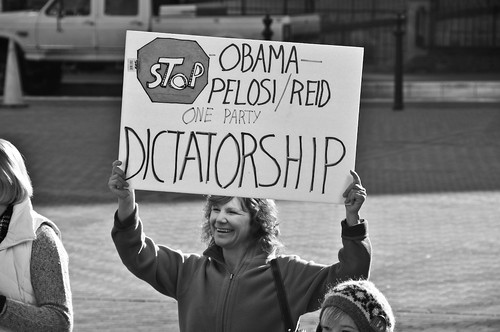 Interestingly, the same issue is being wrestled with across the pond in the US. Barack Obama’s budget will allow the Bush tax cuts on the rich to expire, and will increase the tax burden on the top two percent of income earners. The rest of the population will either see their tax rate remain the same or decrease. Of course this didn’t stop legions of blue-collar “tea-bagging” protesters from turning out on the streets last Wednesday (“tax day,” in the US, a day perhaps of equivalent symbolic importance to ”budget day” in the UK) to decry Obama as a fascist who will tax all Americans into oblivion. Left-leaning media outlets have been at lengths to point out that 99 percent of the people out at those protests won’t see their taxes go up at all under Obama’s plan (although the people organizing those protests, Fox News and lobbying groups like Freedom Works – which interestingly enough also represents AIG – will). The American left used to scream in frustration that the working class was being hoodwinked by Republicans who used an appeal to social issues to get the working class to vote against their own economic interest. Now with the tea-bagging protests, the left has been observing is disbelief that Republicans now seem to be able to convince them to vote against their own economic interest based on an appeal to economic issues somehow as well. It's a strange country.
 But despite the left's dismissal of them as mindless sheep, perhaps the tea-bagging protesters are on to something. While it is true their taxes aren't going up right now, they know that with the huge amount of expenditure being spent to rescue the global economy from collapse, someone's going to have to pay for it. And really, why not the tea-baggers? More than a few people have pointed out that these are the same people who enthusiastically supported the Iraq War and the huge expansion of the government with the establishment of the Department of Homeland Security. Now they're taking to the streets to protest the fact that they might possibly be asked to pay for it.
These are extraordinary times, and they will likely call for extraordinary levels of sacrifice from all people. Sooner or later, the middle class is going to have to contribute financially to solving the mess. The problem, on both sides of the Atlantic, is that nobody wants to be the one who has to tell them that.