
This, the journalists learned, was Frigide Barjot - the
leader of France’s
anti-gay-marriage movement. The Conservative MEPs had invited her to the
European Parliament to speak about her desire to extend her anti-gay-marriage
movement to all of Europe. While notorious in France, Ms
Barjot is unknown outside the country, and the journalists were perplexed as to
why she was there. But I knew of her already, if only from the many Facebook
posts I see from my French friends decrying her antics.
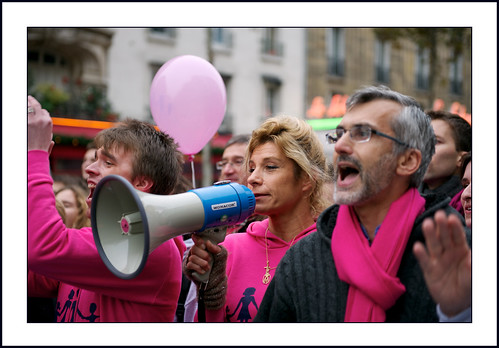
Barjot cuts a strange figure. She is the leader of the French anti-gay-marriage protest movement you may have seen videos of (The Colbert Report has covered it with bemusement), with people dressed in crazy costumes and brandishing pink signs that read ‘Un Papa et Une Maman’. She is a sort of comedian, having chosen the pseudonym Frigide Barjot (a take on Brigitte Bardot) herself. But her act is not satire; she is dead serious. She says gay marriage will lead to the collapse of French society and the corruption of French children.
Barjot’s is not a religious movement. She herself is an atheist
(although she recently described herself in an interview as a “born-again
Catholic”). She used to be a fixture in the Paris gay scene, partying the night away in
clubs like Le Queen and Les Bains. She might best be described as a ‘socialite’
or a ‘personality’, akin to someone like Paris Hilton, who has no specific job
or talent but is famous for being famous.
Some openly gay members of the European Parliament came to
Barjot’s press conference to denounce her, expressing incredulity that their
colleagues would invite a young man to speak at the Parliament who once declared
that French President Francois Hollande’s effort to enact gay marriage is akin
to what Hitler did to the Jews. I’m told that in fact the centre-right EPP group
did not know that this handful of ultra-conservative MEPs were planning to
invite her. In fact the press conference was not announced until one hour
before it happened. But it was an undeniable endorsement. At the end of an
outlandish and bizarre performance by Barjot, a promotional video was played
urging people to come to the anti-gay-marriage rally in Paris next month.
Dressing the part
 For an American, the anti-gay-marriage movement in France is
completely perplexing. They appear to have co-opted the presentations of the
gay rights movement to use for themselves, dressing in pink feather boas and
outlandish costumes at their rallies. There is no talk of God and religion, or
of people going to hell. Instead the message attempts to be positive – emphasising
only the 'goodness' of the family rather than the ‘badness’ of gay people. Needless
to say, the demonstrations against gay marriage in the US are quite
different.
For an American, the anti-gay-marriage movement in France is
completely perplexing. They appear to have co-opted the presentations of the
gay rights movement to use for themselves, dressing in pink feather boas and
outlandish costumes at their rallies. There is no talk of God and religion, or
of people going to hell. Instead the message attempts to be positive – emphasising
only the 'goodness' of the family rather than the ‘badness’ of gay people. Needless
to say, the demonstrations against gay marriage in the US are quite
different.
Barjot says she loves gay people, but thinks gay marriage is bad for
them and bad for society. That young man with the
bleach blonde hair she brought in with her? He is openly gay, and told the
press conference that he is adamantly opposed to gay marriage because it would
lead to the breakdown of the family.
It’s almost as if they have watched the anti-gay-marriage
movement in the US
and tried to learn lessons from how negative and nasty that movement comes
across. In recent weeks a score of
‘mainstream’ Republicans have changed their stance on gay marriage, keen
to separate themselves from the elements of the party that are seen by many Americans as mean-spirited in their tone and rhetoric toward the subject of gay marriage.
Barjot and her followers want to be the ‘positive’ anti-gay
movement. And yet at the end of the day, the objective and the beliefs are
exactly the same: gay marriage is harmful to society and a danger to children, and must be stopped.
So why does the French manifestation of this look so different?
Meanwhile, in the UK...
Across the channel, it just so happens that a British law
that would allow gay marriage is working its way through the parliament at the
same time as in France.
In fact, it's looking like the two pieces of legislation could be adopted in the
same month. But though they are happening concurrently, the debate in the UK could not look more different than that in France.
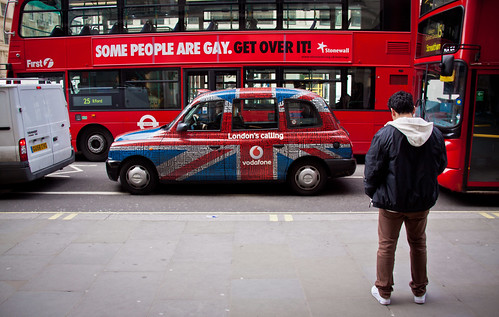
The opposition to the legislation in the UK has been
muted. There has been tepid protest from the Church of England in the form of
letters and op-eds, and during the first legislative debate on the issue last
month there were a handful of MPs who said they objected on moral grounds. But
none of the language used even comes close to the dramatic and inflammatory
rhetoric seen in the French legislative chamber or on the streets of Paris. There have been no
street protests in the UK organised against the measure. And now that the first parliamentary vote has happened in the UK, the media has largely moved on.
It’s over and done with. Not so in France – the heated debate rages
on, even now that it has become clear that the measure will pass.
It is an indication of the wide support for gay marriage in the UK that the change in law was actually proposed by a Conservative prime minister - David Cameron. The lack of
right-wing resistance could partly be explained by the fact that the British
civil unions which have already been in place for eight years are already
marriages in all but name, bestowing the exact same rights. In France, the
‘PAC’ civil unions that have been in place are much weaker – more like a
co-habitation recognition than an actual civil union. So the change will be
greater in France than in
the UK.
French conformity
French conformity

France is officially a secular state, while the UK
has an official state religion. But, in my humble opinion, the reality is that traditionalist values
and conservative attitudes are far more prevalent in France
than they are in Britain.
France is a very ‘collectivist’ society. Strong emphasis is placed on family and society, and less emphasis is placed on the individual. Just look at the education system. Children take a test around the age of 12 to determine the path for the rest of their lives. The education system is a rigid maze of tests and certifications which ensures that switching careers later in life is difficult. From my vantage point, it seems like creativity and individualism are discouraged in France. Deviations from the 'life plan' assigned to you are not generally appreciated.
France is a very ‘collectivist’ society. Strong emphasis is placed on family and society, and less emphasis is placed on the individual. Just look at the education system. Children take a test around the age of 12 to determine the path for the rest of their lives. The education system is a rigid maze of tests and certifications which ensures that switching careers later in life is difficult. From my vantage point, it seems like creativity and individualism are discouraged in France. Deviations from the 'life plan' assigned to you are not generally appreciated.

This fierce individualism can lead to problems of social
breakdown and a lack of solidarity in Anglo-Saxon societies like the UK and
US. But it also leads to greater freedom for people to live their own lives the
way they see fit, and that extends to choosing to live life as an openly gay
person. Having lived both in the UK
and in France, my experience
is that gay people are far more likely to be out of the closet in Britain. In France,
it often seemed that family pressure or social expectations were keeping people
in the closet, which I found counter-intuitive for a society that likes to
think of itself as so much more enlightened and secular than their Anglo
cousins.
If Barjot’s movement is not explicitly religious, then what
exactly is their problem with gay marriage? In an American context, the
movement is difficult to understand. Why would an Atheist be so passionately
opposed to gay marriage? I think the answer is that the movement is more centered
around social expectations. There is a strong tendency in French society to
demand conformity. A person choosing to live their life in a way that is
against expectations is innately hostile to that French impulse. These
protestors in pink are not enraged because the gays are living in sin, they are
enraged because the gays didn’t do what they told them to do. These protestors are but a small segment of French society. But that they feel so passionately about this on non-religious grounds is honestly hard for an American like myself to understand.
 In the end, the resistance to gay marriage is a losing battle in either country. Like in the UK and the US, open homosexuality is coming to
be accepted as a mainstream part of life in France. There will come a time in France when
being openly gay, getting married to ones partner and raising a child together
will not seem outside of expected social norms. But this time has not come
yet. So you get the ladies in pink, furiously resisting the change even though
they don’t seem to know exactly why.
In the end, the resistance to gay marriage is a losing battle in either country. Like in the UK and the US, open homosexuality is coming to
be accepted as a mainstream part of life in France. There will come a time in France when
being openly gay, getting married to ones partner and raising a child together
will not seem outside of expected social norms. But this time has not come
yet. So you get the ladies in pink, furiously resisting the change even though
they don’t seem to know exactly why.
But these feelings will pass. And in hindsight all these
protest movements, whether it be the pink boas in France
or the bible-beating in the US,
will seem quite absurd.

3 comments:
At least one point in this post is completely wrong. Almost nobody takes an important exam at 12 in France. In Britain there is far more school selection at around that age. The vast majority of French kids go to the neighborhood school without taking any entrance exam at all.
Hi, your article is interesting and is true on many points but I'd like to point out some mistakes.
First, Frigide Barjot is absolutely NOT an atheist. She is a fundamentalist catholic, supporting "pro-life" organizations. It's been a few years since she "rediscovered Faith".
Second, it's the ridiculous gay boy that you mentioned, Xavier Bongibault who compared François Hollande to Hitler, not Frigide Barjot. That would have been crazy! She's a pro regarding PR and she would never say such a thing.
Hi Anthony, thanks for the notes! I did actually mean the young man in the sentence about the Nazi comparison, in that he was also technically invited by the MEPs - but I'll make that more clear in the sentence.
On Barjot's religiosity, while it's true that she now identifies as a "born-again Catholic", what's interesting is that there are very few to no religious references in her movement. Perhaps this is because she doesn't want to alienate non-believers. It's very different from the American and UK context, where the anti-gay-marriage movement is explicitly religious. The fact that there is a secular movement against gay marriage in France is absolutely fascinating to me, because I can't imagine such a thing developing in the UK or the US.
BTW apparently Frigide is leading a demonstration of French anti-gay activists at Trafalgar Square this Sunday (24 March), it will be interesting to see how the Brits react!
Post a Comment