 Yesterday’s first round of presidential elections in France
delivered a humiliating defeat for president Nicolas Sarkozy, who trailed over one
percentage point below his Socialist Party challenger Francois Hollande - the ex-partner of Sarkozy's 2007 rival for the presidency Segolene Royal. It is the
first time in the history of the fifth republic that a sitting president has
not won the first round of elections.
Yesterday’s first round of presidential elections in France
delivered a humiliating defeat for president Nicolas Sarkozy, who trailed over one
percentage point below his Socialist Party challenger Francois Hollande - the ex-partner of Sarkozy's 2007 rival for the presidency Segolene Royal. It is the
first time in the history of the fifth republic that a sitting president has
not won the first round of elections.Public polling had predicted a Sarkozy win in the first round, in which all candidates compete, followed by a Hollande victory in the final round on 6 May, where the two leading candidates face off against each other. The low showing for Sarkozy already has papers predicting that, barring a miracle, Sarkozy is finished.
Much of Sarkozy’s trouble has come from Marine Le Pen, the leader of the far right National Front party. She came in at 18%, far higher than the previous leader of the party, her father Jean-Marie Le Pen, scored in 2002 when a split Left meant he came in second in the first round. Sarkozy has been desperately trying to win over the far right vote in France, telling French television that the country has “too many immigrants,” joining a crusade against halal meat, and saying the EU’s passport-free Schengen Area should be renegotiated. But it apparently wasn’t enough to convince the far right voters to vote for him.
Sarkozy now has two weeks to convince Le Pen’s followers to support him in the final round, but it will be a difficult task. National Front voters, aside from being xenophobic, racist and anti-EU, also have a strong anti-establishment impulse. This was reflected in Le Pen’s ecstatic victory speech last night, as she declared with a clenched fist in the air, “We have blown apart the monopoly of the two parties of banking, finance and multinationals. Nothing will ever be the same.”
The next two weeks will be all about convincing the extremes.
While Sarkozy works to win over the far right, Hollande will be working to win
over the far left – the 11% of people who voted for anti-capitalist candidate Jean-Luc
Melenchon.
But Hollande is unlikely to make any grandiose promises to
the far left in order to win them over - and not just because having already received Melenchon's endorsement, he doesn't need to. Hollande has been the self-styled “Mr Normal”
during the campaign, being very cautious and serious in contrast to the
frenetic Sarkozy who seems to announce a new policy every week. If past is any
prologue, the French president can be expected to throw out more new policy
ideas than we can keep track of over the next two weeks in order to win over the
far right. This will only play into the hands of the Hollande campaign, which
has sought to portray the president as impulsive, arrogant and vain.
The return of the red
If Hollande does indeed win in two weeks time, what will
that mean for Europe? After a five year period
in which the continent’s centre-left Socialist parties have been literally wiped from themap, Denmark
was left as the only government to be completely led by the Left. Belgium and Austria have left-right ‘rainbow coalition’
governments led by Socialist prime ministers.

But that situation could be about to change in a big way. France is one
half of the Franco-German alliance that dominates European politics these days,
and having half of that powerful core suddenly shift to the left will have
enormous impacts. It would be a devastating blow to the austerity agenda of
Angela Merkel, who has strongly endorsed Sarkozy for re-election (an unusual
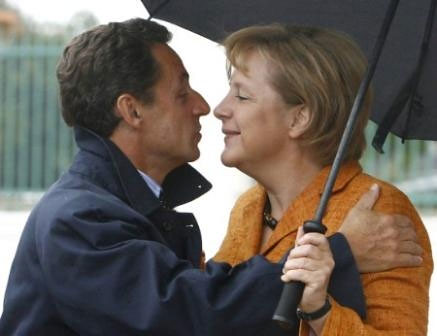
move for the leader of a foreign country). What will a post-Merkozy Europe look like?
Recent developments could mean that Hollande would not be
without new allies. The Dutch government collapsed today, with Prime Minister
Mark Rutte turning in his resignation to Queen Beatrix just an hour ago. The
center-left could win in the election that will be called for the next few
months. Over the weekend the Czech government also fell, and polls predict the
centre-left could take power in the upcoming election.
In neighbouring Slovakia, the centre-left wrested
power from the conservatives in an election last month. And in Greece, an
election to be held in two weeks on the same day as the French final round
could return the Socialists to power there. One could imagine that by
September, eight EU member states could be led by Socialist governments – up from
two just a few months ago.
So what would this mean? In the short term, probably
relatively little. All of these Socialist parties have more or less committed
to the Merkozy austerity plan, but say they want to do it more gradually. The reality is with France's fragile economic situation, he doesn't have much room for maneuver right now.
Hollande has said he wants to reopen the Eurozone’s economic stability pact to add growth measures, saying the EU cannot pursue austerity alone to get out of the crisis. He also wants it changed to allow the ECB to lend directly to countries, for eurozone countries to be able to issue joint Eurobonds, and to eliminate the ‘golden rule’ requiring balanced budgets.
Hollande has said he wants to reopen the Eurozone’s economic stability pact to add growth measures, saying the EU cannot pursue austerity alone to get out of the crisis. He also wants it changed to allow the ECB to lend directly to countries, for eurozone countries to be able to issue joint Eurobonds, and to eliminate the ‘golden rule’ requiring balanced budgets.
Whether such a reopening is possible is an open question. France
has committed to the pact and must abide by the treaties it has signed, and
governments would be very reticent to reopen the issue. If a number of new Left
governments come to power, it could be done. But what is more likely is that
Hollande will try to adjust the course of Europe’s
recovery plans in upcoming talks and agreements, rather than reopening the
stability pact. This will set him on a collision course with Merkel in the long
term, but probably not in the immediate short term.
Of course this reality will probably not keep the world’s
financial markets from panicing this morning in response to the news of
Hollande’s first round victory. Some of Hollande’s highly symbolic initiatives,
such as a 75% income tax on earnings above €1 million euros, are bound to scare
investors. His plans to split the retail and investment activities of French
banks and impose a special tax on them will also cause some jitters on the
markets.

But in truth Hollande has not, in the course of his
campaign, announced any major policy changes that would indicate a massive
change in direction for France.
His interest in the course of Europe as a whole has also been rather muted, in
contrast to Sarkozy who saw himself as a natural leader for Europe.
It may be that Hollande has kept quiet during the campaign
in order to make the contrast with the manic Sarkozy more stark, and that after
he wins Hollande could emerge as a real political lion who will lead Europe’s Socialists in devising a new strategy for growth
out of the crisis.
By appearances alone, Hollande does not seem to be the man
to do this. But appearances can be deceiving.

No comments:
Post a Comment