The EU had been in an 18-month deadlock over whether to grant Serbia free trade and association, which is a precursor to membership. The Dutch, who are hosting the international criminal court proceedings against Serbs accused of genocide during the Balkan civil wars, had insisted for more cooperation from Serbia in tracking down war criminals first.
Showing posts with label Yugoslavia. Show all posts
Tuesday, 8 December 2009
Dutch drop objection to Serbia in EU
Monday, 9 February 2009
The Swiss Say Yes to Europe
The vote is being called a "broad yes" by the Swiss to economic collaboration with Europe, and a mandate for pro-European parties in the Swiss government to increase ties. The news is already being taken as a sign that the financial crisis may lead to a more receptive attitude toward the EU and coordinated pan-European policies. With the Irish revote on the Lisbon Treaty just around the corner, many in Brussels are hoping this is a trend that will continue. But is the vote's outcome the result of changing EU attitudes in the face of the financial crisis, or was it simply the result of a skillful vote mobilisation effort on the ground by pro-EU groups?
Switzerland has a rather unusual arrangement with the EU. While it's not a member, it has a series of seven 'special accords' with the block that make it effectively a shadow member. It isn't an official member, so it doesn't have any representation in the European Parliament or Commission, but the accords oblige Switzerland to follow many areas of EU legislation. Free movement, which allows any EU citizen to work in any EU country, is one of those areas. However, now that EU membership hassuch a change must be put to a public vote (they basically have to have a public vote for everything in Switzerland). But here's where it gets tricky. The EU has made clear that Switzerland doesn't have the right to 'pick and choose' which parts of EU law it will follow, and under the infamous "guillotine clause," if the Swiss voted no to extending free movement to Bulgaria and Romania, all of their agreements with the EU would be torn up. Considering that the vast majority of Switzerland's trade is with the EU, and that non-Swiss EU citizens make up a huge percentage of its skilled workforce, a collapse in the accords would be catastrophic for the country's economy. So one has to ask, is this really a vote for increased EU ties, or a desire to maintain the status quo? And if it's now economically impossible for the Swiss to vote against policies enacted in Brussels, isn't this really just an illusory independence anyway?
A Sign of the Times?
So does the wide victory in Switzerland mean that people's fears about the financial crisis are going to make them less likely to snub the EU, for fear of the economic consequences? I've speculated that the economic turmoil in Ireland will likely make the Irish too scared to vote against the Lisbon Treaty again when the revote occurs later this year. It seems likely that the hold-up in approval by the Czech Parliament may also be resolved quickly now that the future looks so uncertain. On the other hand, many commentators have speculated that the recession could lead to an increase in populism and protectionism, which could put the European single market in jeopardy. The recent walk-outs in the UK and the one-day strike in France have certainly been a worrying sign in that direction.
For now though, Brussels has reason to be encouraged by the Swiss result.
Friday, 14 December 2007
EU hopes to be hero in Kosovo
As we speak the EU is having what will probably be the shortest European Union summit so far, with it having started at ten and due to get out shortly after lunch. Many hope this is a sign that the ‘new EU’ promised by the tightening-up of the reform treaty has arrived. Now that the reform treat has been agreed, the union can get down to business, the argument goes.
For those that want to see an efficient and effective EU, the proposed resolution of today’s meeting is a promising sign as well. The summit is set to agree to offer Serbia a fast track to EU membership in exchange for its acquiescence in Kosovo bid for independence. The agreement would also create an EU police force to protect and stabilize the new country, finally allowing the US-led NATO who have been occupying the country for six years to leave. The draft summit statement says the mission for Kosovo would have up to 1,800 police, judges and prosecutors – making it the largest such mission ever undertaken by the bloc.
For those that want to see an efficient and effective EU, the proposed resolution of today’s meeting is a promising sign as well. The summit is set to agree to offer Serbia a fast track to EU membership in exchange for its acquiescence in Kosovo bid for independence. The agreement would also create an EU police force to protect and stabilize the new country, finally allowing the US-led NATO who have been occupying the country for six years to leave. The draft summit statement says the mission for Kosovo would have up to 1,800 police, judges and prosecutors – making it the largest such mission ever undertaken by the bloc.Monday, 22 October 2007
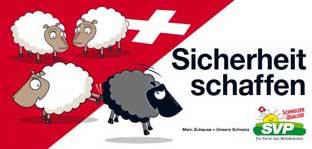
The white sheep win in Switzerland
Despite the "foreigner-friendly" win in Poland, the weekend saw a very different election result just a thousand kilometers away in Switzerland. The right-wing Swiss People’s Party (SVP), which has gained infamy in the past few months for running what many see as a blatantly racist ad campaign, won 29% of the vote this weekend and gained seven seats on the National Council. That makes SVP Switzerland’s largest party by a long shot.
Meanwhile Switzerland’s second-largest party, the center-left Social Democrats, had a disastrous weekend. They lost nine seats and had a 4 percent drop on its showing in 2003 elections. The party now has 43 seats on the 200-person National Council compared to the SVP's 62. SVP is led by the populist Christoph Blocher, who is one interesting character, let me tell you.
The news is highly disturbing to many in Europe because the result means that the party’s overtly racist campaign advertising was a huge success. The party had run a series of ads depicting three white sheep grazing on a Swiss flag, kicking a black sheep off of it. The ads were accompanied by the slogan, "for more security.”
Meanwhile Switzerland’s second-largest party, the center-left Social Democrats, had a disastrous weekend. They lost nine seats and had a 4 percent drop on its showing in 2003 elections. The party now has 43 seats on the 200-person National Council compared to the SVP's 62. SVP is led by the populist Christoph Blocher, who is one interesting character, let me tell you.
The news is highly disturbing to many in Europe because the result means that the party’s overtly racist campaign advertising was a huge success. The party had run a series of ads depicting three white sheep grazing on a Swiss flag, kicking a black sheep off of it. The ads were accompanied by the slogan, "for more security.”
Tuesday, 11 September 2007
Kosovo showdown looming
The deadline for answering the Kosovo question is looming. Some sort of government needs to be put in place by 10 December, when the UN mandate ends. I’m particularly interested in these developments because I send my rent cheque to Kosovo every month as that’s where my landlord is (weird story). If Kosovo becomes independent, he and his family will probably move back here (since he is Serbian) and I’ll be out of a home!Essentially the problem is this: a majority of the people living in the Serbian province of Kosovo are ethnic Albanians (Albania being the neighbouring country to the west). As with other areas in the larger Yugoslav civil war, a big part of the conflict was tension between the Muslim Albanians and the Christian Serbs. During the Yugoslav civil war in the 1990’s, Albanians in Kosovo conducted a peaceful secessionist movement. In 1995, after the Dayton Agreement ended the Bosnian War but did not address Kosovo, the Kosovo Liberation Army (KLA) was formed in 1996 with the goal of attaining an independent Kosovo. They employed guerilla-style tactics against Serbian police forces, paramilitaries and regular civilians. The situation devolved into complete chaos and Serbs began massacring Albanians, triggering a US-led 78-day NATO campaign in 1999. An estimated 10,000 ethnic Albanians and 3,000 Serbs were killed during the fighting, a majority of them civilians and many through a campaign of ethnic cleansing.
Subscribe to:
Posts (Atom)