Showing posts with label riots. Show all posts

Tuesday, 16 August 2011

British police don't want American supercop

David Cameron's announcement last week that he is appointing former New York City police chief Bill Bratton to guide the UK through its response to the riots has been met with a barrage of criticism from the country's police chiefs. The war of words over the appointment of the controversial 'supercop', who implemented New York's "zero tolerance" approach to policing in the 1990's, has exposed a deep rift between Westminster and Scotland Yard, and the atmosphere is only getting more heated.

Bratton gained fame as New York Mayor Rudy Giuliani's right-hand man in implementing the "broken windows theory" of policing in the city. The theory states that petty crime leads to serious crime, so the 1990's led to a serious crackdown on minor offenses. It turned New York from one of the most crime-ridden cities in the Western world to the safest large city in the United States. But on the flip side, many say it has turned New York into a virtual police state, where officers can arrest you for anything.

The original plan was reportedly to appoint Bratton as London's police commissioner, but this was shot down because he is not a British citizen. So instead he has been appointed as a government adviser. But even this has angered Britain's police chiefs, who say Bratton's 'zero tolerance' approach to policing in America is not appropriate for the UK.

Friday, 12 August 2011

David Cameron's 'Katrina moment'

Members of the British parliament were called back from their vacations for an emergency session yesterday to deal with the country's riots earlier this week. The past two nights have been quiet - a combination of bad weather and a surge in police forces seems to have done the trick. But now the political storm begins, with the public demanding to know how the situation could have gotten so out of control.

The focus of much of the public's ire has been prime minister David Cameron. He was seen to be back-footed during the crisis, spending the first few days of the rioting insisting he would not cut short his vacation in Italy, and only returning to the country after the riots got very serious Monday night. The media has been referring to it as his "Katrina moment", referencing the back-footed response of US president George W. Bush to Hurricane Katrina in 2005. The incident is being seen as a defining moment of his premiership, and he has been much maligned for it. The above gag photo of his speech on Tuesday from photoshoplooter illustrates the public's perception of his response.

Cameron has been working overtime to dispel that image over the past few days. In yesterday's emergency session he aggressively denounced the riots, saying the behavior of this bad element of society could not be excused by social factors or circumstances. And though his party often criticised the opposition Labour party for introducing "knee-jerk legislation" after crises during their time in government, he floated no fewer than six new policies. These include a ban on face masks in public, increased curfew powers, allowing courts to ban children from gathering in certain places and, most controversially, he said he is considering allowing temporary bans on social media during times of social unrest.

Tuesday, 9 August 2011

Britain's teenage riot

London was ablaze last night as an unprecedented wave of violence and looting spread throughout the city, spreading to other cities in England. It was the third day of rioting in London, initially sparked by the police shooting of a young black man in Tottenham last week. But last night saw the situation explode and quickly spread after the government and the police appeared to lose control of the situation.

The rioters carrying out the violence were mostly children, teenagers in hooded sweatshirts covering their faces, bashing in store windows and setting cars on fire. I've written before about how Britain is terrified of its own children. Last night was a shocking manifestation of that problem. A 2008 poll showed that more than half of British adults are afraid of British children, believing they behave like animals and pose an increasing danger to themselves and others.

The images from last night are truly shocking, particularly the fires. It was the largest number of simultaneous fires London has seen since the blitz. There were reportedly children as young as seven taking part in the violence. What precipitated the violence was the fatal police shooting of a young black man last week in Tottenham. The police say he had a gun and was shooting at them, but his family says he was unarmed. The facts surrounding the case are still unclear.

Monday, 13 December 2010

Anti-Caucasian football riots in Moscow expose World Cup problem

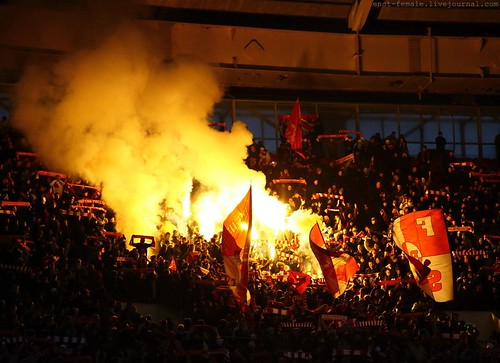
Central Moscow erupted in rioting this weekend as nationalist football hooligans attacked police officers and state buildings. The riots are the result of an explosive mix of ethnic tensions, ultranationalism and football that has cast doubt over the decision by FIFA a week ago to select Moscow as the host of the 2018 World Cup. Today the tensions continue. Hundreds of anti-riot police have amassed around Red Square and the Kremlin.

In Russia, as in much of Europe, football hooliganism often goes hand-in-hand with white supremacy and neo-nazi movements. The spark that lit the fuse for this particular riot came several weeks ago, when an ethnic Russian football fan was killed during a fight with a group of men from the predominantly Muslim North Caucasus region of the Russian Federation. He was a fan of the Spartak Moscow football team and a member of one of its most aggressive fan groups - or "firms" as the Russian hooligan groups like to call themselves. The Caucasian man arrested for the murder was subsequently released, prompting outrage from the Spartak Moscow fans who say the police are favoring the ethnic minorities.

Wednesday, 21 January 2009

Rioting in Iceland

When there's rioting in Iceland, you know we're in trouble. The small Scandinavian country in the middle of the Atlantic isn't usually associated with domestic strife, but rather high quality of life and abundant natural resources. But yesterday thousands of people took to the streets to protest the government's handling of the economy, which has plunged in recent months as a result of the larger global turmoil. Gross national product is down two-thirds, there has been a 45 percent rise in unemployment and the country is defaulting on loan repayments. In October the country's financial system collapsed and its currency plunged under the weight of billions of dollars in foreign debt taken on by its banks.


These weren't just mild demonstrations. Riot police had to fight with a large number of violent protesters outside the country's parliament. Pepper spray was fired at the protesters and 30 arrests were made.

Coming on the heels of the riots in Greece last month, many in Europe are becoming increasingly worried that the economic turmoil could lead to violent clashes between disaffected people and their governments across the continent. Eastern Europe is seen as particularly vulnerable to such violence, with some even predicting a "spring of discontent" in the region to be around the corner.

Eastern Europe has been hit hard by the financial crisis, especially Bulgaria, Romania and the Baltic states - all recent EU entrants. As the Guardian recently reported, incidents have been steadily increasing. Last week police in Vilnius, Lithuania had to tear-gas a crowd of demonstrators protesting tax rises and benefit cuts designed to save the state from bankruptcy. Sofia, Bulgaria has also seen recent widespread violence in which 150 people were arrested. Riga, Latvia has seen street battles as well.

These Eastern European economies are increasingly experiencing unexpected turmoil after years of posting double-digit growth. Their anger will likely be compounded by the fact that they were expecting that growth to continue, particularly after they joined the EU. The post-cold war governments are still new and relatively weak, and could be unprepared to deal with widespread unrest. And the increasing hostility isn't just being directed at the governments. Attacks on minorities are also becoming increasingly common, particularly against Roma (gypsy) communities. Recently 700 members of the far-right Workers' Party in the Czech Republic fought with police when they were prevented from marching on a Roma area.

Of course Iceland is just about as far as you can get from Eastern Europe without leaving the continent. If the global economic turmoil can cause rioting in a country with one of the highest quality of life ratings in the world, could rioting be far behind in the major Western economies? And even if it isn't, how will the major economies of Western Europe respond to growing political unrest to their east, in countries with which they are now united? Clearly the EU has an obligation to help Eastern Europe through the financial turmoil, but if the situation becomes fundamentally dangerous, can the EU do anything to stem the violence without a proper policing military force?

The "spring of discontent" will be an anxious time for Europe.

Tuesday, 9 December 2008

Europe Nervous as Greek Riots Continue

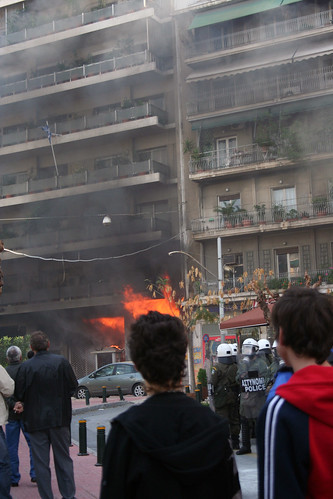
The deep fault lines within Greek society have exploded this week, with huge riots erupting across the country. The causes for the violence are myriad, but considering that part of the cause is the global economic stress, anyone in Europe watching the images on TV right now must be feeling at least a pang of dread. With so much uncertainly looming, there are plenty of people who fear scenes like this could be coming with more frequency across the continent.

The riots were immediately sparked by the fatal shooting of a 15-year-old protestor by police over the weekend, but the severity and length of the violence indicates that this is about much more than the shooting. Even though the country is prone to rioting from a strong left-wing student movement, this is the worst civil disorder to hit the country for decades according to reports. Schools across the country have been shut down, and transport has also come to a standstill. Most of the damage has been against property: luxury hotels, banks, any strong symbol of capitalism. The targets indicate that it is the economic reforms of prime minister Kostas Karamanlis that are driving people to the streets.

Students have a long and respected history of protest in Greece: it was they who brought the right-wing military junta down in the 1970's, and after that students were given special privileges to protest by the new government (similar to what happened in Spain in the 1970's). Police are not allowed to enter university campuses to arrest students, and during these riots students have used the campuses to regroup in between flare-ups of violence.

The government is saying that the police officer who shot the boy is going to be charged with manslaughter. Police say the boy was shot as he and some other young protesters were pelting a police car with stones. They say he was shot as he tried to throw a fuel-filled bomb at the police.

Greece is reeling right now from the effects of the global economic downturn; it has been hit harder than other European countries. The economic hardship has resulted in new flare-ups between the right and left in this country, both very powerful and both seething with hatred for the other side. As Europe watches the violence unfold, there must be fears in other countries with strong leftist movements that if the economic troubles get worse, these tensions between the right and left could flare up in their own countries as well.