Showing posts with label police. Show all posts

Tuesday, 16 August 2011

British police don't want American supercop

David Cameron's announcement last week that he is appointing former New York City police chief Bill Bratton to guide the UK through its response to the riots has been met with a barrage of criticism from the country's police chiefs. The war of words over the appointment of the controversial 'supercop', who implemented New York's "zero tolerance" approach to policing in the 1990's, has exposed a deep rift between Westminster and Scotland Yard, and the atmosphere is only getting more heated.

Bratton gained fame as New York Mayor Rudy Giuliani's right-hand man in implementing the "broken windows theory" of policing in the city. The theory states that petty crime leads to serious crime, so the 1990's led to a serious crackdown on minor offenses. It turned New York from one of the most crime-ridden cities in the Western world to the safest large city in the United States. But on the flip side, many say it has turned New York into a virtual police state, where officers can arrest you for anything.

The original plan was reportedly to appoint Bratton as London's police commissioner, but this was shot down because he is not a British citizen. So instead he has been appointed as a government adviser. But even this has angered Britain's police chiefs, who say Bratton's 'zero tolerance' approach to policing in America is not appropriate for the UK.

Wednesday, 11 May 2011

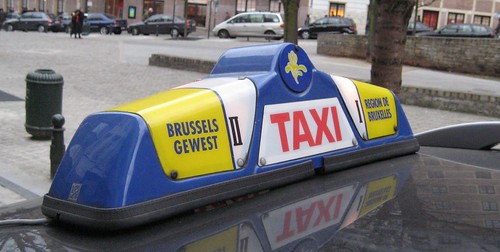
Taxi drivers blockade Brussels Airport

In this land of the surreal, nothing surprises me any more. So it hardly phased me this morning when I read in the local paper that last night 200 taxi drivers blockaded Brussels Airport because an unlicensed taxi driver had been grazed by a bullet during a high-speed police chase. 'Still, something isn't right about this story,' I thought. But I figured I must have been not understanding the French article correctly.

But no, it turns out the story really is that bizarre. Last night police were making routine checks for unlicensed taxi drivers near the airport (who are notorious for swindling tourists by charging them three times the normal fare when they pull up to their hotel). According to the local paper La Derniere Heure, when the police signalled for one 28-year-old driver to stop he instead accelerated to speed away. The police officer jumped on the hood of his car, but the driver still didn't stop.

The police officer was then carried 2km (1.2 miles) along the road, clinging to the car for dear life. He fired into the car toward the dashboard, smashing the screen and forcing the driver to stop. A fight erupted and the police officer fired a shot that grazed the driver's shoulder. They then took him into custody.

Tuesday, 9 December 2008

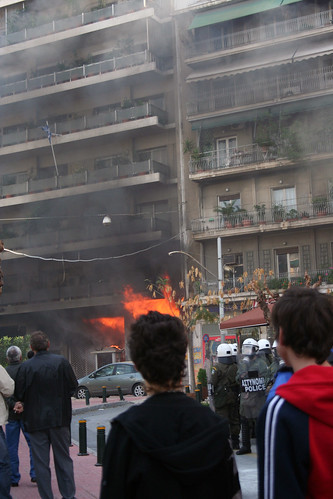
Europe Nervous as Greek Riots Continue

The deep fault lines within Greek society have exploded this week, with huge riots erupting across the country. The causes for the violence are myriad, but considering that part of the cause is the global economic stress, anyone in Europe watching the images on TV right now must be feeling at least a pang of dread. With so much uncertainly looming, there are plenty of people who fear scenes like this could be coming with more frequency across the continent.

The riots were immediately sparked by the fatal shooting of a 15-year-old protestor by police over the weekend, but the severity and length of the violence indicates that this is about much more than the shooting. Even though the country is prone to rioting from a strong left-wing student movement, this is the worst civil disorder to hit the country for decades according to reports. Schools across the country have been shut down, and transport has also come to a standstill. Most of the damage has been against property: luxury hotels, banks, any strong symbol of capitalism. The targets indicate that it is the economic reforms of prime minister Kostas Karamanlis that are driving people to the streets.

Students have a long and respected history of protest in Greece: it was they who brought the right-wing military junta down in the 1970's, and after that students were given special privileges to protest by the new government (similar to what happened in Spain in the 1970's). Police are not allowed to enter university campuses to arrest students, and during these riots students have used the campuses to regroup in between flare-ups of violence.

The government is saying that the police officer who shot the boy is going to be charged with manslaughter. Police say the boy was shot as he and some other young protesters were pelting a police car with stones. They say he was shot as he tried to throw a fuel-filled bomb at the police.

Greece is reeling right now from the effects of the global economic downturn; it has been hit harder than other European countries. The economic hardship has resulted in new flare-ups between the right and left in this country, both very powerful and both seething with hatred for the other side. As Europe watches the violence unfold, there must be fears in other countries with strong leftist movements that if the economic troubles get worse, these tensions between the right and left could flare up in their own countries as well.