After two years in Western Europe, Eurovision will return to the East next year – as far East as it could possibly go. Azerbaijan was the surprise winner of the Eurovision Song Contest Saturday night, meaning next year the contest will be held in the Caspian Sea coast city of Baku. It is located just 150km (93 miles) from the Iranian border.
It will be an awkward host city given that the country is in an ongoing conflict with its neighbour Armenia which has sometimes spilled over into the contest, most notably in 2009 when people in Azerbaijan who had voted for Armenia were interrogated by the police. Azerbaijan was almost banned from the contest as a result, but the European Broadcasting Union decided to only give them a fine.
Many people were left scratching their heads Saturday night asking, "Erm, where is Azerbaijan again?". Depending on which definition you use, this will be just the third time that the Eurovision Song Contest will not be hosted outside Europe, following the contests in Israel in 1979 and 1999. The border between Europe and Asia is generally taken to be the Caucasus Mountains, which Baku is technically just South of. It will be the first time the ESC will go to a region with several active military conflicts - the Caucasus is home to disputed territories and ongoing military conflicts in Chechnya, South Ossetia and Nagorno-Karabakh just to name a few. It will be the second time an ESC will be held in a Muslim country, following the final in Istanbul in 2004. That contest, incidentally, was hosted in the European side of that city, west of the Bosphorus Strait.
Showing posts with label Caucasus. Show all posts
Sunday, 15 May 2011
Monday, 13 December 2010
Anti-Caucasian football riots in Moscow expose World Cup problem
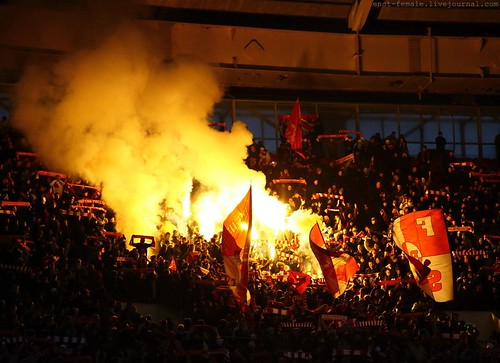
Central Moscow erupted in rioting this weekend as nationalist football hooligans attacked police officers and state buildings. The riots are the result of an explosive mix of ethnic tensions, ultranationalism and football that has cast doubt over the decision by FIFA a week ago to select Moscow as the host of the 2018 World Cup. Today the tensions continue. Hundreds of anti-riot police have amassed around Red Square and the Kremlin.
In Russia, as in much of Europe, football hooliganism often goes hand-in-hand with white supremacy and neo-nazi movements. The spark that lit the fuse for this particular riot came several weeks ago, when an ethnic Russian football fan was killed during a fight with a group of men from the predominantly Muslim North Caucasus region of the Russian Federation. He was a fan of the Spartak Moscow football team and a member of one of its most aggressive fan groups - or "firms" as the Russian hooligan groups like to call themselves. The Caucasian man arrested for the murder was subsequently released, prompting outrage from the Spartak Moscow fans who say the police are favoring the ethnic minorities.
Subscribe to:
Posts (Atom)