
Showing posts with label G20. Show all posts
Showing posts with label G20. Show all posts
Monday, 10 July 2017

Friday, 4 November 2011
Who is the villain in the eurocrisis movie?
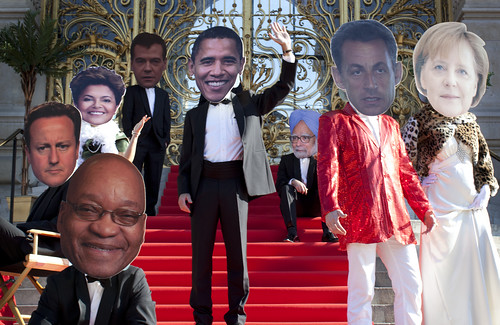
The leaders of the world's 20 richest countries intended to come to Cannes to come up with a solution to global economic crisis which is quickly spiraling out of control. But a shock announcement Tuesday from the Greek prime minister that he would hold a referendum on Greece's acceptance of the bailout package worked out last week changed all that. The resulting outcry threw the Greek government into disarray, putting it near collapse - which could have precipitated a global emergency. The leaders of the 20 richest countries in the world ended up working out nothing, spending the entire summit glued to their blackberries waiting for news from a tiny country in the Mediterranean.
The leaders left Cannes tonight with nothing to show for their meeting. No plan to save the eurozone, no funding, and no consensus. Indeed the G20 summit has ended with the world in a worse state than it was in when it started. Europe, and the world, could be just days away from economic collapse if the Greek government collapses tonight in a no-confidence vote scheduled for midnight.
Thursday, 3 November 2011
Was it all for nought?

Papandreou is facing the same level of fury at home, much of it coming from within his own party. His own finance minister broke ranks shortly after the announcement and reacted with incredulity to the idea of calling a referendum. Papandreou's Socialist government is now hanging by a thread as it looks like he will have to step down or face an imminent vote of no confidence.
Reports coming out of the G20 meeting this afternoon indicate that Papandreou may have been convinced to cancel his call for a referendum. But whether he cancels the referendum or his soon-to-come replacement does, it will only serve to enrage the Greek public further. Promising them a referendum and then snatching it away is undoubtedly worse than having never promised a referendum at all.
Monday, 28 June 2010
When Dave met Barack

There was the famously close relationship between Ronald Reagan and Maragaret Thatcher – two leaders whose ideologies had barely a hair’s length between them. Then there was the notoriously bizarre close friendship between Tony Blair and George W. Bush following September 11th - two men on opposite ends of the political spectrum united by their shared Christian evangelism and anti-terrorism crusade. That buddy-buddy relationship didn’t work out so well for Mr. Blair’s political career or for the UK as a whole.
Gordon Brown’s relationship with Barack Obama wasn’t exactly close (their first meeting was notoriously bungled) but the two men were singing from the same hymnsheet: during the economic downturn the best remedy was an injection of public spending and strong state action. Together they were able to convince the rest of the G20 nations that this was the best course of action, resulting in the consensus and unity of purpose displayed at the 2009 G20 summit in London.
Friday, 3 July 2009
Awkward Handshakes in Italy
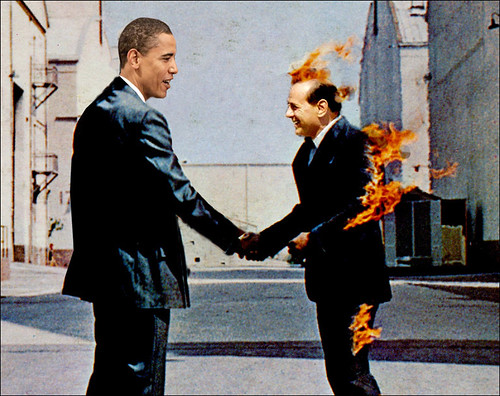 Given his squeaky-clean image, Barack Obama is probably not thrilled about the prospect of clasping hands with sex-scandal-plagued Silvio Berlusconi next week as the Italian prime minister hosts the G8 summit in Italy. Berlusconi, dogged by allegations of sex with minors, hiring prostitutes and organising lavish orgies at his Sardinian villa, will probably be uncomfortable company for all of the G8 leaders, especially for the lone female leader, Angela Merkel. After the stories that have been unveiled about the prime minister’s treatment of women, she’s probably going to feel pretty uncomfortable standing next to the 72-year-old Lothario.
Considering the huge blow this scandal has dealt to Italy’s image abroad (which Berlusconi has bizarrely blamed on foreign media rather than on his own behaviour), this is going to be an awkward few days. But add to that the hugely controversial “vigilante justice” law passed by the Italian parliament yesterday, which will allow citizen patrols to dole out punishments on the street, and you’ve got a hugely important meeting happening in a country that observers fear is edging closer and closer toward a return to fascism.
 In reality, the expectations for this summit are not very high. The meeting is sandwiched between the more important G20 summits in London and Pittsburgh where actual policy on the financial crisis was and will be devised. There will eb some important statements on climate change during this summit, but those policy shifts were dictated by Obama, not Berlusconi. And on development and aid, there is likely to be little in the way of commitment, and even the location of this meeting seems insultingly absurd in that area considering Italy has one of the worst reputations in the Western world for meeting aid commitments, cutting its aid to poor countries by 56 percent this year.
Italy is now so concerned about its rapidly deteriorating image abroad that the president this week begged his country's politicians and journalists to protect Italy's international reputation international reputation by ceasing all talk about the prime minister's sex scandals. Italy's media, which is mostly owned by media tycoon Berlusconi, may be only too happy to comply. But it's unlikely the foreign press will
 Though Berlusconi has tried to make the location of this year’s summit reflect a global mood of “sobriety and solidarity” by moving it to the central Italian region of L’Aquila – battered by a devastating earthquake last year – it’s likely that to many the location of this year’s summit will instead highlight the absurdity of the group’s very existence. If the G8 is supposed to stand as a model for the developing world, why does this year’s host more closely resemble a Central American dictator than a respectable leader of a great power? Why is China - which has the world’s third largest GDP - not in the group, while Canada – ranked 11th – is? Does the G8 still have any moral or economic legitimacy? Is it even relevant? These questions will likely be asked more forcefully as the summit is held in a country with such embarrassing political, social and economic problems.
‘The New Blackshirts’
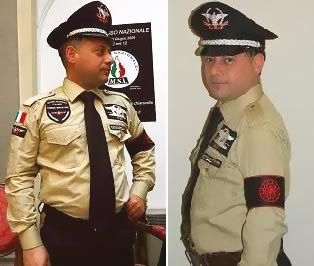 On Thursday the Italian parliament authorized unarmed citizens' patrols patrol Italy's streets, aiding law enforcement and dispensing justice. In anticipation of the move, a right-wing uniformed group called the Italian National Guard was set up last month. They wear beige uniforms and black military-style hats, much like Benito Mussolini's fascists. That group will shortly begin patrolling the streets. The legislation follows significant recent gains by Italy’s neo-fascist parties, most notably when Gianni Alemanno was elected mayor of Rome last May.
The same legislation will make illegal immigration a criminal offense in Italy, introducing fines of €5,000 to €10,000 for those caught, extending detention periods for illegal migrants to six months, and introducing prison terms of up to three years for anyone housing them. It follows recent moves by the Italian government to introduce mandatory fingerprinting for Romani people (gypsies).
Aftershocks and Futureshocks
There was apparently another earthquake in L'Aquila just today - an aftershock from the previous one that devastated the area. One can question the wisdom of holding a meeting of the world's most powerful leaders in an earthquake-prone area, but its perhaps earthquakes of the political variety Berlusconi is most eager to avoid. He is no doubt very aware that his first government eventually collapsed in 1994 after a newspaper published court documents relating to allegations of corruption against him while he was hosting an international security summit in Naples. He’s also surely aware of Italy’s humiliation in 2001 after violence and heavy-handed police action marred the last G8 summit he hosted in Genoa. Berlusconi has passed a lawmaking himself immune to criminal prosecution, so he doesn’t have to worry any more about being subject to any legal embarassment. But he does have to worry that Italy’s host duties will put his philandering behaviour in the international spotlight in a way that is finally too unpalatable for the Italian public, who have so far stuck by the prime minister with approval ratings as high as 72%.
It has been speculated that large swathes of the Italian public are actually unaware of the sex scandal surrounding Berlusconi because he owns most of the media in the country and his stations and newspapers have avoided covering it. But the high-profile nature of the G8 summit could make a further whitewash impossible over the next week if the allegations somehow become connected to the summit.
One thing is for certain – Berlusconi will have to tread carefully over the coming week, and he will have to be on his best behaviour. It looks like Italy’s meter maids, for this week anyway, may get a reprieve from the unprovoked humpings.
Thursday, 2 April 2009
"The Old Washington Consensus is Over"
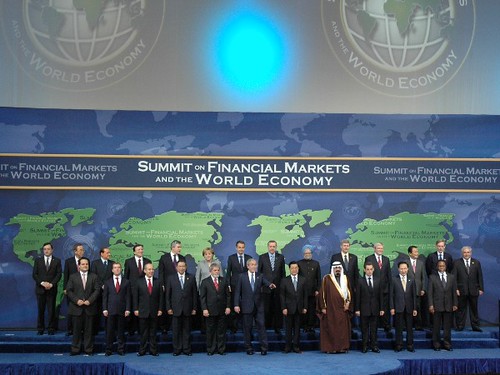 The G20 has wrapped up, and from Gordon Brown's speech today, it looks like France and Germany have in many ways won the day. There was little in the way of new national loan-free stimulus, and much in the way of a new regulatory system, the death of tax havens, and an end to credit-hungry consumerism. In short, today was the last day of the Anglo-Saxon model of capitalism.
So what will replace it? It's not quite clear yet. In fact all that is clear is that the old system is done. "The old Washington consensus is over," Brown declared today. In his press conference later, Barack Obama said much the same thing. Now of course what they were immediately refering to was the consensus which set up the IMF and the World Bank, but the language they used reflected that there is more change afoot here than just a retooling of these two institutions. And yet we didn't get a Bretton Woods 2 today. That will have to be ironed out in some time.
The G20 agreed to majorly reform the organisation of the international financial system, regulating hedge funds, registering credit agencies, overhauling accounting rules, capping bankers' pay, and ending banking secrecy in tax haven countries. The end package included much of what Merkel and Sarkozy had demanded in their joint press conference yesterday, when they said that a complete overhaul of the Anglo-Saxon financial system was nonnegotiable. They also stood firmly opposed to further stimulus. Sarkozy was understandably jubilant today after the meeting, saying that the result was beyond his expectations.
This result will likely help both Merkel and Sarkozy at home, where they are both struggling.
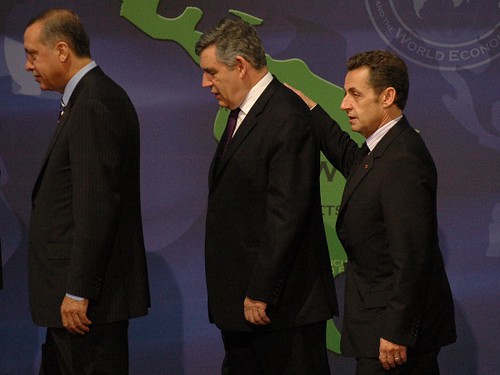 As regards the banking secrecy, Obama was reportedly instrumental in bridging differences between the French and the Chinese on the issue. In the end the Chinese, who are concerned that a banking secrecy clampdown would affect Hong Kong, relented and agreed to the OECD publishing a 'name and shame' list of non-compliant tax haven countries. It will be interesting to see where Switzerland will find itself on that list. In response to a question at his press conference, Sarkozy speculated that Switzerland would find itself in a gray area on the list.
Wednesday, 1 April 2009
G20 Protests Below the Fortress
 I've been out covering the G20 protests in the City today, and aside from a few serious incidents for the most part they were peaceful. Although the big diplomatic events with the world leaders won't take place until tomorrow at Canarry Wharf, the big protest day was scheduled for today in The City, London's financial district. Most of the action was centered at the Bank junction, a large intersection which has the honour of hosting the headquarters of several major British banks, but most notably the country's national bank, the Bank of England. With it's giant imposing walls, much resembling a medeival fortress, it made an appropriate backdrop to a demonstration against the capitalist system.
 The day started out fairly quietly. I did a phone-in report for RTE in Ireland at 10 am and at that time there wasn't more than a few people milling about in front of the Bank of England. But soon four groups of protesters marched to the intersection from four different tube stations. They were organised by a group calling itself the "G20 Meltdown," and they were supposed to represent the four horsemen of the apocolypse. Things started off with more of a carnival atmosphere, but after a few hours they got ugly. The police were using a cordoning strategy and seperated the protestors at the Bank of England into two goups, not allowing anyone to enter or leave those areas. Both peaceful and violent protestors started to become angry that they weren't being allowed to leave, and that was when altercations with the police began. At this point however they were still fairly minor, and the police weren't yet wearing riot gear.
 Soon however a group of protestors managed to break the windows of the headquarters of the Royal Bank of Scotland, and throw smoke grenades inside. Plumes of red smoke came billowing out of the broken windows, and in the confusion a group of protestors were able to storm the building. They quickly started throwing office equipment out of the windows. It took a surprisingly long time for police to get control of the situation. It was at this point that riot gear police entered.
I was able to get out of the Bank of England area using my press pass, and I headed over to Bishopsgate where the climate change protest was happening. This gathering had an entirely different atmosphere. Protestors had converged on the street outside the European Climate Exchange and quickly set up tents in the road. People were singing, dancing, meditating, you name it. As far as I'm aware, there weren't any violent incidents at this gathering.
 What was surprising was that the demonstration that was predicted to be the most likely to result in violence, the march from the American Embassy to Trafalgar Square, had the lowest turnout and was the most uneventful. Interestingly, the anger at these protests didn't seem to be directed at the United States, but rather at bankers or at the global capitalist system. One can only imagine how different these protests would have looked if George W. Bush was still in office. Gone were the effigies and burning American flags that usually accompanied Mr. Bush during his visits to Europe. In fact I would hypothesize that the presence of Mr. Obama at this summit went a long way in diffusing what could have been a very violent day of protests.
 Of course there are still two more days to go, but it looks like the danger of violent demonstrations has passed. Now it's on to the real show, the actual G20 summit. Tonight the 20 world leaders are meeting for dinner, and earlier today Gordon Brown assured the press that the world was "hours away" from a new agreement on the economy. But analysts are cautioning not to expect anything big to come out of this. Summits usually only produce big results if the participants are all in agreement ahead of time, and that is definitly not the case here. German Chancellor Angela Merkel and French President Nicolas Sarkozy have formed an alliance resisting further stimulus money and demanding greater regulatitalist system. Sarkozy has even said he will walk out of the summit if the demands of the continent aren't met. Essentially, this summit could come down to team Obama-Brown versus team Sarkozy-Merkel.
Whichever team you're rooting for, it's nice to see Merkel and Sarkozy getting along again.
Sunday, 29 March 2009
On the Eve of the G20
 I'm heading back to London tomorrow, just in time for the kick-off of the G20 Summit. The meeting of world leaders is already being called the most important G20 ever held, and it isn't just world leaders that are anticipating the big event.
This weekend G20 protests raged across Europe. At least 35,000 people marched in London calling for drastic government action on jobs, welfare and climate change. Of course, protests and the G20 have gone hand in hand since the group's inception, but this year is different. The old protesting stalwarts, who have always opposed the global capitalist system, are now finding a more receptive audience standing at the side of the road watching them march. One large banner at today's protest in London read, "Capitalism isn't working - another world is possible." Four years ago such a banner at the G20 would have seemed silly and irrelevant. For a middle class that has watched the economy collapse around them, the argument may sound quite convincing these days.
Today's march to Hyde Park in London was largely peaceful - just one person was arrested all day, for being drunk and disorderly. But there is a risk that as the week goes on the protests - in London and elsewhere - could turn violent. People are anxious, and there is a palpable sense that this G20 summit may be a turning point in the way this crisis unfolds. Last week George Soros predicted that this G20 summit could be the last opportunity to avoid a world-wide depression.
Large protests have already taken place in Rome, Berlin, Frankfurt, Vienna, Paris, Madrid and Barcelona, and many more are scheduled for later this week across Europe.
It will be an interesting week to be in London.
Saturday, 15 November 2008
The Imminent Collapse of the Pound?
 Gordon Brown is in Washington this weekend, along with the other leaders of the G20 countries, attempting to come up with a solution to the global economic crisis. The ambitions for the group are huge, with suggestions of a global stimulus package and perhaps the creation of a global financial regulatory body. And it is the first time that the leaders of the G8 countries have met to discuss the current crisis with the growing economies like India, China and Brazil, which analysts say will be crucial in jolting the world out of the financial mess its in. But despite the big plans, everyone knows that at this weekend's meeting little is likely to be committed because of one very important absence from the conference: Barack Obama. With the Bush Administration leaving office in two months, countries see little point in making firm commitments now when everything could change come January.
Just now the summit has released a declaration of intent, with key points saying that each country has committed to financial stimulus, with each using government money to prop up the economy. It's also come out with pretty damning language about what got us into this mess, laying the blame on the door of the US and the lack of macroeconomic regulation.
But with little concrete policy news coming out of the meeting, the media in the UK has focused today largely on some side comments made by prime minister Brown on the sidelines. The comments were a response to something said by the Tory shadow chancellor George Osbourne in the Times newspaper today. Osbourne told the Times that Brown's stimulus plans could cause a "proper sterling collapse, a run on the pound." From Washington Brown lashed out at the comments as "irresponsible," suggesting that talk like that could become a self-fulfilling prophecy.
 Osbourne's rant was the first time a senior UK politician has suggested that the country may be just weeks away from a currency collapse similar to what happened in the early 1990's. The pound has lost more than a quarter of its value in four months, dropping from over $2.00 in July to less than $1.50 today. It has also plunged against the Euro, declining by 20 percent just in the last month, particularly in the last week. A Euro is now worth a shocking £1.16. If the currency continues falling at this rate it could be worth less than a euro by the end of the year. With an economy that has become almost completely reliant on financial services, currency speculators seem to have concluded that the UK is going to be disproportionately affected by the economic crisis.
As someone who lives in continental Europe but whose savings and salary are in pounds, this is obviously not good for me. In fact the timing of my little jaunt over to the continent apparently couldn't have been worse. Considering I'll be moving to Zurich at the end of this month (the pound-franc exchange is also not good), it's really hitting home how volatile working across borders can be, especially in times of economic turmoil such as these.
It is clear that Osbourne and many other Tories are hoping that a currency collapse could damage Labour in the same way that the Tories were hurt by the sterling crisis in 1992. But as someone who's livelihood depends on that not happening, I share Brown's annoyance at Osbourne's seeming attempt to use the economic crisis to score political points.
Subscribe to:
Posts (Atom)