Showing posts with label Peter Mandelson. Show all posts

Sunday, 25 October 2009

Brussels - Europe's Pseudo Political Exile?

The European Commission is a strange animal - a massive maze of overlaping departments, constituencies and nationalities. Given that it can be difficult to wrap your head around, I often feel that the perception of "democratic deficit" in the EU has a lot to do with the public's lack of understanding of what the European Commission - the EU's executive branch - is. So I thought this weekend's news from Germany might make a good anecdote for explaining some of its idiosyncrasies.

News is emerging this weekend that German chancellor Angela Merkel will replace Germany's Social Democrat commissioner Günter Verheugen with Conservative Guenther Oettinger. This is a natural consequence of the election result last month, when Merkel's Conservatives got enough votes to kick the Social Democrats out of her coalition government. As they say, elections have consequences. The voters of Germany cast their lot with the Conservatives, and so they will now have a Conservative German commissioner in the EC, hand-selected by Merkel.

Though the commissioners aren't directly elected, they are nominated by the national governments which people elected - so contrary to common belief they are, indirectly, accountable to voters. If (or when) Labour is voted out of power in the UK next year, the Tories will remove the current British commissioner (Baroness Ashton) and replace her with a Tory when the next commission ends after its five-year term.

Another recent election which changed the governing party was in Greece, where the Socialists ousted the Conservative government. For this reason Greece's commissioner, Environment Commissioner Stavros Dimas, will likely be exiting stage left very shortly.

So there's your Democracy. However, there's another aspect of this Germany news which highlights a not-so-reaffirming aspect of the Commission.

Guenther Oettinger is the premier of the southern state of Baden-Wuerttemberg, and has been mired in some controversy in the past. In April of 2007 he gave a eulogy for one of the previous premiers of Baden-Wuerttemberg named Hans Filbinger. Filbinger served in the legal department of the Nazi regime and his involvement with them was an ever-present source of controversy throughout his career after the war (thought he contends he was made to cooperate with the Nazis against his will). In his eulogy, Oettinger played down Filberger's Nazi past and for this he was widely criticised. He even received a public scolding from Angela Merkel for it.

So immediately after news emerged of this pick there were rumblings of discontent - not so much for the fact that Merkel was putting someone with this controversial background into the position, but for the fact that it appeared like Merkel was trying to quickly shuffle a high-ranking CDU politician who had "misbehaved" out of sight. The Social Democrats came out with a statement today accusing Merkel of "withdrawing a beleaguered premier from circulation," according to M&C.

Now, failing to mention someone's decades-old loose Nazi connections in a euology may not seem like a big transgression, but in Germany it was a notable affair. So it seems as if this could be yet another instance of a national government 'sweeping problems under the rug' by sending problematic politicians to Brussels where they remain out of sight, and yet still relatively powerful.

It reminds me of what happened to Peter Mandelson in the UK four years ago. Mandelson is a hugely powerful politician who was intrumental in the rise of Tony Blair, but a series of scandals eventually made it untenable for Blair to keep him in the British cabinet, and he was shuffled off to a political exile in Brussels in 2004. Now during that time as Trade Commissioner Mandelson was hugely influential, but in the British press it was as if he had disapeared. Finally last year, when Gordon Brown's troubles were growing especially daunting, Brown made a shock move by bringing Mandelson back from Brussels and putting him in his cabinet. Speaking at this year's Labour Party Conference, Mandelson made it sound like he had been locked in a dungeon in Brussels for four years, and had at last been let out to see the light of day again.

That's the rather bizarre thing about commissioners. They are very powerful and they set the policy for Europe, yet once they are in Brussels they often disapear from the front pages of their nation's newspapers. It's a bizarre form of modern political exile in Europe, a way for governments to quickly push someone out of the spotlight who is much needed and talented, but also controversial. From some early political reaction in Germany, it appears that the appointment of Oettinger may be that kind of move.

For some people, like Mandelson, they could never be satisfied with power without prestige. For others, it may suit them fine. I don't know anything abotu Oettinger to say into which camp he falls.

But I do think that this practice of trying to 'hide' ministers in Brussels does a disservice to helping people understand how the EU works and who the people are that are running it. In the end I think what many in Europe call a "democratic defecit" is actually an attention defecit. The commissioners feel unelected and unaccountable because nobody ever hears about them. But in reality, the decisions people make at the ballot box do have an impact on the composition of the European Commission, even if it is a few steps removed down the line.

Wednesday, 30 September 2009

Gordon Brown the Populist?

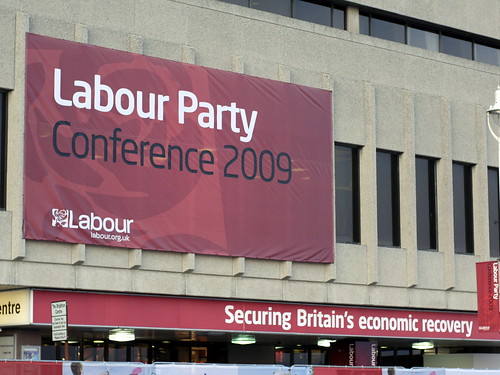
Ah party conference season in Britain. As the ocean breeze wafts in and the trains from London unload hordes of shuffling MPs, there’s always a slight whiff of desperation in these strange rituals. From an American perspective they always seem rather bizarre because they are held every September regardless of whether an election is coming up, whereas US party conventions only happen a few months before an election.

Of course this year there is a real election these conferences are preparing for, as these will be the last gatherings before the polls which should take place next April or May. The three main party conferences are all gearing up for that big showdown, and with the governing Labour party down at record low poll levels (recent polls have put them in third place behind the Liberal Democrats) it has become a natural assumption that the Conservatives will win.

In his rally-the-troops speech yesterday “Our Prime Minister Gordon Brown” basically threw the policy kitchen sink at the crowd, announcing a barrage of blatantly populist measures in a desperate bid to reverse the Labour Party’s fortunes. In the hall it seemed to work – the talk of insurrection was ended and the delegates seemed to resign themselves to the uncomfortable reality that Gordon Brown is not going to step down, and no one in the party is going to challenge him. But considering it was just a few weeks ago that Brown uttered the dreaded ‘c word’ in a speech (cuts – what were you thinking?) and said that Labour was going to have to make some difficult choices, I couldn’t help but wonder where those difficult choices were in his speech. Despite this barrage of people-friendly policies there wasn’t any indication of how any of it would be paid for.


Responding to the MPs expenses scandal, Brown said he will change the law to allow constituents to recall their elected MP – even though this doesn’t really make much sense in a parliamentary democracy. He said Labour would scrap its plans to introduce a national identity card – even though the UK is one of the only countries in Europe to not have one. Labour will increase taxation on the very top earners – even though they already did this last year. Labour will reverse the 24-hour drinking law (which allows pubs to stay open after 11pm if they purchase a special license) in certain areas - even though numerous studies have shown that an enforced 11pm cut-off encourages closing-time punch-ups and traffic accidents. And Labour will scale up efforts to target "anti-social behavior" by menacing youths - even though already those youths are now wearing the ABSOs with pride around their necks.

‘Fat cat’ businessmen will be subject to new regulation that can curb their bonuses – even though it is unclear how this could be enforced by law. Free care for pensioners (seniors) is to be extended in England, though it is unclear where the money for that will come from. And Labour will hold a referendum on whether to change the voting system from the current first-past-the-post system (as exists in the US) to a proportional representation system (as exists in continental Europe).

Free care for old people? No identity cards? Sobering up yobs in city centres? Way to make the tough decisions Gordon. Though this conference was meant to highlight the difference between Labour and the Tories, to me it seemed to only highlight a similarity – both seem to be basing their policy decisions on popular will rather than good decision-making. Granted, several of Brown’s policy announcements are good ones. But his speech was suspiciously lacking in the belt-tightening measures he said were necessary just weeks ago.

I was pleased to hear him mention the Tories dangerous Europe policy in his speech, but I wish he had gone into more detail about it as most British people don’t know anything about the Tories’ move to the fringes of the European Parliament. Of course ‘Europe’ isn’t such a crowd-pleasing word to use in British politics, so I’m surprised it got a mention at all.

The big story of the conference however was Lord Mandelson’s speech. It’s incredibly entertaining, you really should watch it. Unsurprisingly it was almost all about him, but it was remarkably engaging and animated for a British politician’s speech. In fact the general media commentary is that it was overly so, with some comparing his performance to an overdramatic drag queen in a panto show. Of course any American watching this speech would be perplexed as to why the British media is characterising it in this way, but you have to keep in mind that British politicians are not known for their engaging speaking style.


Personally I loved the Mandelson speech. It was exactly what the Labour Party needs right now – dynamism, self-confidence, pizzazz. Mandelson was a close ally of Tony Blair and is known for his cut-throat ways, accused by many of trying to convert British politics to an “American style” of personality-driven politics. His performance was so animated that, if it weren’t for his constant praise of his former enemy Gordon Brown, I would have thought he had designs on challenging Brown for the leadership himself. Watching his speech I thought to myself, “Well, why not?” He’s engaging, intelligent, charismatic – and has a breath of new ideas and experience. I’m not sure whether it’s the fact that he’s gay or his reputation for treachery that has made him calculate that he could only ever be the power behind the throne, but as Labour’s fortunes continue to decay, maybe they should just try it. But I’m not as clued in to British politics as others, is this a crazy thing to suggest?

Incidentally, I was a bit perturbed by Mandelson’s characterisation of his time in Brussels as an EU Commissioner as a banishment to the wasteland. The UK’s EU Commissioner is arguably the second-most powerful position the British have, though it may not come with the kind of fame and recognition Lord Mandelson relishes. Mandelson is a smart man and he did great work as EU Trade Commissioner. It was a bit annoying to see him toss that off as ‘lost time’ while playing to the home troops.

The conservatives’ party conference will be next, and it will be equally as important. A lot of people I know here in London are thinking about voting Tory but have many reservations about it. Lord Mandelson on Monday told the conference that Tory party leader David Cameron is just a new face on old Tory policy, a cheap sell job presenting a face of moderation that masks old Tory intentions to gut public services and reverse socially progressive legislation. Cameron needs to convince those still on the fence that the Tory party really has changed, that it really has pulled to the centre. Right now a lot of the people who say they will vote conservative in polls may not have the guts to actually do it come election time, because they still have lingering concerns about what the Tories would do.

The best thing Labour can hope for is in-fighting between difference factions of the Conservative party at next week’s conference, and it looks like they just might get it in an upcoming row over whether to hold a referendum on the Lisbon Treaty if it’s already been ratified across Europe by the time the Tories come into power. Ireland is holding its second referendum on the treaty Friday, and all polls predict that this time it will pass, completing the last hurdle for the treaty to be ratified across Europe and go into effect (barring some sabre-rattling from Czech President Vaclav Klaus).

Cameron knows that if such a referendum was held and the vote was ‘no’ (as it would probably be), it would be a violation of international law and would most likely result in Britain leaving the EU – which would spark a diplomatic and economic crisis for Britain. It’s a delicate issue, and it will be interesting to see how Cameron dances around it next week.