Showing posts with label EU foreign minister. Show all posts

Tuesday, 22 March 2011

Europe leads on Libya, but divisions persist

We are only in day four of the Libya War, but it doesn't seem to have taken long for confusion to settle in over where we go next and who is in charge. As the aerial bombardment tapers off and the skies clear into a no-fly zone over the Libyan desert, questions are now being asked that are not only causing disunity within the European Union but also between Europe and the United States.

"In most of the foreign policy issues we've talked about for decades, the US has been the lead player," conservative New York Times columnist David Brooks noted on PBS Newshour a few days ago. "Here we're clearly not the lead player, it's the UK and France and we're following along on the caboose. Now we feel like the UK often feels, as the secondary player. So the question is how much is the president really supporting this and how much is he being dragged along?"

So far the Obama administration has seemed disinterested in the Libya situation, and this wasn't helped by the fact that at the time military action was launched the US president was on a trip to South America and had to give comments on the war's launch from a shared podium in Brazil. Over the past few days US politicians haven't even made an effort to try to convince the American public that this war is in America's strategic interest.

Tuesday, 1 February 2011

Better the devil you know

Both Europe and the United States have been put in an awkward position this month by the unfolding political revolt in Egypt. On one hand, they want to be consistent in encouraging democratic values and they don't want to be seen to be propping up dictatorships. On the other hand, they are terrified of the instability that could be set off by a political meltdown in the Middle East's most populous country. This is not helped by the fact that the Muslim Brotherhood is the second most powerful political force in Egypt after the regime of president-for-life Hosni Mubarak.

As the saying goes, better the devil you know than the devil you don't. Thus, the statements coming out of Brussels and Washington this week have been tepid and non-committal, stressing the need for stability over any ideological talk of overthrowing tyrants. The west is no great fan of Mubarak, but his semi-dictatorial rule has kept Egypt's strong Islamist movement in check and kept the country at peace with Israel. If he goes, there's no telling who might replace him.

The EU has come under particular criticism, as political violence has unfolded around the Mediterranean, for its slow reaction to events in its own backyard. This has been a particular embarrassment for the EU because its new diplomatic arm, the EEAS, was supposed to make Europe more decisive and reactive to foreign policy issues. And yet as one riot after the other has unfolded across the Mediterranean over the past weeks, the EU has been very restrained in its reaction.

Thursday, 20 January 2011

EU targets Europe's last dictatorship

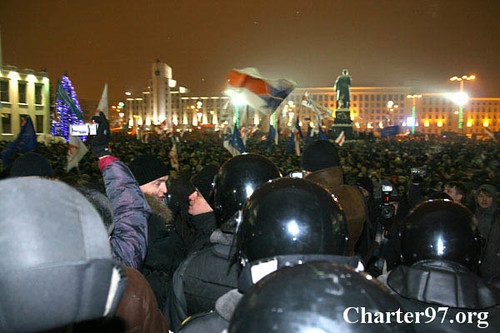
The EU is threatening to cut off relations with its Eastern neighbour Belarus and impose a travel ban on its leaders following a brutal crackdown on dissidents in the country during a rigged election last month.

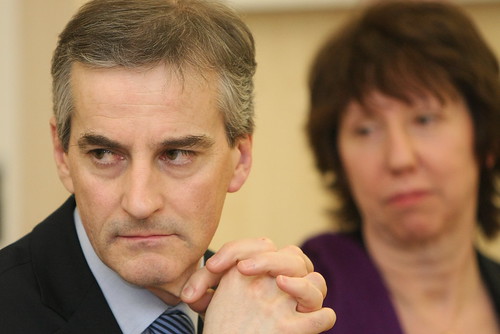
It is perhaps the most crucial test of will yet for the EU's first foreign affairs chief Catherine Ashton, who is expected to issue an ultimatum to 'Europe's last dictatorship': release the political prisoners arrested during the election or fact a travel ban in the West. She will push EU foreign ministers to adopt the travel ban on 31 January, and all indications are that they will all comply. The US may then follow the EU's lead with joint sanctions.

Today the European Parliament adopted a resolution calling for the EU to impose a travel ban and asset freeze on all Belarusian officials, judges and security officers involved in the violent crackdown. They are demanding that Belarus re-run the elections in accordance with international standards before the sanctions can be lifted.

Tuesday, 26 October 2010

EU considers closer ties with Cuba

In one of her first moves after the EU's foreign relations arm (the EEAS) comes into existence at the begining of December, the new EU foreign affairs chief Cathy Ashton is going to contact the Cuban government to explore closer ties with Havana, according to news reports today. The development is interesting because it shows how the new EU foreign policy, made possible by the adoption of the Lisbon Treaty, may seek in some ways to be a counterweight to American foreign policy. But there are deep divisions within the union about whether it should seek a different policy toward Cuba than the United States.

The EU has in fact had a "common position" on Cuba since 1996, but this policy has been seen by some as a NATO-crafted backing of the American position on Cuba. It says that EU member states will only normalise their links to Cuba if the country makes progress on democracy and human rights. Spain has been the leading voice for increasing ties with Cuba, and over the summer they were keen to highlight to Brussels Cuba's decision to release 52 political prisoners. According to reports, these pleas from Spain have found a sympathetic ear with Ashton.

Wednesday, 24 March 2010

A Gallic Plot?

Yesterday there was an amusing story going around about how the French Europe minister has invited Catherine Ashton, the native Brit recently appointed as the EU’s first foreign minister, to learn “the language of diplomacy” at a school near Avignon.

It was more of a tongue-in-cheek jest than an actual offer for assistance, but Ashton has taken him up on it and will be spending a month this summer in the south of France taking French lessons. But of course France’s offer wasn’t really about language. It reflects the increasing French dissatisfaction with Ashton as she creates the new EU diplomatic corps, which they fear is going to be dominated by the English.

Ashton speaks only rusty French, and she will only take questions at press conferences in English – a fact which has deeply irritated the French media. The fact that Ashton does not speak fluent French has been continually pointed out by those who think she is not qualified for the job. This is particularly true in France, where the phrase “the language of diplomacy” is not used with a smirk or as an old-timey throwback, but as their actual understanding of the world. Of course the reality is that French ceased to be the language of diplomacy 70 years ago, but don’t tell that to the French. Even within the EU, English has largely replaced French as the lingua franca since the accession of the Eastern European member states in 2004.

Friday, 20 November 2009

EU Low Representatives?


The look on Catherine Ashton’s face last night said it all. Shocked, flustered and almost a little embarrassed, the largely unknown British commissioner chosen to be the EU’s first “foreign minister” said it was a sign of her surprise that she had no acceptance speech prepared. Speaking in a softly reassuring tone, she said she would pursue a “quiet diplomacy” - characteristic of her low-profile approach to politics. 

Standing beside her, the expression of the unassuming Belgian prime minister Herman Van Rompuy was equally telling. Constantly switching languages every few minutes, he spoke of his reluctant acceptance of the offer from member state leaders to become the European Council’s first president. Oscillating between English, French and his native Dutch, a portrait emerged of a man who has gained a reputation as a quiet consensus-builder, having rescued the national Belgian government from collapse two years ago. 

And with them on the podium stood a beaming European Commission President José Manuel Barroso, a clear winner from last night’s announcement. In these two very low-profile picks Barroso will not have the competition for leadership he feared from a pick like Tony Blair or Jean-Claude Juncker. Since Rompuy will largely relegate his role to being a secretary-coordinator for the European Council, Barroso will continue to be the EU’s de facto leader. And with the demise of the rotating council presidency, he no longer has the prospect of an upstart national leader stealing the show every once in awhile. 

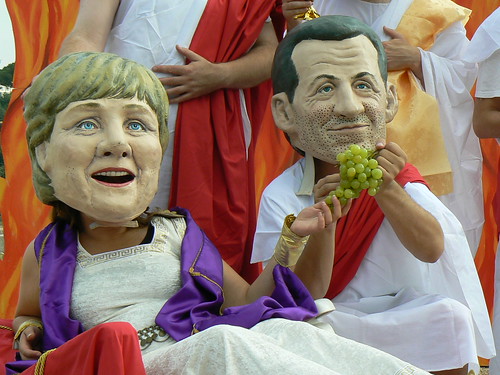
Together the three of them have been dubbed by bloggers today as the “Troika of Boredom” - three rather unengaging and unambitious politicians who are unlikely to give the EU the respected high profile it had sought to achieve by creating these new positions. Indeed, the reaction from Brussels blogs last night and this morning has been overwhelmingly unimpressed. Many are seeing the choice of two rather weak personalities as a deliberate effort by Angela Merkel and Nicolas Sarkozy to ensure that there is no strong supranational EU figure that could challenge their authority in the council. 

As for the fourth man standing in the group, his body language made it clear where his institution is headed. Frederik Reinfeldt, Prime Minister of Sweden (which currently holds the rotating council presidency), was practically being edged off the stage. The rotating country leadership will still continue to host meetings for the Council of Ministers, but it will no longer have any symbolic leadership role.

Franco-German Stitch-Up

Though the people selected for these new EU positions are being seen as boring, the selection itself is anything but. In fact, it is incredibly important. The remit of these two positions was left very vague in the text of the Lisbon Treaty, and all along its been said that the presidency would be defined by the first person who holds the job. 

If it were a high-profile person with much political clout, the presidency could become a powerful position capable of speaking with one voice for the EU on the world stage. If it was a low-profile choice, the presidency would become merely a coordinator role, a consensus-builder who would work behind the scenes to get the different leaders of member states to reach agreement. With the selection of Van Rompuy, member state leaders have made a clear decision about which way the presidency should go. His term length may just be two-and-a-half years, but if Rompuy takes a ‘low-profile coordinator’ approach to it as expected, it would be difficult for the next president to fundamentally reshape the precedent the Belgian set. 

But is this really what EU leaders wanted? Gordon Brown may have had his differences with Tony Blair in the past, but he seems to have been legitimately insistent that Blair should get the position. Indeed, it appears the choice of Ashton was made as a compromise to Brown in exchange for his abandoning the Blair cause. Sweden’s foreign minister seemed less than enthusiastic about the choice this morning, and many in Eastern Europe have been voicing grumbling discontent with the decision today. Certainly the Socialist leaders of Spain, Portugal and Greece can’t be pleased about it, considering they got the short end of the stick. Ashton is a fairly moderate politician who has little to no foreign policy experience. 

This will be largely seen as a Franco-German stitch-up. Merkel had indicated her preference for Van Rompuy early on, and after she persuaded Sarkozy to give up his preference for Tony Blair, the two announced they would be presenting a united front in their selection. This provoked accusations of bullying, with Sweden’s prime minister saying the decision should not be made by just the French and Germans. Certainly, it is a sign of Britain’s lack of influence in Europe that even as one of the ‘big three,’ it was unable to fight against a Franco-German alliance.

“Political Pygmies”

Certainly these two new ‘high representative’ positions were not the only part or even the main part of the Lisbon Treaty. Still, they were a significant part. And after eight long years of fighting for it, this decision has many asking, “What was the point?” The intention of the positions was to give someone the authority and clout to represent the EU on the world stage and stand toe-to-toe with the US and China. These two are unlikely to be able to do that, which bounces authority back to Barroso and back to the status quo, with no united voice for Europe. 

Many federalist Europhiles found themselves in the strange position of agreeing with UKIP leader Nigel Farage last night. Bizarrely, he told the BBC, "We've got the appointment of two political pygmies. In terms of a global voice, the European Union will now be much derided by the rest of the world."  But…isn’t that exactly what UKIP wants? The cognitive dissonance is even more impressive than usual on this one. 

For their part, the Tories praised the decision to go with a low-profile person rather than Tony Blair, with shadow foreign secretary William Hague saying, "I am very pleased that those of us across Europe who said that the president should be a chairman, not a chief, have won the argument.” 

Both the Tories and UKIP were also quick to point out that Baroness Ashton has actually never been elected to anything in her life. She spent most of her career working for a charity run by Prince Charles before being appointed as leader of the House of Lords in 2007 by Gordon Brown. When Peter Mandelson left his “Brussels exile” to return to Westminster in 2008, she took his place as EU Commissioner for Trade, where she’s served for about a year. Trade Commissioner is one of the most important roles in the EU and involves a lot of negotiation with foreign trade bodies (particularly those in the US and China). However it doesn’t necessarily involve any areas of foreign policy outside of trade. 

For his part, Van Rompuy is being lauded by his supporters as someone who united the warring Flemish and Frencophone factions of the Belgian parliament and brought the national government back from its year-long long shutdown in 2008. He reportedly took that job reluctantly after being asked by the Belgian king, who pleaded with him for 90 minutes. He had been set for retirement, and had already been on a long hiatus from politics. Merkel and Sarkozy have argued that his skills as a quiet consensus builder make him perfectly suited to coordinate the diverse member states of the EU. 

But it’s unclear whether this skill will translate to a European level. The disagreements in Belgium are between two parties, not 27. And authority in Belgium has been so devolved to the regions of Flanders and Wallonia by this point that the national government barely does anything at all – as evidenced by the fact that it was barely noticeable when the national government shut down for about a year. Is it that impressive that he was able to bring back to function a body that is largely symbolic by this point anyway? The EU may have it’s problems but it is by no means dysfunctional and is not about to shut down.

Realism

Perhaps the consensus reached last night appropriately reflects the fact that many Europeans are not ready for the notion of an “EU President.” The Liberal Democrats in the UK had an interesting interpretation of the decision yesterday, telling the BBC that the decision would expose the stupidity of the Eurosceptic British media referring to the Lisbon Treaty as if it was solely designed to create a powerful EU presidency for Tony Blair. Foreign affairs spokesman Ed Davey said,
"With low-profile appointees, no-one can take seriously any longer the Eurosceptic deception that these positions would challenge the supremacy of nation states acting together when they agree."
From the perspective of the UK and Scandinavia, where the prospect of an “EU President” was most unpopular, this may be true. But what about the many other Europeans who wanted the EU to speak with a stronger, more coherent voice on the world stage? Who now will have the clout to stand up to the United States in situations like the Iraq War? Who now will bring trade power to bear in negotiations over climate change? The decision to choose low-profile people may allay some of the fears expressed in the British media, but does it do so at the expense of offering a solution to the problem the Lisbon Treaty was trying to solve? 

Time will tell how these two will use their roles, but it looks like the wild card is more likely to be Ashton than Van Rompuy. She is younger, newer, and there is less known about her political stances on foreign policy issues (she by the way has a very left-of-centre husband I understand). Van Rompuy is unlikely to surprise anyone and will probably stick to a low-profile role. But it she wants to, the Baroness could shape the EU's foreign policy positions to be far more powerful than the presidency. 

That is, if she is so inclined.

Tuesday, 10 November 2009

Miliband says there’s no place like home

It would appear David Miliband decided to click his ruby slippers three times yesterday in Berlin, definitively turning down the new position of EU ‘foreign minister’ and opting to return home to a troubled government in the UK.

Of course this could all just be a ruse to take him out of the ‘frontrunner’ status, a notorious handicap when it comes to getting EU appointments. But all indications are that his conversation with the head of Europe’s socialist group yesterday in Berlin was genuine – he will not take the new high representative position if offered. Given that it appears Tony Blair is now out of the running for the position of EU president, it looks like there will be no Brits filling either of these two new roles. Given the UK’s lack of participation within the EU, there will be many on the continent who feel this result is appropriate.

Miliband had gained increased attention after a remarkably pro-Europe speech he delivered two weeks ago, saying the UK needed to abandon its ‘hubris and nostalgia’ and engage fully with the EU, working to reform it and make it strong. Given that this kind of talk is so rarely heard from a senior British politician, many Socialists in Europe were so elated they immediately began pushing for Miliband to take the foreign minister post.

However there was always some trouble with this logic. Miliband’s words were so encouraging precisely because he was such a senior politician delivering a pro-Europe speech in the UK. Take him out of the UK, and the beneficial aspect of that is nullified. David Miliband may have a moderately high profile in Britain, but its doubtful that his presence in Brussels would have focused British media attention on the EU in the way that Tony Blair being there would have. As I’ve written about before, a posting to Brussels is often considered a ‘banishment’ in the UK, and politicians sent there quickly disappear from the British media landscape. Having a pro-European in Brussels rather than in Westminster won’t do much to change the UK’s attitude toward the EU.

There was also a question on the mind of continental Socialists as to what sort of benefit he would bring for them as foreign minister. Though New Labour is part of Europe’s socialist grouping it is certainly at the more centrist, Atlanticist end of the spectrum. Miliband is after all a committed Blairite, which taints him with the brush of the Iraq War legacy. There were concerns that an EU foreign policy under Miliband would too often acquiesce to the plans of the United States, rather than offering a strong alternative. Then again, given that the governments of Europe will be dominated by conservative parties next year, it’s difficult to see how a far-left Socialist foreign policy chief could bring Europe to a consensus.

Miliband is still viewed by many as the last great hope for the dying Labour party, and there will be many within Labour who are relieved at today’s news. Many would have seen Miliband’s move to Brussels as a rat fleeing a sinking ship, given that Labour is almost guaranteed to lose the upcoming UK general election next year. In fact there are many who think Miliband is Labour’s last hope, and that the only way the party can win the upcoming election is if he leads a revolt against Gordon Brown and stands as Labour’s leader instead.

Given the widespread loathing of the British Conservative party in Europe these days, there were probably many on the continent from both the left and the right who thought their best hope was to keep Miliband in the UK and hope that he can somehow deal a miracle defeat to David Cameron. Of course if Labour does lose and Miliband becomes the head of the opposition, it's hard to see what benefit his pro-European views will bring then. It's all a bit up in the air, but one thing is certain - you haven't heard the last of David Miliband.

Monday, 2 November 2009

Europe in Denial of a Changing World

The European Council on Foreign Relations came out with an interesting report today on the US-EU relationship, concluding that Europeans “remain in denial about how the world is changing, making a fetish out of the transatlantic relationship.”

In essence the report concludes that Europeans remain stuck in a ‘spectator’ mindset, harbouring damaging “illusions” acquired over “decades of American hegemony.” The result, the authors conclude, is “an unhealthy mix of complacency and excessive deference” to the United States, which has a “rapidly decreasing interest” in a Europe as it fails to speak with a strong united voice in the world.

The report is not just a rebuke of the nationalists and isolationists spread across Europe, it is also a rather grim summary of how the US views the prospects of the EU actually rising to the challenge. Though the US badly needs a strong partner to counter the rising influence of China and would like to see a more united EU, the consensus in Washington since 2005 has been that it is unlikely to see that materialise. So it now essentially takes a piecemeal approach to treating Europe as an equal partner. When Europe is strong and united in trade issues, Washington listens. When it is split in foreign policy however, it ignores them. In the later scenario, where different national governments act individually, the report concludes, “Europeans are asking to be divided and ruled.”

The result of all this, the authors concludes, is “a frustrated US and an impotent Europe.” The situation manifests itself, for example, in the Afghanistan conflice – where Europe has 30,000 troops yet virtually no say in strategy. They write:
“European governments need to get over the mistaken belief that their individual ‘special relationships' matter in Washington, and learn instead to act together and speak to the US with one voice.”
Reading this report, I can’t help but feel that it is in large part addressed to the UK in particular. The British public should keep these things in mind when they head to the polls next year. As I’ve written about before, Cameron’s Europe policy will have important ramifications for not only the future of the UK, but the future of Europe as a whole. As the report points out, the danger of ‘damaging illusions’ in policy-making are no insignificant matter.

Wednesday, 4 April 2007

Could a strong EU solve the Iranian hostage crisis?

It looks like the Iranian hostage crisis (it’s like déjà vu all over again) may be cooling down, although any hope in this direction obviously has to be tempered with a healthy dose of skepticism. It’s been over a week now since Iran stopped a British vessel in the Persian Gulf and arrested 15 British sailors, saying they had entered Iranian territorial waters. Britain is denying that they were in Iran’s territory and have showed GPS records and photographs to prove it. But Iran has refused to back down and is demanding an apology from the UK in order to even begin discussing the sailors’ return, along with an agreement to never violate Iran’s territory again. With images of the one female seaman being paraded in a headscarf all over British media, many are naturally outraged and are furious at the government’s inaction.

But the reality is, Britain doesn’t have a whole lot of options here. The UN security council couldn’t get a resolution condemning the Iranian action (Russia refused to go along). Everybody involved in this, including the Iranians, know that the ship was not actually in Iranian territory. The cause for this situation goes much deeper than that, having little to do with Iran and the UK and everything to do with Iran and the US, which still have no direct talks with each other. Iran is still seething over the detention of several Iranian diplomats in Iraq who have not been released. Just today this story broke in the Independent which casts some light on the real reason for this diplomatic stand-off. Apparently the US tried to kidnap some very high-ranking Iranian officials and failed. This move may have been a rush by the Iranians to get something to bargain with before the US makes another attempt. And since the US refuses to speak directly with Iran through diplomacy, kidnapping soldiers from a country allied with the US may be the only way they're choosing to communicate.