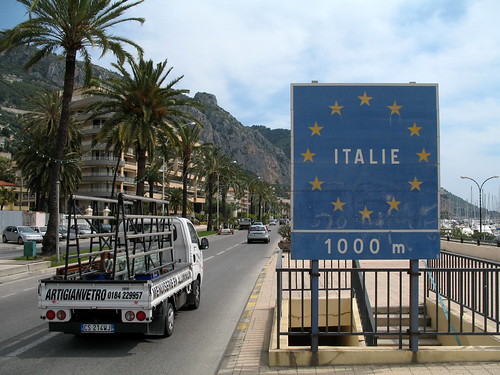
The June summit of EU leaders has wrapped up here in Brussels – the blockades are being removed from the streets and the whirl of helicopters overheard is slowly starting to dissipate. As expected, the council voted to establish a "safeguard mechanism" in the Schengen passport-free travel zone that would allow member states to reintroduce internal EU border controls in exceptional circumstances.
The final text adopted today says the border checks should only be reintroduced "as a very last resort" in a "truly critical situation where a member state is no longer able to comply with its obligations under the Schengen rules as concerns the prevention of illegal immigration of third country nationals."
Such a mechanism was demanded by Italy and France earlier this year when the two got into a row over illegal immigration happening as a result of the Arab spring. France accused Italy of deliberately sending Tunisian migrants to France and issuing them bogus identity cards because they wanted to get them out of Italy as soon as possible. France said it should be allowed to set up border controls with neighboring countries who are failing in their duties to protect the EU external border. But existing rules forbid member states from imposing border controls at internal EU borders. Italian PM Silvio Berlusconi wholeheartedly agreed, as if to say "Yes, we're completely incompetent. Please allow France to set up protections against us."
Showing posts with label 2011 Arab Revolt. Show all posts
Friday, 24 June 2011
Thursday, 23 June 2011
'Baby steps' toward a real EU border patrol
The EU institutions and member states reached an agreement last night to beef up the EU's border patrol agency, Frontex. The news, coming just before the summit of EU national leaders today and tomorrow in Brussels, shows how much immigration concerns are at the centre of the political agenda right now. While the populist rhetoric in member states is more often calling for less EU rather than more of it these days, an agreement to expand the EU's border patrolling powers was easily reached.
The deal will allow Frontex to buy its own equipment, so that it will be less dependent on helicopters and vehicles leased from member states. It will also make it binding for member states who have pledged personnel to the agency to deliver on their promises. The Frontex patrols will now be coordinated into "European border guard teams" that will be swiftly brought in if a member state is struggling to control it's external EU border – but still only on the invitation of the member state. To date, the only EU member state that ha summoned a significant number of Frontex forces is Greece.
Sunday, 15 May 2011
Eurovision leaves Europe
After two years in Western Europe, Eurovision will return to the East next year – as far East as it could possibly go. Azerbaijan was the surprise winner of the Eurovision Song Contest Saturday night, meaning next year the contest will be held in the Caspian Sea coast city of Baku. It is located just 150km (93 miles) from the Iranian border.
It will be an awkward host city given that the country is in an ongoing conflict with its neighbour Armenia which has sometimes spilled over into the contest, most notably in 2009 when people in Azerbaijan who had voted for Armenia were interrogated by the police. Azerbaijan was almost banned from the contest as a result, but the European Broadcasting Union decided to only give them a fine.
Many people were left scratching their heads Saturday night asking, "Erm, where is Azerbaijan again?". Depending on which definition you use, this will be just the third time that the Eurovision Song Contest will not be hosted outside Europe, following the contests in Israel in 1979 and 1999. The border between Europe and Asia is generally taken to be the Caucasus Mountains, which Baku is technically just South of. It will be the first time the ESC will go to a region with several active military conflicts - the Caucasus is home to disputed territories and ongoing military conflicts in Chechnya, South Ossetia and Nagorno-Karabakh just to name a few. It will be the second time an ESC will be held in a Muslim country, following the final in Istanbul in 2004. That contest, incidentally, was hosted in the European side of that city, west of the Bosphorus Strait.
It will be an awkward host city given that the country is in an ongoing conflict with its neighbour Armenia which has sometimes spilled over into the contest, most notably in 2009 when people in Azerbaijan who had voted for Armenia were interrogated by the police. Azerbaijan was almost banned from the contest as a result, but the European Broadcasting Union decided to only give them a fine.
Many people were left scratching their heads Saturday night asking, "Erm, where is Azerbaijan again?". Depending on which definition you use, this will be just the third time that the Eurovision Song Contest will not be hosted outside Europe, following the contests in Israel in 1979 and 1999. The border between Europe and Asia is generally taken to be the Caucasus Mountains, which Baku is technically just South of. It will be the first time the ESC will go to a region with several active military conflicts - the Caucasus is home to disputed territories and ongoing military conflicts in Chechnya, South Ossetia and Nagorno-Karabakh just to name a few. It will be the second time an ESC will be held in a Muslim country, following the final in Istanbul in 2004. That contest, incidentally, was hosted in the European side of that city, west of the Bosphorus Strait.
Monday, 18 April 2011
Tensions flare at French-Italian border
France and Italy are locked in a war of words today after France stopped several trains from crossing the border between the two countries over the weekend. France, suspecting that Italy was trying to dump North African immigrants into the country, stopped the trains at the old border station between Ventimiglia and Menton, 20km east of Nice. Now, each country is accusing the other of violating the rules of the EU's passport-free Schengen Zone.
Since the pan-Arab uprising began in January in Tunisia, Italy has been sounding the alarm bell about an increase in migrants trying to cross the Mediterranean to escape the chaos in North Africa. The tiny Italian island of Lampedusa, just off the Tunisian coast, has been inundated with refugees washing up on its shores in makeshift boats. There are now more migrants housed in a refugee camp on the island than there are residents.
Italy has asked the EU for assistance in dealing with the migrants, most specifically through deployment of the EU's Frontex border patrol force. They have also asked other member states to contribute financially to the effort, saying that Italy can't afford to patrol the EU's borders all on its own. Because the Schengen Zone is a passport-free area, most of the migrants crossing into Italy are just trying to get into the EU. Once they get into Italy they can go to France, Sweden or Germany without facing a border check.
Since the pan-Arab uprising began in January in Tunisia, Italy has been sounding the alarm bell about an increase in migrants trying to cross the Mediterranean to escape the chaos in North Africa. The tiny Italian island of Lampedusa, just off the Tunisian coast, has been inundated with refugees washing up on its shores in makeshift boats. There are now more migrants housed in a refugee camp on the island than there are residents.
Italy has asked the EU for assistance in dealing with the migrants, most specifically through deployment of the EU's Frontex border patrol force. They have also asked other member states to contribute financially to the effort, saying that Italy can't afford to patrol the EU's borders all on its own. Because the Schengen Zone is a passport-free area, most of the migrants crossing into Italy are just trying to get into the EU. Once they get into Italy they can go to France, Sweden or Germany without facing a border check.
Tuesday, 22 February 2011
Chaos in EU backyard causing panic
The situation in Libya continues to spiral out of control, and EU foreign ministers are scrambling to figure out what to do about it. After the bloc spent days hemming and hawing about whether it would organise an evacuation of EU citizens, Libyan airspace was closed yesterday trapping thousands of EU nationals in the country.
Now there are fears that the country's erratic and defiant leader Colonel Gaddafi will use the trapped Western foreigners as hostages in what is developing into a tense stand-off with the EU. Over the weekend Gaddafi threatened that if the EU criticised his crackdown on protests he would "unleash a flood" of refugees across the Mediterranean to Italy.
The past few days have seen incredible bloodshed in Libya, where Gaddafi's forces have killed as many as 519 protestors. The Libyan air force is even reportedly bombing the protestors from the skies. Yesterday two Libyan pilots landed in Malta seeking asylum, saying they had been ordered to bomb civilians in the protests.
Now there are fears that the country's erratic and defiant leader Colonel Gaddafi will use the trapped Western foreigners as hostages in what is developing into a tense stand-off with the EU. Over the weekend Gaddafi threatened that if the EU criticised his crackdown on protests he would "unleash a flood" of refugees across the Mediterranean to Italy.
The past few days have seen incredible bloodshed in Libya, where Gaddafi's forces have killed as many as 519 protestors. The Libyan air force is even reportedly bombing the protestors from the skies. Yesterday two Libyan pilots landed in Malta seeking asylum, saying they had been ordered to bomb civilians in the protests.
Monday, 14 February 2011
Tunisian refugees overwhelming Italy
Egypt may have stolen the spotlight from the revolution in Tunisia, but the situation there is still in chaos. Since the uprising that overthrew long-time President/Dictator Zine al-Abidine Ben Ali there have been strikes and clashes on the streets and a state of lawlessness still exists as many police officers have abandoned their posts.
Amid all of this Italy said this weekend a flood of Tunisian refugees coming across the Mediterranean Sea have overwhelmed the tiny Italian island of Lampedusa, just off the Tunisian coast. More Tunisian immigrants have arrived on the island in the past week there are residents of the island, they say.
But the situation seems to be mired in confusion and perhaps not a small amount of exaggeration. Though the Italian foreign minister claims that he asked for EU help in stemming the flow of migrants on Saturday, today a European Commission spokesperson said there has been no such request from Italy. In fact, he said, the EU offered Italy assistance but the Italian government refused it. So they were "surprised" by the foreign minister's comments, he said.
Amid all of this Italy said this weekend a flood of Tunisian refugees coming across the Mediterranean Sea have overwhelmed the tiny Italian island of Lampedusa, just off the Tunisian coast. More Tunisian immigrants have arrived on the island in the past week there are residents of the island, they say.
But the situation seems to be mired in confusion and perhaps not a small amount of exaggeration. Though the Italian foreign minister claims that he asked for EU help in stemming the flow of migrants on Saturday, today a European Commission spokesperson said there has been no such request from Italy. In fact, he said, the EU offered Italy assistance but the Italian government refused it. So they were "surprised" by the foreign minister's comments, he said.
Friday, 4 February 2011
An embarrassing day for Ashton and Van Rompuy
Today's summit of European leaders is winding down, and now everyone is waiting for the prime ministers and presidents to emerge to announce what they have decided for the stability of the Eurozone. Between the euro crisis and the turmoil in Egypt, this council has turned out to bear little resemblance to the gathering it was supposed to be – a special summit on European energy issues.
This is actually the first European Council (the summits of European heads of government) that I've covered. Since my beat is environment, there hasn't been an occasion so far where the leaders have had an environmental issue on the agenda important enough for me to spend the day here. Today was supposed to be different. European Council President Herman Van Rompuy, now one year into his newly created position, called for this summit dedicated to energy last year. But as the European debt crisis has raged on, in the past two months it became clear that the seemingly non-pressing issue of energy security and sustainability was going to take a back seat to the crisis. And now that a revolution is underway in Egypt, by yesterday few were expecting to see anything significant come out of this council in the way of energy - even though that was still purportedly the main subject behind today's meeting.
Sure enough, at noon today we received a very short list of conclusions on energy by the council - and there was little to really sink your teeth into. I'm told the leaders spent just an hour talking about energy before moving on to the Egypt issue. Essentially they just looked over the pre-agreed conclusions and signed off on it. Ah well, it did mean I could file my story earlier and be done with it!
This is actually the first European Council (the summits of European heads of government) that I've covered. Since my beat is environment, there hasn't been an occasion so far where the leaders have had an environmental issue on the agenda important enough for me to spend the day here. Today was supposed to be different. European Council President Herman Van Rompuy, now one year into his newly created position, called for this summit dedicated to energy last year. But as the European debt crisis has raged on, in the past two months it became clear that the seemingly non-pressing issue of energy security and sustainability was going to take a back seat to the crisis. And now that a revolution is underway in Egypt, by yesterday few were expecting to see anything significant come out of this council in the way of energy - even though that was still purportedly the main subject behind today's meeting.
Sure enough, at noon today we received a very short list of conclusions on energy by the council - and there was little to really sink your teeth into. I'm told the leaders spent just an hour talking about energy before moving on to the Egypt issue. Essentially they just looked over the pre-agreed conclusions and signed off on it. Ah well, it did mean I could file my story earlier and be done with it!
Tuesday, 1 February 2011
Better the devil you know
Both Europe and the United States have been put in an awkward position this month by the unfolding political revolt in Egypt. On one hand, they want to be consistent in encouraging democratic values and they don't want to be seen to be propping up dictatorships. On the other hand, they are terrified of the instability that could be set off by a political meltdown in the Middle East's most populous country. This is not helped by the fact that the Muslim Brotherhood is the second most powerful political force in Egypt after the regime of president-for-life Hosni Mubarak.
As the saying goes, better the devil you know than the devil you don't. Thus, the statements coming out of Brussels and Washington this week have been tepid and non-committal, stressing the need for stability over any ideological talk of overthrowing tyrants. The west is no great fan of Mubarak, but his semi-dictatorial rule has kept Egypt's strong Islamist movement in check and kept the country at peace with Israel. If he goes, there's no telling who might replace him.
The EU has come under particular criticism, as political violence has unfolded around the Mediterranean, for its slow reaction to events in its own backyard. This has been a particular embarrassment for the EU because its new diplomatic arm, the EEAS, was supposed to make Europe more decisive and reactive to foreign policy issues. And yet as one riot after the other has unfolded across the Mediterranean over the past weeks, the EU has been very restrained in its reaction.
As the saying goes, better the devil you know than the devil you don't. Thus, the statements coming out of Brussels and Washington this week have been tepid and non-committal, stressing the need for stability over any ideological talk of overthrowing tyrants. The west is no great fan of Mubarak, but his semi-dictatorial rule has kept Egypt's strong Islamist movement in check and kept the country at peace with Israel. If he goes, there's no telling who might replace him.
The EU has come under particular criticism, as political violence has unfolded around the Mediterranean, for its slow reaction to events in its own backyard. This has been a particular embarrassment for the EU because its new diplomatic arm, the EEAS, was supposed to make Europe more decisive and reactive to foreign policy issues. And yet as one riot after the other has unfolded across the Mediterranean over the past weeks, the EU has been very restrained in its reaction.
Friday, 14 January 2011
Chaos around the Mediterranean
The explosion of violence this week in Tunisia, the smallest and most affluent country of North Africa, is just the latest unrest to affect the shores of the Mediterranean Sea. From East to West and North to South, the region seems to be on the brink of becoming a hot zone for political crisis.
Rolling riots have broken out against Tunisia's authoritarian president, and the government has cracked down on the protests in such a violent way that the country appears to be headed for political collapse. Across the sea, the government of Lebanon collapsed on Wednesday, and the situation threatens to descend into violence as the various factions vie for control.
Not too far away in Greece, the country is still reeling from massive protests against the government's austerity cuts that have been forced by the debt crisis that has plunged the country into political and financial chaos. And at the western end of the sea, Spain continues to face protests over its own austerity cuts in response to its debt crisis, and the country hangs by a thread as it desperately tries to avoid financial collapse.
Rolling riots have broken out against Tunisia's authoritarian president, and the government has cracked down on the protests in such a violent way that the country appears to be headed for political collapse. Across the sea, the government of Lebanon collapsed on Wednesday, and the situation threatens to descend into violence as the various factions vie for control.
Not too far away in Greece, the country is still reeling from massive protests against the government's austerity cuts that have been forced by the debt crisis that has plunged the country into political and financial chaos. And at the western end of the sea, Spain continues to face protests over its own austerity cuts in response to its debt crisis, and the country hangs by a thread as it desperately tries to avoid financial collapse.
Subscribe to:
Comments (Atom)