Showing posts with label Syria. Show all posts

Friday, 7 April 2017

Europe's misplaced relief after Trump's Syria strikes

Does Trump's military strike in Syria signal that the American military protectorate over Europe is back? 

Last night at a mixer of policy wonks here in Berlin, I could feel the relief in the air.

The details were still emerging, but we knew at that point that President Trump was launching airstrikes against Bassar Al Assad's forces in Syria in retaliation for a brutal chemical weapons attack against his own people.

"It took some time but he's finally becoming serious," one Berliner told me. "He can say all he wants on the campaign trail but now that he's president he has to live up to American responsibilities."

Thursday, 28 July 2016

Despite a gruesome week, Germans keep calm and carry on

Reports in American media of German 'panic' are greatly exaggerated. Most still believe Merkel's refugee policy is the right thing to do.

Over the past week, as Germany was struck by a string of four violent attacks in a row, German Chancellor Angela Merkel stayed on holiday.

It might seem strange for people in other countries. It stands in stark contrast to the political reaction in neighboring France, where French President Francois Hollande rushed to the scene of recent attacks there and made dramatic pronouncements and new policy promises. 

It has matched the general tone of the measured response here in Germany, both from the media and from politicians. There has been no hysteria.

Of course, this is largely because the scale and scope of the French and German attacks were very different. The German terrorist attacks were failures, killing no one but the perpetrator. While the attacks in Belgium and France were co-ordinated large-sale attacks by ISIS cells, the events in Germany have been small attempts by lone wolves. While the other attacks have had clear links with ISIS, the Germany links are tenuous or non-existent.

Thursday, 26 November 2015

For the first time, I'm considering leaving Europe

Europe and America are both facing problems, but Europe's governing structures are more vulnerable and seem ready to collapse. It's left me pondering my future.

Since I first moved to Europe ten years ago, I've been surprised by how often I am asked one particular question - "will you ever move back to America?"

It always struck me as unusual, because I don't think a European who moved to America would get that question all the time. But in the four European cities I've lived in, people have seemed genuinely perplexed about why I'm here. Why would someone prefer to be in Europe rather than the United States? The question always annoyed me, and my answer was resolute.

"No, I'm not planning to move back," I responded. "I have a better quality of life here, I'm no longer in an American bubble separated from the rest of the world and, most importantly, I feel more hopeful for the future here than I did in the United States."

As we come to the end of 2015 I have to ask, is there reason for me to feel hopeful for Europe any more?

Thursday, 3 September 2015

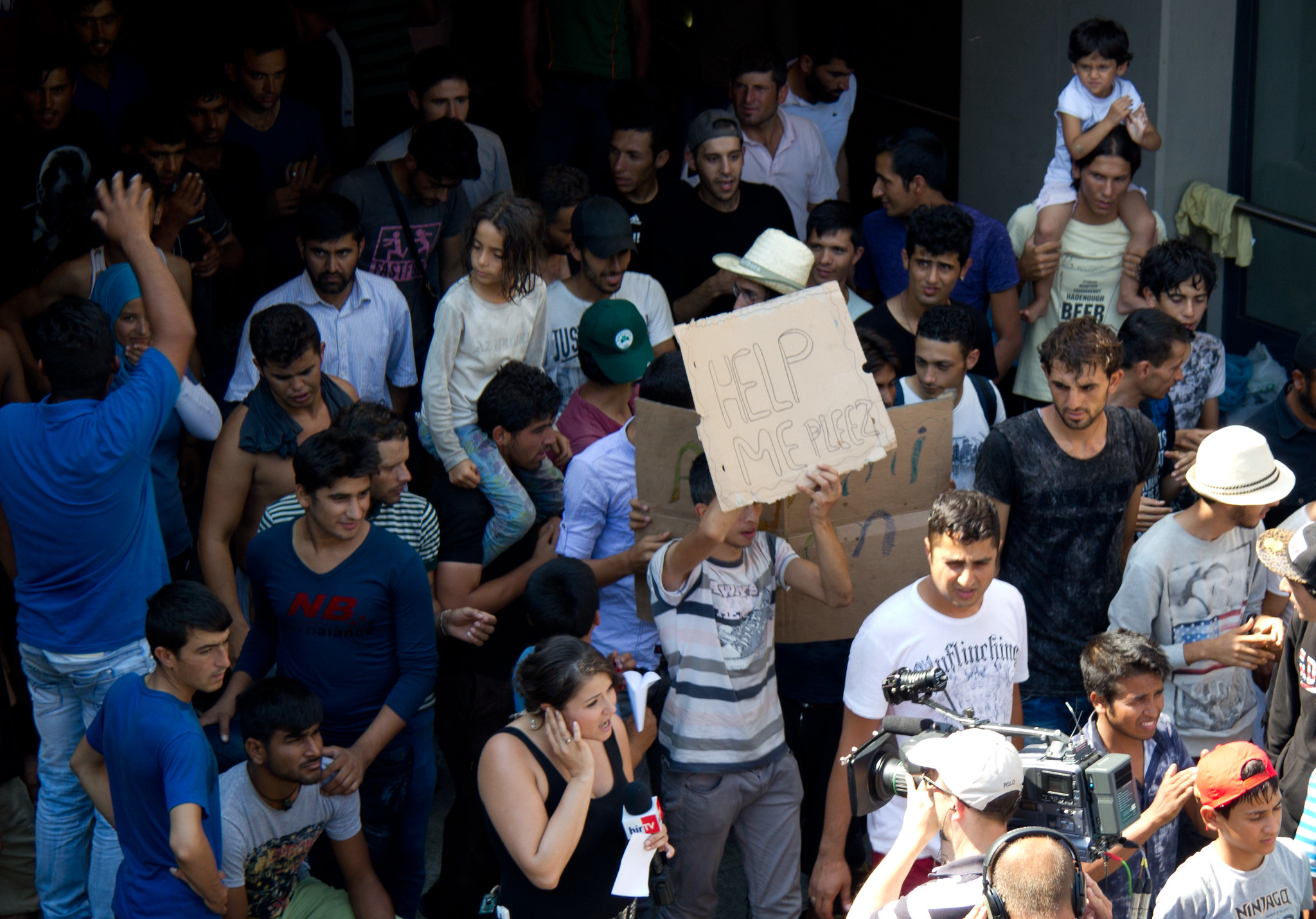
The coalition of the unwilling

Hungary, Poland, Spain and the UK were willing to invade Iraq in 2003, but they are unwilling to deal with the refugee crisis which that invasion has spawned 12 years later. Germany and France are the countries shouldering the responsibility.

Today I bought a ticket for the overnight train from Berlin to Budapest, to interview people next week for a radio story I'm working on about the disappearance of Europe's cross-border rail routes. As I was making the booking at the DB ticket office, the woman gave me a look of concern. "That train is going from Hungary to Germany," she said. "Be careful."

Despite watching the news reports about what is happening at Budapest Keleti Station the past few days, it did not occur to me until that moment that I am going to be on one of these international trains next week. This international train travel piece could end up being very different from what I had planned.

The images of Middle East refugees trampling each other trying to get onto trains to Western Europe in Budapest broadcast today were truly horrific. I'm still a bit unclear about whether these are regularly scheduled trains or specific migrant trains, and whether or not my Budapest-Berlin train will be affected at all. But it's hard to imagine it won't be.

Monday, 14 July 2008

Club Med: Levant Becomes the Focus

Though French president Nicolas Sarkozy's ambitious original plans for a Mediterranean Union have been dramatically scaled down, the group still had its first meeting yesterday in Paris.

Sarkozy was practically beaming after the meeting, calling his idea for the Mediterranean Union an “extraordinary concept,” and heralding the fact that the meeting was able to get Arab leaders and the Israeli leader in the same room. While it's still debatable what impact this new union will actually have, and whether it can really accomplish any of the goals it has set out, it was interesting to see where the media focus on the event seemed to fall.

From the time Sarkozy first suggested the concept during the French presidential campaign last year, the language was always about a union between the “North” and “South” Mediterranean, with seeming focus being on North Africa, the majority of which was formerly held by the French. But the media coverage of yesterday’s event was largely focused on the Levant. The Syrian and Lebanese leaders, both in attendance, said yesterday that the two countries might establish diplomatic relations for the first time in their history. And the Israeli leader said a peace deal with the Palestinians had never been closer. There was also a theoretical statement by the leaders saying they would like to keep the region “free of weapons of mass destruction.” Here's the coverage from ITN:


But there were also significant initiatives announced at the meeting that had nothing to do with the Middle East peace process, including a high-speed rail network from Casablanca to Istanbul, a plan to make the Mediterranean the cleanest sea in the world by 2020 and the development of a common emergency response force to deal with natural disasters in the region. For now though, it was the diplomatic aspects of the meeting that attracted most of the media attention.

Interestingly, with all the talk of the MidEast peace process and further governmental and economic ties, there was no talk about Democracy, or the lack of it, in the Middle East and North Africa. Perhaps such lecturing would have been counter-productive to the larger goal of bridging gaps between the North and South Mediterranean, but it was an interesting omission nonetheless.

Sunday, 26 November 2006

"Arrogant self-delusion"

Wow. Did anyone else see Jordan's King Abdullah on This Week this morning? His observation that the middle east could see three simultaneous civil wars in 2007 was really scary. He painted a scenario in which the Palestinians, Iraq and Lebanon all descend into civil war and chaos. This would be an earth-shattering catastrophe that could easily spread even further to neighboring countries.

And as long as we're talking about all things shocking GOP Senator Chuck Hagel's editorial in today's Washington Post literally made my jaw drop to the floor. It was probably the most sobering, brutal and realistic assessment of what has happened and what needs to happen in Iraq to ever come from a Republican. And it's dead on.