Showing posts with label European Central Bank. Show all posts

Wednesday, 20 March 2013

A Cyprus whodunit

Brussels is in full blame-game mode today following last night’s rejection by the Cypriot parliament of the bailout package offered to the country by the EU. It’s a veritable whodunit mystery, with the answer depending on whether you’re inclined to believe the President of Cyprus, or the rest of Europe.

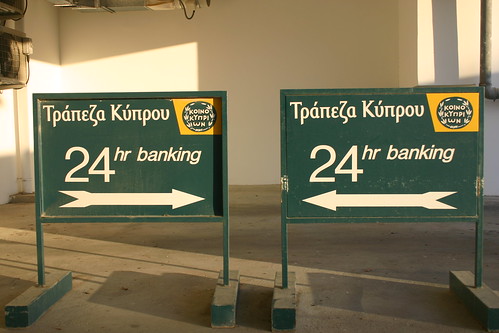
All sides agree on one thing – the decision taken by European finance ministers in the early hours of Saturday morning to require a one-time levy on all Cypriot bank accounts in exchange for the bail-out was colossally stupid, plunging the Eurozone into a new crisis and risking a bank run in the country. What cannot be agreed upon is whose idea it was.

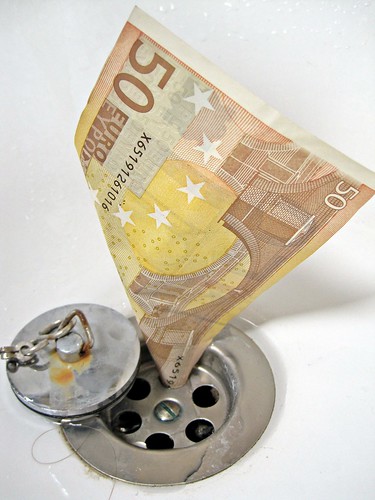
Raiding people’s savings accounts is an unprecedented move. Such conditions were not imposed on any other country receiving bailout money, and indeed no such idea was ever even discussed. But Cyprus is a special case. As the likelihood of an EU bailout for the small Mediterranean island increased, worry began growing that the move would actually be a bail-out for wealthy Russian oligarchs who use the island for money-laundering or tax-evading.

Wednesday, 9 May 2012

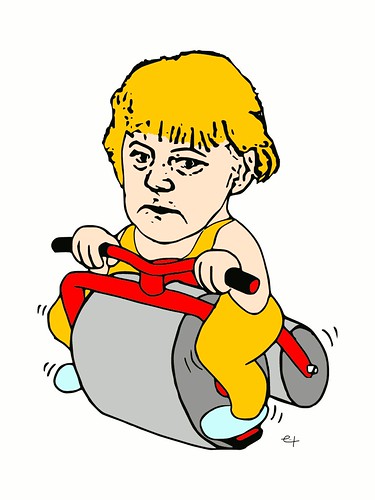
Angela vs. the growth

As predicted, Socialist Francois Hollande ousted the centre-right Nicolas Sarkozy in French elections on Sunday after a campaign in which he railed against the German-led austerity drive in Europe. He has insisted that Europe needs to end its obsession with austerity to dig its way out of the debt crisis, and instead focus on growth.

Coming as it did on the same day that anti-austerity parties in Greece took a majority of the vote, Sunday has been interpreted as a Europe-wide rejection of German Chancellor Angela Merkel and her insistence on austerity and budget cuts. The markets have certainly interpreted it as such. Stock exchanges across the world have taken a dive the last three days, particularly in Europe, over fears that the delicately crafted ‘fiscal union pact’ worked out over the past several months is now about to fall apart.

Whether that actually comes to pass may depend less on Hollande than on how his victory is interpreted in other European capitals. All eyes will be on the new French president’s first meeting with Merkel next week, a day after he is sworn in on 15 May. It is in both of their interests that the meeting goes well. Hollande needs to walk away with something to say that he “renegotiated” the fiscal compact, while Angela needs to reassure the German people that Eurozone countries will still have to adhere to strict budgetary rule while at the same time reassuring the markets that there will be no Franco-German rift.

What will likely be worked out is the addition of a paragraph about stimulating the economy into the compact – something that wouldn’t require new ratifications by national parliaments.

Friday, 4 November 2011

Who is the villain in the eurocrisis movie?

Cannes has seen its fair share of cinematic flops over the years. But this red carpet-laden city on France's south coast has never seen a political flop like the one it witnessed over the past two days. It had all the elements of an edge-of-your-seat political thriller: high stakes, sudden plot twists, personal rivalries and looming global disaster. But who is the villain in this particular script? Today there was plenty of finger-pointing to go around.

The leaders of the world's 20 richest countries intended to come to Cannes to come up with a solution to global economic crisis which is quickly spiraling out of control. But a shock announcement Tuesday from the Greek prime minister that he would hold a referendum on Greece's acceptance of the bailout package worked out last week changed all that. The resulting outcry threw the Greek government into disarray, putting it near collapse - which could have precipitated a global emergency. The leaders of the 20 richest countries in the world ended up working out nothing, spending the entire summit glued to their blackberries waiting for news from a tiny country in the Mediterranean.

The leaders left Cannes tonight with nothing to show for their meeting. No plan to save the eurozone, no funding, and no consensus. Indeed the G20 summit has ended with the world in a worse state than it was in when it started. Europe, and the world, could be just days away from economic collapse if the Greek government collapses tonight in a no-confidence vote scheduled for midnight.

Friday, 21 October 2011

Indignant occupiers and the EU’s ‘sink or swim’ moment

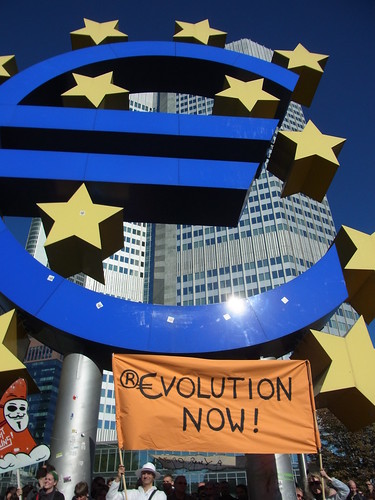
The past few weeks have witnessed a remarkable coalescence between the months-old ‘Indignados’ movement that started in Spain and spread to other European capitals with the ‘Occupy Wall Street’ movement that started in New York and spread to other American cities. Coordinated demonstrations and unrest took place this weekend in from London and Paris to Brussels and Frankfurt.

I was in Italy on Saturday when Rome saw the worst of the violence outside Greece, and the news coverage was clearly unnerved in tone. Everyone is now wondering – where is this all going?

The protests on both sides of the Atlantic are expressing the same frustration: people feel powerless and confused by a North Atlantic economic crisis where solutions seem to be dictated by the all-powerful 'markets'. It's reminiscient of how the Pope in Rome excersised ultimate authority over kings and queens in midieval Europe. Now European and American leaders follow the dictates of 'the markets'. In 2008 following the Lehman Brothers collapse, the US congress was told that it must immediately pass a rescue package for the banks or 'the markets' would panic, causing economic catastrophe. Now European leaders are being told that they must immediately inject an enormous amount of cash into the struggling Southern European economies to prevent 'the markets' from panicing.

Friday, 22 July 2011

Eurozone agrees second bailout for Greece

Stocks are rising today as the markets digest the news that Europe has taken a step back from the brink of economic disaster. Eurozone leaders yesterday agreed on a second €109bn bailout for Greece, something economists said had to come in the next few days to avoid calamity. Once again, Europe's leaders have taken a small step to narrowly avert disaster. But without a big step to reform the Eurozone, is there any end to the debt crisis in sight?

Greece's private lenders will be forced to participate in the bailout and take an estimated 21% loss on their loans to the country, in what is being called a 'selective default'. But it is still unclear whether the ratings agencies will decide this qualifies as a default or not. The private lender participation was something German Chancellor Angela Merkel wanted, but French President Nicolas Sarkozy and the European Central Bank had been resisting.

Wednesday, 20 July 2011

North Atlantic crisis: US, Europe edge toward economic disaster

Normally at this time of year, politicians on both sides of the Atlantic would be preparing for their August break. But there will be no relaxing getaways this year, in what is turning into probably the most anxiety-packed summer of my lifetime.

Both Europe and the US may be just days away from serious financial troubles. And if situations on either continent spin out of control, a worldwide economic panic could be ahead.

On both sides, there are obvious and straightforward solutions that could avert disaster. But in the US, the recent electoral success of a Tea Party movement that wants to see the US default on its debts has rendered the political process incapable of taking action. In Europe, the recent surge toward nationalism and a lack of political courage has rendered the EU incapable of confronting the debt crisis head on. It is a massive failure of the political systems of the Western world.

Wednesday, 13 July 2011

Eurozone in panic: Is Italy next domino to fall?

The Eurozone is looking at several doomsday scenarios this week after Italy emerged as the latest EU state to face serious and sudden attack by international bond and security markets. After a very public spat between Prime Minister Silvio Berlusconi and his finance minister, and with the continued political uncertainty over Berlusconi's position, the markets have decided Italy may not be safe to lend to any longer.

With the paralysis in the country's government likely to prevent decisive action to confront the crisis, some are saying Italy is perhaps days away from becoming an economic failed state. And unfortunately it is not too big to fail, but it is too big for the EU to bail out.

Such extreme rhetoric may or may not be justified, depending on who you talk to. But the risk is extreme. The countries that have so far fallen victim to the debt crisis and required an EU bailout – Portugal, Ireland and Greece – are relatively tiny and their debt makes up less than 5% of overall eurozone public debt. If worse came to worse, France and Germany could afford to buy back all of their debt combined.

Friday, 26 March 2010

To IMF or not to IMF?

You were lucky yesterday if you caught a glimpse of Angela Merkel running around Brussels like a mad woman. The German chancellor was the center of attention during the spring summit of EU national leaders, as all of Europe looked to her to come to the rescue of Greece, and by extension, the Euro currency.

Merkel was going it alone in her unyielding objection to a bail-out for debt-ridden Greece, and she dug in her heels firmly. After much negotiation she relented and agreed to a bail-out, but on one condition – the American-controlled International Monetary Fund would have to be involved. European leaders are leaving Brussels today with a bailout plan in place, but only as an “emergency measure” to be triggered if Greece goes completely broke and cannot get any more credit.

Though it's stabilised the situation for the moment, the solution devised seems to have truly pleased no one. The euro rebounded from its long decline today in response to the news, but the markets did not reflect much confidence in the measure. Merkel is under tremendous pressure. The idea of a bail-out is extraordinarily unpopular in Germany, where many point out that such a bail-out is specifically forbiddon by the Maastricht Treaty. Many in Germany are saying that a core part of the eurozone agreement was that one state would never have to bail out another in the currency union. That, say some analysts, is why Merkel insisted on involving the IMF. Making the bail-out appear like an international effort will shield her from legal challenges that will surely be launched at home on the basis of the fund's violation of the Maastricht Treaty.

Monday, 17 September 2007

ECB on Northern Rock: What Northern Rock?

It’s official. The UK has become the first country to have a bank run caused by the current market turbulence. The run on Northern Rock bank that started on Friday and is continuing today is sending the public here into a panic. British commentators are speculating that there could be another Black Wednesday around the corner, while the Bank of England is trying to reassure the public that there’s nothing to be alarmed about.

Northern Rock is Britain’s fifth largest mortgage lender and is a massive bank here. So when news broke on Friday that the bank is going broke because of the worldwide credit crisis and the Bank of England has bailed it out with a limitless line of credit, the bank’s customers ran to the branches and started queuing to get their money out in cash. It was really insane, I walked by a branch on Friday and it was complete pandemonium, like that bank run scene in It’s a Wonderful Life.