Showing posts with label Euro economy. Show all posts

Monday, 27 June 2011

US getting worried and impatient over euro crisis

The Greek parliament is voting this week on the drastic austerity measures that have been ordered by the EU as a condition for the country receiving the rest of its bailout money. As Washington watches the situation unfold with unease, US officials are voicing an increasing amount of frustration that European leaders do not seem to have the situation under control. And the officials know that if the euro collapses, it could easily take the US economy down with it.

As Quatremer noted today, the euro has become such a powerful currency (now the second reserve currency of the world) that if it runs into trouble it would have a devastating impact not just in continental Europe but throughout the world.

Back in the 1970's when the US took the decision to take the dollar off the gold standard, the situation was watched intensely by the rest of the world. As the US treasury secretary noted at the time, "the dollar is our currency but your problem." Now, with the euro being used by a common market larger than America's, the opposite could be said to America. And the increasing grumblings suggest that American officials don't like being at the whim of decisions being taken across the Atlantic.

Monday, 20 June 2011

EU issues Greece an ultimatum - could it backfire?

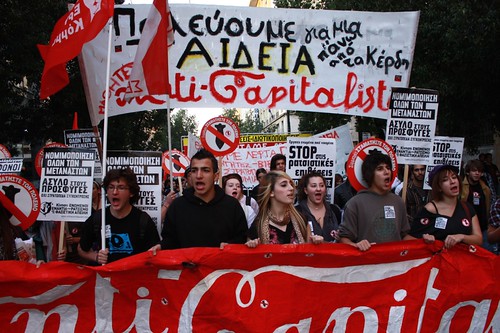
Last night Eurozone finance ministers got tough with Greece, deciding to withhold payment of €12 billion in emergency loans until the Greek Parliament enacts drastic austerity measures. The move is intended to intimidate the opposition forces (which includes the majority of the Greek public) into accepting the cuts, as the Greek prime minister faces a confidence vote in parliament this week.

But given the enormous disaster that would likely befall the Eurozone if Greece leaves the currency union, is this a threat the EU can afford to make? There is a real risk that this latest move could backfire. Massive protests continue in Athens today as people stand in front of the parliament chanting "we won't pay". Inside the building, Socialist prime minister George Papandreou is holding a confidence vote to reaffirm his mandate before he attempts to push these austerity measures through the parliament.

Now facing defection from his own party's members and extreme pressure from public opinion, Papandreou's confidence vote will be a rollercoaster ride over the next few days. There is a chance that this latest move from the finance ministers will further enrage Greek public opinion, where there is already an impression that the EU, at the insistence of Germany, is dictating draconian measures in an anti-democratic way. A perceived insult like this could put public optinion in Greece over the edge and cause even more Socialists to withdraw from the parliament. If Papandreaou's government falls it could mean a default on Greece's debt and, most chillingly, a withdrawal from the Euro. These events could spiral out of control and cause a meltdown of the European economy, and maybe even the world economy. Given that reality, is this really a threat the finance ministers can afford to make?

Monday, 22 November 2010

Ireland in crisis

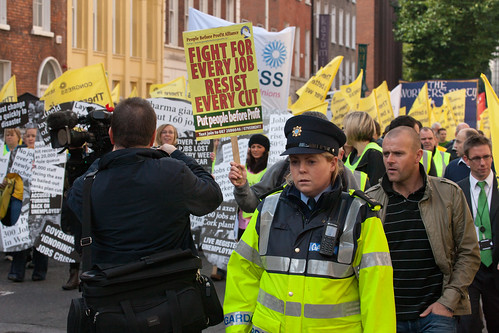
Today was a dramatic day in Dublin. First came the news that the government was giving in and accepting an EU bail-out, prompting angry demonstrators to swarm government buildings in protest of the decision. But as the day went on Ireland’s financial crisis morphed into a political one. The Green Party, a junior partner in the governing coalition, announced it was pulling its support - prompting a collapse of the government and a general election. The Irish government now appears to be in complete meltdown.

Since last week Ireland has been under pressure from the EU to accept the bail-out as it became clear that Ireland’s banks were in so much trouble that the Irish government was going to be unable to borrow money. Brussels was afraid this insolvency would spread to the other vulnerable so-called “PIGS” countries, causing the euro currency to collapse. If such a crisis were to spread to Spain, the eurozone's fourth largest economy, it could spell the end of the euro and as a consequence, some leaders have suggested, the end of the EU. After spending a week denying that they would take the money, today the Irish government accepted a rescue package worth up to €90 billion ($124bn).

So why the initial resistance, and why the protests today? Surely Ireland getting money is a good thing for Ireland right? Well the rescue package comes with a lot of strings attached, and they will be painful strings for the Irish population. In exchange for the aid, Ireland must make €4.5 billion in public spending cuts and €1.5 billion in tax increases. Overall, the country will have to save €15 billion by 2014. This will undoubtedly cause an increase to the unemployment rate, aleady high at nearly 15%. Essentially, it doesn’t matter who the Irish public elects in the general election that will likely be called in January (after the bail-out has been approved by the current parliament). The country will be governed by the International Monetary Fund and the European Central Bank for the next three years.

Friday, 12 November 2010

Is direct democracy preventing a solution to the euro problem?

Angela Merkel may have won her battle for a change to eurozone rules last month, but as lawyers grapple with exactly how to make those treaty changes, the devil is proving to be in the details. The greatest irony of the whole situation may be that it is the eurosceptic populations of Northern Europe - who have been the most unfairly hurt by the euro currency crisis - that are proving the biggest block to making changes with real teeth that would stop Southern European states from from again abusing the rules of the common currency.

Ever since the German chancellor reluctantly agreed to bail out the collapsed Greek economy and create a permanent mechanism for similar crises in the future, she has insisted that EU treaty changes are needed to prevent the bail-out being challenged in Germany's constitutional court. So she has called for treaty changes explicitly allowing such bail-outs and also measures to punish eurozone states who abuse the bloc's rules as Greece did. The later element would have the objective of preventing the need for another such-bail-out in the future. The changes are needed urgently, she says, because that future may be of the not-too-distant variety considering the recent economic news coming out of Ireland and Spain.

Thursday, 28 October 2010

A day of deal-making in Brussels

As European leaders meet in Brussels today everyone seems to have something to sell. David Cameron and new Dutch prime minister Mark Rutte have stepped off their trains this morning with demands for an EU budget freeze for 2011. Angela Merkel and Nicolas Sarkozy arrived this morning having formed a pact between them a few days ago to jointly demand treaty changes allowing the EU to sanction eurozone countries who misbehave. And representatives of the European Parliament will be on hand to demand the introduction of direct EU taxation that would go directly to Brussels. It will be an intense day of horse-trading as each block tries to get what they want.

The British and Dutch conservatives want to freeze next year's budget at 2010 levels, opposing the 6% increase approved by the parliament last week. They say it would be obscene to increase the EU budget, which is financed by member states, at a time when national governments are pursuing drastic budget-cutting measures. Members of the European Parliament (MEPs), on the other hand, point out that a 6% increase is significantly lower than what they usually call for. But they say they would be willing to consider a freeze if the member states agree to new forms of direct EU taxation on things like aviation, financial trading and carbon credits. Right now the EU is entirely funded by member state governments.

Friday, 2 July 2010

Angie takes a licking, but will she keep on ticking?

Angela Merkel may be riding high on the world stage, but at home in Germany she is in trouble. Deep trouble. Already heavily battered by her decision to provide money to Greece to prevent the euro collapsing, her current efforts to make drastic austerity cuts to the German budget caused a major revolt this week within her governing coalition.

The German parliament is this week voting to select a new president for the country. It's a largely ceremonial position, roughly equivalent to the Queen of England bar for the fact that nobody outside of Germany would know who their president is. Ordinarily the leader of the party in power selects the president, because he or she controls the majority of votes in the parliament. Merkel's selection was Lower Saxony governor Christian Wulff, perceived by the public as a rather uninspiring career politician.

Monday, 10 May 2010

Angie’s anguish

Poor Angela Merkel. You do have to sympathize with the conservative German chancellor, trapped between a rock and a hard place. The dire situation in Greece requires her to commit tons of German money to keep the crisis from spreading throughout the eurozone. But a bail-out of this Meditteranean nation that has behaved so badly is enormously distasteful to the German public.

It’s a bit like the fable of the grasshopper and the ant. Germany has held down wages and been frugal in its spending, while Greece has been profligate and irresponsible, spending far more than they had while at the same time not bothering to collect taxes appropriately. For the average German, it’s enfuriating that the squirell will now have to bail out the racoon.

But perhaps the more appropriate literary counterpart for Angie is Hamlet. Her foot-dragging and indecision during this crisis has been blamed by many for making the crisis get far worse. In the end she had to relent - so the delay accomplished nothing but exacerbated the problem. This weekend EU finance ministers agreed to establish a €962bn emergency crisis fund. It’s designed to stop the financial market turmoil as the situation in Greece deteriorates, reassuring jittery investors that the problem will be solved. Yet many are concerned that this fund is too late, and should have been agreed weeks ago before the situation got out of hand. Back then, it was Merkel who was the lone EU leader standing in the way. She knew the German people would punish her for agreeing to a bail-out.

Friday, 19 September 2008

The Blame Game

As the global financial system falls apart around our ears, a few things have stuck out to me in the way that politicians in the US are reacting to the crisis. One has been the incredibly bizarre words coming out of John McCain's mouth in response to this disastrous week. Suddenly he's lambasting a "culture of unrestrained greed" on Wall Street and urging greater oversight. This is from a senator who has been one of the biggest champions of unbridled free-market capitalism throughout his decades in the senate. Has the world gone topsy-turvey? This may be what a paniced American population wants to hear right now, but it is clearly not the way John McCain truly views how the economy should be run.

I mean who would have thought they'd see the day that Hank Paulson, who is as aggressively free market as you can get, would be leading the kind of bailouts we're seeing today. He has to, the government doesn't have a choice in these circumstances. But it's truly bizarre to see John McCain blasting "unrestrained greed" on Wall Street as causing the current crisis when he and his party have led the charge to unrestrain that greed over the past ten years.

Beyond that, I think there is something culturally interesting about the language both candidates are using about the crisis, language which shows that no matter which candidate is elected in November, the US is unlikely to address the fundamental problem it faces any time soon.

Big Bad "Washington"

Both candidates are blaming the crisis on purely conceptual factors like "Wall Street Greed." It is symptomatic of the way the entire campaign has been phrased. The many problems America currently faces are the fault of "Washington," "terrorism," "lobbyists," "oil companies," you name it. In fact if you listen to American politicians, the one group that doesn't share any blame for the country's problems is the American people themselves.

But this argument is not only illogical, it's also unproductive. The dirtiest word during this election campaign has probably been "Washington." This is nothing new. Each election since Nixon has been presented to the American public in this way: Washington is broken and we need an 'outsider' or a 'maverick' to change it. It's how Reagan, Clinton and Bush were all elected. But this year the anti-Washington rhetoric seems to have hit new heights. And yet, what is Washington? Washington is a creation of the people, full of democratically elected politicians who the American public put there. Washington is, therefor, a reflection of the US population. So if there's something wrong with Washington, then there's something wrong with the US public.

The current economic troubles have been presented in the same way, as if it's all conceptual factors that are affecting the blameless American people. Nowhere was this more evident than when John McCain made the bonehead mistake of repeating his "the fundamentals of the economy are strong" line in Florida Monday morning on the day of the Lehman Brothers collapse. Rapidly going into damage control mode, he quickly shifted his wording later in the day to say that the 'fundamentals' he was referring to was the 'hard-working American worker.' Beyond being a laughable backtrack, it reflects the fundamental problem with the way American politicians are dealing with this cris. They're not being straight with the American people, because they won't tell them that it is the people who are to blame.

Debt Addiction

The American economy has been fundamentally operating on borrowed money for decades now. From the most microeconomic level (Americans now have a negative rate of average savings) to the most macroeconomic (the national debt is at a record high level), America is addicted to spending money it does not have to fund an opulant lifestyle. And it isn't just consumer debt like credit cards that has saddled the American people and the American economy. People took out mortgages that they couldn't possibly pay back, thereby spurring the mortgage crisis. People took out student loans that they knew they wouldn't be able to pay back for 30 years (I'm one of them). A combination of a lack of government oversight and assistance and Americans own culture of greed and vanity has pushed the country into a system where it lives far beyonds it means.

The average family debt in America is around $30,000, and that's not even including mortgages and student debt. The average college graduate from a private university leaves school with $60,000 in debt (Me? I had $120,000 in debt by the time I finished grad school). And how does Americans' -0.2 percent rate of savings compare our rapidly emerging superpower rival? In China, the average savings rate is 20 percent.

Jimmy Carter was the last president to touch this issue with a ten foot pole, in a speech he gave shortly before he lost the election to Ronald Reagan. The speech, widely called the "malaise" speech because it seemed defeatist, is widely credited with losing the reelection for Carter, who was defeated by Ronald Reagan who promised the American people "morning in America" with an endless luxurious lifestyle. Reagan then plunged the nation into an unprecedented level of peacetime national debt.

America has a problem. It is addicted to spending money, and resources, it does not have. The only solution to this problem is for Americans to stop spending what they don't have. But no politician is willing to say that. Instead, everyone in government is blaming the ethereal concepts of "Washington" and "Wall Street." And while much of this crisis can be blamed on the deregulation that a Republican congress has championed over the past 15 years (and that New Democrats rubber-stamped), most of it can be blamed on Americans' spend today, worry about it tomorrow lifestyle. The only real solution, for people, government and business, is to live within our means.

But per usual, when something goes wrong with the United States, it is never the fault of its citizenry. When a hijacking disaster came to its shores, it was blamed on the ethereal concept of "terrorism" rather than American foreign policy or the isolationism of its citizenry. When George W. Bush was elected - twice - it was somehow the fault of some larger "Washington" system rather than the fault of the voters themselves. And now, with the financial crisis, once again we see that Americans are refusing to look in the mirror and take responsibility for their own culture and their own lifestyle.

Self-Efacing Europe

I can tell you that this contrasts sharply with how Europeans view their own problems. When I speak with Europeans about the problems plaguing Europe, and the inability of the continent to address those problems, they throw their hands up in the air and give a morose explanation about how Europeans have petty rivalries and nationalism that make them unable to cooperate, or how they are are rendered complacent by their generous social welfare systems, or how the people of Europe lack any significant ambition or direction. They don't blame their concepts on etherial concepts, but rather themselves. They could never be as sucesful as America, so many of them say to me, because Europeans don't have the same drive for success.

In the end, I'd say Americans could do with a lot less self confidence and Europeans could do with a lot more. Americans inability to take personal responsibilty and tendency to blame vague concepts for their woes has gotten them into a quagmire in which they are unable to come up with real solutions to their problems. Europeans' lack of self confidence and their acceptance of a storyline that paints them as lazy and complacent makes it difficult to achieve any new success.

Maybe America has some extra swagger it could loan to Europe for awhile.

Thursday, 14 August 2008

Eurozone in trouble

The jury's still out as to whether continental Europe will be partly immune to the financial woes being experienced in the US, but the latest data isn't promising. Figures released today showed that the economies in the fifteen countries that use the euro - known as the eurozone - contracted by .2 percent between April and June. The news is likely to accelerate the steep drop that the euro has been experiencing on currency exchange markets over the past few weeks.

The data is heightening concerns that the eurozone is going to follow the US into a recession. Reacting to the report, a German finance minister said Germany's economy could contract again in the next quarter. That would officially mean Germany is in a recession. And given that Germany is the main driver of growth in the eurozone and the dominating economy, that would likely mean recession for the whole zone.