Ireland is set to be the first country to see a government fall as a result of the eurozone crisis, following yesterday's announcement by the Green Party that it is deserting the governing coalition. The news has thrown Ireland into political turmoil as politicians tussle to set the date for an election whose result will be anything but certain.
In a hastily arranged press conference yesterday the leader of Ireland's Greens, an environmental party, said there had been a "breakdown in trust" between the two parties and the Greens patience had reached an end. The ruling Fianna Fail party, which has governed Ireland almost continuously since 1987, failed to get an outright majority at the last general election in 2007 and so formed a coalition government with the Green Party to put them over the edge.
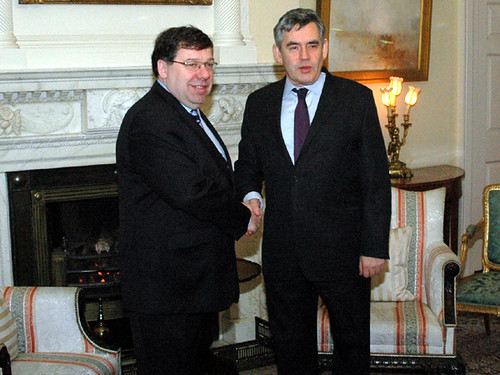
But the government has been under fire over the past year because of its handling of the debt crisis. The Irish public largely blames Fianna Fail not only for presiding over the boom period of heavy borrowing and the housing bubble, but also for its decision to bail out the Irish banks by guaranteeing their holdings and for accepting an EU bailout fund with strict conditions attached. The pressure became so acute that on Saturday Prime Minister Brian Cowen (pictured above) resigned as leader of the party, though without resigning as the prime minister - a situation highly unusual in a parliamentary democracy. Apparently this was all too much for the Green Party, which announced it was bolting just 24 hours later.
Showing posts with label Brian Cowen. Show all posts
Monday, 24 January 2011
Monday, 22 November 2010
Ireland in crisis
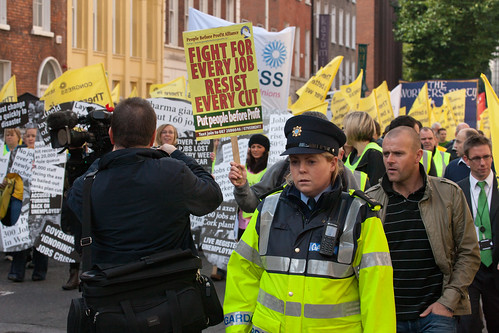
Today was a dramatic day in Dublin. First came the news that the government was giving in and accepting an EU bail-out, prompting angry demonstrators to swarm government buildings in protest of the decision. But as the day went on Ireland’s financial crisis morphed into a political one. The Green Party, a junior partner in the governing coalition, announced it was pulling its support - prompting a collapse of the government and a general election. The Irish government now appears to be in complete meltdown.
Since last week Ireland has been under pressure from the EU to accept the bail-out as it became clear that Ireland’s banks were in so much trouble that the Irish government was going to be unable to borrow money. Brussels was afraid this insolvency would spread to the other vulnerable so-called “PIGS” countries, causing the euro currency to collapse. If such a crisis were to spread to Spain, the eurozone's fourth largest economy, it could spell the end of the euro and as a consequence, some leaders have suggested, the end of the EU. After spending a week denying that they would take the money, today the Irish government accepted a rescue package worth up to €90 billion ($124bn).
So why the initial resistance, and why the protests today? Surely Ireland getting money is a good thing for Ireland right? Well the rescue package comes with a lot of strings attached, and they will be painful strings for the Irish population. In exchange for the aid, Ireland must make €4.5 billion in public spending cuts and €1.5 billion in tax increases. Overall, the country will have to save €15 billion by 2014. This will undoubtedly cause an increase to the unemployment rate, aleady high at nearly 15%. Essentially, it doesn’t matter who the Irish public elects in the general election that will likely be called in January (after the bail-out has been approved by the current parliament). The country will be governed by the International Monetary Fund and the European Central Bank for the next three years.
Since last week Ireland has been under pressure from the EU to accept the bail-out as it became clear that Ireland’s banks were in so much trouble that the Irish government was going to be unable to borrow money. Brussels was afraid this insolvency would spread to the other vulnerable so-called “PIGS” countries, causing the euro currency to collapse. If such a crisis were to spread to Spain, the eurozone's fourth largest economy, it could spell the end of the euro and as a consequence, some leaders have suggested, the end of the EU. After spending a week denying that they would take the money, today the Irish government accepted a rescue package worth up to €90 billion ($124bn).
So why the initial resistance, and why the protests today? Surely Ireland getting money is a good thing for Ireland right? Well the rescue package comes with a lot of strings attached, and they will be painful strings for the Irish population. In exchange for the aid, Ireland must make €4.5 billion in public spending cuts and €1.5 billion in tax increases. Overall, the country will have to save €15 billion by 2014. This will undoubtedly cause an increase to the unemployment rate, aleady high at nearly 15%. Essentially, it doesn’t matter who the Irish public elects in the general election that will likely be called in January (after the bail-out has been approved by the current parliament). The country will be governed by the International Monetary Fund and the European Central Bank for the next three years.
Thursday, 4 December 2008
Ireland's Road Trip
So far Cowen has been in Luxembourg and Germany. Today he's in London with Brown and tomorrow he'll be in Paris with Sarkozy.. At the same time, his Europe minister is visiting the small countries to tell them of Ireland's plans. The two of them are coordinating with the leaders for next week's proposal to the European Councilon what to do about the situation. According to reports, that solution is going to be another vote. But what they have to come up with is a way to say that this is not the exact same vote done over, but rather a different vote that will be palatable to the Irish people.
Surveys have been done over the past few months that have indicated that if the Irish government were to get specific guarantees for key areas - namey abortion, neutrality - the referendum would pass. Of course there was nothing affecting these two areas in the treaty anyway, but it is thought that if the Irish were to have the issues spelled out in disclaimaers. This will surely not be enough for the dedicated no campaigners - since their beef is with the EU itself, but it may be enbough to convince some of the fence sitters.
The revote would be a big gamble, particularly for Cowen whose government hangs by virtually a thread at home. But it is thought now that the economic turmoil has set in, it is thought voters will be more receptive to argument sthat Ireland shouldn't cut off its ties to the safety net of the European Union. The Irish may have been feeling a bit overconfident about their economy during the last vote, no doubt their optimism about whether Ireland needs the EU has changed over the past few months.
So as much as the first referendum was watched, the second one will be even more so. If Ireland votes no again, there are only two options: Scrap the treaty and allow the EU to operate in disfunction, or or go ahead with the treaty and kick Ireland out of the union. Considering that the current economic crisis means that the EU's institutions must function properly as soon as possible, the second option is perhaps the more likely. And I think that this time around, in these uncertaint times, EU leaders won't be above using this as a threat before the vote.
Subscribe to:
Comments (Atom)