
The day started with a speech by humiliated ‘technocrat’
prime minister Mario Monti at the European Commission. Having been rejected by
his home country, it is perhaps unsurprising that the former European Commissioner wanted
to come to Brussels,
where people understand him. It was Brussels
after all, at the behest of Berlin,
who installed Monti on the Italian throne after forcing out Silvio Berlusconi
at the height of the Italian crisis in 2011.
And it is no coincidence that it was the ‘Italians abroad inEurope’ voting region in which Monti received
his highest share of the vote – 30%. This compares to the 9% of the vote he
received at home – less than half the vote chare received by anti-establishment
comedian Beppe Grillo.
If he came to Brussels for appreciation, he got it. The crowd gave him a standing ovation after a speech in which he explained that the brutal austerity reforms he had imposed on the country over the past year would eventually pay off, but it was tough for an angry Italian electorate to understand that now. Austerity was the right response to the crisis, he said. It is right and it will continue to be right.
After the speech Monti met with Commission President José
Manuel Barroso and Council President Herman Van Rompuy to discuss the Italian
situation. The EU leaders made clear that they expect any new administration to
continue the Monti austerity reforms.

“We demand respect for our country,” Napolitano told members
of the Italian community in Munich,
in what was described as an “emotional” speech. Reuters reports that the
president “stifled a sob” as he said, “"Our country has serious problems
in its structure and daily life ... It has darkness but many lights, and you
can be proud.”
But if Italians were demanding respect, they weren’t getting
it yesterday from German leaders. “The politically responsible people in Rome recognise that Italy
needs a continuation of a policy of reform, of consolidation, one which is able
to secure the confidence of the citizens and the markets,” said Guido
Westerwelle, Germany’s
foreign minister. German economy
minister Philipp Rösler said there is “no alternative to the previously adopted path of structural reforms.”
Indeed the reaction generally from Northern
Europe was unsympathetic. In a speech yesterday in London’s financial center,
Olli Rehn, the Finnish European Commissioner for Economic Affairs, insisted
that the EU is not only pursuing austerity but also growth. But at the same
time he made bizarre overture to Southern Europe
which sounded more like a veiled insult. “We need to build bridges between the
stability culture of the north and the solidarity culture of the south.” I’m
not quite sure what a “solidarity culture” is, but it sounds awfully similar to
the “makers versus takers” argument we hear so often in Europe these days
(Flanders versus Wallonia anyone?)
But there were others in Germany and
Northern Europe who had a mote inward-looking
reaction to the Italian result. Klaus Barthel, and German Social Democrat who
is quite far to the left, told the newspaper Handelsblatt that it was this kind
of divisive rhetoric that had contributed to the huge anti-German feeling in
Italy, which is being blamed for Monti’s humiliating defeat.
“Mrs Merkel delivered enough substance to Berlusconi’s
nationalist slogans,” he said. “Her advances to the Teutons [aka glorifying
Northern European work ethic] bring perhaps one or two votes [in Germany] but
come back negatively a million times over from our neighbours.”
Chastising Cameron

"I believe it is firmly in Britain's interest to use its energy for reforming Europe rather than seeking to undo our Community, which would leave us all weaker,” he told the assembled bankers and British politicians. “In a nutshell, why not focus on reform rather than repatriation?"
"It is in everyone's interests for Britain to be an active player here,” he continued. “This is a game in which, if I were a British citizen, I would want my country to be playing as a midfield playmaker rather than watching from the sidelines. No-one ever scored goals sitting on the bench."
His speech was followed by an even more combative one from Council President Herman Van Rompuy, who blasted Cameron’s quest to redefine Britain’s role within the EU as both counter-productive and impossible.
"It is not just a matter between ‘London’
and ‘Brussels’" but "would impact the
relationship between your country and 26, soon 27 others,” he told the London audience.
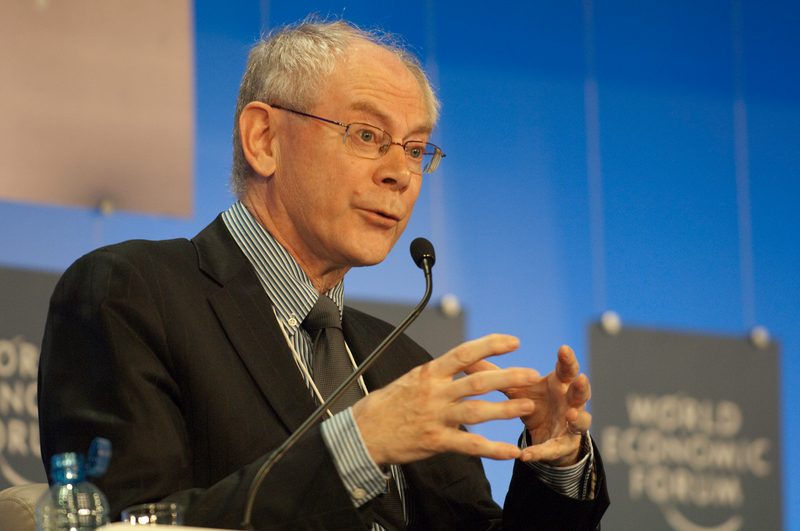
"Leaving the club altogether is legally possible"
but it would be "a most complicated and unpractical affair,” he said.
“Just think of a divorce after forty years of marriage.”
The EU may have had a brief period of calm over the past
several months, but it is clear that this rest period is now over. The
double-whammy of Cameron’s Brexit speech and Italy’s
disastrous election have plunged Europe into
new uncertainty. The next few months are going to be a delicate period.

No comments:
Post a Comment