
It’s been interesting to watch the political developments in Bulgaria since I
visited the country for my
article on vote-buying in February. At the time, everyone was focused on the upcoming summer election and whether any result could rescue the country’s government from the deep morass of political corruption it had sunk into.
As predicted, the newly-created reformist party of the mayor of Sofia won the vote. However though the outcome on election day wasn’t a huge shock, the formation of the government since then has been noteworthy, and can be seen as a positive sign for those both at home and in Brussels who are desperate to see the Bulgarian government change its ways. The new prime minister, Boyko Borisov, officially
took the reigns yesterday and introduced the minority government he has formed – remarkably – without entering into a coalition with the hard-right parties in the parliament.
Borisov, a bit of a political celebrity in Bulgaria, formed the new party in 2006 while he was mayor of the country’s capital, calling it “Citizens for European Development of Bulgaria” (known by the acronym GERB in Bulgarian). It’s no doubt a populist party but, as a Bulgarian friend puts it, perhaps “the good kind of populism”. Borisov came to the public with an anti-establishment message, lambasting the ruling Socialists (many of whom are aging former communists) as hopelessly corrupt and saying only he, with his new and independent political party, could tackle the corruption endemic in Bulgaria’s government.
 But he’s also been critical of the nationalist parties of the right, refusing to form a clear coalition with the three right-wing parties in parliament– the Blue Coalition; Order, Lawfulness, Justice; and the ultra nationalist anti-Turkish party Ataka (whose billboards, pictured, were all over Sofia when I visited). By not making a coalition he will be forced to rule as a minority government – a fragile position that will likely fall before he can serve out his full term. In practice, he will still depend on the loose support of the three right-wing parties.
Borisov has a steep hill to climb in tackling the corruption issue. Last year the EU froze over €800 million of development aid to Bulgaria because of corruption, mostly out of concern that that money was going directly to regional and local authorities which are sometimes run as fiefdoms of organised crime. EU funds are almost always distributed locally, which presents a problem for a country like Bulgaria where the national government often has little control over regional authorities.
Overall Brussels seems happy with the election result, though Borisov’s ties to the right wing may be worrying. Still, the Bulgarian socialist party has proven itself an unreliable partner for Brussels in the past, and the EU probably feels that for the moment, any change is a good one.
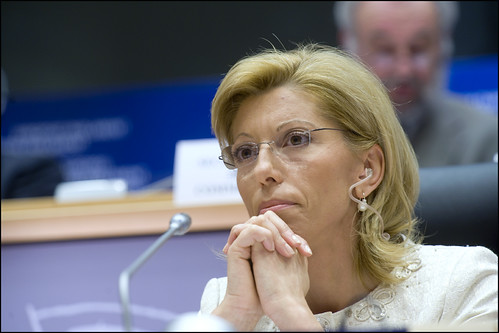 The European Parliament is holding confirmation hearings for the new EU commissioners this week, and by far the most dramatic one yet has been that of Bulgaria’s nominee Rumiana Jeleva, who is being accused of having ties to the Russian mafia. Yesterday’s chaotic hearing reflected the EU’s continuing problem of how to deal with Bulgaria’s corruption, which is so widespread in their political class one isn’t sure who to believe in the dispute over Jeleva’s past.


