Much ink has been spilled over the accession of Romania and Bulgaria to the EU in 2007, and there are still many questions floating around over the decision. Should they have been admitted, or has the EU bit off more than it can chew in taking on two such poor countries? How can the EU effectively deal with the high level of corruption in the Bulgarian and Romanian governments? And when should the new EU entrants be given the full rights and privileges enjoyed by other EU citizens?
 After spending last week in Bulgaria I am perhaps not qualified to offer a solid answer to these questions, but I have come to understand the country much more. For one thing, all this talk about 'Romania and Bulgaria,' as if they were one geopolitical block, seems strange to Bulgarians. When interviewing politicians and NGOs, I would often ask them if the factors they were mentioning in Bulgarian society were present in Romania. They would always respond that they had no idea, and even seemed a bit confused by the question. Though the countries tend to be talked about together now because they entered the EU at the same time with the same set of restrictions, in terms of culture, language and government they're quite different. In fact the photographer in our group was from Romania, and she said she doesn't necessarily feel any kind of strong connection to the country.
 The event on Saturday went quite well. In addition to being an EU Debate on the Ground, it was also the official launch of CafeBabel Sofia. The event was hosted by a well-known local radio personality and was in Bulgarian, but the non-Bulgarian journalists had a great simultaneous translator. We had three MEPs there and the Bulgarian Minister for European Affairs, Gergana Grancharova (pictured above left). Essentially it was a debate between EU government officials and the public, designed to foster greater interaction between the European public and Brussels. Coming from Western Europe, it actually seemed to me that Bulgaria has a shockingly high level of interest in EU affairs. The attendees at the event were quite well-informed. Most of the major Bulgarian television networks showed up to film, and it made the nightly news. As I wrote last week, I learned on this trip that three times as many Bulgarians have faith in EU institutions as have faith in the Bulgarian government. This isn't surprising considering the level of dysfunction in the Bulgarian government, but as the MEPs mentioned at the event, the expectations of the Bulgarian public for the EU may need to be ratcheted down quite a bit. After all, the EU can't solve all of Bulgaria's problems, nor is that its intention.
 Speaking with the French ambassador to Bulgaria on Friday, I learned this is an increasing concern for Western European nations. The high level of enthusiasm for EU integration in Bulgaria may be flattering for Brussels, but it will liekly lead to inevitable disappointment when the EU is unable to deliver, particularly as the economic crisis hits Bulgaria especially hard. The increasing trend of Bulgarian NGOs and business interests going directly to Brussels to get problems solved, bypassing the national government, is actually a worrying trend, he said. It is the dysfunction of the Bulgarian government that needs to be solved, and if it isn't, it will strengthen the increasingly popular far left and far right. The nationalist, anti-Turkish party Ataka (pictured left), is getting particularly popular, and it's thought that they will gain seats in the June national election as people cast a protest vote against the government.
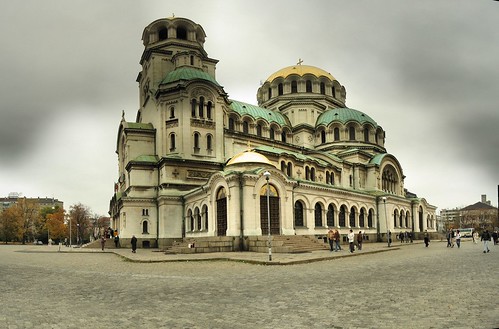
 Having only spent time in Sofia, I can't say I'm qualified to concretely answer any of the questions I posed in the first paragraph after my trip. I can say that while it was a bit rough around the edges, the level of development in Sofia didn't even resemble the post-apocalyptic picture often painted by the British media. As the poorest country in the EU, clearly Bulgaria has a long way to go before it enjoys the same standards of living as its Western counterparts. But at the same time Sofia looked like any other Eastern European capital. We felt perfectly safe walking around on the street at any time of day or night, and the modern conveniences were the same as most other capitals of the East. I'm told that Sofia is extremely different from the rural areas of Bulgaria, but of course that's true for any country.
So all in all it was a very interesting and fun few days, I'm glad I participated in the project. If you're interested in finding out if an EU Debate is coming to your city any time soon, check out the schedule.