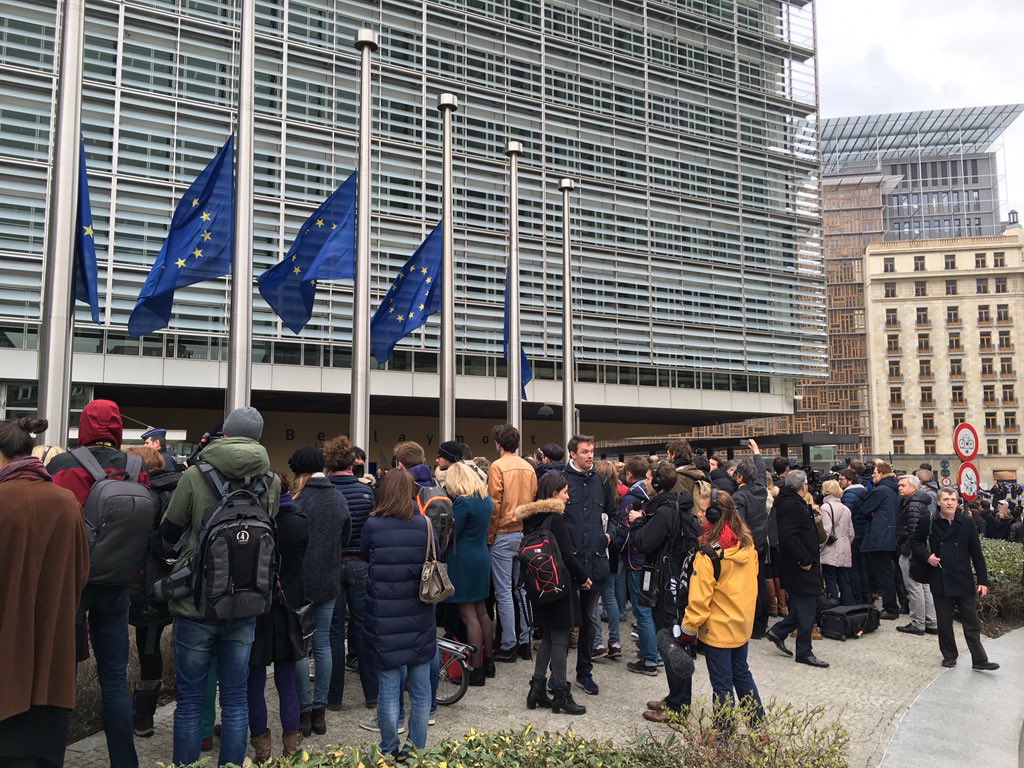
Monday, 25 April 2016

Is Brussels dead?

Media coverage in the aftermath of the terrorist attacks in Brussels have had a crippling effect on the city's economy. But it's only the latest setback for this unloved and underdeveloped city.

There have been reports in the Belgian media that over the past month, as many as 600 cafes, restaurants and hotels have filed for bankruptcy in Brussels. The normal amount is 40 per month.

The reports seem to reaffirm what people in Brussels have seen with their own eyes over the past weeks. Since the terrorist attacks of 22 March, Brussels city centre has been eerily quiet.

I have been mostly in Brussels over the past month rather than in Berlin, and I can confirm that the atmosphere has sometimes resembled a ghost town. At first, people were blaming it on the Easter break. "Brussels would always be empty at this time of year," they insisted. As the weeks wore on, their continued insistence that Easter was the culprit seemed less and less plausible.

Saturday, 23 April 2016

Obama bursts Britain’s post-imperial hubris

The crux of the Brexiters' argument is an anglosphere alliance. Yesterday the US president told them it’s not going to happen.

That sound you heard yesterday across the United Kingdom was the collective wince of a nation finally made to accept an uncomfortable truth – he’s just not that into you.

Americans are largely unaware of what’s happening with the Brexit debate, but whether they know it or not they are central to the case for the UK seceding from the European Union. They are also largely unaware that they are in a “special relationship” with the UK, a term which, as I’ve written before, is obsessed over in the UK but unknown in the US.

For years US politicians have indulged the British in their fantasies of a two-way relationship between equal partners. But in light of the severe risk a Brexit presents, Barack Obama had no choice but to fly to the UK and finally break the bad news to the Brits.

Thursday, 21 April 2016

Laissez-faire politics: how America's free-market elections compare to Europe's

Election campaigning is tightly controlled in Europe, where even political TV ads are banned. Is it time for America to do the same?

Few would disagree that the 2016 US presidential election in is a low point for American politics. But what has frustrated me over the past months is that there doesn't seem to be much serious conversation about what to do to fix the problem.

On this Sunday's Meet the Press, I was relieved to hear Washington Post columnist Kathleen Parker bring up a subject that few in America seem to grasp. The American structure of running election campaigns is an entirely different animal from most other democracies. It is the fundamental structure that is broken. The 'money in politics' problem that Bernie Sanders rails about is only a symptom of the broken foundation.
"What I want to know is, is there ever any serious consideration given to a possibility of just limiting campaigns as other countries do, to two months, say, and make them completely publicly funded?" she asked Debbie Wasserman Schulz, the chairwoman of the Democratic Party. "Is that ever anything that gets serious consideration and would it be possible?"

Friday, 1 April 2016

Would Brexit banish English from continental Europe?

'Brussels English' could be vulnerable to French attack if the UK leaves the EU.

Much has been written about the future of the UK if it chooses to leave the European Union in June’s referendum. Less has been written about the effect of Brexit on the EU. 

The loss of British influence in Europe would be felt in many ways, most likely resulting in a less neoliberal, free-market-oriented bloc. Recently I’ve written about the possibility of a more proactive EU environmental policy if the UK were to leave. But could a Brexit also affect linguistics?

Today The Local, an expat newspaper in France, published a tongue-in-cheek (note today's date) evaluation of what a Brexit would mean for the English language in Europe, given that it has long been in the crosshairs of the French government. They imagine a future where the Academie Francaise, France's notoriously strict language enforcer, would send patrols around the country looking for British expats who can't speak French. Given the (well-deserved) reputation of Anglophones for not sufficiently learning the langauges of the countries they move to, the April Fools article hits where it hurts.

But in fact there is truth behind this gag. Right now UK citizens have the right to live and work in France, and the government cannot require them to speak French in order to do so. Were the UK to leave the EU and not be allowed to join the European Economic Area, it would mean Brits would have to apply for a visa to live in France. And France could easily require language proficiency as a requirement for granting visas.

Thursday, 24 March 2016

Would an EU Intelligence Service fix weak links like Belgium?

Europeans have lost confidence in the ability of Belgium’s fractured government to deal with jihadists exporting terror to neighboring states.

For reporters trying to cover the Brussels terrorist attacks this week, it has been a frustrating few days. As in any unfolding crisis, incorrect information been quick to spread. But in Belgium, the amount of conflicting information has had a surreal quality. 

Information about whether suspects have been apprehended, or who blew themselves up where, has all depended on which Belgian authority you talk to. And in usual Belgian fashion, the authorities are not communicating with one another. 

Yesterday the Turkish President said his country had arrested one of the suicide bombers last year and deported him, telling the Belgian embassy that he was a foreign terrorist fighter. The Belgian justice minister’s response today? “It’s only normal that a justice minister doesn’t know what happens in embassies. We could not know this.”

Tuesday, 22 March 2016

International targets

The locations of today's bomb blasts in Brussels were more international in nature than in November's Paris attacks. Was that the intention?

Across Belgium, people are extremely shaken up by the gruesome terrorist attacks today which took the lives of at least 34 people. But perhaps none more so than the people in Brussels' expat community.

The two targets in today's attacks are extremely public spaces - an airport departures hall and a metro station. But these two particular spots are ones that are visited over and over by the people working in and around the institutions of the European Union.