 It shouldn’t be a surprise to anyone that UK foreign
secretary William Hague has found a new way to annoy his European counterparts.
But today he’s managed to bring a North American country into the fray, and for
once is isn’t the one with whom he believes he has a “special relationship”.
It shouldn’t be a surprise to anyone that UK foreign
secretary William Hague has found a new way to annoy his European counterparts.
But today he’s managed to bring a North American country into the fray, and for
once is isn’t the one with whom he believes he has a “special relationship”.
During a visit to Canada
today Hague announced that the UK
is going to close some British embassies across the world and merge them with Canadian
embassies. The two countries will establish joint diplomatic missions, sharing
embassy offices and consular services.
The move, an attempt to save money in these cost-cutting
times, might seem logical enough at first glance. But the more you delve into
it the more you realize it is diplomatically and logistically bizarre. While
the UK and Canada may have
similar foreign policy (something irrelevant to the consular services they are
merging), they are completely separate countries which share no unified visa
system. The only thing they share is a queen.
But what makes this all the more baffling is that if the UK wants to consolidate embassies, there is already a way for them to do that through the EU. A major part of the
2009 Lisbon Treaty was the creation of the European External Action Service (EEAS) –
the EU’s new 'foreign ministry'. The EEAS has been setting up EU embassies across
the world. The idea, which all 27 member states signed up to under the treaty,
is that this will free up European countries to close many of their embassies
and allow the EEAS to undertake routine consular services.

Given that the EU member states in the Schengen zone share a
unified travel visa system, many continental European countries have chosen to take
advantage of this opportunity and closed embassies. The UK is not in Schengen, meaning that people wishing to travel to the UK would
need to get a separate visa
than the Schengen visa which allows them to travel anywhere in continental Europe.
Perhaps partly for this reason, the UK has not
chosen to close any embassies and transfer the workload to the EEAS. And they
are free to make that choice. The creation of the EEAS foreign offices does not
oblige any member state to close embassies – it only allows them the
opportunity to do so if they want to save money.
Hague’s announcement today acknowledges that the UK doesn't have the money to maintain all these embassies and that consolidation is a good
idea. And yet he shuns the entire programme which his government and 26 others
developed to help enable that to happen, and instead links up with a country
with whom the UK is not in a union apart from a rather anachronistic historical
legacy (the Commonwealth).
Of course British euroscepticswould not
describe the Commonwealth in the same way I just did. ‘Reuiniting and
stregthening’ the Commonwealth has been a major line of the UK IndependenceParty (UKIP) that has now come to be parroted by the Tories. The idea is that the UK should leave the EU
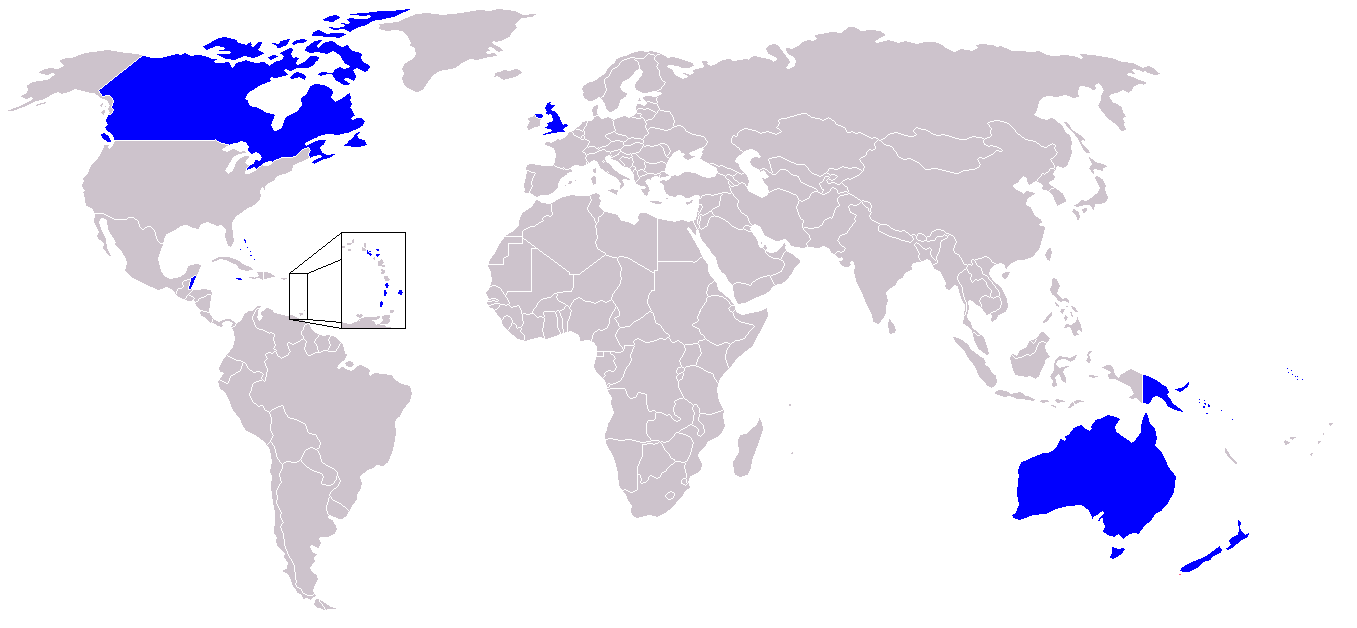
and instead work to form a strengthened Commonwealth – a union of Britain, Canada,
Australia and New Zealand, in addition to the British overseas
territories like Bermuda. It would unite those
nations in the commonwealth which still have the British monarch as their head
of state.
They don’t just mean this symbolically. They want to
transform the commonwealth into a free trade area and establish supranational
governing ties between them. This argument has begun to be voiced even louder
in the UK
since the eruption of the European soveign debt crisis, both by UKIP and by
Eurosceptic Conservatives. The British National Party has also embraced the
idea.
Here’s the problem – nobody in the other commonwealth
countries is asking for this. In Australia even the continuation of
the monarchy was only able to barely squeak by in a referendum ten years ago. The
economies of Australia and New Zealand are much more focused on East Asia
and Canada is, obviously,
more focused on the United
States.
But this is the foreign policy outlook of the current
British government – disengagement with Europe
and strengthening of the commonwealth ties. And increasingly, it’s going to end
up in barmy ideas like this one.

No comments:
Post a Comment